HOME   CONTACT  |  TECHNICAL  |  CONVERTER  |  VIDEO  |  LINKS  


Classic Bikes
Custom Bikes
Racing Bikes


AC Schnitzer
AJS
Alfer
Aprilia
Ariel
Arlen Ness
ATK
Bajaj
Bakker
Barigo
Benelli
Beta
Big Bear
BigDog
Bimota
BMS Choppers
BMW
Borile
Boss Hoss
Boxer
Brammo
Britten
BRP Can-am
BSA
Buell
Bultaco
Cagiva
CCM
Confederate
CR&S
Daelim
Deus
Derbi
DP Customs
Drysdale
Ducati
Dunstall
Exile Cycles
Factory Bike
Fischer
Foggy Petronas
GASGAS
Ghezzi Brain
Gilera
Harris
Harley Davidson
HDT
Hesketh
Highland
Honda
HPN
Horex
Husqvarna
Husaberg
Hyosung
Indian
Italjet
Jawa
Kawasaki
KTM
Kymco
Laverda
Lazareth
Lehman Trikes
LIFAN
Magni
Maico
Matchless
Matt Hotch
Megelli
Midual
Mondial
Moto Guzzi
Moto Morini
MotoCzysz
Mr Martini
MTT
Münch
MV Agusta
MZ
NCR
Norton
Oberdan Bezzi
OCC
Paul Jr. Designs
Piaggio
Radical Ducati
Richman
Ridley
Roehr
Roland Sands
Royal Enfield
Rucker
Sachs
Saxon
Sherco
Suzuki
Terra Modena
Titan
TM Racing
Triumph
Victory
Vincent
Viper
VOR
Voxen
Vyrus
Waken
Wrenchmonkees
Wunderlich
Yamaha

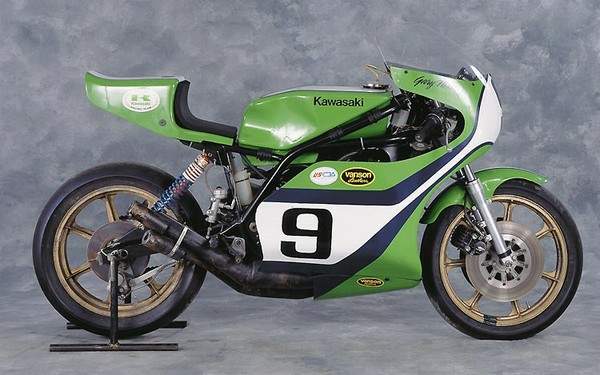
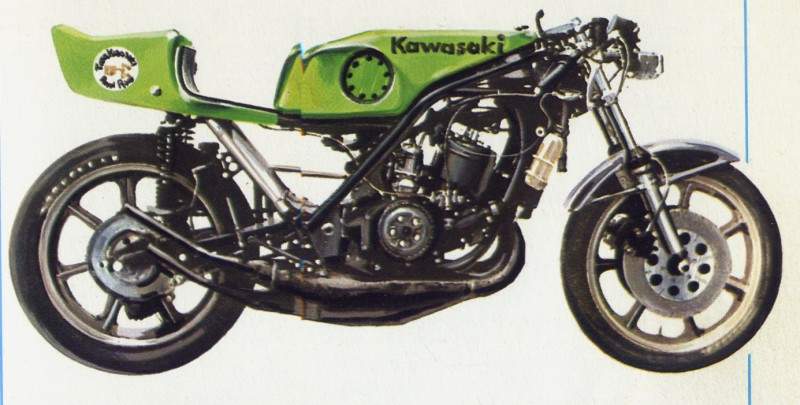
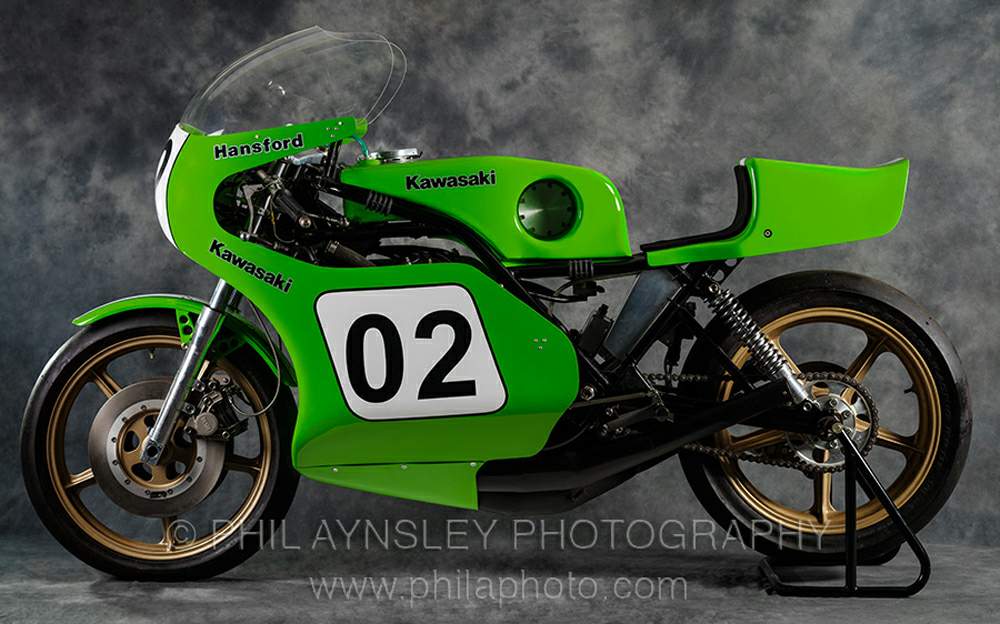
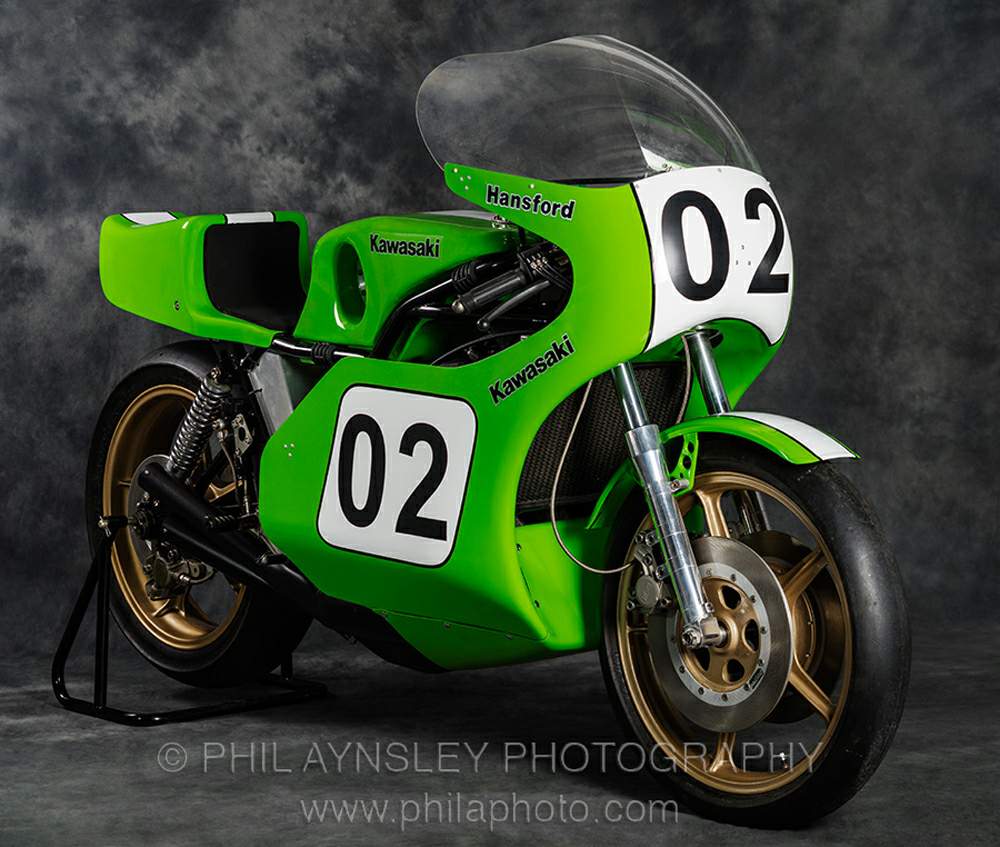
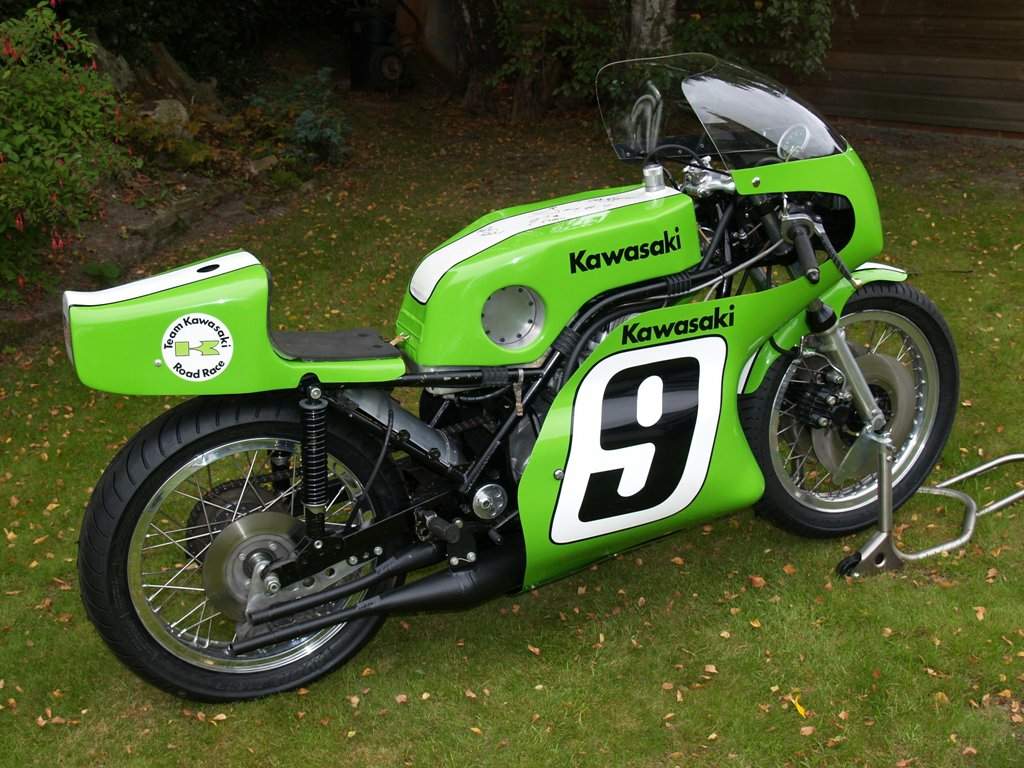
Kawasaki KR 750 Daytona


The Kawasaki 750, like the Suzuki 750, was built exclusively for winning the Daytona 200 Miles.
This new Kawasaki was the racing version derived from that miracle of power and acceleration that was normally sold around the world, the Kawasaki Mach IV 750.

Bob Hansen's American team rode the Kawasaki 500 Daytona in 1971. The motorcycle was very fast but still slightly inferior in continuity of performance to the BSA-Triumph 750 and the Suzuki Titan-Daytona 500.
In 1972 Hansen's team pitted the brand-new Kawasaki 750 against the equally new Suzuki, fully equipped with technological innovations.
The Kawasaki H2R 750 had a twotroke, three-cylinder transverse inline engine. The Kawasaki and the Suzuki were closely matched in power, having about 100 h.p. at 9,000 r.p.m. The Kawasaki 750 had 27 h.p. more than the old 500.

Both Suzuki and Kawasaki experienced a host of problems at Daytona —chiefly with tires and chains, which had trouble standing up to the power of the engine.
Not until late in the season were the two most powerful motorcycles in the world sufficiently tuned. Paul Smart, a British racer, rode the Kawasaki to its first important win at Ontario and received the handsome sum of $25,000 in prize money. This decisive victory encouraged the Kawasaki people to try to improve the H2R. In 1973 the Kawasaki H2R 750 stood ready at the starting line of the Daytona 200. It was the fastest vehicle in the field but had to withdraw.

The official riders of the Hansen team, Art Baumann and Yvon Du Hamel, were sent to Europe to try their luck at the Imola 200 Miles, but they repeated their Florida performance at Imola. Baumann was in second place behind Jarno Saarinen for some time. After this promising beginning he fell and had to pull out of the race. Du Hamel, who was racing as usual with the number 17, stopped at the pits for refueling. His motorcycle caught fire, which prevented him from returning to the race.

Bad luck dogged Kawasaki all season long. It lost the 1973 FIM Cup to Suzuki. In 1974 it had to face the new four-cylinder in-line Yamaha 700-750, which started chalking up victories at once.
The following year the H2R was given water cooling and a new chassis in the hope of closing the gap. Despite an increase of 15 h.p., the Kawasaki never managed to give regular performance.

Motorcycle: Kawasaki 750 Daytona Manufacturer: Kawasaki Industries, Tokyo Type: Formula Daytona Year: 1976
Engine: Kawasaki three-cylinder, two-stroke, with cross-port distribution. Displacement 748.2 cc. (71 mm. x 63 mm.)
Cooling: Water
Transmission: Six-speed block Power: 115 h.p.
Maximum speed: Over 185 m.p.h.
Chassis: Double cradle, continuous, tubular. Front and rear, telescopic suspension
Brakes: Front, double hydraulic disk; rear, hydraulic disk
 

Review

In the hands of famed tuner Erv Kanemoto and legendary rider Gary Nixon, this Kawasaki road racer might have conquered the world.

In fact, it arguably did.

Nixon rode this KR750 to an apparent victory in the international Formula 750 championship in 1976. But the record books don’t see it that way.

Formula 750 racing, roughly based on the U.S. road-racing rules of the era, was hot in the ’70s. In fact, in 1977, the Federation Internationale de Motocyclisme (FIM) planned to make it a full world championship, like the 500cc grand-prix series. For ’76, it was an FIM Prize series, one small step below the world championships.

In an effort to win that series, Kanemoto took Kawasaki’s liquid-cooled, three-cylinder, two-stroke road-racer and improved it, particularly in the handling department.

He scrapped the original frame in favor of his own innovative design, built from large-diameter, thin-wall tubing. The result was a structure that was both stiffer and lighter than the original. Kanemoto also experimented with the rear suspension, mounting the shocks in a more laid-down position for more suspension travel and more progressive action.

With that bike, and a proven rider, Kanemoto recalls that he entered the season with big plans: “We knew if everything went well, we would have a good chance of winning the title.”

The Daytona 200 was the first round of the international series, and Nixon scored a solid second. Then he appeared to win the second race, in Venezuela, but officials gave the victory to fellow American Steve Baker instead.

While appealing that decision, Nixon battled Spain’s Victor Palomo for the title all year.

At the end of the season, a Venezuela win would have given Nixon the championship by a single point. But at the series’ end, the FIM threw out the confused results of the Venezuela race, leaving Nixon in second place, behind Palomo.

A year later, Baker won the Formula 750 championship, and he, rather than Nixon, is remembered as the first American to win a world road-racing title.


NOTE: Some of the photos on Motorcycle Specs are owned by somebody. If you see any of your photos, you can let me know so that I can acknowledge it, or if you object to it, I can remove it altogether. If any copyright holder objects  to their articles being placed on Motorcycle Specs, it will be removed upon request.  Any correction or more info on these bikes will kindly beappreciated                                          Contact Me      Privacy Policy     Website Stats