|
|

|
|
|
|
Classic Bikes
Custom Bikes
Individual
Racing Bikes AJP
AJS
Aprilia
Ariel
Avinton / Wakan
Bajaj
Benelli
Beta
Bimota
BMW
Brough Superior
BRP Cam-Am
BSA
Buell / EBR
Bultaco
Cagiva
Campagna
CCM
CF Moto
Combat Motors
Derbi
Deus
Ducati
Excelsior
GASGAS
Ghezzi Brian
Gilera
GIMA
Harley Davidson
Hero
Highland
Honda
Horex
Husaberg
Husqvarna
Hyosung
Indian
Jawa
Kawasaki
KTM
KYMCO
Laverda
Lazareth
Magni
Maico
Mash
Matchless
Mondial
Moto Guzzi
Moto Morini
MV Agusta
MZ / MuZ
NCR
Norton
NSU
Paton
Peugeot
Piaggio
Revival Cycles
Roland Sands
Royal Enfield
Sachs
Sherco
Sunbeam
Suzuki
SWM
SYM
Triumph
TVS
Ural
Velocette
Vespa
Victory
Vincent
VOR
Voxan
Vyrus
Walt Siegl
Walz
Wrenchmonkees
Wunderlich
XTR / Radical
Yamaha
Zero
Video
Technical
Complete Manufacturer List
|
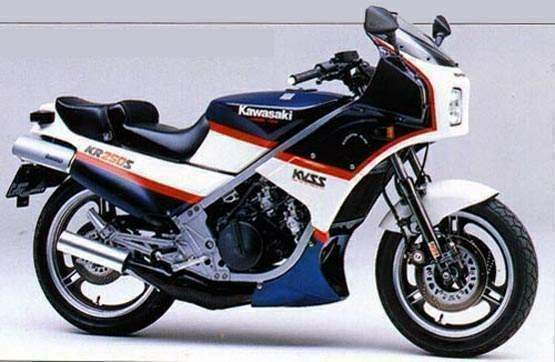
Kawasaki KR 250
With the stoplight about to turn green, our guide through Tokyo looked back and winced. he was unnerved by the raspy wail of the K.R250 behind him preparing to launch away from a traffic light at 8000 rpm. It was a racetrack sound, out of place in most cities. But in Tokyo, even the taxi-cabs come off the line hard. And to stay ahead of traffic and keep up with our guide's quick and torquey Yamaha RZV500, the peaky Kawasaki demanded drag strip starting techniques. Indeed, one way or another, the KR250 brings out the closet racer in the most conservative of riders. That's its heritage. In 1981 Kawasaki won a world championship with another bike named KR250. But while the street KR owes its basic design to the racer KR, the two share no parts. Both have at their heart a twin-cylinder two-stroke engine that is, in effect, two 125cc Singles mounted one behind the other in a common crankcase, their cranks connected by large gears. Rotary-valve induction is used on both racer and replica, with dual carbs feeding into the side of the crankcase. An exhaust pipe from the front cylinder tucks under the engine; the other pipe snakes its way from the back of the rearcylindertoexit high nearthe seat. Both KRs are narrow, light and powerful. That racer heritage shines through in the street KR250. The engine pulls cleanly everyplace, but it's happiest between 8000 and 10,500 rpm. When the engine hits eight grand at full throttle in first gear, the front wheel claws for the sky while the KR leaps forward almost as quickly as a catalyst-equipped RZ350 Yamaha. And the Kawasaki cruises smoothly and effortlessly at speeds unheard of for a 250: 80, 90, 100 mph. Top speed is well over 110 mph. The penalty is that, much like a racing 250, the KR only makes good power in one gear at any given speed. Come out of a corner a gear too high, the engine will drone ineffectively. Handling-wise, the KR is quick-steering yet stable, and the suspension is supple over small bumps, rather harsh over large ones. The only real handling defect, however, comes from the slightly rearward weight bias: The front end lightens so much under power that the steering can be vague and imprecise when charging out of slow turns. Still, for a thoroughbred racer that's been tamed for street use, the KR250 has few weaknesses. It's racy enough to be more high-revving fun on the street than just about anything on two wheels.
|
|
|
Any corrections or more information on these motorcycles will be kindly appreciated. |