
It is, however, the second cheapest, beaten on price only by Kawasaki's own KLR650 thumper.
So what do you get for your R47 500?
You get a smooth, responsive little engine of proven reliability. The liquid-cooled, dual-cam unit wais lifted from the long-running ER500 street bike - and before that it was used in the GPz500S mini-sportster of the 1980s
In this application it's tuned
for a moderate 33kW at 8300 revs, with 41Nm available at 7500rpm. It's redlined
at 11 000, although there's little to be gained by going there as the power
tails off sharply after 9500rpm.
It breathes through a pair of 34mm Keihin CVK carburettors, almost old-fashioned
in these days of fuel-injected machinery, and its throttle response is a little
slower, a little less crisp, than today's riders are used to.
There's very little vibration thanks to a gear-driven balancer, no powerband
worth talking about and very little sense of urgency. The engine just revs ever
more frenetically and the bike just goes a little faster.
It tops out at a respectable 169km/h at 9300rpm – but needs a long run to get
there, although it runs rock steady at full taps, seemingly unstressed and happy
to keep up that pace all day
Even with a low-tech twin piston floating front brake calliper the front end dives extravagantly
The power is transmitted to the six-speed gearbox by a rather
grabby clutch (unusual for this maker) that takes up suddenly a
long way out from the handlebar grip. Fortunately the lever is
adjustable for span so that you can move the take-up point to
suit any size hand – although there's not much you can do about
its narrowness.
The gearshift action is short, positive and distinctly notchy,
especially a low revs. With more than 6000rpm on the
rev-counter, (almost) seamless changes in both directions are
easy.
To its credit the 'box didn't miss a shift in either direction
throughout the test and there's remarkably little lash in the
final drive but the transmission remains the only part of this
20-year-old design that shows its age.
It's housed in a neat double-cradle frame of round steel tubing
with a few sheet steel pressings at the stress points – a design
philosophy perfected by Soichiro Honda four decades ago but
still valid today.
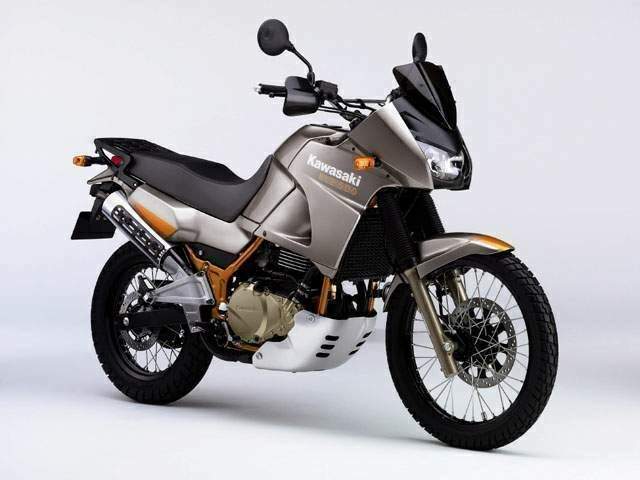
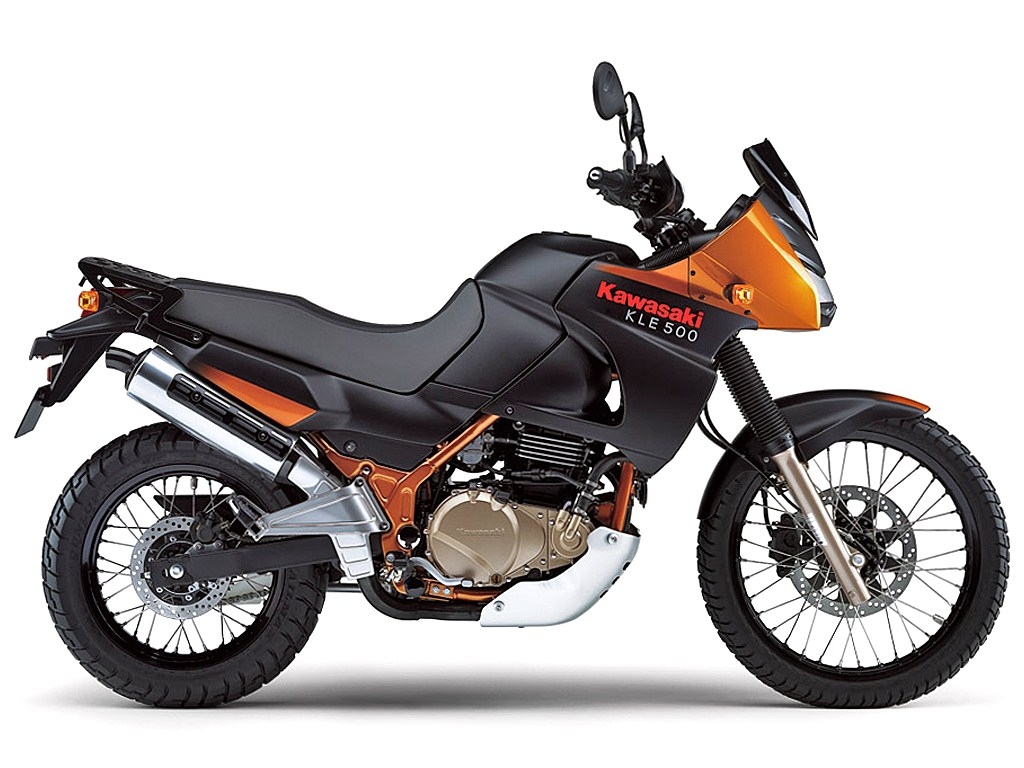
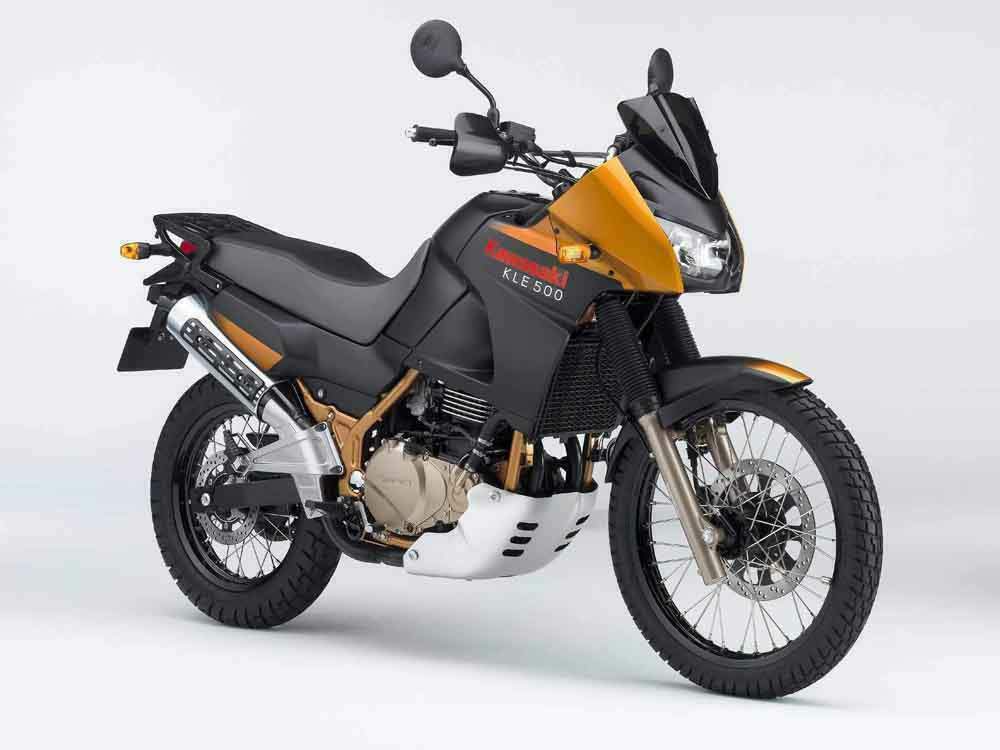
This example is so well executed that instead of painting it
plain black to de-emphasise it, Kawasaki has finished it in
metallic "Candy Gold Spark", making a bold (and successful)
styling statement.
The right lower frame member is detachable, making it easier to
get the motor out of the frame but doing little for chassis
rigidity, which is in any case never an issue with only 33kW on
offer. There's a big aluminium bash plate under the motor,
looking a little incongruous on this prettified
street-scrambler.
The big rectangular-section steel swingarm is finished in black,
as are the rims and most of the bodywork, giving the bike an
unusual and striking overall colour scheme – almost reversing
the traditional format.
It's articulated via a uni-track linkage and single shock
adjustable only for preload.
Squodgy suspension
The 41mm leading-axle forks are preload-adjustable by means of
tyre valves – it's at least 12 years since I've seen a set of
air forks and I don't know whether you can still buy those
little shock pumps to adjust them with.
Certainly there isn't one in the bike's issue toolkit and I
couldn't find mine so the forks stayed exactly as they were for
the duration – distinctly squodgy.
Even with a low-tech, twin-piston floating front brake calliper
the front end dives extravagantly under hard braking, enough to
unsettle the steering in anything but a straight line.
The rear suspension is a little more self-possessed but the ride
is still marshmallow soft, the steering a little vague and and
the whole bike prone to doing the hippy-hippy shake on long
sweeps.
It's a lot better in the dirt, however, where the 21" front
wheel comes into its own and the compliant springing soaks up
all the bumps and gullys of my favourite green area. Make no
mistake, this is not an enduro bike but on gravel roads and easy
trails the KLE500 is surprisingly comfortable.
The soft, broad and deeply padded saddle helps, as does the
relaxed seating position with the footpegs directly under the
nose of the saddle.
Modern styling
In contrast to the conservative chassis engineering the body
styling is right up to date with a deep-shouldered fuel tank and
integrated fairing, laid out in bold strokes and large blocks of
colour.
Aside from the side panels of the fairing, which are sprayed the
same gold as the frame, the whole bike is finished in semi-matt
black – all the graphics are printed on large self-adhesive
decals, which will make refinishing the bike after a minor fall
a lot quicker and easier.
The exhaust tailpipe runs high up on the right, almost hidden
under the side cover, and there's a neat (plastic) carrier
behind the pillion seat, which is nearly as broad and even more
deeply padded than the front seat.
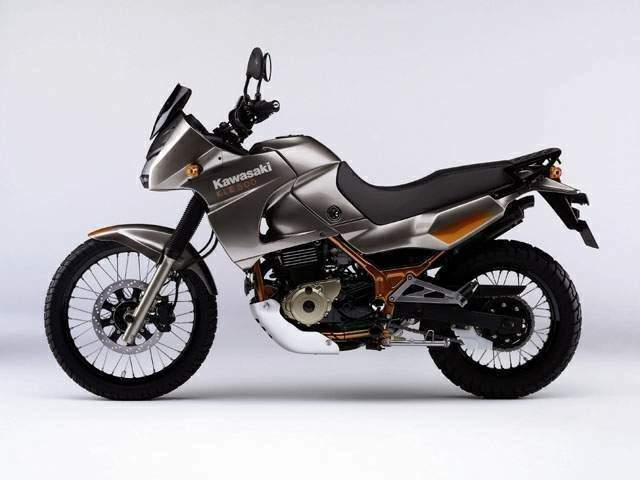
The mini-fairing with its cantilevered fly-screen is taken
directly from the Z750S, with side vents to produce the "air
curtain" that takes most of the slipstream straight over the
rider's head. Don't laugh, the principle has been used in
air-conditioning for years.
The analogue instruments are set in a neat fascia, boldly marked
out in gold, strongly backlit at night and surrounded by a
rather haphazard arrangement of warning icons; the only extra I
would wish for is a clock – which is more an indictment of a
lifestyle that always needs to know how late it is than a
criticism of the bike.
User friendly
In the end the beautifully finished KLE500 just misses the mark;
it's a great first bike, a wonderful learning tool, almost
without vices but also without character.
It'll teach you how to ride off-road and how to cope in traffic.
It'll go round corners in style if without urgency and it's
comfortable for a good few hours at a time.
But unless all you want is a competent commuter in stylish
"adventure" clothing, once you find out who you are and where
your riding is going to take you, you'll move on to something
with a bit more bite.
Source
Motoring.co.za