|
Make Model |
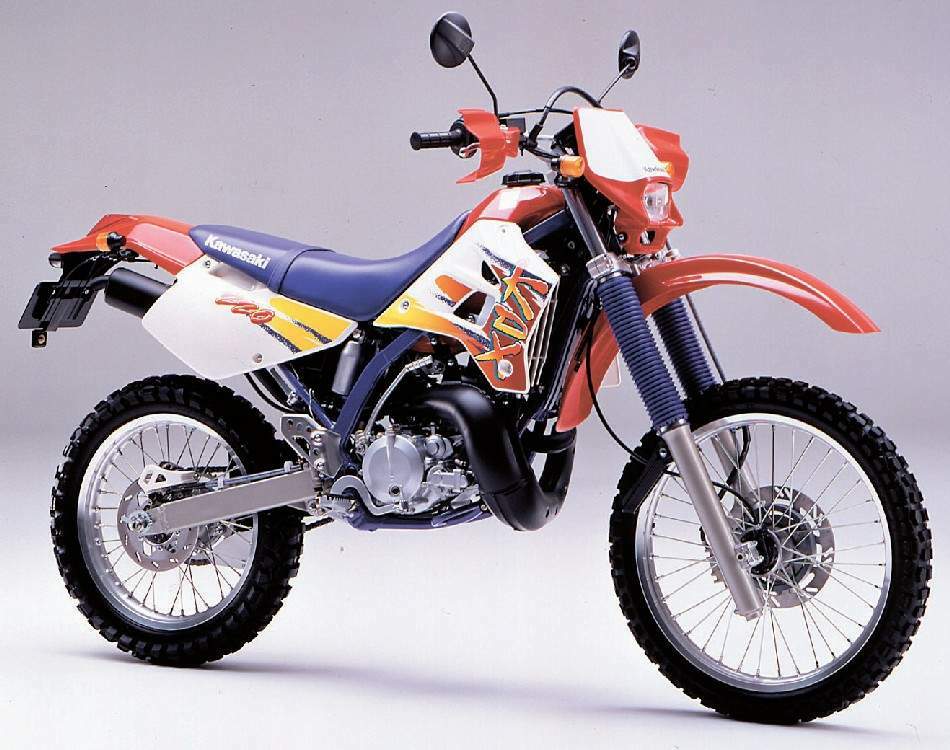
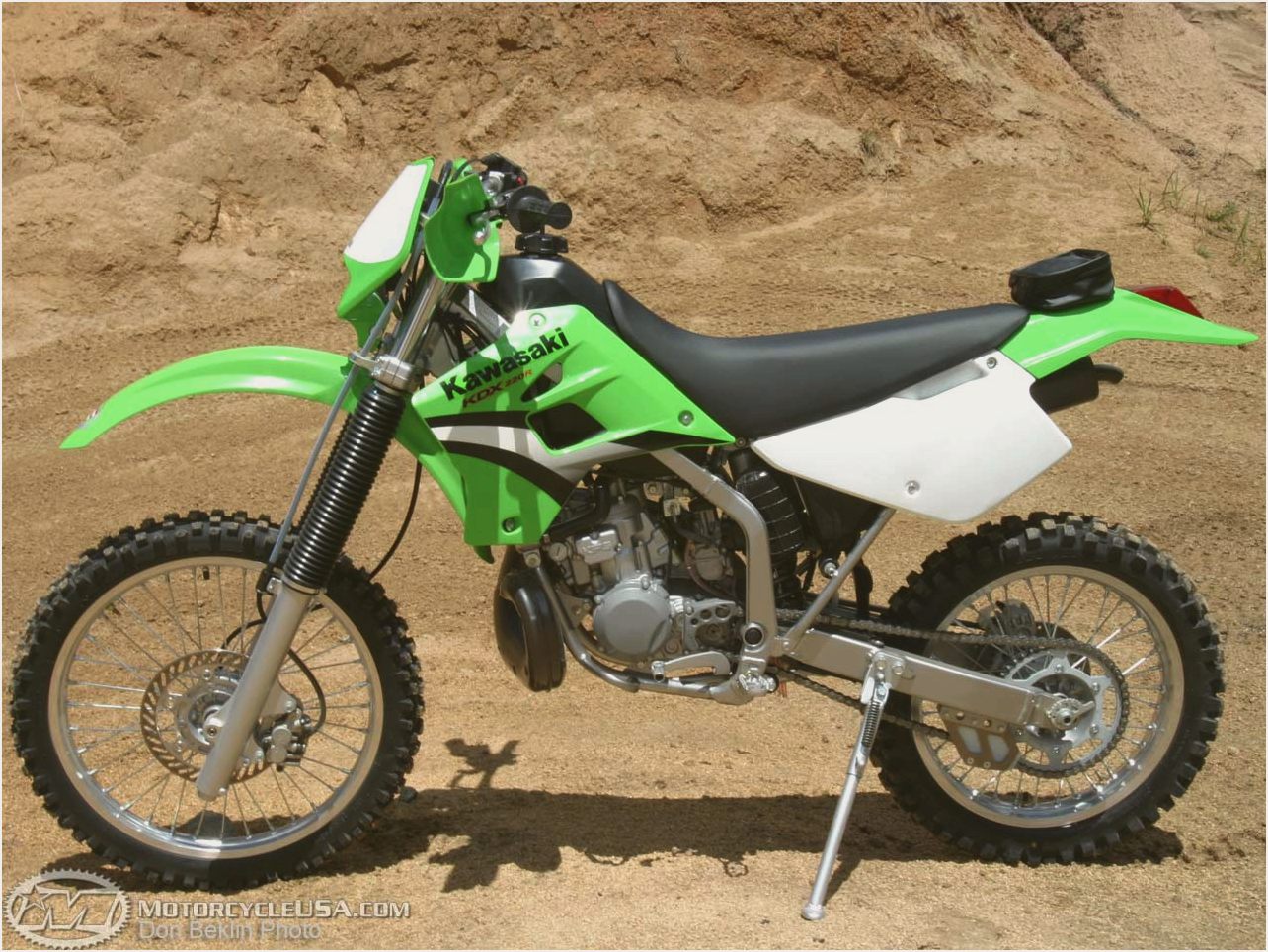
Kawasaki KDX 220R |
|
Year |
1995 |
|
Engine |
Liquid cooled, single cylinder, two stroke |
|
Capacity |
216 |
|
Bore x Stroke |
б9 х 58 mm |
|
Compression Ratio |
6.8:1 |
|
Induction |
PWK33 Keihin PWK35 |
|
Ignition /
Starting |
|
|
Max Power |
37 kg @ 8000 rpm |
|
Max Torque |
3.5 kg-m @ 7000 rpm |
|
Transmission /
Drive |
6 Speed / chain |
|
Front Suspension |
|
|
Rear Suspension |
|
|
Front Brakes |
Single disc |
|
Rear Brakes |
Disc |
|
Front Tyre |
3.00-21 |
|
Rear Tyre |
4.60-18 |
|
Dry-Weight |
104 kg |
|
Fuel Capacity |
11 Litres |
Kawasaki has a good thing
going with their KDX 200, a motorcycle they humbly refer to as "the greatest
trailbike ever made." But what do you do for an encore when your bike is
already considered to be the standard by which all others are judged?
A lack of significant changes can result in a
loss of sales as buyers flock to what's new from other manufacturers, but even
worse is change for change's sake that results in an inferior product.
Kawasaki solved this dilemma by introducing the
new KDX220R while still keeping the venerable 200 in the line up for those
loyal to that machine. Clearly the powers at Kawasaki were cautious of
alienating faithful customers with a "New Coke" version of their famous
enduro.
We had a chance to test both bikes back to back
along with the new KLX300R which replaces last year's KLX250, at Kawasaki's
ride introduction. The three day event took place in a tiny mining town
nestled deep within the beautiful mountain ranges of central Idaho. Scenery
was stunning with views rivaling Switzerland and Austria's best. Sorry, but
we're keeping the place a secret as some things are better left undiscovered.
Temperature was the only downside to this spectacular locale as the mercury
dropped to a bone-numbing thirty degrees in the morning and only mustered
fifty-five during the afternoon.
Kawasaki pulled out all the stops to make sure
the test bikes were properly presented to the press. The Team Green crew,
complete with their eighteen wheeled rolling workshop, had a fleet of KLX's
and KDX's gassed up and ready to go upon our arrival. Off-road heroes Ty Davis
(two time ISDE top American), and Larry Roeseler (winningest off-road rider to
date) were on hand to guide the group, lend their expertise and do what they
do best for the cameras.
"I was anxious to
climb aboard the new 220R to see what happens to "the world's greatest
trailbike" when it is improved."
Over the next three days we rode all three
models in a variety of conditions. The trails were primarily single track
loops joined by tracts of dust, mud, technical rocky sections, rutted
switchbacks, trees, logs and considerable snow in the higher elevations.
Having personally owned nearly a half dozen KDX
models over the years I was anxious to climb aboard the new 220R to see what
happens to "the world's greatest trailbike" when it is improved.
KDX220R
This year's all new 220R has generated a great
deal of excitement amongst KDX diehards everywhere. Kawasaki claims that the
220R "bridges the gap" between riders who feel a 200cc machine might be
underpowered, but consider a 250cc bike to be too much motorcycle. Both KDX
models share an identical chassis with the only differences being the motor
and carb.
Kawasaki is presenting the 220R as the more
race-worthy version of the KDX family because of its engine modifications. The
220R comes on strong off the bottom and builds smoothly until it's time to
shift. However compared to the 200 it seems to run out of steam quickly,
almost as if it's being held back. These type of power characteristics make
the bike more suitable for trail riding than serious competition. Maybe the
altitude played with our best judgement but the smaller 200 seems capable of
generating power more rapidly and for a longer duration than the 220R. Without
a Dyno run we can't be sure but a quick dissection of Kawasaki's new lime
green Frankenstein might shed some light.
It's rumored that the 220 engine is borrowed
directly from a domestic (Japanese) dual purpose unit. While the motor is
virtually identical to the 200 there are a few subtle differences which no
doubt contribute to the 220R's tamer disposition. The cylinder bore is three
millimeters larger yielding an overall displacement of 216 cubic centimeters
as opposed to the 200's 198 cubic centimeters. This looks like we're on the
right track, however, from here things go awry. Strangely, a carburetor that
is a full two millimeters smaller (PWK33) than the 200's provides the intake
mixture. While theoretically this would create improved low end response one
would assume bumping the displacement and leaving all things constant would
accomplish the same end.
Kawasaki engineers cooked up further changes in
their cauldron. At idle both models report almost identical compression ratios
but as rpm builds the 200 comes out .7:1 higher. On the 220R both the transfer
and exhaust port timing has been ever so lightly tinkered with to produce
smoother, more tractable power. We would be interested to see the results of a
carb swap but time did not permit this.
We're looking forward to reviewing a 220R for
an extended period of time but at this zero hour we're hard pressed to
recommend one model over the other. Both KDX's are very good and very similar.
With the 200 retailing a full $250 less it's difficult justifying the purchase
of a 220R for racing purposes. It makes more sense to buy a 200 and spend the
savings on an aftermarket 240cc kit, a pipe and maybe a port job. At least
you'll be starting out with a larger carburetor.
KDX200
Kawasaki's KDX200 has experienced a strong
following since its inception in 1983 and the latest perimeter steel frame
version (H model)is probably the best ever.
While the only noteworthy refinement is the
addition of 10% stronger clutch springs the little 200 is still a very
competitive mount, both on the showroom floor as well as the trail.
A suggested retail price of just $4,299 makes
the KDX a very attractive package indeed.
Frankly, we did not expect any significant revelations from a motorcycle who's
powerplant is based on last year's borderline-anemic KLX250. But after having
ridden the package it's hard not to be excited about what we discovered.
Kawasaki has come up with a combination of engine and component modifications
that have made notable improvements in power and handling.
Displacement was increased by boring the
cylinder an additional six millimeters to bring total size to 292cc. A Keihin
CVK34 (Constant Velocity) carburetor is fitted and performed without
hesitation or error during our evaluation although we did experience some
minor backfiring during high speed runs when the throttle was abruptly
chopped. This did not seem to affect performance, although it did scare off
nearby wildlife.
Starting the bike hot or cold is easy thanks to
Kawasaki's Automatic Compression Release (KACR) system while last year's rough
idling has been eliminated by advancing the ignition five degrees.
Modifications were also made to fifth and sixth gears to improve transmission
performance while attempting to reduce overall gear noise.
However, during our test the KLX jumped out of
gear on two separate occasions, both while under load. This problem wasn't
unique to our bike either as several members of the press were able to
duplicate this condition.
Kawasaki is aware of the problem and says it
will be fixed. Smaller detail changes include a repositioned oil filter for
easier access and larger radiator shrouds that are fastened via a plastic
"pop-in" tab rather than the traditional bolt-on design. One rider managed to
pop one out during a crash but the piece was undamaged and quickly snapped
back into place. Very nice.
Front forks are 43mm upside-down cartridge
units with 16-way adjustable compression damping. A rear shock with piggyback
reservoir and 16 compression and rebound damping adjustments rides on
Kawasaki's patented Uni-Trak linkage system. Kawasaki claims that both front
and rear suspension spring rates have been slightly increased to suit faster
riders. With stock settings at both ends the suspension did a good job of
keeping the machine on its intended course and only a few unexpected drop-offs
and some large jumps resulted in light bottoming.
The plastic engine coolant reservoir shares the
same under-the-seat left side positioning as older KDX models. It's easily
accessible, or rather would be if the KLX came with a toolbag like it's KDX
cousin. In the event that the KLX requires any sort of trailside maintenance
necessitating tools you're out of luck. Although there's plenty of room on the
rear fender you'll have to shell out the extra cash for a KDX or aftermarket
toolbag in order to enjoy the comfort of having tools.
The KLX's exhaust canister has a removable
baffle assembly for competition riding. While this does not compromise the
function of the mechanical spark arrestor it does, obviously, result in a
louder exhaust note that might be offensive in some parts of the world. Sound
levels were not overly obnoxious in the wide open areas we traversed but you
should use your own judgment based on the situation.
Both front and rear brakes are the same as last
years KX250 and are very capable of hauling the bike down from speed. We were
less pleased with the routing of the front brake line which hangs below the
front left fork leg inviting possible failure in the event of a severe enough
hit. While we did not experience any troubles we would anxiously keep an eye
on this.
The KLX has .8 inches less ground clearance
than the KDX although its seat is .2 inches taller. Despite the numbers,
riding the KLX gives the pilot an impression of sitting very close to the
ground with ergonomics reminiscent of the older KDX175, albeit superior in
design. Whether it's the seat's slimness or perhaps the positioning of the low
footpeg, the layout works well as the KLX inspired confidence in nasty mud and
snow-covered terrain. It is a very easy bike to ride and worked well in
technical situations that required frequent touching down to stay upright.
With a claimed weight of only 231.5 pounds dry
the KLX weighs just 8.5 pounds more than both KDX200's and a full 25.5 pounds
less than the 1997 Honda XR400R. Having ridden both machines it's clear that
Kawasaki has jumped into the ring with a viable open class contender that can
go head-to-head with the XR. Perhaps putting the KLX over the top is that
performance gains are easily achieved by installing a steel sleeve and 340cc
piston. Larry Roeseler (714-528-1448) claims 375cc is attainable with a bored
and stroked motor which, with a different carburetor, would give much more
horsepower.
As mentioned earlier both KDX models are
identical in every way except for their engines. Both share the same steel
perimeter frame based on the KX125 and 250 designs. Both are fitted with
conventional 43mm cartridge forks, with 16-way compression damping, and a
nitrogen-filled aluminum body rear shock. The rear unit supports 16-way
compression and rebound damping as well as a spring pre-load adjustment and
uses a remote reservoir to avoid shock overheating. Stock suspension settings
produced some rear wheel hop and some front end deflection but worked quite
well overall.
"Kawasaki should be
applauded for their continuing efforts to produce high quality two-stroke
motorcycles for recreational off-road enthusiasts -- an off-road segment that
is under heavy scrutiny due to ever-tightening emission regulations."
All three models mentioned here utilize a
special Electrofusion cylinder bore. This is a process that leaves a porous
hard coating of molybdenum and steel permanently secured to an aluminum bore
by using high voltage during manufacture. While such cylinders can't be bored
in the same manner as steel units the benefits of the design are a resistance
to wear and the ability to transfer heat more efficiently.
An O-ring chain, quick release rear wheel,
snail cam chain adjustment, head and taillight assembly, U.S.
Forestry-approved spark arrester and a resettable tripmeter come standard on
each model.
Each machine comes stock with flimsy plastic
handguards designed to protect you from bugs, small branches, the cold and
little else. Toss them in favor of some good aftermarket aluminum or sturdy
plastic wrap-around pieces. The psychological effects of real protection will
do wonders for your riding confidence.
Kawasaki should be applauded for their
continuing efforts to produce high quality two-stroke motorcycles for
recreational off-road enthusiasts -- an off-road segment that is under heavy
scrutiny due to ever-tightening emission regulations. It would seem that
producing four-stroke motorcycles is not only the politically correct thing to
do but they are also easier to market. With impending CARB regulations we're
not sure how much longer you'll be able to purchase new KDX's in California
but consider this model the last of a dying breed. Two-stroke off-road
machines may soon join their street siblings as classic heirlooms to remember.
Get 'em while you can.
By Motorcycle Online