|
|
|
|
Classic Bikes
Custom Bikes
Individual
Racing Bikes AJP
AJS
Aprilia
Ariel
Avinton / Wakan
Bajaj
Benelli
Beta
Bimota
BMW
Brough Superior
BRP Cam-Am
BSA
Buell / EBR BullitBultaco
Cagiva
Campagna
CCM
CF Moto
Combat Motors
Derbi
Deus
Ducati
ExcelsiorFantic
GASGAS
Ghezzi Brian
Gilera
GIMA
Harley Davidson
Hero
Highland
Honda
Horex
Husaberg
Husqvarna
Hyosung
Indian
Jawa
Kawasaki
KTM
KYMCO
Laverda
Lazareth
Magni
Maico
Mash
Matchless
Mondial
Moto Guzzi
Moto Morini
MV Agusta
MZ / MuZ
NCR
Norton
NSU
Paton
Peugeot
Piaggio
Revival Cycles
Roland Sands
Royal Enfield
Sachs
Sherco
Sunbeam
Suzuki
SWM
SYM
Triumph
TVS
Ural
Velocette
Vespa
Victory
Vincent
VOR
Voxan
Vyrus
Walt Siegl
Walz
Wrenchmonkees
Wunderlich
XTR / Radical
Yamaha
Zero
Video
TechnicalManufacturer ListContact
|
Kawasaki H1 500 Mach III
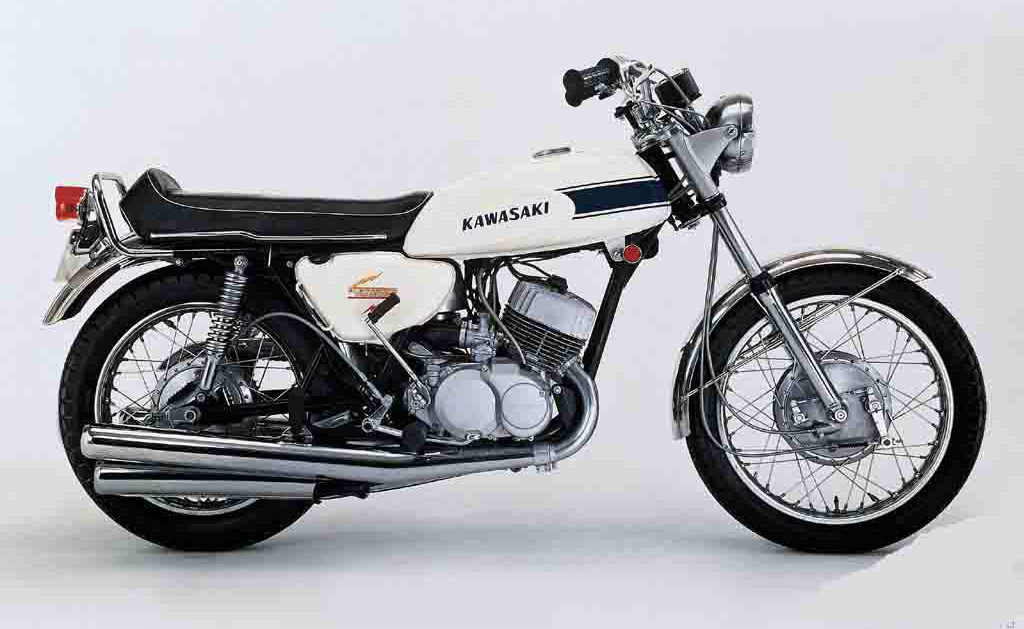
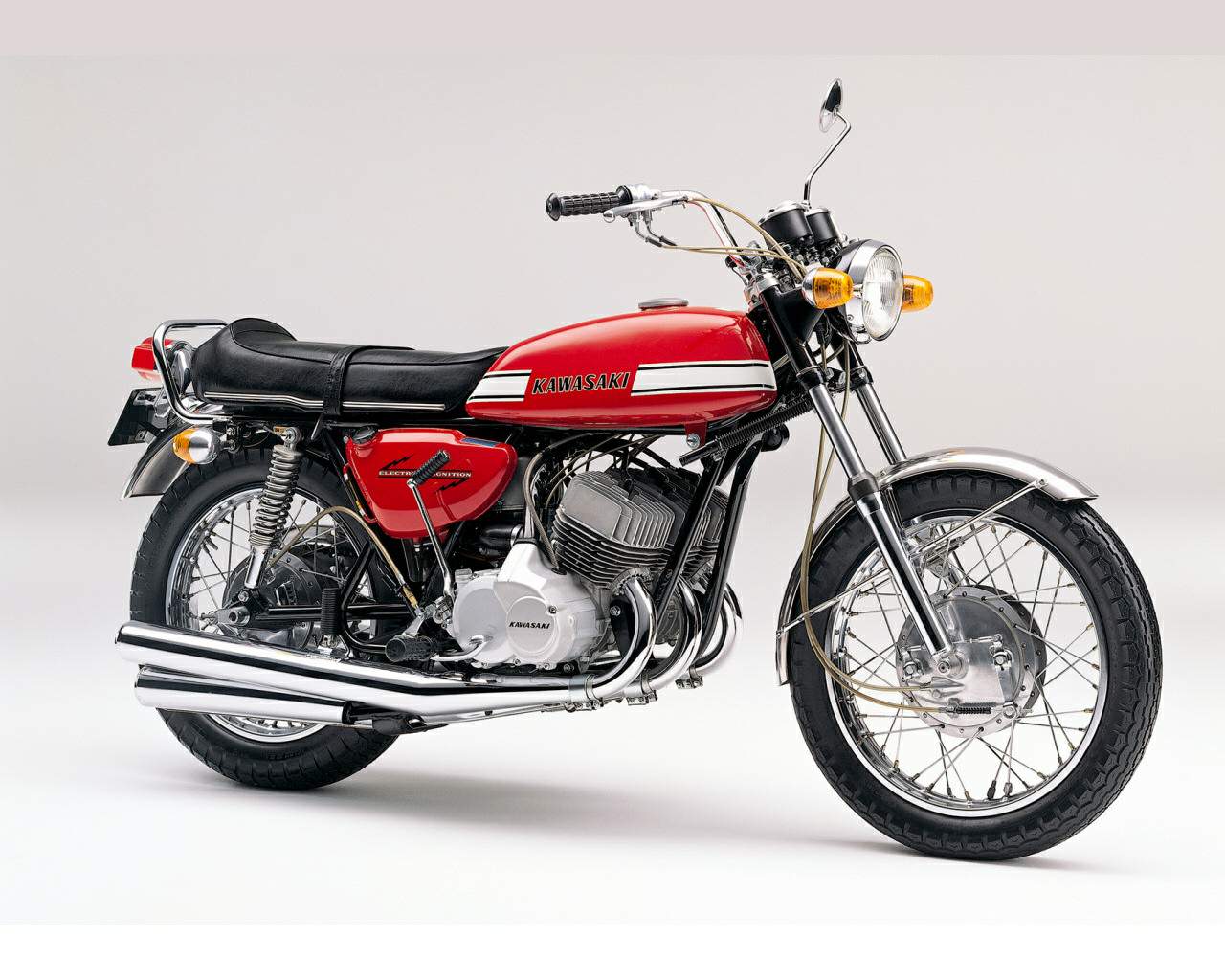
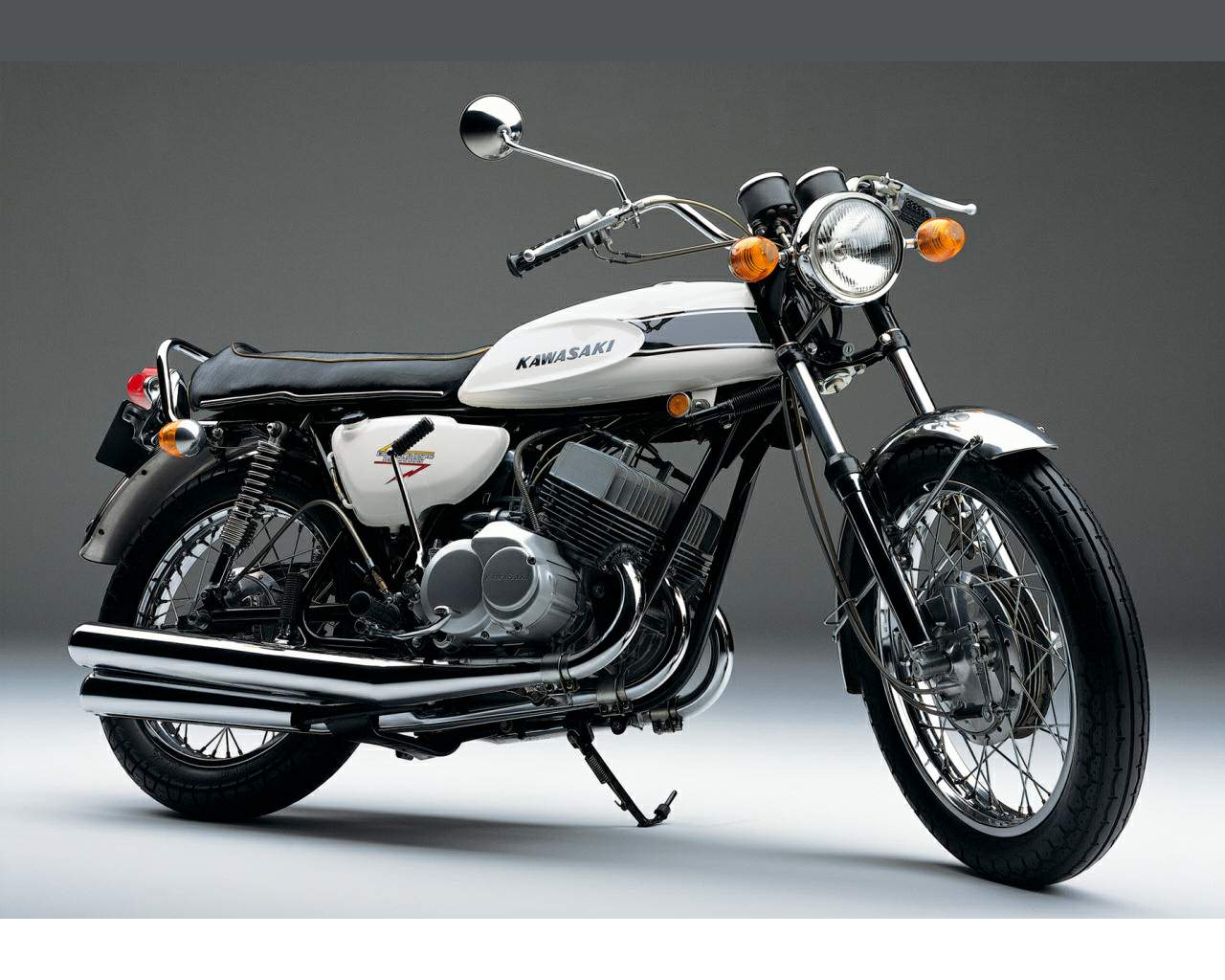
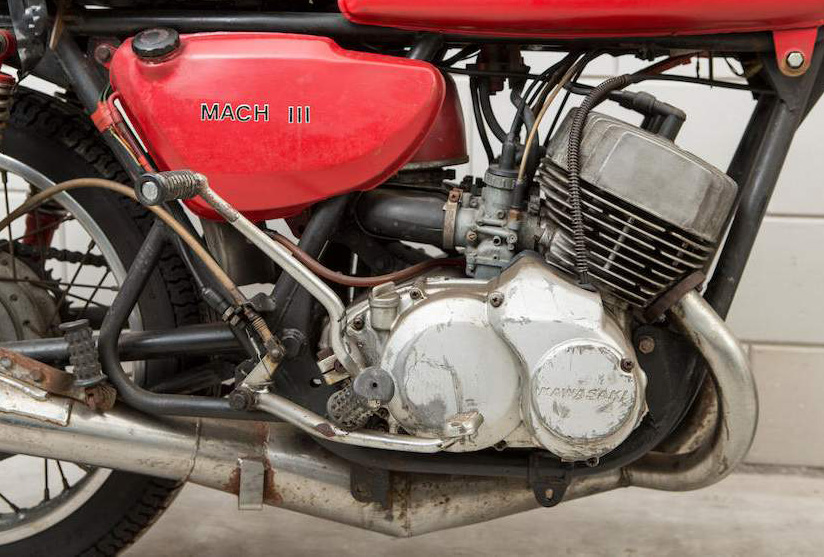
The 'seventies really started in 1969. That was the year Honda's CB750 Four went on sale, leading inevitably to the coining of the word 'superbike.' There'd been fours before, of course, but never a mass produced one — at a mass produced price for a mass market. The CB750 was fast, too, but a little too awe inspiring at the time to seem plain fun and furious as well: the credit (or blame) for setting the tone of those crazy early years of the last decade went to a very different motorcycle. Kawasaki's Mach III H1 500cc triple hit the streets soon after the CB750 but it wasn't the technology which socked everyone between the eyes, it was its unique combination of raw, bad-mannered power and supposedly homicidal handling. Nearly 60bhp was claimed for the Mach III, most of it crammed into a powerband which bit like a starving Mako shark at 6000rpm and ran out just 2000 revs later. If the performance was supposed to make your hair stand on end, the handling was said to be enough to make it fall out. Bike dubbed the 1972 H1B The Fastest Camel in the World and refused to go near another Mach III for two years. Those were heady days when it was taken for granted that Japanese motor design was far ahead of chassis, tyre and brake technology — H1 freaks probably took the headline as' a backhanded compliment to their taste in machinery. All the same, 'handles like an early Kawasaki triple' still turns up as a roadtest cliche for bad handling long after the machines which created the phrase went out of production. So when someone rings up in the middle of winter to offer a ride on his newly restored, original-down-to-the-rear-shocks, vintage '69 HI, it's tempting to put the receiver down sharpish and pretend it was a crossed line. Unfortunately, Mick Presland called back — and back and back until I found myself warily eyeing an admittedly immaculate looking Mach III in a pub car park near Letchworth. It was an unseasonally bright, dry day., .but if everything they said was true then I'd, er: 'Let's go in and have a pint while you tell me about it, Mick.' Seems Mick, 23, had had a hankering for an early Kawa triple for quite some time. A pretty weird ambition for someone who'd had to sell a CS1000 because it wouldn't handle properly under his light weight. Now he's got a Rickman framed Z1 for day-to-day work and play. Mick was looking for a lazy restoration project as much as a second string roadburner to complement the Z1, hence the two years it's taken him to get the H1 on the road. 'I was really looking for an early H2 750 but the H1 turned up first at a dealer in Essex so I bought it instead. It looked quite clean until I got close. Then it looked pretty bad, though I suppose it wasn't that dreadful seeing as the previous owner used it as an everyday bike.'
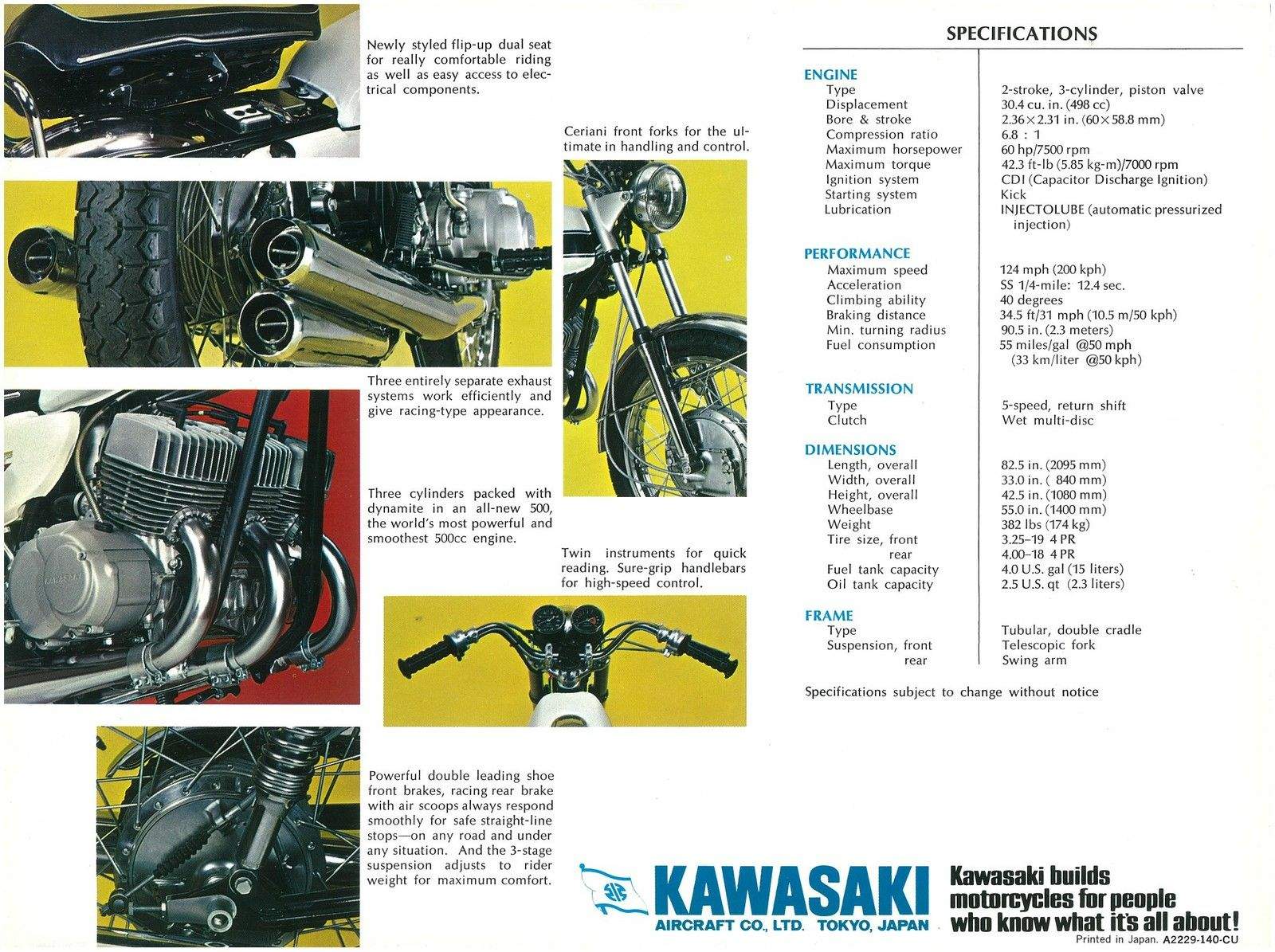
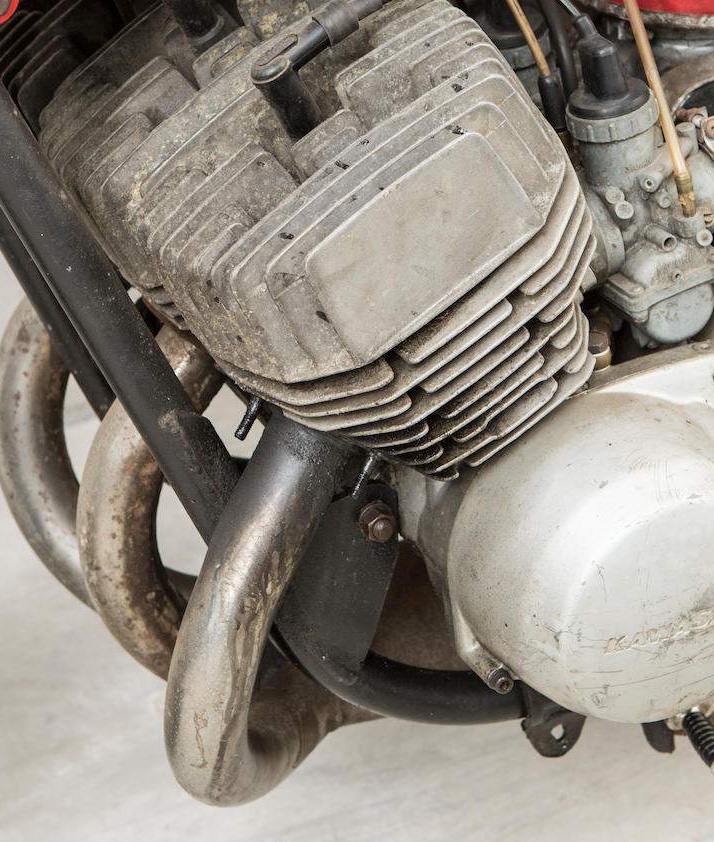
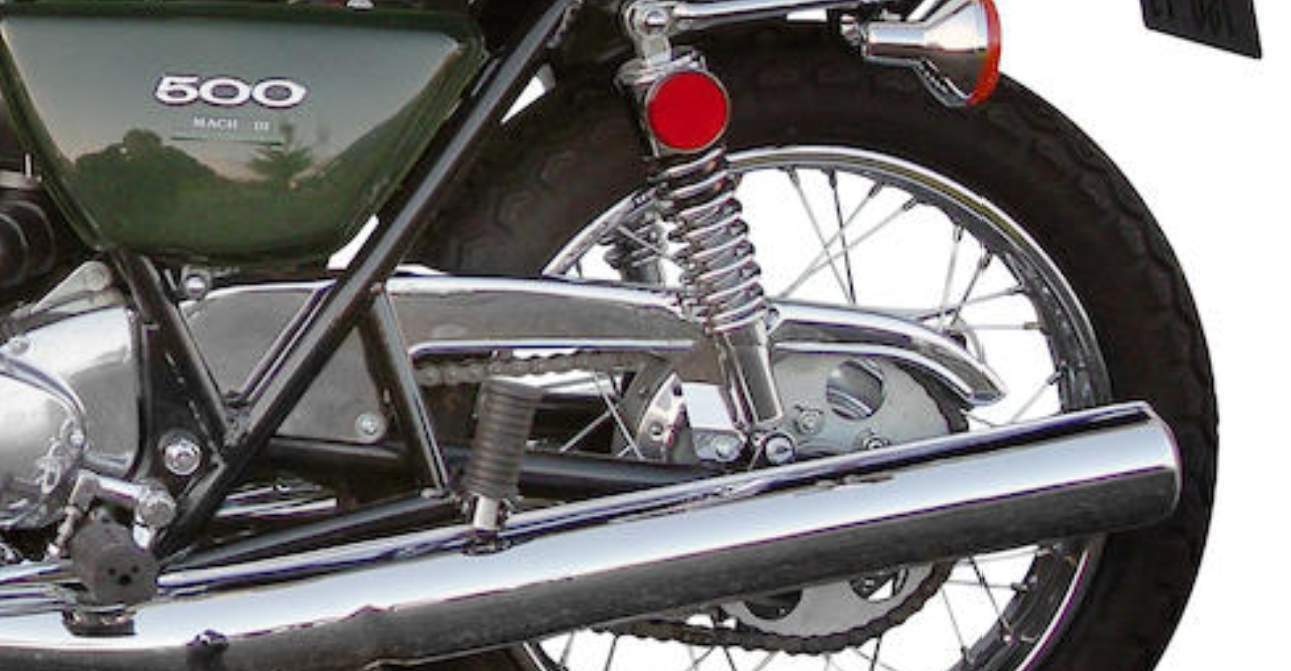
Luckily the triple was mechanically sound and in almost original condition bar a crude home made air scoop and a bit of al fresco drilling on the front brake, apparently aimed at preventing overheating. Mick wasn't sure about the paint scheme — off-white with a red panel on the tank but seeing as neither Kawasaki UK nor former importers Agrati Ltd could help him with details, he wrote to Kawasaki in Japan. Two months later he received a couple of fuzzy photos and a few details: enough to tell him the original colours were Midnight White and Peacock Grey (powder blue really), so tank, side panels and oil tank went off to Dream Machine for a convincing respray. The Mach III badge on the sidepanel was obtained through an advert in MCN but the electronic ignition flash on the oil tank is a bit of restorer's licence. The first His did use CDI ignition and pretty hot zits that was back in 1969 but UK versions had conventional points (lucky, because the CDI version proved so troublesome that Big K eventually dropped it for a while in 1971 before going over to the improved H2 type in '72). Well, the logo looks smart and it takes Mick's mind off the exacting job of setting up the carbs and ignition timing. Aside from a basic top-end overhaul, Mick hasn't done anything to the motor. The bottom end's a pretty tough piece of work anyway, with the 120° crank running in no less than six main bearings. He had* the wheels rebuilt and renewed all cables, including the one operating the rear brake, and scored a new set of pipes and front brake assembly from the Cradley Heath emporium which supplied the bike. All that remained was to entice some ail-too suspecting hack up to north Hertfordshire for a bout of fear and loathing in the lanes. Two things stood out about his finished Mach III. First it looked as if it'd just come out of a crate; secondly, the first production models bear only a passing resemblance to the beautifully swoopy, sleek lines of the restyled 1973 H1D and its successors. The narrow, slab-sided tank with shallow knee cut-outs looks reminiscent ot a Triumph Trident's, the impression being reinforced by the Triumph-type 'bars on Mick's H1 which probably aren't original. The forks are original though, as is the friction damper on the steering head, but the hydraulic damper is a graft from a later model. Not to put too fine a point on it, the H1's an odd looker. A 19in wheel and long forks at the front, combined with an 18in rear wheel and short shox, give the bike a mean, raked-back look despite its moderate 55in wheelbase. All the weight is carried low and far back with a massive overhang on the right of the motor where the points and Injectolube (now there's a quaint term) oil pump live under a large silver-grey casing. All in all it's not a recipe for ideal handling, especially when combined with a short, small diameter tubular swing arm and an upright riding position dictated by the wide bars and forward-mounted rider's pegs. Back in '69, Kawasaki's marketing men rather hoped buyers would overlook all this once the performance of 'probably the most explosive motorcycle ever built' became established in riding legend. Much was made of the motor's pedigree: designed by Kawasaki's aeronautical engineers, the blurb ran. A real, uh, flyer. Riding the thing had become somewhat unavoidable at this stage so I held the handlebar-mounted, spring loaded choke lever forward and prodded the kick lever a couple of times. The motor caught quickly and idled with a surprisingly gentle burble and vast clouds of blue haze from the three mufflers. The gearchange is a five-speed item with neutral at the bottom of the five-up pattern. Pulling out of the car park, the Mach III proved to possess rather more bottom end power than its all-or-bugger-all reputation would lead most to expect.
Spotting Mick anxiously standing by an upcoming righthander, I self-consciously changed up into second before opening up — well, s'not my bike after all. The exhaust note remains deep and quite musical through the rev range; nothing like the manic rattling banging and screaming of smaller Kawa triples like the KH250. Six grand . . . any moment now . . . eyeballs pressed into sockets . . . brain swirl . . . arms wrenched . . . world going backWards. Seven grand . . . oh, so that's it. The power step when the motor got on to its pipes was there all right but it wasn't the blitzing transformation from docility to naked aggression I'd somehow come to expect. From merely trundling along at a gently increasing speed, the Mach III suddenly started really accelerating noticeably. If I'd hit the throttle as hard in second on Yamaha's YPVS 350LC, which is said to make as much power as an H1, I'd have been fighting to keep the front wheel down. Of course, the modern Yamaha is getting on for 1001b lighter than the old Kawasaki so the difference isn't really so astounding. You have to cast your mind back to biking as it was in the late '60s (no, I can't either) to appreciate the impression made by what was, for those days, an extremely pipey powerplant. Unfortunately, the only bug Mick hasn't been able to squash is a slip-prone clutch. He thought he'd got it sorted but it wasn't long before it started losing its grip when the powerband was reached while accelerating hard. Shame, because once I'd recovered from the first taste of the Mach Ill's lack of cornering prowess I wanted to cane it — which means using all the gears and lots of revs for, true to form, this H1 wouldn't accelerate in top from less than 70mph. Approaching the bumpy, varying radius bend where the pics were shot was nerve wracking at first. If Everything They Said Was True the Mach III might well break into a series of frenzied leaps and bounds without warning. In fact, in spite of the poorly braced frame and antiquated suspension, it coped very well apart from a pronounced desire to carry on in a straight line. Heartened, I went through the other way at a more progressive pace but was confounded at the apex by an ominous scrape as the centrestand grounded early. Big K made the cornering clearance somewhat smarter later on. versions. So long as one took care not to hit the powerband until well out of a bend, the Mach III wasn't too much of a handful: find a sudden dose of extra horsepower, though, and it'd try to pick itself up and carry straight on. Much the same thing applied to rolling off power in a corner — especially those on the crests of hills. This is a big H1 DO NOT 'cos it provokes double-treble 'I'm going straight on and nothing can stop me' behaviour. Maybe this tendency would've been lessened without the effect of two steering dampers but, in view of the lightness of the front end, that alternative was too horrible to contemplate.
Shucks, at least half the legend's true. Mick's pride and joy was shod with Contis front and rear, each a size up from the original 3.25 x 19in and 4.00 x 18 Japlops and they at least presented no worries. The rebuilt front brake wasn't bedded in, though, and the 7in sis rear drum was no great shakes either, dinky chromed airscoop with adjustable vent an' all. Compare the Mach III with the Uni-Track GPz750 also in this ish and you can see just how far Jap motorcycles have progressed in the last 14 years. In its time the triple was one hell of a radical scoot what with CDI ignition, bare arsed performance, and the rest left to buyers' guardian angels. Riding both bikes really underlines the difference. The CPz is smooth, fast, comfortable: it looks and feels poised and aggressive. The H1 is harder, far more basic and strikingly clumsy in appearance by contrast — 90 per cent of the designers' effort went into its motor and it was four whole years before a serious attempt was made to improve all the deficiencies in handling, braking and styling. They never did manage to do anything about its appalling thirst which rarely delivered more than 30mpg, meaning fuel stops every 60 or 70 miles no thanks to a mean 3.3gal (15 litre) fueltank. It's doubtful whether any Mach Ills ever came close to the 125mph top whack and low 12sec standing quarter times often rumoured: about 110 per and c. 13.5 sees is more likely. Even so, there weren't a lot of 500s around in 1969 which'd better the Kawasaki's sprint figures. After more than a decade, the Mach Ill's reputation has definitely outgrown the motorcycle. Still, it's essentially the right image and it didn't succeed in putting off many riders who wanted the hairiest stroker of the early 'seventies. They didn't buy His in spite of their reputation anyway — they bought them because of it. Source Bike 1983
|
|
|
Any corrections or more information on these motorcycles will be kindly appreciated. |