|
|
|
|
Classic Bikes
Custom Bikes
Individual
Racing Bikes AJP
AJS
Aprilia
Ariel
Avinton / Wakan
Bajaj
Benelli
Beta
Bimota
BMW
Brough Superior
BRP Cam-Am
BSA
Buell / EBR
Bullit
Bultaco
Cagiva
Campagna
CCM
CF Moto
Combat Motors
Derbi
Deus
Ducati
Excelsior
Fantic
GASGAS
Ghezzi Brian
Gilera
GIMA
Harley Davidson
Hero
Highland
Honda
Horex
Husaberg
Husqvarna
Hyosung
Indian
Jawa
Kawasaki
KTM
KYMCO
Laverda
Lazareth
Magni
Maico
Mash
Matchless
Mondial
Moto Guzzi
Moto Morini
MV Agusta
MZ / MuZ
NCR
Norton
NSU
Paton
Peugeot
Piaggio
Revival Cycles
Roland Sands
Royal Enfield
Sachs
Sherco
Sunbeam
Suzuki
SWM
SYM
Triumph
TVS
Ural
Velocette
Vespa
Victory
Vincent
VOR
Voxan
Vyrus
Walt Siegl
Walz
Wrenchmonkees
Wunderlich
XTR / Radical
Yamaha
Zero
Video
Technical
Manufacturer List Contact
|
Kawasaki GPz 550
The Uni-Trak CPz550 really set the middleweight class alight when it came out in 1982. It was the result of steady development that produced a mid-weight that could give the big boys a good run for their money. They had it pretty much their own way since Honda's CBX550 wasn't out and Suzuki admirable 550 wasn't out and Suzuki's admirable 550 was not aimed at such a sports market. Obviously the GPZ600R has largely replaced it, but the 550 still has plenty of fans who prefer its handling, lines and air-cooled integrity.
Power went up from 54 to a claimed 65bhp, so the move to monoshock was a sensible and successful one. A steady stream of improvements in every department shows what can be done when the manufacturer sticks with one design and refines it rather than chucking it all away and starting with a new configuration. Like a lot of the classics here, it is a blend of many attributes that makes it so good just as much as outright performance.
Models and Years The GPz evolved from the 500 in 1980, becoming the Z550A1. The basic engine configuration remained the same throughout with double overhead camshafts running off a central chain. 58 x 52.4mm bore and stroke, producing 54bhp at 8500rpm. This model had seven-spoke cast wheels and a slab-sided tank, with black engine and chrome exhaust
A Z550C custom version did appear but we'd rather not talk about it In '81 they got closer with the Z550GP, still with twin shocks but with 58bhp at 9000rpm, a handlebar fairing and an oil cooler. The engine and exhaust were painted in black, but it usually fell off when you switched on the ignition. The problem with this model is that the power was starting to overcome the handling.
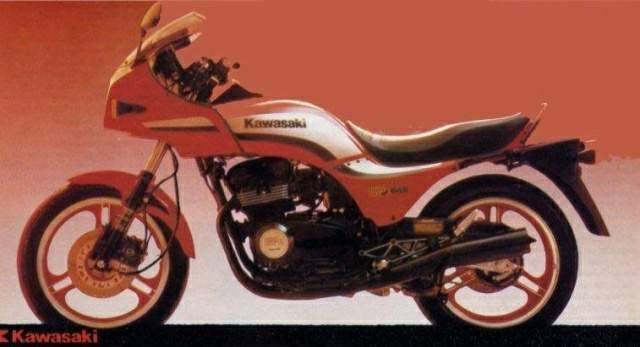
The logical progression was the true GPz550 of 1982 with Uni-Trak rear end. Wheelbase and rear wheel travel both went up, and the forks got air assistance and dual rate springs. They squeezed another 3bhp out of it with 28mm instead of 25mm inlet ports and Tekei carbs up to 26mm. Finish was better, and you can identify this one by the five-spoke wheels and black tail-light, it had the sidestand cut-out switch, and camchain problems were solved by fitting a Hy-Vo chain with Teflon-coated slippers. The final model came in 1984. This had the LCD unit set in the petrol tank, the three-spoke wheels and a frame-mounted fairing. Suspension was made easier to adjust and anti-dive went on the forks. By now they had got the hang of black chrome as well.
Faults and Quirks Despite their eventual fairly high state of tune the CPzs don't seem either fragile or thirsty. Pre-Hy-Vo chained models could lunch their camchains in only 10,000 miles, but the later versions would go on for much longer. You can forget the ignition except for an occasional lubing of the mechanical advance. The later models managed to get more performance and more economy by dint of the lean-bum engines, but these run very hot even with the oil-coolers, so make sure you change the oil often and keep it topped up since they hate running low.
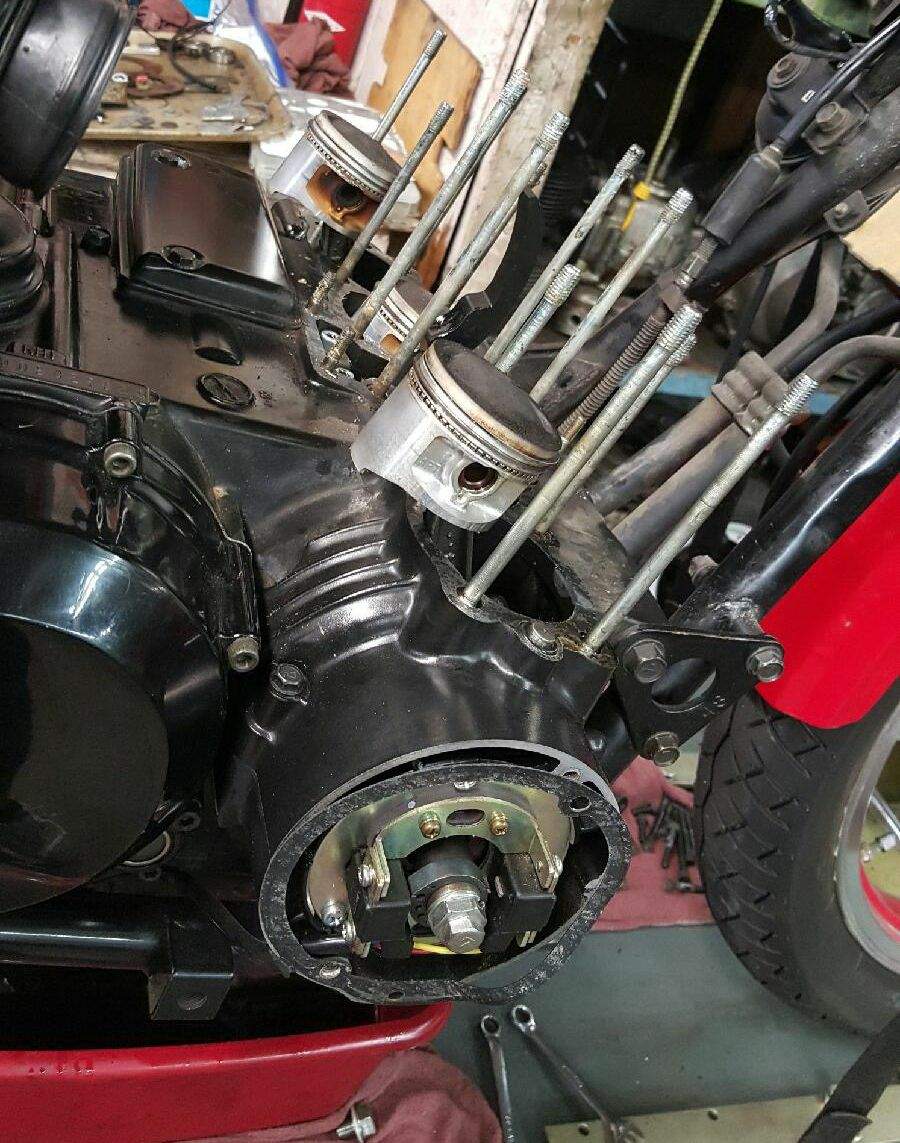
They normally start to smoke around the 35,000 mile mark, but can normally go on to 50,000 before you need a top-end overhaul, which is normally for worn valve guides and piston rings.
A major area to inspect is the Uni-Trak rising-rate linkages, if you are going for a later model. These have a highly stressed linkage arrangement and it needs frequent lubrication, stuck, as it is, down where grit and salt can attack it To check it stand at the back of the bike and lift it up and down. If it is worn you will hear a clunking when you change direction. The handling will be very rough and choppy. Note that there need not be any lateral movement as the swing arm pivot may be unaffected.
Subtle refinement has made this GPz the best in its four-year history. Is it enough to stave off the competition? It has always been a sore point with evolutionists that the roughest corn pone duffer can poke big holes in their theorizing with the simple observation that you can't get Gucci from a Nauga's backside, no matter how long you're willing to wait. Given plenty of time, a fin may sprout a toe and a toe a Florsheim, but the leap to a whole new system is beyond the capacity of random chance. Moving forward, according to Darwin, means moving in a series of discrete, progressive stages. Kawasaki understands. Since the sporting cousin of the KZ550 first appeared on the scene in 1981, the GPz has enjoyed remarkable staying power, fending off the onslaughts of other motorcycles through the continual upgrading of its solid basic design. Chassis components have been modernized and refined, and every season Kawasaki engineers wring a few more ergs from the 553cc two-valve engine with hot-rod trickery and time-tested tuner's legerdemain.
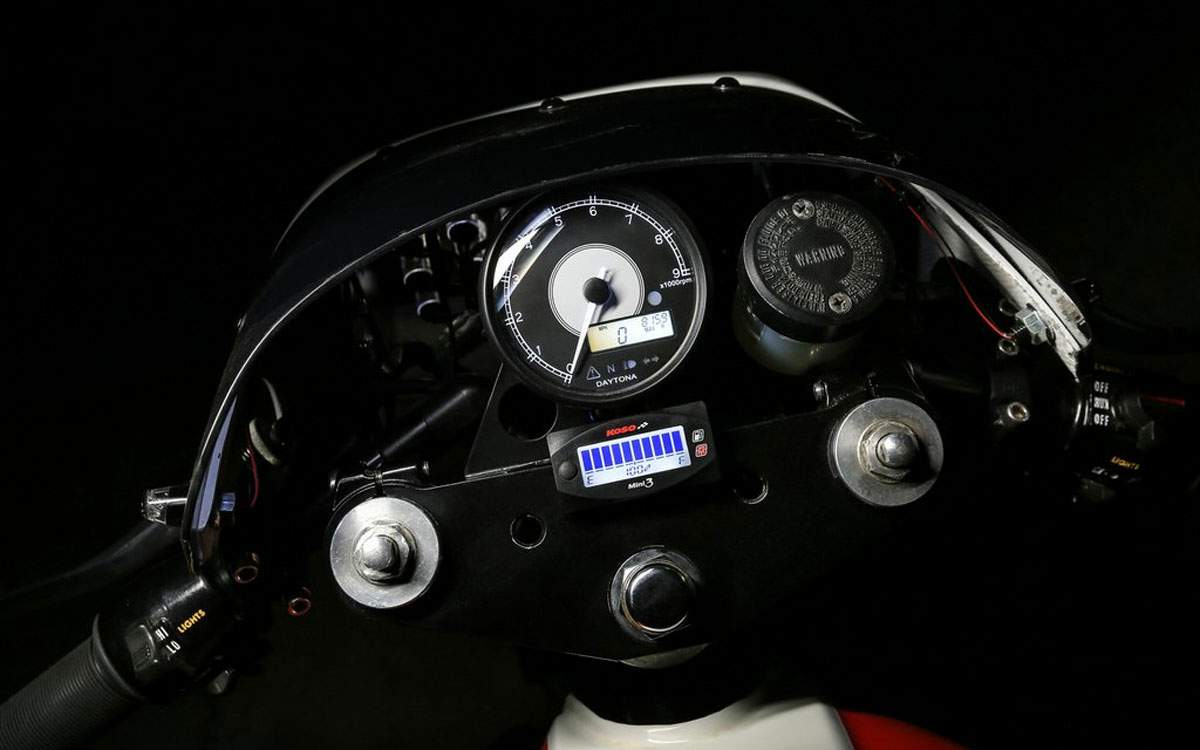
This year's 550 arrives at the middleweight skirmish dressed in Kawasaki's new-style "wraparound" bodywork, bringing it into fashion with the other ZX models in the GPz corps: the 1100, 750 and 750 Turbo. A plastic, frame-mounted quarter fairing supporting mirrors, turn signals and an inner liner replaces the bikini screen of past GPz550s, the tank is reshaped to mesh with the sculpted side panels, and the stepped seat has been thinned and narrowed to enhance the bike's aggressively sporting ergonomics. The new instrumentation includes a 150-mph speedometer with push-button reset odometer, smaller-diameter tach with integrated voltage meter, the standard cluster of idiot lights surrounding the ignition switch, and a pod on the fuel tank displaying fuel level and a number of warning indicators in two-color LCDs. The GPz's new layout offers both benefits and drawbacks. First the bad news: The short-stemmed mirrors are mounted too close to the bike's cen-terline to offer an unobstructed view of the road behind, and the small-sized tachometer is sometimes difficult to read, as are the warning lights in the tank pod, being situated below the rider's line of sight. Perhaps the worst aspect of the ZX styling is the bike's new seat. GPzs have never been renowned for their plush passage, but the '84 550's saddle is a real pelvis cleaver—thin, stiff and sufficiently narrow and convex that an hour's ride leaves you feeling like a dressage competitor stuck on a sway-backed burro. On the positive side, the rear-set footpegs and forward-mounted, narrow handlebars give the GPz more riding room for larger riders, and the frame-mounted fairing affords good wind protection for the upper body without compromising highspeed stability. Modest stoking in the engine bay has upped maximum output to a claimed 65 horsepower at 10,500 rpm, five horsepower and 1000 rpm up on last year's 550. Much of the increase comes from intake and exhaust cams with 10 degrees more duration, fed by constant-velocity TK carburetors, one millimeter larger this year at 27mm. The mechanical advance mechanism has been replaced by an all-electronic ignition system with five degrees more spark advance near redline. The GPz's added muscle appears when riding in its upper register, and the 550's mid-range is noticeably stronger as well. The new GPz, far from acting high-strung and temperamental, starts readily, warms up quickly and pulls cleanly and smoothly through the range with no discernible hiccups or flat spots in its power curve. Fuel economy also proved excellent for any middleweight, sport bike or no, the GPz turning in a 46.9-mpg average, dipping to 38 mpg on one redline-intensive canyon ride.Our GPz, a California-only model, arrived equipped with its mandated tangle of paraphernalia for trapping evaporative emissions: a collector bottle under the right side panel to gather condensed fuel droplets from the tank, plus a charcoal canister mounted in the tail section, all connected by yards of rubber hose coiling in and out around the chassis. Kawasaki representatives assure us that performance of the California model is on a par with that of the so-called 49-state bikes; however, West Coast GPz owners are advised that accidentally pinching the fuel fume hoses may damage the ventless gas tank when a full load of fuel presses against the tank under heat expansion. The greatest boon to the rider with touring on his mind is the GPz's incorporation of the ZX series' rubber-mounting system, which isolates the engine in a set of four elastic dampers to quell vibration. Last year's bike with a solid-mounted engine proved an-noyingly buzzy when ridden above 6000 rpm for anything longer than a sprint. Aboard the new 550, an irritating hum still buzzes through the bars at precisely 60 miles an hour in sixth gear, but this must be attributed to a maverick harmonic; at virtually every other speed and rpm, the rubber-cradled GPz is remarkably smooth and vibration-free. While styling and engine alterations are the most obvious changes to the '84 GPz, much of the new model's face-lift is centered in its chassis. Here changes abound, though it takes a keen eye to ferret them out. In an effort to keep pace with the new breed of sporting middleweights with 16-inch front wheels, Kawasaki has quickened up the GPz's steering geometry. The switch from a leading-axle fork to center-axle legs steepens rake by 1.5 degrees and shortens trail by more than half an inch. Stiffer spring rates give a tauter ride, and new-style 18-inch wheels fitted fore and aft replace last year's 19-inch front and 18-inch rear spinners. Though the new GPz still loses ground through tight transition turns to Suzuki's hyper-fast GS550 and the new Honda 500 Interceptor, its newfound agility, excellent ground clearance and high-spee ahead of last year's GPz in overall sporting prowess. The new fork also carries anti-dive units adjusted by cranking a knurled knob at the bottom of the fork leg. Activated by increased hydraulic pressure when the brakes are applied, the hardware added little to fast-riding control. Unlike many other hydraulic systems, however, the units do not compromise braking action by creating a spongy sensation at the lever. Stopping action is linear and progressive front and rear on the GPz, though the Kawasaki's dual front discs cannot match the power and controllability of the dual-piston calipers mounted on the Suzuki or the Honda 500 Interceptor. Like the other ZX models in the GPz line, the 550's Uni-Trak rear suspension system's gas-charged Kayaba damper is now carried in forged aluminum arms, and the shock bolts directly to the frame at its upper end, allowing the rocker arm and linkage to be positioned beneath the extruded, box-section aluminum swing arm for a lower center of gravity. Wheel travel is somewhat reduced by this system, spring rates are up, but the suppleness and load-handling range of the GPz's new rear end give it compliance and stability to match that of the latest ad weaponry. Damping rates are se-jcted by turning a wheel at the base of the shock body, and preload changes are eased by the use of a remote hydraulic adjuster mounted just under the left side panel. If you're getting the impression the new GPz is in every fundamental way " better motorcycle than its predecessors, you're right. Deft and careful ands have corrected this bike's ortcomings while preserving the strengths that have fostered a cult of GPz fanatics, and the precepts of function have been followed at every turn. For years, riding a GPz was as close as you could get to owning a piece of the sport-bike rock. The 550 ruled as uncontested king of the middleweight jungle, winning its spurs in canyon battle, often against larger foe. Now the GPz's toughest challenge comes from its rivals in the middleweight camp; the GS550 is quicker, the FJ600 stronger, the 500 Interceptor more advanced. Designs have inherent limitations, and refinement risks annihilation in a period of exploding change. Ultimately, the only law the sport-bike community observes is survival of the fittest, and the fittest is the fastest in a world the GPz550 did much to create. Source Cycle 1984
|
|
|
Any corrections or more information on these motorcycles will be kindly appreciated. |