|
|

|
|
|
|
Classic Bikes
Custom Bikes
Individual
Racing Bikes AJP
AJS
Aprilia
Ariel
Avinton / Wakan
Bajaj
Benelli
Beta
Bimota
BMW
Brough Superior
BRP Cam-Am
BSA
Buell / EBR
Bultaco
Cagiva
Campagna
CCM
CF Moto
Combat Motors
Derbi
Deus
Ducati
Excelsior
GASGAS
Ghezzi Brian
Gilera
GIMA
Harley Davidson
Hero
Highland
Honda
Horex
Husaberg
Husqvarna
Hyosung
Indian
Jawa
Kawasaki
KTM
KYMCO
Laverda
Lazareth
Magni
Maico
Mash
Matchless
Mondial
Moto Guzzi
Moto Morini
MV Agusta
MZ / MuZ
NCR
Norton
NSU
Paton
Peugeot
Piaggio
Revival Cycles
Roland Sands
Royal Enfield
Sachs
Sherco
Sunbeam
Suzuki
SWM
SYM
Triumph
TVS
Ural
Velocette
Vespa
Victory
Vincent
VOR
Voxan
Vyrus
Walt Siegl
Walz
Wrenchmonkees
Wunderlich
XTR / Radical
Yamaha
Zero
Video
Technical
Complete Manufacturer List
|
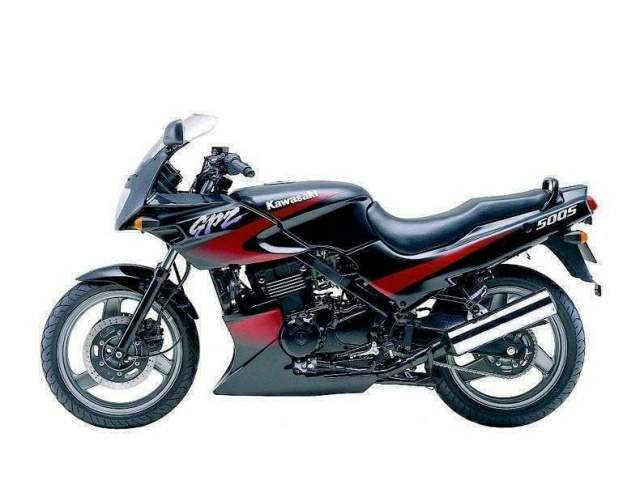
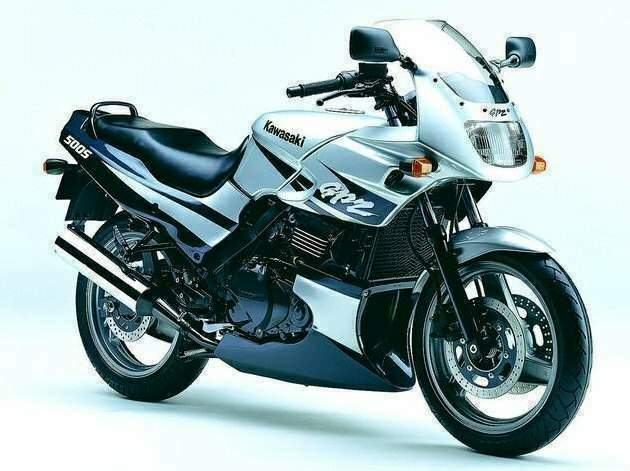
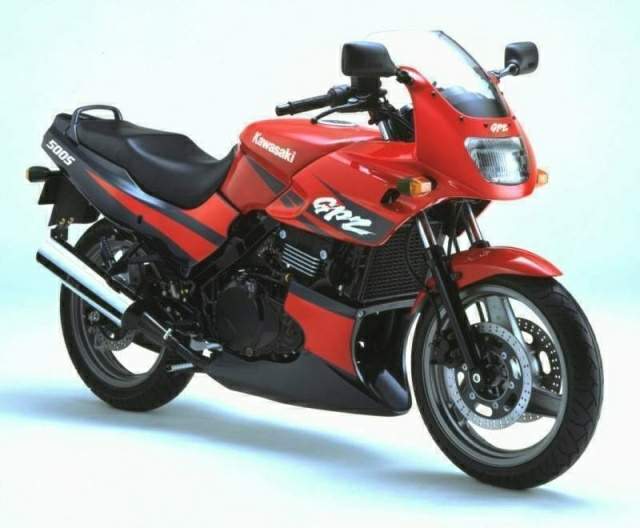
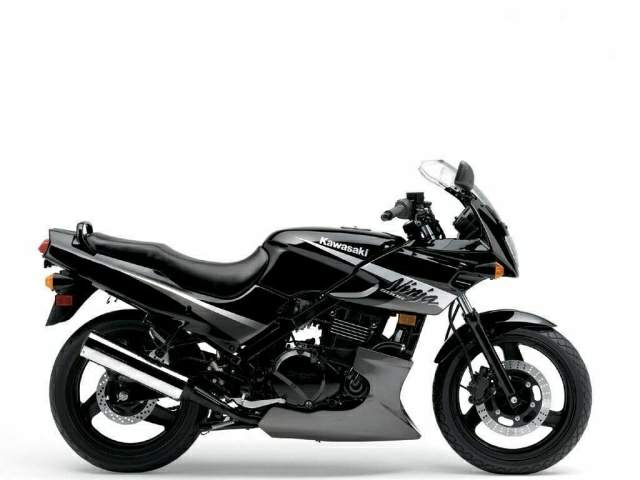
Kawasaki GPz 500S / EX 500R Ninja
First launched in 1987, the GPZ500S was Kawasaki's attempt at a modern, lightweight sportsbike. Its parallel twin engine owes much to the GPZ900R of 1984: in many ways, it resembles half a GPZ900R engine. The chassis is dated, but is still capable of being hussled down a fast back road or round a track. The suspension is too soft to offer truly sporting performance, but the brakes work well if kept in good order, and the relaxed steering geometry means predictable handling. In 1994, the GPZ500 received a facelift. New bodywork gave a more up-to-date appearance, while 43cm (17in) wheels allowed modern rubber to be fitted. Wider 37mm (1.5in) front forks stiffened the chassis.
Torrance, California, August 18, 2000 -- It's a natural human response, really. Like Keeping up with the Jones' we always want something just a little bit bigger, a little bit louder and, where motorcycles are concerned, something a little faster. Sure, it's a good idea to start out on a Kawasaki EX250, a Honda Rebel 250 or something similar. But what was once a thrilling mode of transportation can eventually become nothing more than a tool as a rider becomes more proficient and the machine (not the rider's skill level) becomes the limiting factor. Then it becomes time to step up to something a little larger that will allow you to pursue the outer edges of your personal talent envelope with help from a comfortable, confidence-inspiring motorcycle. The new GSX-R750? Well, it sure looks the part. No need to jump the gun, though, and step right into the fire. After all, you're trying to grow your skill level and not your medical bills, right? As capable and sexy as a race replica is, it's still way too much bike for most people. Don't rush, take your time. Even working up incrementally in engine size can substantially increase the usability and fun of a machine. On PaperKawasaki's EX500 Ninja fits the bill nicely, for example. Introduced in 1987 as the EX500-A1, the machine started attracting not only beginning riders, but also people who wanted a low-maintenance, high fun bike. Since this particular piece of Kawasaki machinery is not exactly on the cutting edge of technology (they smartly favored a well-proved design) it's last update of significant note was in 1994, when the bike became known as the EX500-D1. in that iteration, the bike received a rear disc, a new fairing, better OE tires as well as new instrumentation, grips and a host of other little changes that made Kawasaki's versatile EX and even better bike. The almost littlest Ninja gets its propulsion by way of an eight valve (four valves per cylinder), liquid-cooled 498cc parallel twin that features 74.0 x 58.0 mm bore and stroke figures. The motor ingests its fuel/air mixture through a pair of 34mm CVK (Constant Velocity Keihin) semi-flat slide carburetors before that mixture gets ignited by a digital ignition which is microprocessor controlled. Power makes its way to the rear six-speed unit that features something that all new riders love: Kawasaki's exclusive "positive Neutral Finder." With this as part of the transmission, any time you're at a standstill in first gear and wish to click into neutral, just lift the gearshift lever and you'll be where you want to be every time. "The frame is a double-cradle steel box section type which is designed for light weight without sacrificing rigidity." The frame is a double-cradle steel box section type which is designed for light weight without sacrificing rigidity should a rider try his or her hand at playing Eric Bostrom for a few corners. At the front of the bike are 37mm conventional forks that provide 5.1 inches of travel and work in unison with a Uni-Trak® rear suspension whose objective is to keep a low center of gravity and provide a plush, progressive ride throughout its 3.9 inches of travel. The 500 stops by way of a single disk mounted at either end. The chassis has 27 degrees of rake and features 3.6 inches of trail while the wheelbase is 56.5 inches while the overall length of the bike is 82.5 inches. The bike is relatively small thanks to its 27.6 inch overall width and 30.5 inch seat height, and checks in at a claimed dry weight of 388 pounds. The brakes are single disks at both the front and rear, attached to 17 inch rims that carry a 110/70-17 front and 130/70-17 rear tire, respectively. The fuel tank holds 4.8 gallons and the bike is available in the blue you see in the photos as well as a Metallic Violet hue, both for $5,099 US Dollars. On RoadKawasaki's EX500 may not be an all-out sportbike in the race-replica sense, but for someone who desires decent performance with a low seat height and rider-friendly ergonomics, it's one of the best choices out there. You'll find no peaky powerbands here, and no bent-over-with-your-head-on-the-triple-clamp seating position. True, you won't find the kind of power that allows you to do huge roll-on wheelies in second gear, but you will find ample power to overtake slower vehicles and make any ride enjoyable. Again, if some is good, more is better, right? Despite the bike's rather aggressive (for a small bike, anyway) stance, the seating position is surprisingly upright and had our testers commenting how they were used to being leaned over further even on bikes that didn't offer as much in the way of performance. Aside from Minime (all 185 pounds packed into a frame just over six feet tall) who's only complaint was the the footpegs were positioned a bit high, every tester felt comfortable with the ergonomic package Kawasaki has put together. Even our smallest tester (Sugi Wong who checks in at just a half inch over five feet tall) was able to reach all controls comfortably, no doubt aided by adjustable clutch and front brake levers. The motor on this bike worried some of our less experienced riders who thought that doubling the displacement meant double the chance for GP-style high-sides. Luckily the EX500 has such a docile personality that the motor never does anything to surprise you. But if you ever feel like you want some excitement, go ahead and rev it out. It'll get along just fine, thanks. There were no annoying flat spots in the carburetion or anything that was cause for concern. The only "negative" comment about the motor was from a rider who usually pilots an NSR250 (a grey market two-stroke). She was not used to the slightly thicker vibes coming from the cylinders on the blue Kawi she sat atop. That was to be expected, though, as the pistons on the NSR are little vibrating bottle tops next to the larger items thrashing about below her on the EX. Suspension action on the EX is a good compromise between soft and firm that should appease most anybody who rides the bike as it was intended. The front forks dive a bit excessively under hard braking, but unless you frequently try to outbrake your riding companions, this shouldn't become an issue. The brakes on our bike worked well, doing a fine bit of balancing on the line between mucho stopping power and feel without becoming so sensitive that a junior rider may inadvertently lock the front wheel in slow going. The layout of the dash was clear, with the only thing missing being a low-fuel warning light. A lot of beginners will buy this bike and, as if they don't have enough to worry about on the freeways already, imagine pushing along in one of the faster lanes when your bike starts sputtering and, in the middle of your fears, you have to remember to reach down and turn your petcock to "reserve" before you get run over by the delivery man who has just taken up residence only three inches aft of your license plate. Sure, the bike has two trip meters, but couldn't there be a low-fuel warning light, too? Oh, and throw in a clock while you're at it, OK? Every thing from parking-lot speed maneuvering to blasting up a sun drenched canyon road on a weekend morning, this 500 Ninja did a wonderful job of keeping the riders in touch with what was going on around them. For an all-around bike that will not drain your energy reserves like wrestling around a much bigger bike can -- or drain your wallet, for that matter -- Kawasaki's EX500 Ninja seems a remarkably easy decision to make if you are in the market for a fun, light, do-it-all bike. Maybe bigger is better?
Commuting on the bike? You can do it, but the seat sloped me forward into the tank and made some parts tender. Canyon riding? It was more fun than I thought it would be, especially after becoming so jaded riding the latest and greatest hyper-bikes from all over. "Really," I thought, "what sort of enjoyment could I possibly derive from an EX500?" As it turns out, quit a bit. Not sharp-focused (this is a good thing) nor dull (this is even better). Not so much as a beginner's bike, but more as a bike for people who have a hard timer handling big bikes, this EX500 is a great bike that is definitely worth taking a long, hard look at. Calvin Kim, Associate Editor: No big deal, throw a few bucks into the suspension, and a few more for a jet-kit and exhaust and you'll have a capable bike for all occasions. Be it touring, commuting or more sporty endeavors, the EX500 can deliver. Its cheap too! Sugi Wong, Mini Tester: I was surprised at the rest of the bike's ergonomics. It felt like I was riding around on an easy chair! When everyone else IS Falling off their bikes complaining of "dead butt", I'm sure I'd still be bopping around happy as a pig in the mud. It was very easy to control and responded surprisingly well. The upright position took a little getting used to though... isn't even the EX250 a little racier? My little brother just bought this bike (it's his first) and after riding it I feel a lot better knowing he'll be less apt to get into trouble. Source by Dirck Edge
|
|
|
Any corrections or more information on these motorcycles will be kindly appreciated. |