|
|

|
|
|
|
Classic Bikes
Custom Bikes
Individual
Racing Bikes AJP
AJS
Aprilia
Ariel
Avinton / Wakan
Bajaj
Benelli
Beta
Bimota
BMW
Brough Superior
BRP Cam-Am
BSA
Buell / EBR
Bultaco
Cagiva
Campagna
CCM
CF Moto
Combat Motors
Derbi
Deus
Ducati
Excelsior
GASGAS
Ghezzi Brian
Gilera
GIMA
Harley Davidson
Hero
Highland
Honda
Horex
Husaberg
Husqvarna
Hyosung
Indian
Jawa
Kawasaki
KTM
KYMCO
Laverda
Lazareth
Magni
Maico
Mash
Matchless
Mondial
Moto Guzzi
Moto Morini
MV Agusta
MZ / MuZ
NCR
Norton
NSU
Paton
Peugeot
Piaggio
Revival Cycles
Roland Sands
Royal Enfield
Sachs
Sherco
Sunbeam
Suzuki
SWM
SYM
Triumph
TVS
Ural
Velocette
Vespa
Victory
Vincent
VOR
Voxan
Vyrus
Walt Siegl
Walz
Wrenchmonkees
Wunderlich
XTR / Radical
Yamaha
Zero
Video
Technical
Complete Manufacturer List
|
Kawasaki GPz 1000RX
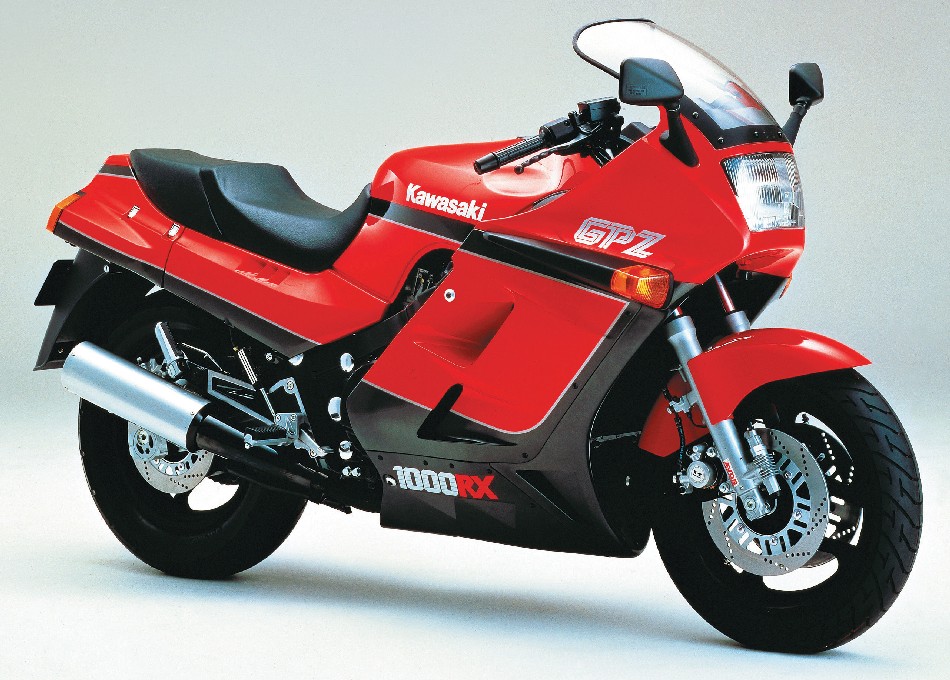
At its heart is a bored and stroked version of their award-winning GPz900R engine, a liquid-cooled, DOHC, 16 valve, transverse four, as technologically advanced and sophisticated as any lump around. Having decided on one last mega-bike, a horsepower-packed speedball, their engine designers looked at all the possible types of engine configuration from V4s and V6s to straight sixes; they concluded, nevertheless, that their tried and trusted inline four was still the best, and one that Kawasaki have stuck with since the heady, halcyon days of the 1970s and the Z1.
The 1000R has more power everywhere than the 900 but also more bulk and weight. The engine has been rubber mounted because of increased vibration but otherwise it follows the same careful and compact pattern - wet liners, a cam chain repositioned at the side of the engine with the alternator above the gearbox. Features unique to the 1000R dazzling engine specification include flat aluminium pistons, a unique cool air induction system and hand-polished intake ports. Surprisingly, it is not at all peaky. Power is available with a beautifully smooth surge from 3,000rpm and above 6,000rpm there is plain, no nonsense stomp all the way to the 10,500rpm redline. Response is lively, strong and clean. This is not an engine for the fainthearted. Unlike the 900 which has a steel diamond frame using the engine as a stressed member, the 1000R gets an all new perimeter-type frame with square-section top rails curving wide around the engine to meet in a massively braced and extremely rigid steering head. Kawasaki claim the rear aluminium swing-arm is the strongest they have ever produced. There is state of the art suspension; Uni-Trak at the back with all the linkages placed below the single shock to keep the weight low.
The 40mm braced forks with AVDS (automatic variable damping system) vary the compression damping according to changes in both the speed and distance of wheel travel. Wheels are 16in front and back, with low-profile tyres, the rear being a notable, drag strip like, 150/80 section. Handling and roadholding are more than respectable for the weight and sheer size of the bike. Although it is undeniably more powerful and faster than its illustrious predecessor, the 900R, motorcycle enthusiasts around the world have also found it more cumbersome and unstable. The 900R is quicker through most bends and around a race-track because it is more manageable. Hence popular opinion has deemed the 1000R to be for professional use only and to rate the 900 as both a better all-rounder and a specifically better sports bike. One has even so to admit the 1000R impressive specification and totally irresistible performance. It's just that maybe, after all, you can have too much of a good thing.
At its heart is a bored and stroked version of their award-winning GPz900R engine, a liquid-cooled, DOHC, 16 valve, transverse four, as technologically advanced and sophisticated as any lump around. Having decided on one last mega-bike, a horsepower-packed speedball, their engine designers looked at all the possible types of engine configuration from V4s and V6s to straight sixes; they concluded, nevertheless, that their tried and trusted inline four was still the best, and one that Kawasaki have stuck with since the heady, halcyon days of the 1970s and the Z1.
The 1000R has more power everywhere than the 900 but also more bulk and weight. The engine has been rubber mounted because of increased vibration but otherwise it follows the same careful and compact pattern - wet liners, a cam chain repositioned at the side of the engine with the alternator above the gearbox. Features unique to the 1000R dazzling engine specification include flat aluminium pistons, a unique cool air induction system and hand-polished intake ports. Surprisingly, it is not at all peaky. Power is available with a beautifully smooth surge from 3,000rpm and above 6,000rpm there is plain, no nonsense stomp all the way to the 10,500rpm redline. Response is lively, strong and clean. This is not an engine for the fainthearted. Unlike the 900 which has a steel diamond frame using the engine as a stressed member, the 1000R gets an all new perimeter-type frame with square-section top rails curving wide around the engine to meet in a massively braced and extremely rigid steering head. Kawasaki claim the rear aluminium swing-arm is the strongest they have ever produced. There is state of the art suspension; Uni-Trak at the back with all the linkages placed below the single shock to keep the weight low.
The 40mm braced forks with AVDS (automatic variable damping system) vary the compression damping according to changes in both the speed and distance of wheel travel. Wheels are 16in front and back, with low-profile tyres, the rear being a notable, drag strip like, 150/80 section. Handling and roadholding are more than respectable for the weight and sheer size of the bike. Although it is undeniably more powerful and faster than its illustrious predecessor, the 900R, motorcycle enthusiasts around the world have also found it more cumbersome and unstable. The 900R is quicker through most bends and around a race-track because it is more manageable. Hence popular opinion has deemed the 1000R to be for professional use only and to rate the 900 as both a better all-rounder and a specifically better sports bike. One has even so to admit the 1000R impressive specification and totally irresistible performance. It's just that maybe, after all, you can have too much of a good thing.
|
|
|
Any corrections or more information on these motorcycles will be kindly appreciated. |