Liquid cooled, four stroke, parallel twin
cylinder, DOHC, 4 valves per cylinder.
Capacity
498
Bore x Stroke
74 х 58 mm
Compression Ratio
10.2:1
Induction
2x 32mm Keihin carbs
Ignition /
Starting
- / electric
Max Power
50 hp @ 8500 rpm
Max Torque
4.8 kg-m @ 7300 rpm
Transmission /
Drive
6 Speed / chain
Front Suspension
36mm Telescopic forks
Rear Suspension
Dual shocks preload adjustable,
Front Brakes
Single 300mm disc
Rear Brakes
180mm drum
Front Tyre
100/90-19
Rear Tyre
140/90-15
Dry-Weight
187 kg
Fuel Capacity
15 Litres
Braking 60 - 0 / 100 - 0
13.6 m / 36.9 m
Standing
¼ Mile
14.8 sec / 137.7 km/h
Top Speed
160.8 km/h
A sporty engine in a cruiser? Not logical
Captain. But is it fun? John Mitchell goes Star Trekkin’ across the universe
(well Gloucestershire anyway – and enough of the awful Vulcan jokes…)
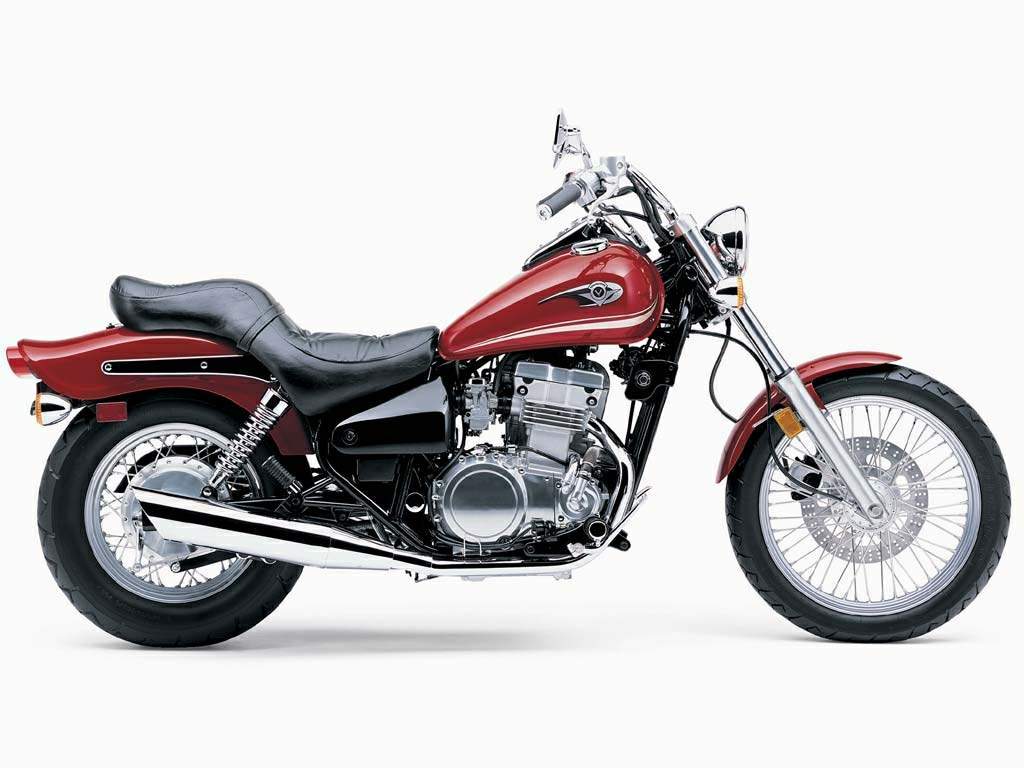
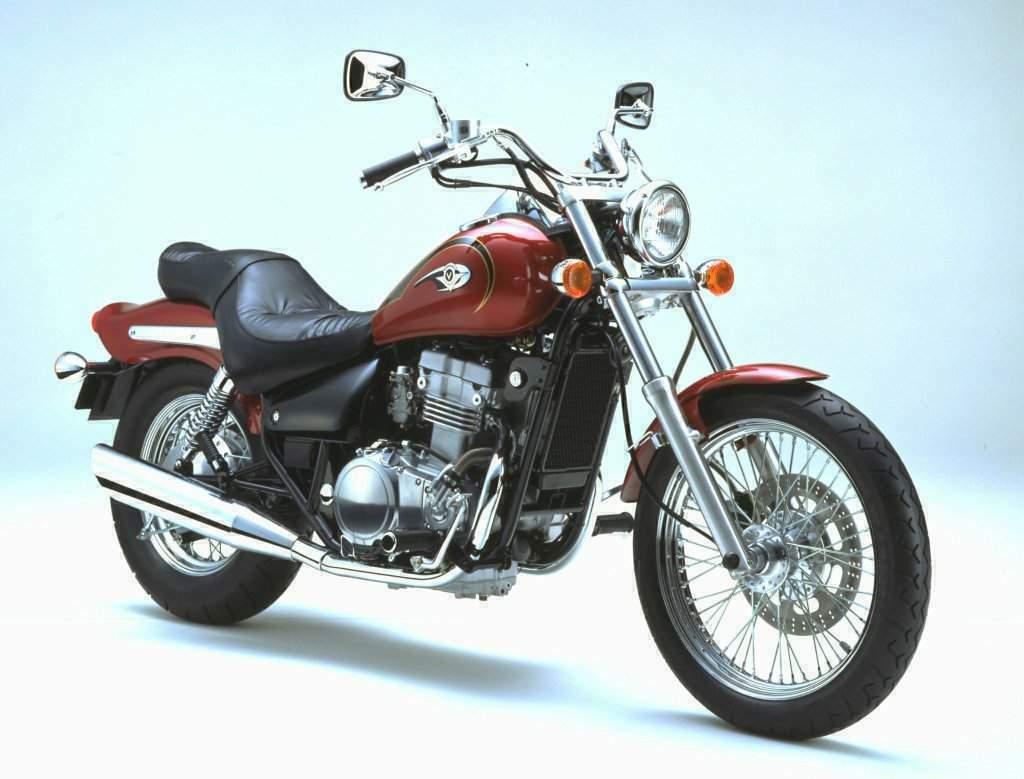
The Kawasaki EN500 Vulcan (US import) is basically an EN500 wearing a Vulcan
badge, as that’s what the Yanks call it over there. The bike was a 1994
(imported to the UK in 1996) with 16k on the clock and an asking price of
£1300
It looks long and lean, with a real “American” feel about it. The EN uses the
same water -cooled motor as the proven GPZ500S, so it can’t be bad.
The bike was pretty much immaculate, apart from a little corrosion around the
engine where road salt had penetrated the engine lacquer. The only thing that
worried me was that there was oil dripping out of a pipe underneath the
engine, this turned out to be coming from an over-lubricated air filter
sponge. The Kawasaki had just had the front discs replaced, and the drive belt
adjusted, which was nice.
I
put the key in the ignition, which was situated just behind the radiator, and
the lights came on, and the indicators glowed at me, this puzzled me for a
moment. “It’s OK, that’s normal” the seller said (Editorial Note: this is down
to it being a US import – Stateside regulations require this), so I fired her
up, off I rode with the back wheel just leaving the car park as I reached the
first roundabout. The bike felt quite nimble but I seemed to be going straight
over the roundabout, as opposed to round it. The bike briskly reached the
speed limit, and before I knew it, I was approaching another roundabout and
was struggling to find the brakes and gears that were somewhere near the front
of the bike.
The motor was quite smooth, thanks to the balancer shafts, which I am told is
the reason why the tickover is a bit lumpy, but I think it gives the bike a
bit more character. I quite liked the feet forward riding position, but the
bars were adjusted too low, I am just over 6ft tall, but most of the length is
in my back. With my feet foreword and my arms pointing down I felt like “The
Karate Kid” practising the final contest winning blow.
The handling is strange at first but after a few miles I was leaning further
and further over. The rear drum brake took a bit of getting used too as well,
it just didn’t seem to be working well at all, but by the end of the journey I
was starting to make allowances in braking distances to compensate there poor
performance. Apart from the bars being too low the riding position is really
comfortable, the plush and supportive seat helping a lot.
Adjusting the belt-drive is an interesting experience. The Vulcan does not
come with a centre-stand. The hand book says to put a 10lb weight on the seat,
then adjust the belt accordingly!
To improve rider comfort when upping the pace, I had a Highway Hawk screen
fitted by Tredworth Motorcycles, which worked a treat and kept me safe from
the worst the weather could throw at me.
After six months ownership, only had a few minor quibbles; the lack of a rev
counter being one them, with the bike having 6 gears it took a bit of getting
used to. The gearbox itself is another gripe it is a bit clunky, especially
when it’s cold, but as most cruisers come with a shaft drive, you would have
the same problem.
The Vulcan is a nice bike to ride, it is economical, returning around
70mpg in cruise mode, and a bit less on motorways. The bike has a wide and
comfortable seat, for both the rider and pillion. I have only managed to cover
70 miles, but I think I could go further, at least to the tank range, which is
about 120 miles.
The Vulcan’s motor is quite flexible. Its no ball breaking V-Monster, but then
again, it’s easy to drag out of the garage unlike some of the big cruisers I
could mention. But don’t forget it is powered by the same lump as the GPZ500S
(albeit in slightly detuned state), so you can still have lots of fun at the
‘Traffic Light Grand-Prix’.
Because of its weight, or rather the lack of it, the EN500 handles well, but
best not to push the bike too far on uneven roads as the long forks and wheel
base will not like it one bit. You might as well spend your money on one of
those rides that are always sat outside the supermarkets; the experience will
be the same. I think the handling would be improved by fitting a new front
tyre, as it’s worn in an odd shape. This is due to the steering geometry of
custom bikes, which can make the front end feel a bit light, and the Vulcan
loves skipping over road markings, especially on cold tyres.
All in all I was pleased with the Vulcan/EN500, its economical, cheap to
insure and tax, being a relatively small capacity engine. With the increased
interest in road speed, owning a cruiser makes perfect (and licence
protecting) sense.
Surce bobpickett.co.uk
NOTE: Some of the photos on
Motorcycle Specs are owned by somebody. If you see any of your
photos, you can let me know so that I can acknowledge it, or if
you object to it, I can remove it altogether. If any copyright
holder objects to their articles being placed on Motorcycle
Specs, it will be removed upon request. Any correction or more
info on these bikes will kindly beappreciated
Contact MePrivacy
Policy
Website Stats