|
|
|
|
Classic Bikes
Custom Bikes
Individual
Racing Bikes AJP
AJS
Aprilia
Ariel
Avinton / Wakan
Bajaj
Benelli
Beta
Bimota
BMW
Brough Superior
BRP Cam-Am
BSA
Buell / EBR
Bultaco
Cagiva
Campagna
CCM
CF Moto
Combat Motors
Derbi
Deus
Ducati
Excelsior
GASGAS
Ghezzi Brian
Gilera
GIMA
Harley Davidson
Hero
Highland
Honda
Horex
Husaberg
Husqvarna
Hyosung
Indian
Jawa
Kawasaki
KTM
KYMCO
Laverda
Lazareth
Magni
Maico
Mash
Matchless
Mondial
Moto Guzzi
Moto Morini
MV Agusta
MZ / MuZ
NCR
Norton
NSU
Paton
Peugeot
Piaggio
Revival Cycles
Roland Sands
Royal Enfield
Sachs
Sherco
Sunbeam
Suzuki
SWM
SYM
Triumph
TVS
Ural
Velocette
Vespa
Victory
Vincent
VOR
Voxan
Vyrus
Walt Siegl
Walz
Wrenchmonkees
Wunderlich
XTR / Radical
Yamaha
Zero
Video
Technical
Complete Manufacturer List
|
Kawasaki Z 750N Spectre
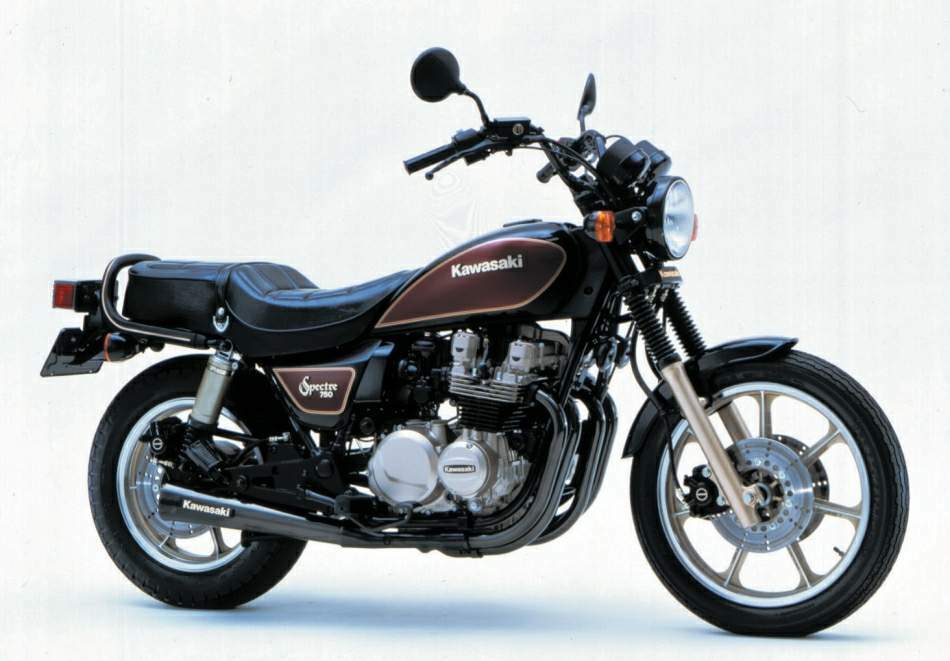
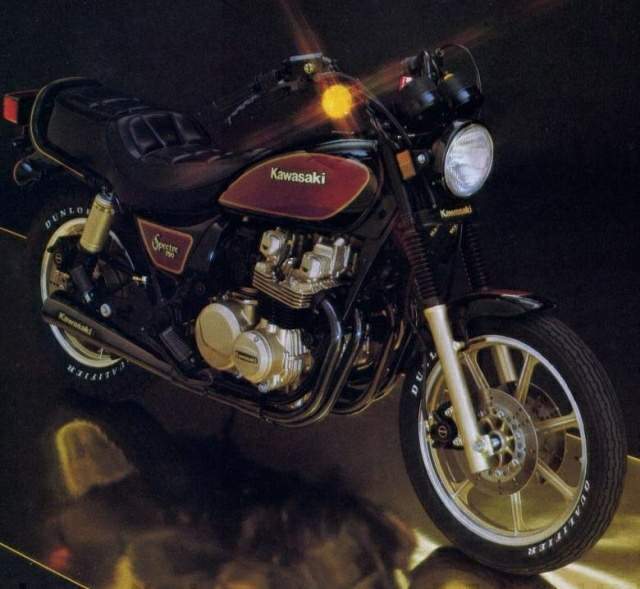
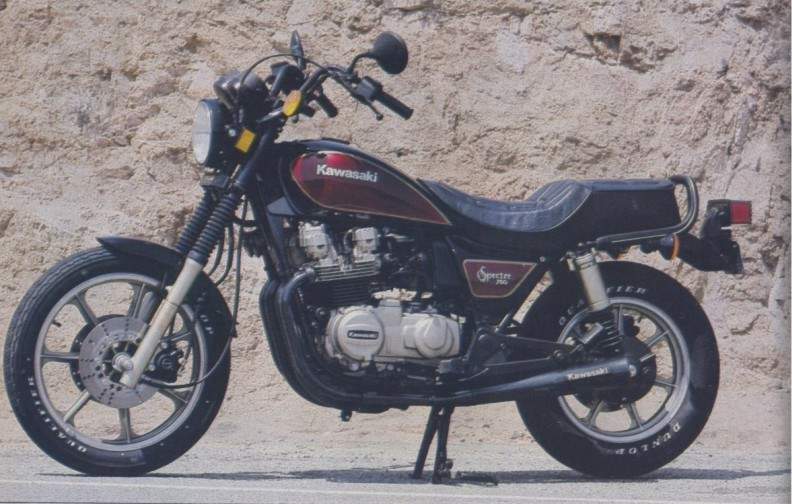
Motorcycles are fun and part of the fun is the way they look. Presently looks come in three variations; standard, which is the median, normal bars-seat-tank-pegs; sports, with low bars, semi-rearseat pegs and something resembling racer profile; and cruiser, with high pull-back bars, stepped seat, small tank and fat rear tire. These schools of design imply certain ideas, for instance that the cruiser buyer isn't concerned with performance, the touring man never sneaks a glance at his reflection in the store window, etc. Kawasaki knows better, and as proof they've come out with the Spectre; cruiser looks, some high performance features as seen on sports bikes, and features like shaft drive, air-adjustable suspension and rubber engine mounts like those on the better touring machines. The Spectre is the latest in a family of Kawasaki 750s that began with the standard KZ750, grew with the fat-tired, high-riser 750 LTD, and got faster with the super sports GPz750. Chrome is conspicuously absent. The gas tank, side covers and fenders are black with deep maroon panels outlined in gold. The carburetors, airbox, cylinders, headlight shell, mirrors, control pods, levers and footpeg supports are painted black. The exhaust pipes and handlebars are black chrome. The fork stanchion tubes and rear shock shafts are hidden by black rubber covers. The wheels, fork sliders, shock covers, engine cases and cylinder head, even the metal strip in the middle of the passenger grab bar, are painted gold. Sides of the wheel rims are natural aluminum and the brake discs are the silver of stainless steel but everything else seems to be black or gold. The seat is stepped, the bars rise up and swoop back, the pegs are forward and the taillight perches on a bobbed rear fender. The leading axle forks look longer than they are and in combination with the fat 16-in. rear tire the style is semi-chopper. There's no mistaking the Spectre for a standard KZ750. The differences result from, and go beyond, the styling. The leading axle forks lengthen the wheelbase, from the KZ's 57.25 in. to 58.4. The Spectre's front tire is a 110/90-19, the equivalent of a 3.50, while the KZ comes with a 3.25-19. The rear tire is a 130/90-16, equal to a 5.10 in width and section height, while the KZ's rear tire is a 4.00-18. The Spectre's front tire is thus taller and the rear tire is shorter. The engineers took the opportunity of giving the Spectre tapered roller bearings for the steering head and swing arm pivot while the KZ gets by with ball bearings, but otherwise the two frames are alike. But, because of the tire heights, the Spectre has 28.5° of rake and 4.33 in. of trail, vs the KZ's 27° and 4.25 in. The suspension is changed, too. The air forks are connected through a pipe running from one side of the top triple clamp to the other, so pressure is added at one fitting, not two. The rear shocks are air adjustable through a single fitting located underneath the flip-up, locking seat, and shock rebound damping has four settings. The Spectre has more rear wheel travel, too, 3.9 in. vs. the standard's 3.75 in. Front wheel travel stays at 6.3 in. The brakes are the same all around, dual discs up front and a single disc in the rear. The differences in wheels, tires, tank capacities, etc., make charting the weights of the three Kawasaki 750s fairly complex. Weighing each machine with half a tank of fuel shows the KZ and its 4 6 gal. capacity at 491 lb. The Spectre carrying half its 3.9 gal. weighs 506 lb. The GPz750 has a 5.7-gal. tank and its test weight is also 506 lb., same as the Spectre except that part of the GP's weight is fuel and part of the Spectre's is shaft drive. The drive conversion for the 750 Four is straightforward. The shaft is driven off the engine countershaft by bevel gears located in an adaptor unit bolted to the cases. There's a set of universal joints between the bevel gears and the main section of the driveshaft, and a ring and pinion gearset at the rear wheel. There are two pairs of gears involved in getting power from the engine countershaft to the rear wheel (one set at each end of the shaft) instead of the two sprockets used on the standard KZ750, and the final reduction ratio is slightly higher for the Spectre. But the Spectre's 16-in. rear tire, while wider than the standard's 18-in. tire, is also smaller in diameter, the result being that the Spectre turns just over 4600 rpm at 60 mph, compared with the KZ's 4480 and the GPz750's 4430 rpm.
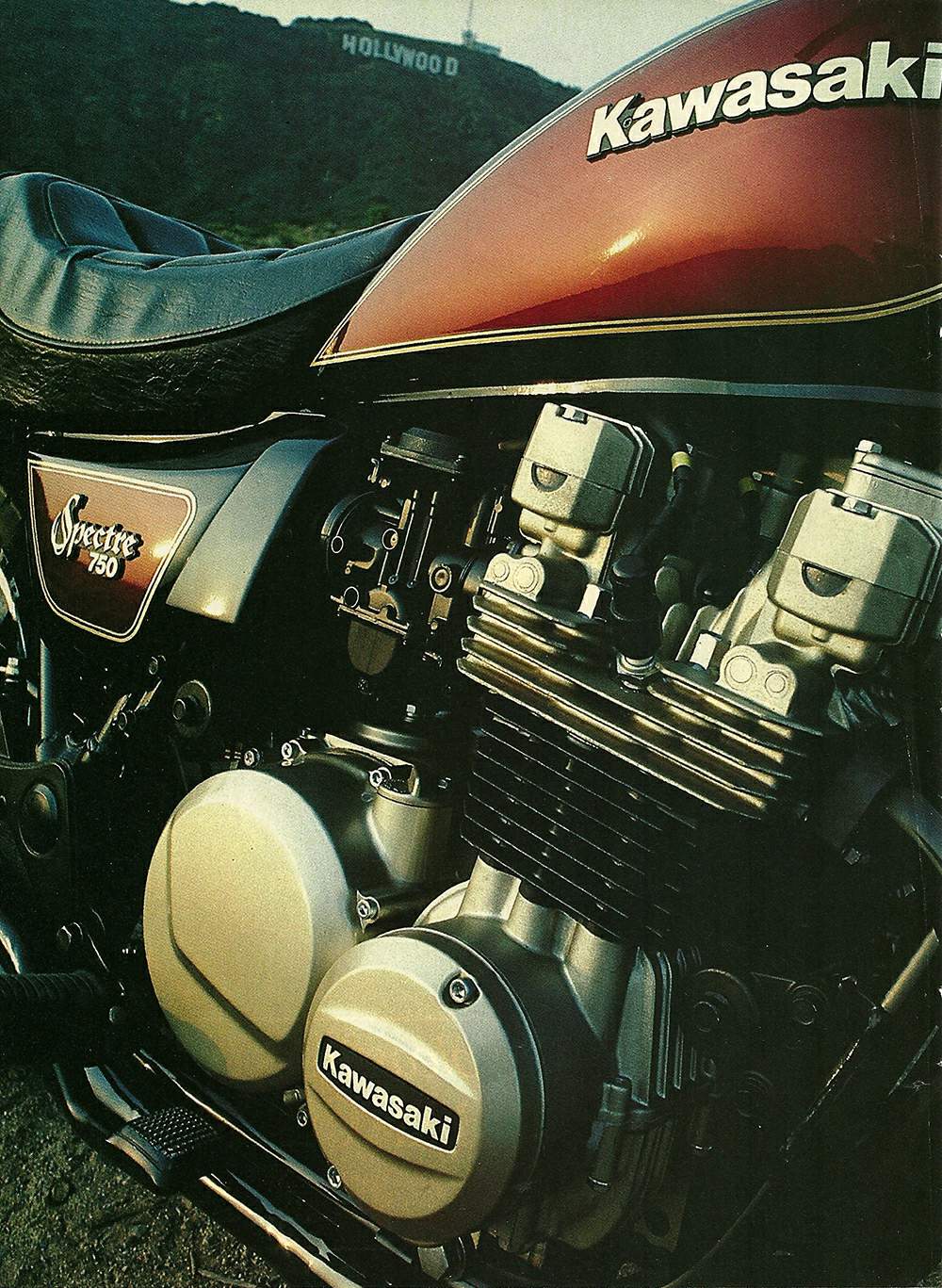
Internal transmission and primary reduction ratios are the same for all three Kawasaki 750 models, as are the basic engine specifications. It is a dohc Four with two valves per cylinder and bore and stroke of 66 x 54mm. Displacement is 738cc and the crankshaft rides in plain bearings. The dual camshafts are driven by a link-plate cam chain with automatic tensioner. Cam lobes act directly upon bucket-style tappets with lash adjusting shims located underneath, between each tappet and valve stem. Ignition is transistorized electronic. The engine is electric start only (no kickstarter). The KZ750 is rated at 75 bhp, while the GPz and Spectre list at 80 bhp. There may be some gamesmanship here. The Spectre has most of the engine changes first seen on the GPz. The cylinder head has smaller combustion chambers, which raises the compression ratio to 9.5:1 from the KZ's 9:1, and the chambers have cast-in ridges that are supposed to swirl the incoming charge. The Spectre engine shares GPz camshafts. They have the same timing and lift, as the KZ models, but the cam lobes are fatter in the middle. They open the valves at a faster rate, which means the valves spend more time open, so to speak, and that gives more time and space for the mixture to come in and the exhaust to go out. The result is more torque, and better acceleration in the mid-range. Spectre/GPz pistons have higher domes (also part of the gain in c.r.) To reduce friction the pistons have thinner rings, 1.0mm steel for the top ring, 1.2mm cast iron for the center ring, while the standard KZ uses 1.5mm cast iron rings for both. What the Spectre doesn't get is the GPz's 34mm CV Mikuni carbs. The Spectre has 34mm CV Keihins. Nor are Spectre heads given the hand porting seen on the GPz. For engine insurance the Spectre engines have an oiling jet built into the intake side of each connecting rod, a tiny hole fed by the main bearing and designed to squirt oil up to the underside of the piston dome. The stream of oil cools the piston domes. The engine is rubber mounted at the front—just like the GPz750—to reduce vibration reaching the rider but rigidly mounted at the rear to keep the engine firmly in position relative to the swing arm pivot, an important handling consideration. This is a smooth motorcycle. Images in the mirrors are sharp at 65 mph, and there isn't any buzz in the handlebars. The rubber mounts are to thank for that. Besides being smooth, the Spectre's engine is responsive and powerful. The Spectre gets down the dragstrip with an elapsed time (we were tempted to use the normal "E.T." but these days that abbreviation is for reviews of space movies) of 12.59 sec. and a terminal speed of 103.92 mph. That's slower than the GPz750's 11.93 and 109.62 mph, and the standard's (1981) KZ750's 12.39 sec. and 106.88 mph. Despite Kawasaki's claims, it's plain from the dragstrip results that the Spectre makes less power than both a GPz750 and a standard KZ750. It's likely that the Spectre exhaust system has something to do with that; perhaps the combination of carburetors, unported cylinder head, GPZ cams and c.r. don't work with the stylishly-short pipes. The figures don't illustrate the Spectre's excellent powerband—shared with the GPz750—which makes it one of the most practical and useful 750s in traffic and around town. The Spectre doesn't need a lot of rpm to leave a stop or to take advantage of a hole in traffic. Instead, there's always power, and more rpm just means there's more power. The same is true on the highway—the Spectre easily pulls out and passes slower vehicles without a downshift.
The bike gets pretty good mileage, too, 53 mpg, although the smallish tank demanded by the cruiser genre means that range-to-reserve is a less-than-spectacu-lar 175 mi. under the best conditions. Turn up the throttle with blasts to 80 mph and significant time spent at 70 mph, and range-to-reserve drops to 150 mi., about 45 mpg. That's still respectable. The Keihin CVs on the Spectre work better than the Mikunis on the GPz750 we tested in the March issue, lacking flat spots and responding well enough on full choke to allow fast getaways after cold starts. There isn't any hint of a surge at steady, low-rpm running—such as encountered threading one's way through rush-hour traffic jams. The air-adjustable suspension inspires praise as well. With air pressure at both ends set at minimum (7 psi front, 21 psi rear) the ride is cush and compliant without bottoming, for an average-sized solo rider. The maximum recommended fork air pressure is 10 psi, with 43 psi maximum recommended rear shock pressure. Kawasaki suggests increasing air pressure for heavier loads (such as two-up riding) and for rough roads. Air pressure can also be used to increase ride height and reduce front end dive under braking, making the bike useful for wild-eyed canyon riding. The changes in air pressure actually make some difference. Experimentation shows 20 psi in the forks and 50 psi in the shocks is best for high-performance riding. We liked the rear shock rebound damping on the lowest position for normal street use and the stiff est position for determined riding. While the Kawasaki's adjustable air pressures allows it to suit a variety of riders, loads and riding conditions, the seat won favor only with one, tall, staffer. The men under 6-ft. tall complained that the seat and the footpeg position conspired to send them constantly creeping forward, bunching up pant legs in the crotch. The passenger pegs are too far rearward to offer an alternative to the footpeg position so most riders had to live with it. Even the tallest rider said the bars are too high and too close. For the most part this is just styling; the bars give the upright posture favored on the boulevards and fatiguing for hours on the open road unless the bike is fitted with a windshield or fairing. There is at least a possible fix here The Spectre's bars are the round kind, fastened to the top triple clamp in the normal way. This means they can be traded for lower, shorter, whatever bars the owner wants. True, this will leave cables and wires to be tucked away or strapped down or replaced with standard KZ versions, but at least the owner has a choice. The GPz's sporting low bars clip to the stanchion tubes and if you don't like them, tough. What the factory installs is all you get. The Spectre gives away little in handling, at high or low speeds, to its rivals in the shaft-drive class. It's stable in fast, bumpy sweepers that send the. Honda Magna into a weave. The chain-drive Kawasaki LTD 750 will cover ground faster because the chain doesn't raise and lower the bike the way the Spectre's shaft does when the throttle is snapped open or shut, but a skilled rider can push the Spectre to its road limits without fear. Less enthusiastic riders found themselves constrained by the upright position and the leverage of the bars and thus didn't get close to the limits. At any rate speeds didn't bring out any hidden flaws or surprises. In town the Spectre's fat rear tire reacted to rain grooves more than we've experienced recently, and on slow turns, for instance right-angle city streets, the bike begins to fall inward. (This could be reaction to the position: the higher you are, the more you move sideways per degree of lean.)
The driveshaft intrudes on the street at times. There's more driveline slack in the Spectre than in the KZ750 or GPz750 or KZ750 LTD, the chain-driven models. A rider can't be sloppy with the throttle—in either direction—without the slack coming up as a lurch or rise or fall of the rear end. It can be allowed for, and after several days using the Spectre to commute, one rider reported that he had adapted and wasn't troubled by the characteristic. And no one complained about the Spectre's brakes, which hauled the bike down in 140 ft. from 60 mph and 35 ft. from 30 mph. The strident dual horns and their easy-to-find, bright-red button/lever found respect, along wnn m<-bright, quartz-halogen headlight and the easy-to-read, simple instruments consisting of a cable-driven speedometer and electric tach. Dogleg levers made it easy to work the clutch and front brake, and the automatic turn signal canceller benefitted the forgetful. (The canceller turns off the signal after 4.0 sec. have passed and the bike has traveled 164 ft.). There are other nice touches, such as the dual-bulb taillight/stoplight with a lens that looks black during the day but which glows red at night. The nice touches and extra horsepower and shaft drive add up to an appealing motorcycle for the rider who wants cruiser styling. The bike works well, so well that it endeared itself even to staff members who prefer racebike styling. Source Cycle 1982
|
|
|
Any corrections or more information on these motorcycles will be kindly appreciated. |