|
|
|
|
Classic Bikes
Custom Bikes
Individual
Racing Bikes AJP
AJS
Aprilia
Ariel
Avinton / Wakan
Bajaj
Benelli
Beta
Bimota
BMW
Brough Superior
BRP Cam-Am
BSA
Buell / EBR
Bullit
Bultaco
Cagiva
Campagna
CCM
CF Moto
Combat Motors
Derbi
Deus
Ducati
Excelsior
Fantic
GASGAS
Ghezzi Brian
Gilera
GIMA
Harley Davidson
Hero
Highland
Honda
Horex
Husaberg
Husqvarna
Hyosung
Indian
Jawa
Kawasaki
KTM
KYMCO
Laverda
Lazareth
Magni
Maico
Mash
Matchless
Mondial
Moto Guzzi
Moto Morini
MV Agusta
MZ / MuZ
NCR
Norton
NSU
Paton
Peugeot
Piaggio
Revival Cycles
Roland Sands
Royal Enfield
Sachs
Sherco
Sunbeam
Suzuki
SWM
SYM
Triumph
TVS
Ural
Velocette
Vespa
Victory
Vincent
VOR
Voxan
Vyrus
Walt Siegl
Walz
Wrenchmonkees
Wunderlich
XTR / Radical
Yamaha
Zero
Video
Technical
Manufacturer List Contact
|
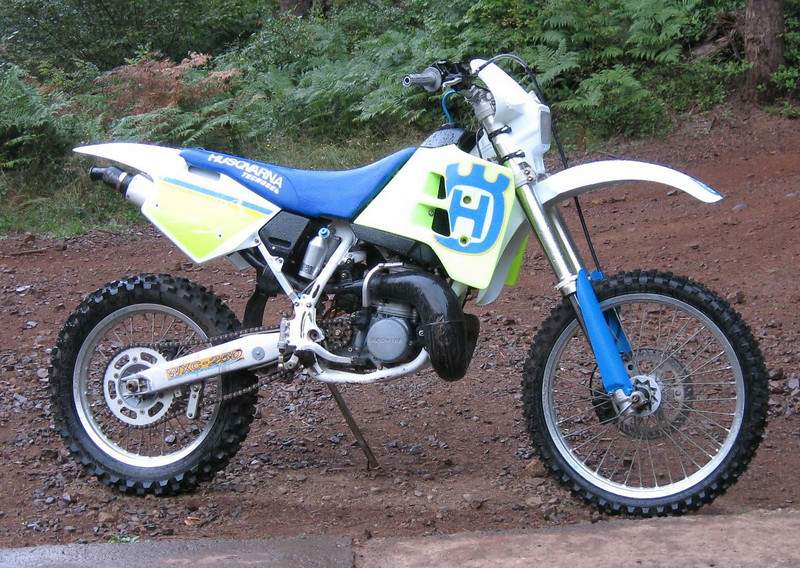
Husqvarna WXC 250
This has to be one of the toughest
bike tests we've completed in recent memory, for a handful of reasons. First
problem, squeezing in a couple hundred miles of test riding between mid-Atlantic
blizzards, deluges and other winter time fun proved formidable, to say the
least. This dilemma was compounded by the fact that the Husky's stay in the
Trail Rider stables would be short, only a month or so. Every snow-covered
and/or flooded day that passed served to heighten our anxiety. Needless to say,
there were fresh Kold Kutter ice screws in the tires by the time we finished.
The final straw, however, no doubt proved the toughest to overcome. Soldier on
as we may, this pseudo problem was in fact that riding the '96 Husky turned out
to be a real eye opener, perhaps even pure joy (testosterone category), just
forcing us to seek more time in the saddle and drooling at the prospect of
trying trick new setups and aftermarket parts combos. Returning the Husky to its
rightful owners was akin to pulling politicians away from PACs. Dress Her Up The
'96 Husqvarna model line is adorned with considerable new stuff and unique
features. Leading that category is the new Marzocchi front end, similar to the
'96 KTM fork, with a different lower leg casting (and subsequent caliper
mounting scheme) and Husky-specified valving. Lower leg Ground Clearance is
good, for a conventional fork, and the Husky Marzocchis don't wad up debris in
the caliper, like some others do. Husky ditched the Nissan brakes this year too,
returning to quick change Brembos. The bike continues to maintain a right side
final drive (chain and sprockets are found on the right side of the engine, like
our old Trail King), going against convention and making the rear Brembo an
identical mirror image of the KTM rear caliper--pads and major parts should
still be interchangeable. Front calipers between the two bikes are completely
the same. The Mikuni TM38 carby showed up at the Trail Rider garages with stock
brass and settings, noted as air screw 1.5 turns out; number 6AEJ3-64 needle
with the needle clip in the #2 (second from top) position, a 40 pilot, and a
stock 3.5 slide. Our bike came with a 430 main jet, while the owner's manual
claims that a 450 main is stock. Right off the bat, running the bike in this
state of tune with premium pump gas found things kind of lean on top, yielding a
slight detonation when pushed. This could possibly be corrected with a richer
main jet or perhaps running race gas. Otherwise, the motor ran really clean in
this configuration, with a nice tan plug insulator and no funky starting habits,
bogging, or spark plug fouling. In the stock
configuration, there is absolutely no hit anywhere in the power band, as the
engine is totally choked by the stock pipe. The bike had trouble pulling top
(sixth) gear in mostly level straights! I know this is going to sound bad, but
with the stock pipe, the power is comparable to an untuned RMX or perhaps even a
KDX. You might think that all this choking and smoothness makes the bike a chore
to ride--not true! Its actually a blast once you adjust, and we're told that
most New Englanders (rock riders) prefer it this way, for the lack of explosion
on top. Bottom line, the stock 250 motor must be ridden like a 125 to make it
go, but with the right attitude, things get moving pretty swiftly. However,
where's there traction and open country, some motor fiddling (a la RMX) will be
required. No doubt all top riders will want more ponies, so we went a-searchin'.
First we tried messing with the jetting in the stock configuration, figuring
that perhaps the perceived slight leanness was slowing things down. This proved
fruitless, as output got sloppy and blubbery with our richening attempts, and
performance suffered. Conclusion: the jetting specs noted above were about
optimum for our temperature and altitude. No free lunch here.
|
|
|
Any corrections or more information on these motorcycles will be kindly appreciated. |