|
|
|
|
Classic Bikes
Custom Bikes
Individual
Racing Bikes AJP
AJS
Aprilia
Ariel
Avinton / Wakan
Bajaj
Benelli
Beta
Bimota
BMW
Brough Superior
BRP Cam-Am
BSA
Buell / EBR
Bultaco
Cagiva
Campagna
CCM
CF Moto
Combat Motors
Derbi
Deus
Ducati
Excelsior
GASGAS
Ghezzi Brian
Gilera
GIMA
Harley Davidson
Hero
Highland
Honda
Horex
Husaberg
Husqvarna
Hyosung
Indian
Jawa
Kawasaki
KTM
KYMCO
Laverda
Lazareth
Magni
Maico
Mash
Matchless
Mondial
Moto Guzzi
Moto Morini
MV Agusta
MZ / MuZ
NCR
Norton
NSU
Paton
Peugeot
Piaggio
Revival Cycles
Roland Sands
Royal Enfield
Sachs
Sherco
Sunbeam
Suzuki
SWM
SYM
Triumph
TVS
Ural
Velocette
Vespa
Victory
Vincent
VOR
Voxan
Vyrus
Walt Siegl
Walz
Wrenchmonkees
Wunderlich
XTR / Radical
Yamaha
Zero
Video
Technical
Complete Manufacturer List
|
Husqvarna TE 410e
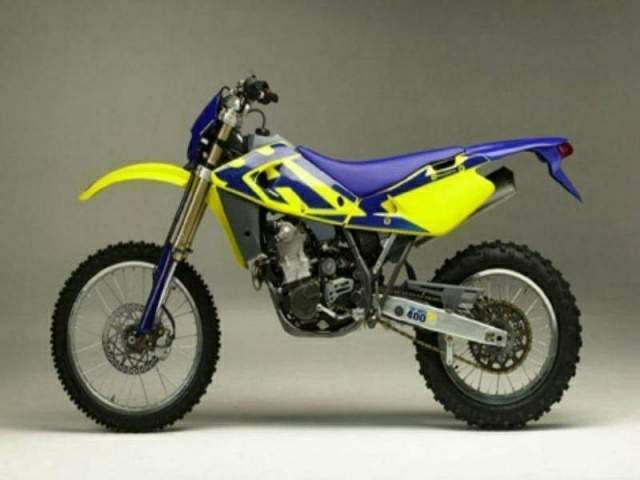
Technically-speaking, the Husky, despite the 410 denomination, is still a 400 with an engine capacity of 399.5cc. The bike, during its time with me, disrupted a system which I use to deal with tiger snakes that often visit my house - encounters start with the words "get the 410", referring to a small-bore (.410 calibre) shot-gun. "Oh, you mean the Husky, whew, that's a relief." This Husky doesn't go off like a shotgun either, rather the power delivery is very even, with plenty of revs all the way to the willing top-end - it's very similar to the Husaberg in that respect. Kickstarting is comparatively easy, notwithstanding that the starter is domiciled on the left-hand side of the bike. If kicking isn't your caper though, it's an easy bike to clutch start too. The Marzocchi front forks are quite plush and easy to steer, and there's none of this bouncing off rocks or locking into ruts - only plenty of solid feel instead. The steering feels a little slow, but this is probably due to its wheelbase, which is the longest in the comparo at 1495mm. The forks firm-up smoothly as the suspension compresses, and it really took the sting out of the jumps on the motocross track. It's one of the few bikes where I upped the compression and rebound damping to slow the action down a bit - it's usually the other way around. I found the TE410 was one of the easiest bikes to ride around the enduro loops. The even power delivery makes it very predictable when things are tight and steep. When the trail opens up, you can really notice the top-end of the engine giving its all through the six-speed gearbox. The $9995 410TE becomes a different bike when you keep the engine revving and gearbox constantly on the move. When things start getting a bit tricky again, the solid mid-range torque helps the rear wheel to find grip, and you know the front-end is going to hold whichever line you choose to take. While enduro riding, I caught up with a few old riding mates and met a few new ones. Their comments on the bike ranged from "nice smooth, broad power" to "easy to ride". I think they were expecting the TE410 would be a bit of a monster that would take them for a ride; they were pleasantly surprised at how much of a user-friendly bike it really is. The only negative, especially for larger riders, is that the riding position is a little cramped with the stock handlebars. Finally, enduro gun Ben Grabham was handed the TE410 for the bike's photo shoot, and he showed what the machine is capable of in the hands of an A-grader. Grabham commented that the rear shock is the biggest improvement on the 2000 model over the previous TE410 releases, which date back to 1994. This Husky is still a good example of a European enduro bike which is not out-and-out weapon like some of the other examples in this class. Instead, its mandate is on taming rough conditions in a most user-friendly way - and, of course, being very stylish in the process. Source Bikepoint
|
|
|
Any corrections or more information on these motorcycles will be kindly appreciated. |