|
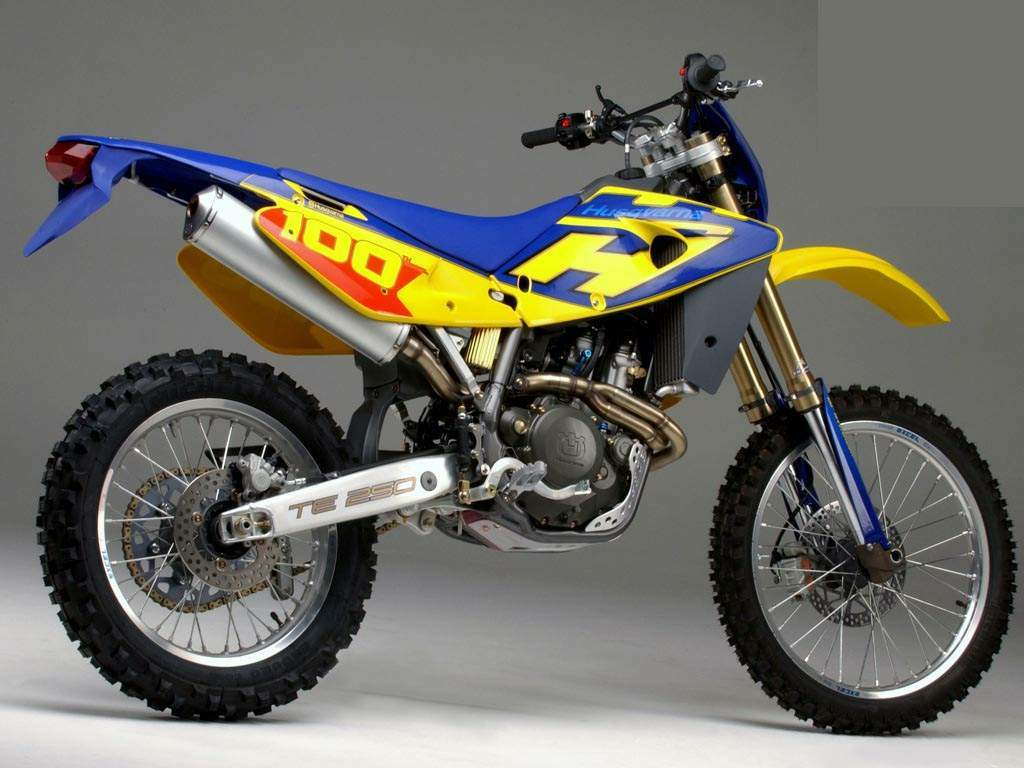
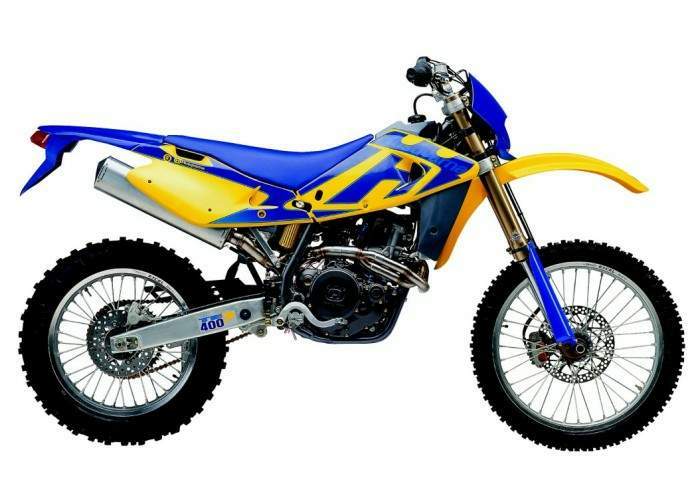
Husqvarna TE 400

|
Make Model |
Husqvarna TE 400 |
|
Year |
2002 |
|
Engine |
Liquid cooled, four stroke, single cylinder, |
|
Capacity |
399 |
|
Bore x Stroke |
91.5 x 60.8 mm |
|
Compression Ratio |
|
|
Induction |
|
|
Ignition /
Starting |
Digital CDI / electric & kick |
|
Max Power |
|
|
Max Torque |
|
|
Transmission /
Drive |
5 Speed / chain |
|
Frame |
Steel single tube cradle (round tubes);
rear frame in light alloy
|
|
Front Suspension |
Marzocchi "Upside-Down" telescopic hydraulic fork with
advanced axle. compression
and rebound stroke adjustment
|
|
Rear Suspension |
Sachs progressive "Soft Damp" type with single hydraulic
shock absorber, spring
preload adjustment, compression and rebound adjustment
|
|
Front Brakes |
Single 260mm disc |
|
Rear Brakes |
Single 220mm disc |
|
Front Tyre |
90/90 -21 |
|
Rear Tyre |
140/80-18 |
|
Dry-Weight |
107 kg |
|
Fuel Capacity |
8 Litres |
The clutch has an improved feet and lighter pull, with the
two-stroke bikes perch fitted this year, but the left side kick-starter is
something that can still annoy the most tolerant of riders. It's awkward -
simple as that. While we're on the petty gripe thing, we also can't understand
why Husky don't use Dzus clips to fasten the airbox cover. If they're good
enough to hold a seat in place, surely they'd do the job on the airbox and make
air filter access a whole lot quicker and easier. After all, these are enduro
bikes.
ENGINES
The 2001 engines are noticeably quicker revving animals than last year's bikes.
While they do have more life and snap to them, they still fall well short of the
new generation four-stroke-type throttle response and free-revving nature of the
Yamaha, Suzuki, KTM and to a lesser extent, the VOR's and Husaberg. The Husk's
remain 'old school' four-strokes, for want of a better term, - they are torquey,
tractable, strong off the bottom, like to be short-shifted ... and are
deceptively fast. They just don't fell as fast as they actually are. (Stefan
Merriman, despite being an incredibly talented rider, made use of the TE400's
awesome tractability on the very slick and greasy trails of the 2000 ISDE and
won by miles. He had only a few weeks on the bike to get accustomed to it and
credited much of his speed to the useable power delivery).
The TE's higher headstock has allowed the bars to be
raised substantially, and all enduro riders who ride
satnding a lot will like this.
So while the host of riders are getting used to the two-stroke fell of the quick
revving competition in the four-stroke class, the Husky's remian a very user
friendly bike to ride for the average rider, and yet can still produce the goods
for Expert enduro pilots, especially with a pipe to get a little more top-end
out of them.
The 400 definitely feels to offer a couple of thousand more revs this year,
thanks to the new high comp piston and mods made to lighten the conrod and
crankshaft. But trying ot ride the bike like a Yamaha will slow you down. If you
use the torque and have faith that the traction is delivering the forward motion
instead of the revs, then you'll get the most out of these engines. The 400 is
an excellent bike for the bush, expecially when the gearing is tweaked a little.
Husky has purpose-built this bike for the bush and that is where it excels. The
570 engine has very similar power delivery charactersitics to the 400, but
substantially more power all round. As you'd expect from a big bore, it's got a
mucj torquier bottom and mid range and the bike can be short-shifted easily and
requires less gear changes than the 400 to keep it hooking. The 570 will pull
without complaint and chugg effortlessly up the snottiest of hills with more
traction than you thought possible from your tytres. while htere's plenty of
power on tap, the super-smooth delivery keeps the bike within the grasp of
average riders. In the tight stuff, the mass of the bigger engine does affect
the bikes handling - although not by much - but on open firetrail, the 570
smokes the 400. Its throttle response off the bottom is much better and it's
much easier for a good rider to steer the 570 with the rear-end. On fast,
sweeping turns on the firetrail or a big old grasstrack, there are few bikes
which are as confidence inspiring as the TE570.
On the downside, the TE's still have more vibration than the other bikes in
their class and, strange as it may seem, this can tire a rider over long hauls.
While the user friendly motor and impressive turning ability of both bikes will
be good for GNCC style enduro racing, that vibration won't. The gerabox is a
little notchy if compared with the Yamaha, Suzuki or even KTM, but gearshifts
remain positive without any false neutrals. It simply needs a little more foot
pressure to effect the gear change.
HANDLING
At the heart of the TE's handling changes for 2001 is the radcially altered
steering head, which is at an incredible four degrees steeper. Believe it!
Usually, half a degree is big news, but, thanks largely to the respect the
Italians had for four time world champ, Stefan Everts' input into the bikes
geometry, the radical change was made. And it has paid big dividends, expecially
for the enduro bikes that had begun to lag behind the competition in the high
speed tree dodging stakes. It gets into, and stays in, ruts much more readily
and changes lines far easier through any other type of turn you throw at it. In
the really tight sutff, the 2001 bikes make the 2000 models feel like slow
steering pigs, and there's no headshake to speak of, despite the much more
aggressive steering head angle.
Like any bike that has undergone major geometry changes, the 400 and 570 will
need a little more suspension refinement to get the front-to-rear balance right.
All the same, the suspender package that comes on both bikes is very capable and
every bit a match for last year's bikes - a surprise, given the radically new
chassis they are supporting. We reckon the new 50mm shaft on the Sachs shck
produces an improved performance over the long haul. With a greater oil volume,
it's less inclined to fade when it gets really hot under the heat of battle. It
tracks well under acceleration but we found it to pack down a little in the arse-end
on braking bumps and unleash its energy by kicking the rider in the bum. It's
better than last year's bike in this department, but the shock still runs too
much rebound damping, even with the clickers backed right off.
The Marzzochi fork has a good progressive action throughout the stroke, but it
goes through the stroke far too easily despite the extra travel with the TC-spec
fork on the bikes this year. Husky has gone up from a 0.42kg/mm spring last year
to a 0.45kg/mm unit this year with plusher valving, but even for the average
75kg rider, it will bottom out much too easily. Fast guys will look for a 0.48
spring real quick to get this thing sitting up in its stroke and offering better
resistance to bottoming. We also thought that the Marzzochi's notoriously
average mid-valve compression damping still needs some work. With the steeper
fork this year, more emphasis is put on the compression damping to take the hits
effectively, and a little fine-tuning is still required to help top the bike
feeling stiff in the mid-stroke and then falling throught it on the larger hits.
DE-RESTRICTING THE TE'S
Like any registerable machine answerable to stringent ADR requirements, the TEs
come out with a pretty performance sapping baffle in the mufflers. To remove it,
the muffler is removed from the pipe and the baffle's lip welds are busted and
the baffle removed. For about $40, a Husky Imports Powercre unit is used in its
place. The minor mod makes the bikes breathe much better and it broadens the low
and mid-range appreciably. Note that some riders will like the standard baffle
left in the 570. It's a big bore with lots of torquey grunt off the bottom and
average riders should reserve judgement about the Powercore mod until they've
ridden the bike and know they can handle the increased off the bottom punch it
delivers. Once the baffle has been removed and the airbox cover drilled out to
help the bike breathe better, jetting mods must also be done to make the TE rev
cleaner through the entire range. Out of the box, the bikes are jetted very
rich. Even by throwing more air at them with the airbox and muffler mods, you
still need to go leaner. Here's what we found to work best:
Source husky.com.au
|