|
|
|
|
Classic Bikes
Custom Bikes
Individual
Racing Bikes AJP
AJS
Aprilia
Ariel
Avinton / Wakan
Bajaj
Benelli
Beta
Bimota
BMW
Brough Superior
BRP Cam-Am
BSA
Buell / EBR
Bultaco
Cagiva
Campagna
CCM
CF Moto
Combat Motors
Derbi
Deus
Ducati
Excelsior
GASGAS
Ghezzi Brian
Gilera
GIMA
Harley Davidson
Hero
Highland
Honda
Horex
Husaberg
Husqvarna
Hyosung
Indian
Jawa
Kawasaki
KTM
KYMCO
Laverda
Lazareth
Magni
Maico
Mash
Matchless
Mondial
Moto Guzzi
Moto Morini
MV Agusta
MZ / MuZ
NCR
Norton
NSU
Paton
Peugeot
Piaggio
Revival Cycles
Roland Sands
Royal Enfield
Sachs
Sherco
Sunbeam
Suzuki
SWM
SYM
Triumph
TVS
Ural
Velocette
Vespa
Victory
Vincent
VOR
Voxan
Vyrus
Walt Siegl
Walz
Wrenchmonkees
Wunderlich
XTR / Radical
Yamaha
Zero
Video
Technical
Complete Manufacturer List
|
Harley Davidson XLH 1200 Sportster
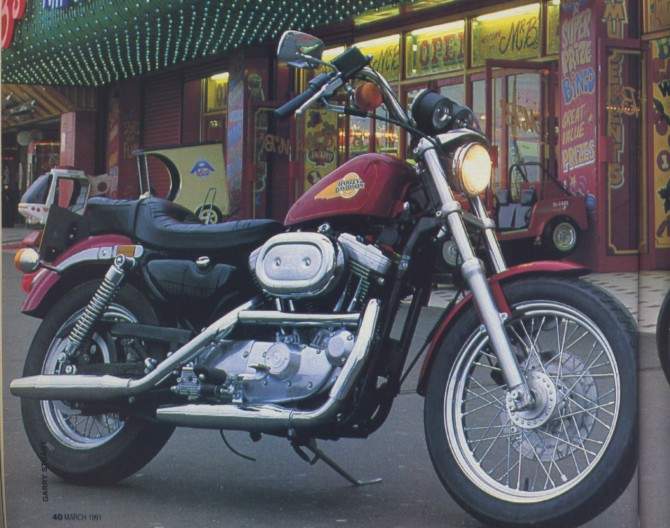
Review I should admit here and now that a Hariey-Davidson XLH1200 Sportster is my chosen mode of transport during those brief periods when this office is temporarily out of Bimotas, RC30s, GSX-Rs, ZZ-Rs and such like. Not for me those 200mph plastic missiles; when I get home I want my bike to be something different, something special, something that exudes style and savior faire. After a hard week testing Japan's finest I want to go home to a Harley. For this reason I am not exactly impartial when it comes to this particular marque - I like Harleys (most of them, anyway). However, the purpose of this test is more to compare the new XLH1200 Sportster to the old one than to evaluate the Sportster as a bike in its own right. For a start, it's very difficult to evaluate the Harley on its mechanical and technical merits alone because they have so few of them. What they do have is an indefinable quality that more than compensates for the plethora of failings they have as a motorcycle. The old Harley adage that 'if I had to explain, you wouldn't understand' just adds to the mystery surrounding the Harley name, because the fact is that no one understands, nor can they adequately explain.aThe appeal of the Hariey-Davidson is a curious one. To the Americans it has always been a symbol of the American dream - a steed for the latter-day cowboy, freedom made in the US of A. It's entirely reasonable for an American, but why does the Harley command such a following in Europe and Japan? Surely not every H-D owner outside the USA is a fan of Americana. No, it's all to do with the image riding a Harley confers. Harley riders are rufty-tufty bikers who don't give a damn and who certainly never eat quiche. Of course most Harley riders are middle-aged professionals who love quiche and worry about their cholesterol levels, but riding a Harley is perceived as being a macho and cool thing to do. The fact that Harleys are no longer the leaky, unreliable piles of junk they used to be has helped the meteroric rise of the Harley as a fashion accessory. Now city slickers can ride around on their Harleys without worrying about them breaking down or getting oil on their Gucci loafers. And this taming of the Harley is typified by the new XLH1200 Sportster. Harley-Davidson have long-since worked out that their target market don't wish to concern themselves with the sordid detail of engine internals, rather they want a bike that needs little or no maintenance and which looks the biz. Performance is not a major factor, nor is handling or braking or any of those other things that are considered important by other motorcyclists. As long as the bike will start easily, effortlessly and require little attention from the owner, Hariey-Davidson have achieved what they set out to do. The Sportsters have long been the entry-level Harley upon which H-D hope to convert the masses to their cause. According to American sources, the Sportster is the best-selling bike in the USA, with 25,000 units sold in the last two years. That's a massive number, especially in view of the appalling decline in the number of new bike sales last year. While sales of Japanese bikes dwindle to a fraction of what they used to be, Harley-Davidson continue to sell every bike they can produce and show no signs of suffering the depression that has settled over the rest of the US bike industry. So if the Sportster is such a good seller, why change it? Well, because H-D wanted to drag the Sportster screaming and struggling into the 1970s. The original Sportster was designed back in the mid-1950s when push-rod V-twins were considered sporting motorcycles and the basic design has remained unchanged since. The change to the aluminium-alloy Evolution design in the early '80s was a nod in the direction of modern technology, but basically the Sportster was still a 40-year old design the H-D sold geaps of them and no one seemed to mind that it was slow and old fashioned. However, as the 21st Century looms large on the horizon, H-D have decided to up-date the Sportster in an attempt to make it a little more user friendly and in doing so have addressed some of the more irritating faults that have plagued the Sportster for nigh on 40 years. Unfortunately they made a rather half-hearted stab at it and and consequently the result is a improved Sportster, but one that still has a lot of room for further improvements. For those unfamiliar with the XLH1200, it's an air-cooled push-rod 45-degree V-twin that displaces 1202cc through a bore and stroke of 88.9 x 96.8mm. Primary drive is still via a triplex chain, but the gearbox is now a five-speed affair and the final drive is now via a toothed Kevlar belt. There is, however, a bit more to the new Sportster's engine than an extra ratio in the gearbox and a belt final drive. In squeezing a larger gearbox into the engine Harley were forced to use new crankcases, and if new casings were called for then they figured they might as well redesign a few other bits and pieces, too. In the end Harley-Davidson changed just about everything in the engine except for carb, pistons, con-rods and cylinders. The list of modifications is extensive, but major changes include new tappet rollers, one-piece push-rod tubes, modified cams, a new oil pump with simplified plumbing between the pump and the filter, and a new engine-breather set-up vents crankcase pressure through umbrella valves into the air-filter. More importantly, the alternator has moved from the clutch to the crank, which now allows the Sportster to use a clutch almost identical to the big twins (the friction and separator plates, and the outer clutch basket are common to the 1340s). In the gearbox the input and output shafts are new, as are the gears and bearings, although the basic design remains the same as the four-speed Sportster. Further back is perhaps the single biggest improvement - a low-maintenance Kevlar belt that drives the back wheel and requires little adjustment and no messy lubrication. This is basically the same as used on the 1340s, but a quarter of an inch narrower, which in turn makes it only a quarter of an inch wider than the standard chain from the four-speed Sportster. The new final drive system has necessitated slightly repositioned rear shock absorbers. As you can see, although externally the new Sportster looks pretty much like the old one, internally there are significant differences. But how do those differences compare on the road? To find out we dusted down my old four-speed XLH1200 for a head-to-head test. However, it should be noted that my Sportster derviates from standard in that it has flat handlebars, uprated suspension and an uprated front brake. Swinging a leg over the new Sportster you instantly realise that although this is a 1200 it's actually very small. In front of you is a minuscule petrol tank, minimal instrumentation and a pair of buck-horn handlebars. The seat height is only just over 30 inches so both feet can be placed firmly on terra firma and the feel of the Harley is of a middleweight rather than a 1200, even if it weighs in at a not inconsiderable 490lb gassed up. Prodding the electric starter produces an amazing series of graunching noises as the big twin splutters into life. The exhaust note is muted and innocuous, producing a sort of chuffing sound more like a steam train than a rip-snorting sports bike. The first real difference between this Sportster and its predecessor is noticeable when you pull in the clutch and tap it into first gear - the clutch is lighter and smoother than before, with an action considerably more pleasant than days of old. Not only that, but instead of the deafening 'kerlunk' that used to frighten pedestrians when you knocked the old Sportster into first, now there's a barely perceptible 'snick'. At a standstill the Sportster still jumps around at tickover, there being no difference in the solid engine mounting system, but once in motion things feel very different. Apart from the improved clutch action, the Harley is much smoother at low revs and below 3000rpm the new 1200 feels more like a 1340 than a Sportster. The familiar shudder of a big V-twin is always there, but the new 1200 has had the rough edge taken off it, making the old one feel much more agricultural by comparison. Shifting up through the gearbox is a pleasure, with the ratios sensibly spaced and the gearbox action considerably improved - there's much less lever movement and the gear selection is much slicker. Compared to a modern Japanese bike, the Sportster is still an antique, but for a Harley Sportster it's an eye-opener. Accelerating out along the open road the Sportster pulls willingly and strongly from under 2000rpm, with great gobs of torque compensating for the relative lack of horsepower. We didn't dyno this Sportster because it was still relatively new and barely run-in, but an American magazine recently ran the new Sportster on their dyno and got 50.4hp at 5000rpm and 62ftlb of torque at 3500 revs. That's not exactly startling, but compare that to other Harleys and you begin to see that this is one of the best H-Ds yet - it's only 2.4hp less and 0.4ftlb more than the new 1340 Sturgis they tested. Considering how much lighter it is than the 1340s, this makes the 1200 the real sportster of the Harley range. In an outright sprint, there's nothing to separate the new Sportster from the old and on the open road they will both press on at a respectable rate if you try hard. However, the thing that came as a big surprise is how little difference that fifth gear makes at motorway cruising speeds. We'd expected the new Sportster's engine to be turning over around 500rpm less than the old 1200 at motorway speeds, but according to the speedos and tachos this is not the case. At an indicated 70mph in top gear both bikes showed 3000rpm on the tacho, and 3500 revs at 80mph. The new Sportster's smoother belt drive meant that it was more comfortable at those speeds, but it didn't seem to be revving any lower than the old 1200. The Jekyll and Hyde character of the new 1200 makes itself felt at the 3500rpm mark because it is at this point that the horrendous engine vibes become painfully intrusive (they are just as bad as on the old 1200) and make riding at much over 80mph a no-no - the upright riding position, with forward-placed footrests and wide handlebars, add to the rider's agony if speeds in excess of 80mph are maintained. I think the high handlebars are extremely naff, not only because they make fast riding painful but also because they look naff and isolate the rider from what's going on at the front. When you consider that most Sportsters are used as urban transport, the increased smoothness below 3000 revs and 70mph, is exactly where it's needed, and you have to remember that this bike was built by Americans for Americans. You'd do well to remember this when rushing up to your favourite series of back-road bends. If you're accustomed, on your GSX-R750, to screaming in fast, hauling hard on the brakes and pitching it in for a late apex, then you'd better beware of the Sportster. One area in which Harley-Davidson have made absolutly no ground is with the suspension and brakes. For sedate cruising they are perfectly adequate, but anything approaching spirited riding should be avoided unless you particularly want a close look at the road-side flora and fauna. The basic trouble is that no one seems to want to admit that the suspension and brakes are rubbish. At best they are adequate for cruising, but there's more to life than that. No matter how many times I am told by Harley importers and dealers that 'the brakes are fine, you just need a good, firm pull on them', I just can't seem to believe them. If, like me, you prefer to do most of your braking using two fingers on the front lever, then this is not the bike for you. A full four-finger grasp, backed up by a firm boot on the rear brake pedal, is required to stop the Sportster quickly. Add to that front forks that are way too soft and rear shocks that can best be described as dross, and you can see why serious scratching is not for the faint-hearted. It's perfectly possible to get the 1200 to handle and stop well (relatively) by equipping it with lower handlebars, beefing up the front end and slinging on some after-market shocks and front brake, but you shouldn't have to on a bike that costs £5700. The other irritating thing which needs attention is the ludicrously small petrol tank. With a bike that returns little over 40 miles to the gallon it seems crazy to give it a 1.8 gallon petrol tank, but then the riding position is so uncomfortable and the seat so thinly padded that stopping every 50 to 60 miles for petrol is a welcome relief When you examine the XLH1200 in the cold light of day, without the benefit of your rose-tinted glasses, it's not much of a bike. I own one so I should know. It's slow, uncomfortable, it doesn't handle or brake, it won't take two people in any comfort, and it's expensive. The curious thing is that no one seems to mind. The Sportster's sleek lines, classic good looks and the prestige that goes with the Harley name outweigh most of its faults for a lot of people - me included. The thing that bugs me most about the new Sportster is that although it is better than the old one, Harley-Davidson missed an opportunity to turn it into a truly great bike. Better suspension and a good front brake would make it into a good one; a bigger petrol tank, better seat and a flat-handlebar option would make it a very good bike; and a rubber-mounted engine using a similar system to that of the new Sturgis would make it a truly great bike. That the new XLH1200 is worth £500 more than the old one is unquestionable, but £5700 is quite a lot of money for a bike that still needs a lot of work to bring it up to the sort of standards we now expect of bikes in the 1990s. Many of us make allowances for Harley's failings, but we shouldn't have to and for me the new Sportster is just as notable for the things left undone as for the refinement of its transmission. Let's hope the refinement of the cycle parts takes rather less time than the 40 years it took to refine the engine, gearbox and final drive to its present commendable state. Source Motorcycle International 1991
|
|
|
Any corrections or more information on these motorcycles will be kindly appreciated. |