|
Make Model |
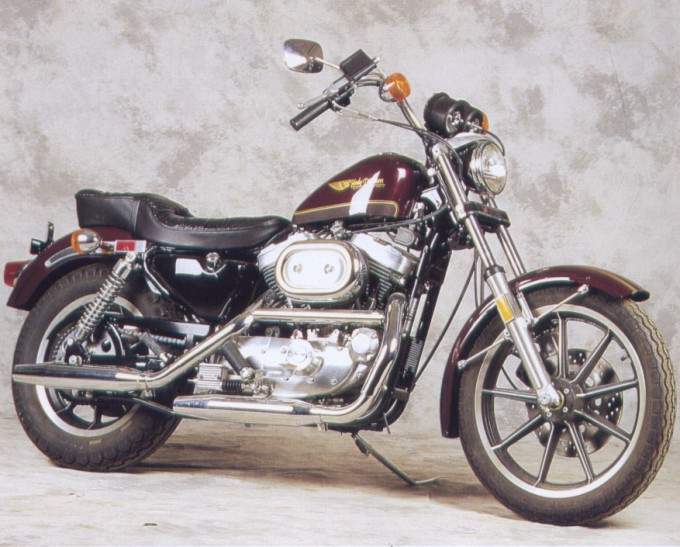
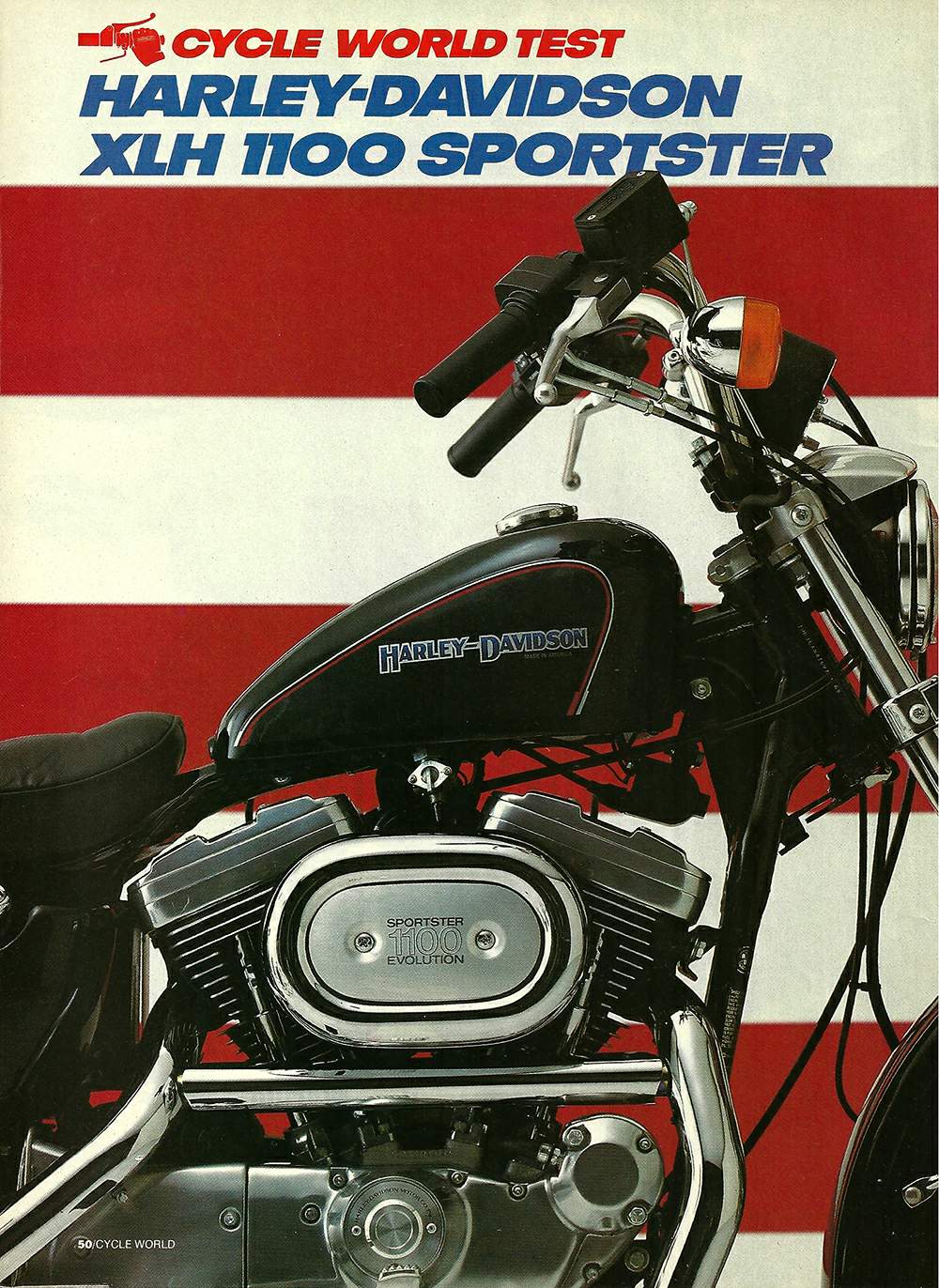
Harley Davidson
XLH 1100 Sportster Evolution |
|
Year |
1986 |
|
Engine |
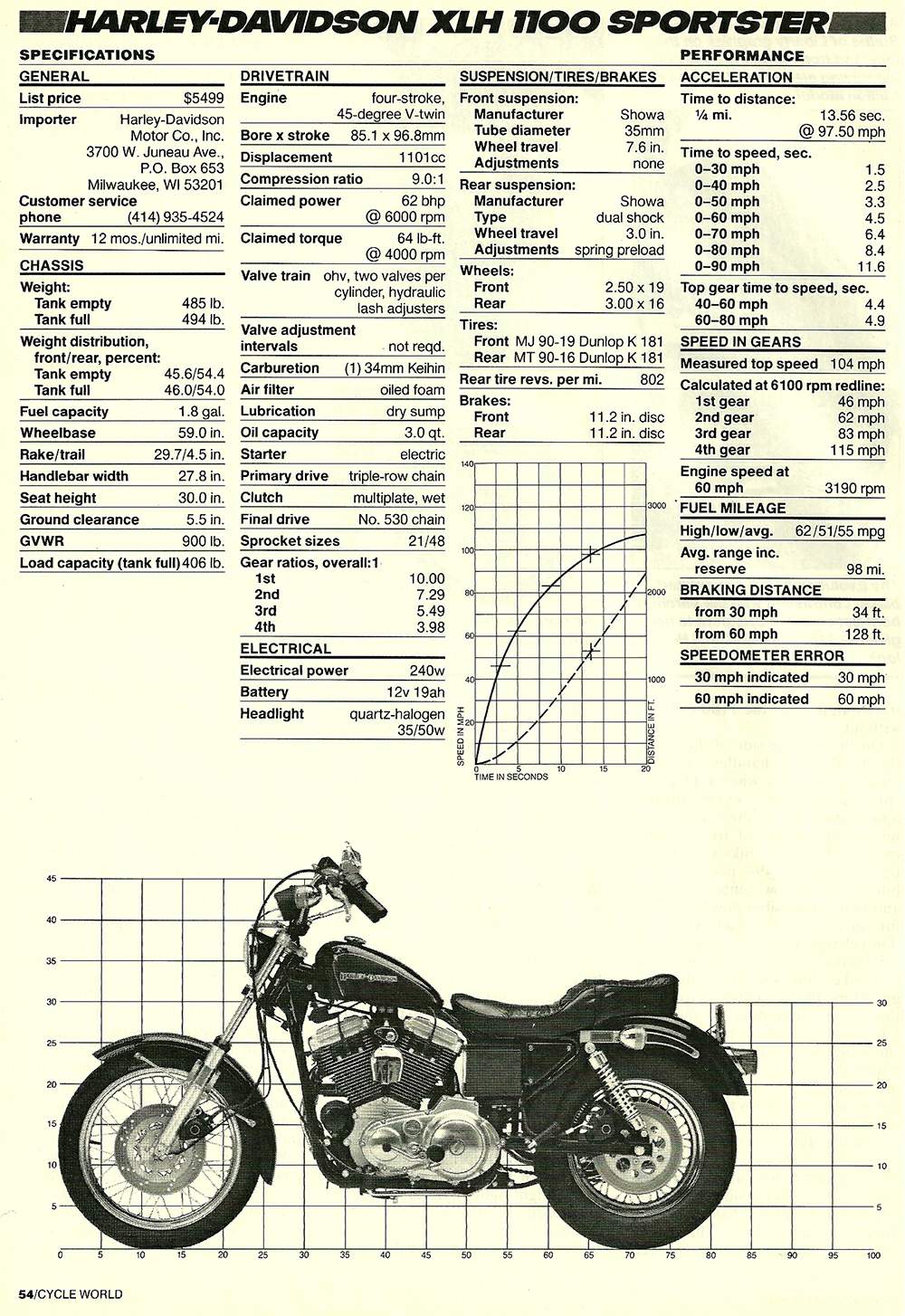
Air cooled, four stroke, 45° V-Twin, OHV, 2
valves per cylinder. |
|
Capacity |
1101 |
|
Bore x Stroke |
85.1 x 96.8 mm |
|
Compression Ratio |
9.0:1 |
|
Induction |
Single 34mm Keihin carb |
|
Ignition /
Starting |
- / electric |
|
Max Power |
62 hp @ 6000 rpm |
|
Max Torque |
64 lb-ft @ 4000 rpm |
|
Transmission /
Drive |
4 Speed / chain |
|
Front Suspension |
35mm Showa tubs diameter 193mm wheel
travel. |
|
Rear Suspension |
Dual Showa shocks spring preload adjustable,
76mm wheel travel. |
|
Front Brakes |
Single 285mm disc |
|
Rear Brakes |
Single 285mm disc |
|
Front Tyre |
MJ 90-19 |
|
Rear Tyre |
MT 90-16 |
|
Dry-Weight |
220 kg |
|
Fuel Capacity |
8.5 Litres |
|
Consumption average |
55 mp/g |
|
Braking 60 - 0 / 100 - 0 |
- / 39 m |
|
Standing
¼ Mile |
13.5 sec / 97.5 mp/h |
|
Top Speed |
104 mp/h |
In 1986, the Sportsters not only got the new V2 motor in
their frames, but the XL buyer had a choice of two displacements. Either 883
or 1100 were seen in the latest XLH model, providing a new level of fitment
for the smaller or beginning rider. Producing 53 and 63 horsepower
respectively, both versions were coupled to a four-speed gearbox. The
XLH-1100 sold for about $5,200 in 1986, which placed it more than $1,000
over its smaller XLH-883 sibling in the price line. A set of two instruments
and buckhorn bars made the 1100 easier to differentiate from the smaller 883
variant.
Road Test
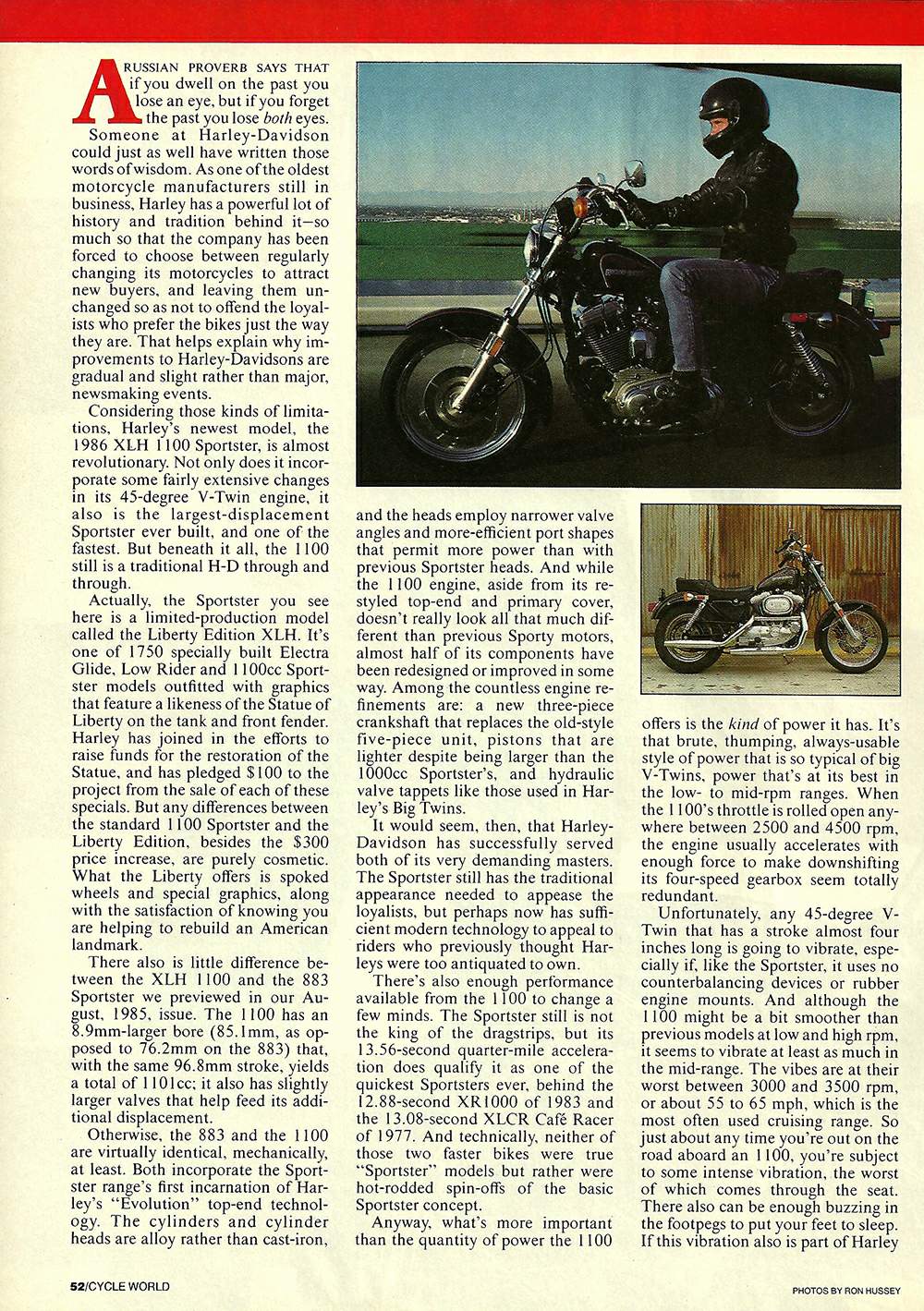
A RUSSIAN PROVERB SAYS THAT if you dwell on the
past you lose an eye, but if you forget the pasi you lose both eyes.
Someone at Harley-Davidson could just as well have written those words of
wisdom. As one of the oldest motorcycle manufacturers still in business,
Harley has a powerful lot of history and tradition behind it-so much so that
the company has been forced to choose between regularly changing its
motorcycles to attract new buyers, and leaving them unchanged so as not to
offend the loyalists who prefer the bikes just the way they are. That helps
explain why improvements to Harley-Davidsons are gradual and slight rather
than major, newsmaking events.
Considering those kinds of limitations, Harley's
1986 XLH 1100 Sportster, is almost revolutionary. Not only does it
incorporate some fairly extensive changes in its 45-degree V-Twin engine, it
also is the largest-displacement Sportster ever built, and one of the
fastest. But beneath it all, the 1100 still is a traditional H-D through and
through.
There also is little difference between the XLH
1100 and the 883 Sportster we previewed in our August, 1985, issue. The 1100
has an 8.9mm-larger bore (85.1mm, as opposed to 76.2mm on the 883) that,
with the same 96.8mm stroke, yields a total of 1 lOlcc; it also has slightly
larger valves that help feed its additional displacement.
Otherwise, the 883 and the 1100 are virtually
identical, mechanically, at least. Both incorporate the Sportster range's
first incarnation of Harley's "Evolution" top-end technology. The cylinders
and cylinder heads are alloy rather than cast-iron, and the heads employ
narrower valve angles and more-efficiefit port shapes that permit more power
than with previous Sportster heads. And while the 1100 engine, aside from
its re-styled top-end and primary cover, doesn't really look all that much
different than previous Sporty motors, almost half of its components have
been redesigned or improved in some way. Among the countless engine
refinements are: a new three-piece crankshaft that replaces the old-style
five-piece unit, pistons that are lighter despite being larger than the
lOOOcc Sportster's, and hydraulic valve tappets like those used in Harley's
Big Twins.
It would seem, then, that Harley-Davidson has
successfully served both of its very demanding masters. The Sportster still
has the traditional appearance needed to appease the loyalists, but perhaps
now has sufficient modern technology to appeal to riders who previously
thought Har-leys were too antiquated to own.
There's also enough performance available from the 1100 to change a few
minds. The Sportster still is not the king of the dragstrips, but its
13.56-second quarter-mile acceleration does qualify it as one of the
quickest Sportsters ever, behind the 12.88-second XR1000 of 1983 and the
13.08-second XLCR Cafe Racer of 1977. And technically, neither of those two
faster bikes were true "Sportster" models but rather were hot-rodded
spin-offs of the basic Sportster concept.
Anyway, what's more important than the quantity
of power the 1100
offers is the kind of power it has. It's that brute, thumping, always-usable
style of power that is so typical of big V-Twins, power that's at its best
in the low- to mid-rpm ranges. When the 1100's throttle is rolled open
anywhere between 2500 and 4500 rpm, the engine usually accelerates with
enough force to make downshifting its four-speed gearbox seem totally
redundant.
Unfortunately, any 45-degree V-Twin that has a
stroke almost four inches long is going to vibrate, especially if, like the
Sportster, it uses no counterbalancing devices or rubber engine mounts. And
although the 1100 might be a bit smoother than previous models at low and
high rpm, it seems to vibrate at least as much in the mid-range.
The vibes are at their worst between 3000 and
3500 rpm, or about 55 to 65 mph, which is the most often used cruising
range. So just about any time you're out on the road aboard an 1100, you're
subject to some intense vibration, the worst of which comes through the
seat. There also can be enough buzzing in the footpegs to put your feet to
sleep. If this vibration also is part of Harley tradition, it's one the 1100
could do without.
On the positive side of the ledger, the MOO steers, handles and stops quite
competently when ridden in a spirited fashion, even though
Sportsters—despite their name—are no longer considered true sporting
motorcycles.
The bike's relatively light weight of 494
pounds, combined with its low center of gravity and easily accessible power,
make it fun to ride on the backroads. You don't charge corners in the same
banzai fashion as you might on a real sportbike, but you still can make good
time in the twisties if you keep the engine humming in the mid-range and
concentrate on picking the smoothest lines. Only a light touch is required
to bank the Sportster over into a turn, and once it's there, it's
dead-stable and sticks to the line you select as though on autopilot.
Braking the 1100 does require quite a bit of effort, even though the bike
can stop much quicker than you might think. It is possible to lock up either
wheel, but you have to be trying pretty hard to do so. This can be
beneficial, though, in that you can apply a lot of pressure on the brake
lever or pedal without worrying about the wheels locking up.
The brakes aren't the only area where the l 100
Sportster feels rather stiff. The Showa-built front fork soaks up most of
the road undulations, but it is a little underdamped, and sharp bumps or
holes in the road can cause it to bottom. In the rear, the Sportster has
only three inches of oversprung and underdamped travel to work with, so the
best it can offer on a rough road is a buckboard ride. Once again, however,
Harley tradition may be partially to blame here, because to maintain the
requisite Sportster look, the seat had to be kept as low as possible. When
the bike's short-travel rear suspension is combined with a seat that doesn't
have much padding, the obvious result is a bike that isn't meant to be very
comfortable for very long. Compounding this discomfort is the Sportster's
mandatory bolt-upright seating position, which puts all of a rider's
upper-body weight right on his tailbone.
In addition, other elements of the ergonomics
seem to have been designed for something other than rider
comfort. The handgrips and levers are scaled for people of gargantuan
proportions, so it takes a decided movement to span the exceptionally long
distance between grip and lever, or to reach the horn and starter buttons.
What's more, the clutch bulge on the primary cover prevents the rider from
tucking in the rear of his left boot, and the buddy pegs are so close to the
rider's that a passenger's toes constantly make contact with the rider's
heels. And in typical H-D fashion, the air-cleaner cover on the right side
fouls the rider's leg just below the knee. The cover also gets quite hot
because it touches the rear cylinder head, so the rider gets bruised and
burned by the same part.
This is not to say that human engineering was
completely ignored in the design of the 1100 Sportster. For one thing, the
pushbutton turn-signals that Harley has preferred for years will now either
work momentarily as long as the buttons are pushed only part way, or stay on
until intentionally released when the buttons are depressed all the way. The
1100, like the 883, also shifts much more easily and quietly than previous
Sportsters have shifted. In addition, even though the span between the
handgrips and the control levers is quite long, the pull of the diaphragm
clutch is smooth and light. And the relative absence of engine clunking,
clattering and whining compared with previous Sportsters makes long stints
in the saddle just that much more bearable.
Due to these sorts of improvements, and many
others, the 1100 Sportster emerges as a much better bike than its 883cc or
lOOOcc predecessors. Which only makes sense: It's greatly improved in some
areas and no worse in the others, so the end result is a superior
motorcycle-perhaps the best Sportster ever.
But it's also just as traditional as ever, a motorcycle that continues to
exude the kind of classic appearance that the Japanese companies continue to
strive for—and generally fail to achieve. In many ways, of course, the
maintenance of this tradition has stood in the way of improving the
Sportster even more; but in certain crucial areas, effecting improvements
would probably detract from whatever it is that makes the bike a, well, a
Sportster.
Whether or not that's a good thing depends on your point of view. But one
thing is certain: Harley-Davidson must believe in Russian proverbs. Because
it is counting on its future by relying on its past. E3
Source Cycle World 1986