|
|
|
|
Classic Bikes
Custom Bikes
Individual
Racing Bikes AJP
AJS
Aprilia
Ariel
Avinton / Wakan
Bajaj
Benelli
Beta
Bimota
BMW
Brough Superior
BRP Cam-Am
BSA
Buell / EBR
Bultaco
Cagiva
Campagna
CCM
CF Moto
Combat Motors
Derbi
Deus
Ducati
Excelsior
GASGAS
Ghezzi Brian
Gilera
GIMA
Harley Davidson
Hero
Highland
Honda
Horex
Husaberg
Husqvarna
Hyosung
Indian
Jawa
Kawasaki
KTM
KYMCO
Laverda
Lazareth
Magni
Maico
Mash
Matchless
Mondial
Moto Guzzi
Moto Morini
MV Agusta
MZ / MuZ
NCR
Norton
NSU
Paton
Peugeot
Piaggio
Revival Cycles
Roland Sands
Royal Enfield
Sachs
Sherco
Sunbeam
Suzuki
SWM
SYM
Triumph
TVS
Ural
Velocette
Vespa
Victory
Vincent
VOR
Voxan
Vyrus
Walt Siegl
Walz
Wrenchmonkees
Wunderlich
XTR / Radical
Yamaha
Zero
Video
Technical
Complete Manufacturer List
|
Harley Davidson XLCR 1000 Café Racer
The Harley-Davidson XLCR was an American café racer motorcycle manufactured by
Harley-Davidson between 1977 and 1979. Some say that designer Willie G. Davidson
created it from the existing XLCH Sportster, initially as his personal vehicle.
The bike was actually designed by a committee of three people: Bob Modero (an
engineer at Harley) Jim Haubert (Jim Haubert Engineering) hired as an
independent Skunkworks contractor and Willie G. Although he was not present,
this group had a strong styling influence from Dean Wixom when the three
decided, as one of the starting points, to enlarge a dirt track XR750 fuel tank.
Mr. Wixom was the original designer of this fuel tank.
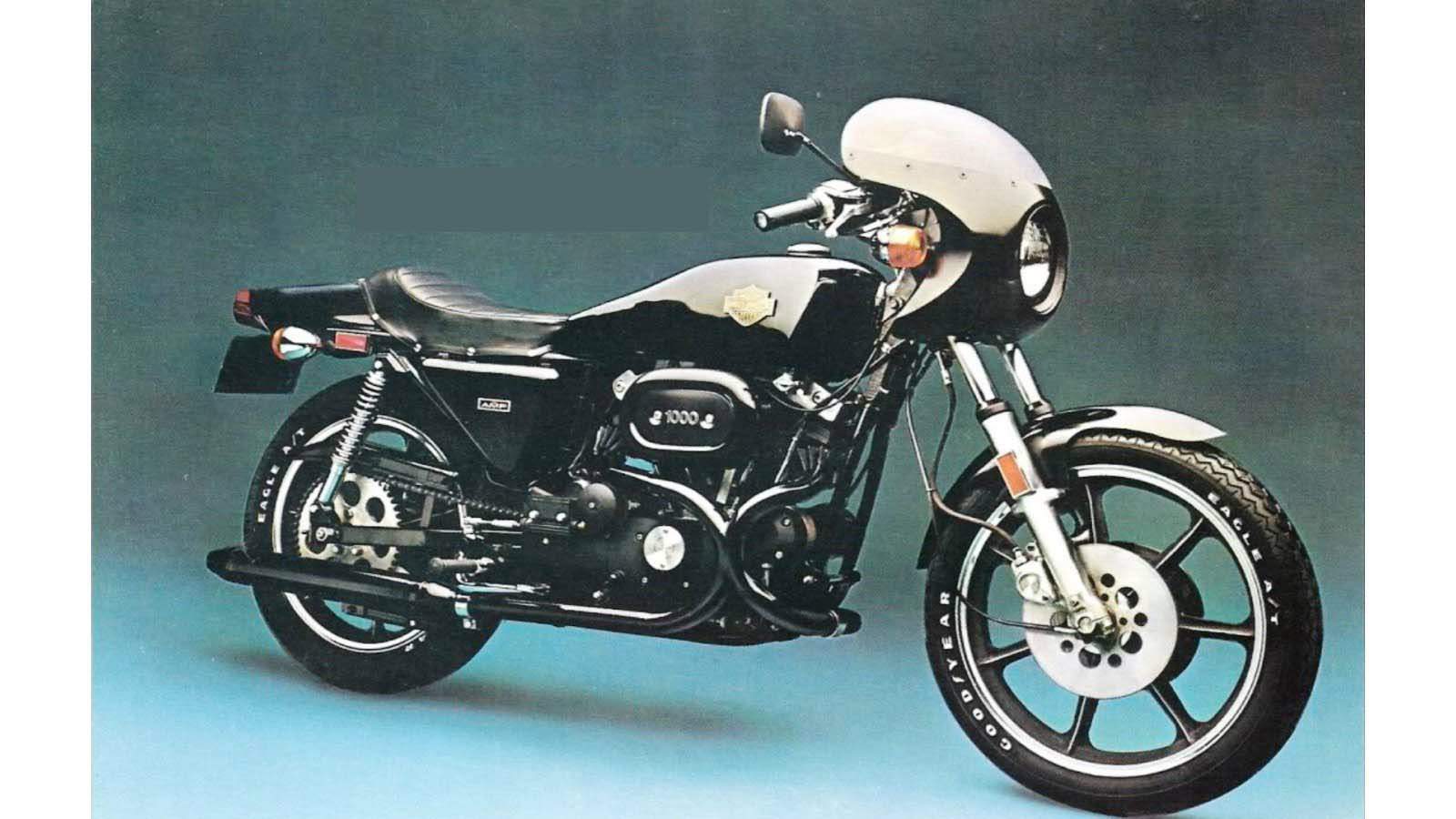
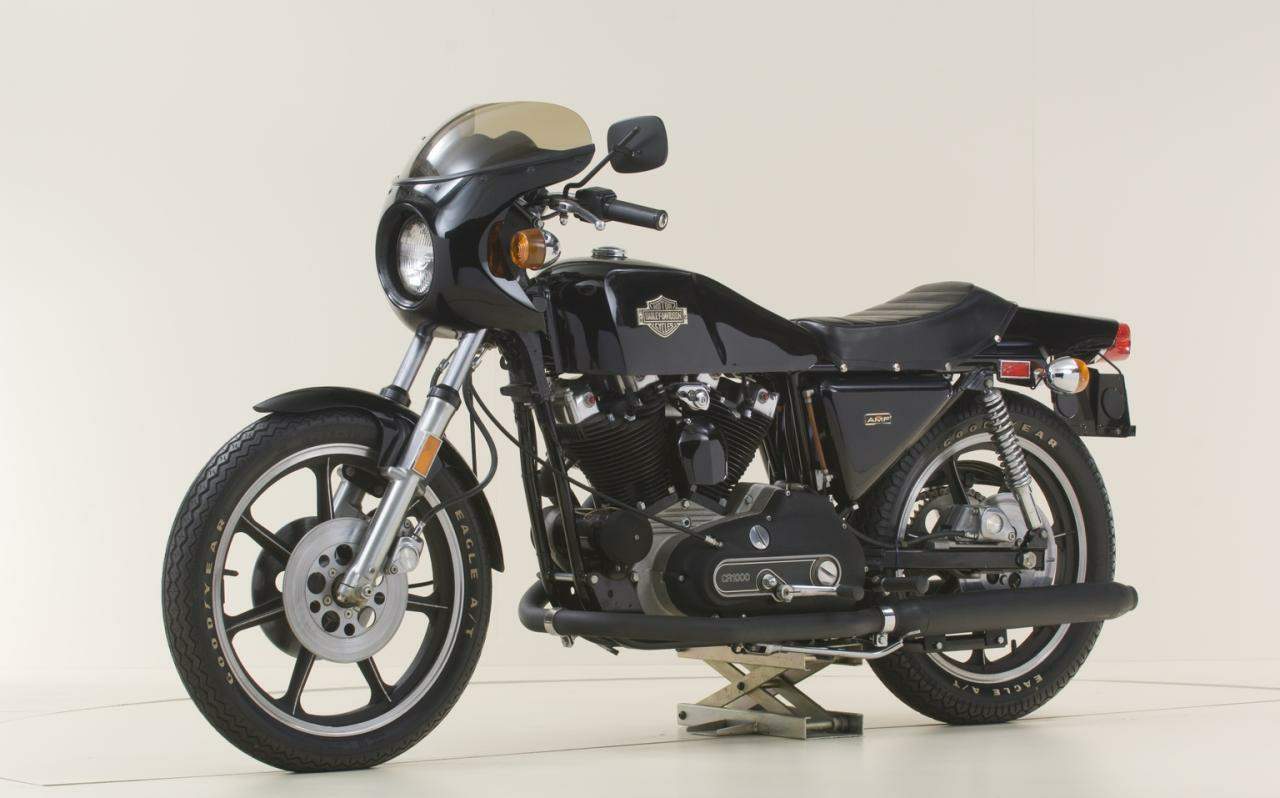
The Harley-Davidson XLCR1000 is unique in the range of models built by the famous Milwaukee, Wisconsin, company, in that it is definitely not built on the same 'laid back' lines as its tourer stable-mates. In fact the CR part of the title stands for Café Racer, and the Harley is unquestionably one of the most aggressive looking Café racers available. Although outwardly different from the other Harleys, the XLCR still has the famous V-twin engine which, with very undersquare dimensions of 81 mm X968 mm, displaces 997-5cc. A45degree unit, the engine features a 9:1 compression ratio, simple pushrod operated valves, a single 38 mm Keihin carburetor and all the reliability one could possibly need. Unsophisticated it may be, but the engine could pull a house down with its 68 bhp at 6200 rpm and, although undisclosed, probably around 60 lb ft of torque. Although the torque figure is not quoted by the company they do say that the 'secret amount' is produced at 3500 rpm, well down the rev scale but just the thing for instant acceleration in any of the XLCR's four gears. An electric start is the only concession to modern times in the engine and it copes surprisingly well with getting the engine under way. Unlike a silky smooth Japanese multi, one is very well aware of when the Harley's engine is running. It has an off-beat exhaust note, it rumbles and shakes and leaves the rider in no doubt as to its capabilities.
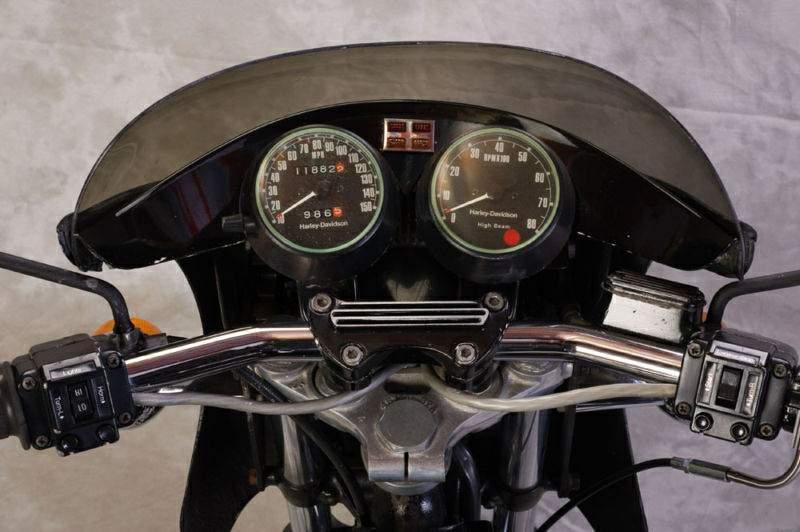
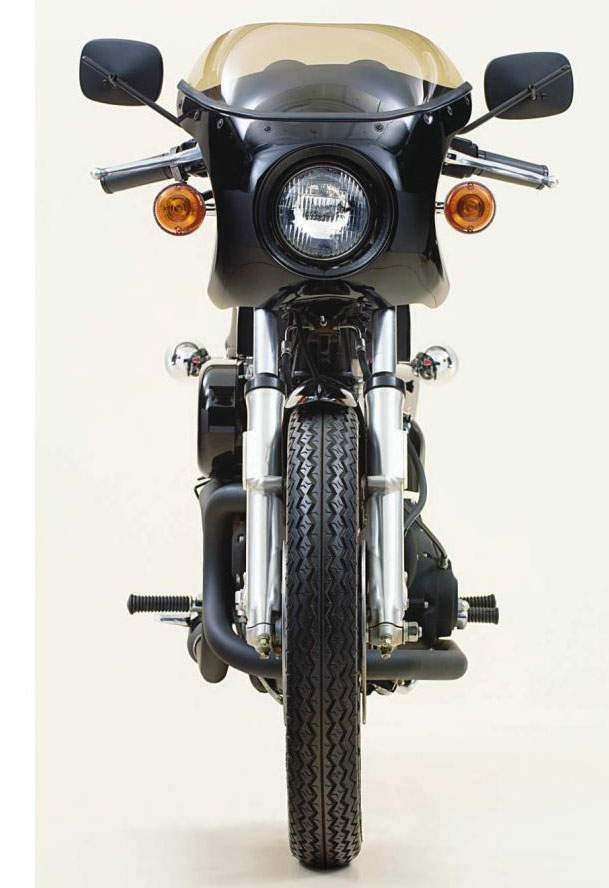
The engine, wet-multi-plate clutch and gearbox are mounted in a very narrow duplex frame to which is attached a rear end similar to the famous long-track Harley racers. Conventional springing is used, by courtesy of Showa of Japan, with neat alloy wheels built by Morris. Kelsey Hayes disc brakes are fitted all round. Lowered bars are fitted, there is a neat little windscreen, a 4gal fuel tank and a combined single-seat/rear fairing added to the machine, and just about everything is black, from the tinted wind screen and fairing to the matt-finish exhaust system. When first astride the XLCR one is aware that it is smaller than it looks as it weighs a trifling 485lb (low by Harley standards) and is as slim as a pencil. One's hands are greeted by two enormous grips that feel seven sizes too big and one settles into the comfortable saddle, which is quite low at 30-5ins from the ground. Once the carb has been primed with the throttle and the carburetor-mounted choke lever pulled out, the engine will fire immediately and settle down to a 900 rpm idle. The clutch is extraordinarily heavy and the gearchange is vague, but once first has been selected one can rocket away from a standstill with the quarter mile coming up in just over 13secs.
There is really little point in taking the engine above 6000 rpm and even changing gear at 4000 rpm allows rapid progress. The bike's top speed is really governed by its low gearing as the red line speed of just over 110 mph in top can be reached with no fuss at all. Vibration and a deafening roar are other factors that make approaching the red line of 6500 rpm of little value. With grippy Goodyear tyres and a long wheelbase, the Harley handles and corners well, with plenty of feel of the road being transmitted to the rider. In fact, on bumpy surfaces it would be fair to say that the ride can be quite jarring, but that is worth trading for a Harley that handles. Braking is 'fair to middling' in the dry, but just about non-existent in the wet, and waiting for the discs to work in the rain is hair-raising to say the least. On the other hand, the Goodyear A/T covers cope well in most conditions and the XLCR is a lot less of a handful than most of its stablemates on wet roads. Source of review : Super Bikes by Mike Winfield
|
|
|
Any corrections or more information on these motorcycles will be kindly appreciated. |