|
|
|
|
Classic Bikes
Custom Bikes
Individual
Racing Bikes AJP
AJS
Aprilia
Ariel
Avinton / Wakan
Bajaj
Benelli
Beta
Bimota
BMW
Brough Superior
BRP Cam-Am
BSA
Buell / EBR
Bullit
Bultaco
Cagiva
Campagna
CCM
CF Moto
Combat Motors
Derbi
Deus
Ducati
Excelsior
Fantic
GASGAS
Ghezzi Brian
Gilera
GIMA
Harley Davidson
Hero
Highland
Honda
Horex
Husaberg
Husqvarna
Hyosung
Indian
Jawa
Kawasaki
KTM
KYMCO
Laverda
Lazareth
Magni
Maico
Mash
Matchless
Mondial
Moto Guzzi
Moto Morini
MV Agusta
MZ / MuZ
NCR
Norton
NSU
Paton
Peugeot
Piaggio
Revival Cycles
Roland Sands
Royal Enfield
Sachs
Sherco
Sunbeam
Suzuki
SWM
SYM
Triumph
TVS
Ural
Velocette
Vespa
Victory
Vincent
VOR
Voxan
Vyrus
Walt Siegl
Walz
Wrenchmonkees
Wunderlich
XTR / Radical
Yamaha
Zero
Video
Technical
Manufacturer List Contact
|
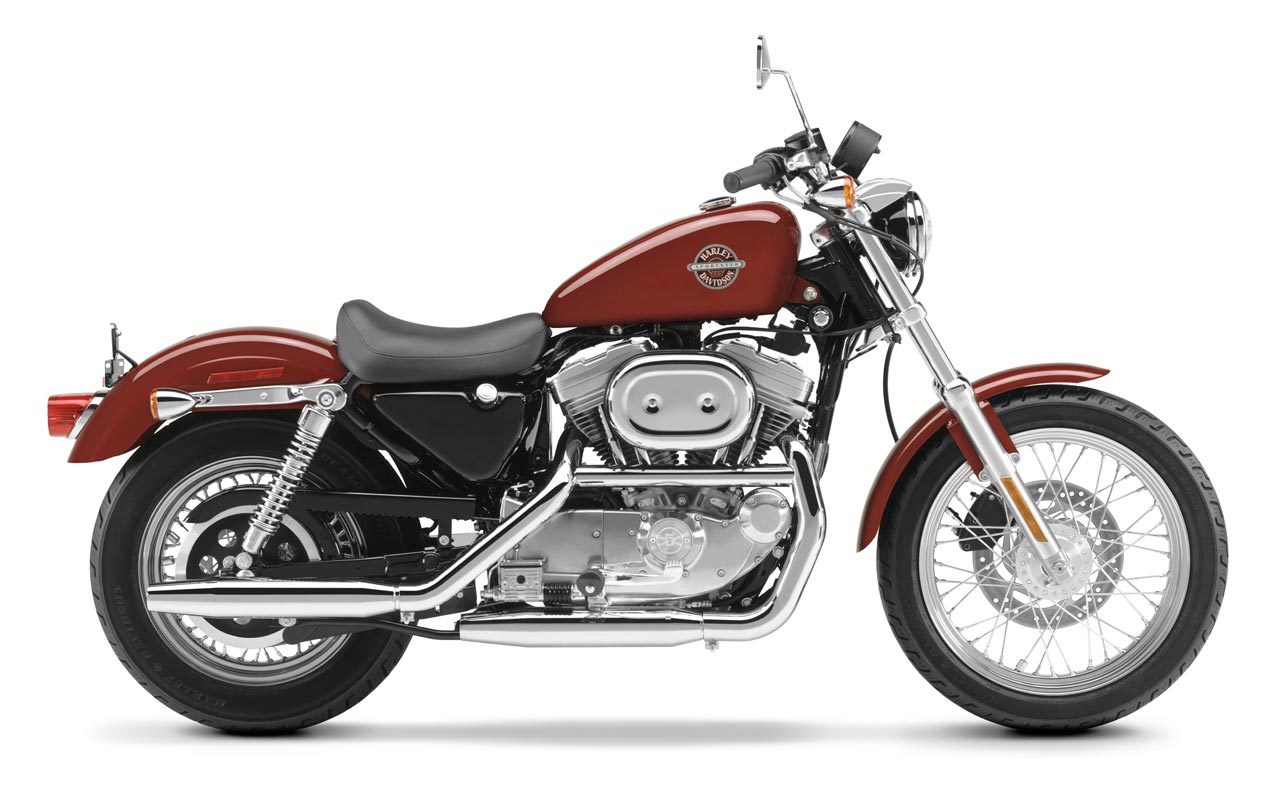
Harley Davidson XL 883 Sportster
Even if you don't presently own a Harley-Davidson it is very easy to dismiss the stocky little XLH883. When was the last time you (or I for that matter) really looked at one while perusing the more exotic machinery in the local Harley showroom? Even when a helpful salesperson directs your gaze towards this bargain basement beauty, do you not find your attention wandering, eyes drawn away to rest more easily on a much more expensive object of desire. And yes, stood up alongside their bigger, brasher brothers, they are remarkably easy to walk past. But hey, that's not the XLH883's fault, it's ours … and our rucksack full of preconceptions. Because outside of that showroom, out on the street, where any bike really belongs, the XLH883 easily holds its own. And in more ways than one: The most obvious place to start a roadtest on this particular Sporty is always the asking price (and often, sadly, that's where most 'professional' appraisals finish too), but I'll come to the price last, the XLH883 really deserves a much better look than that. Take a proper look now. In isolation the 2001 XL really has become a handsome motorcycle. Subtle changes over the five decades that Sporties have been in continuous production have culminated in a quite brutal looking, back-to-basics bike which also can boast a fine standard of finish and even sophistication. Look at the new style 12.5 litre petrol tank for instance - it actually looks like it belongs on the bike - more than you could say for most previous 883 offerings. And the redesigned single seat looks better (and is much more comfortable) than the amorphous lump they were previously afflicted with. The wire wheels still strike a chord with anyone who loves real motorbikes and proudly sticks 2 fingers up at 'modern' conventions and ideas of modern motorcycle design - it has wire wheels, it must be an old, slow dinosaur. Mustn't it? Not necessarily! While looking just right, the flattish narrow bars of the stock XLH883 are also dead comfy to use too - unlike the ridiculous 'bunny ear' bars the 883 Hugger is still afflicted with, which fail on both points as far as I'm concerned. Of course the mirrors are still quite unusable at anything over 45mph, but we'll come to ride and handling later. Also impressive is the overall finish of the motorcycle, nothing comes across as cheap, ill-designed or tacky, perhaps due to the nothing-but-the-essentials ethos, everything that actually is on the 2001 XLH883 Sportster has the look of being well designed, well made and well put together. No time, money or effort has been wasted making the XL look like something it isn't, it is just itself, and that's that. Looks wise, the XLH883, like any other Sporty, is dominated by its motor. Shoehorned into the frame, the uncluttered motor is intimidating, huge and impressive the only real focal point of the machine, and none the worse for it either. So let's talk motor for a bit then: 883 II, In Search of Stonk However, insurance companies don't know everything (like when to cough up for an obvious example) and the XLH883 is a stunningly good motorcycle to learn with, despite its weight and displacement. The power, what there is of it, is delivered well down the rev range, and allied to a fairly light and long action clutch and low comfortable bars the XL allows for stress free ride-aways from the lights and a sympathetic stonk-a-bility around town. The weight, luckily, is low down, so it's a stable beast and the narrowness of the bike along with a seat height of just 72cms means that most of us can keep both feet flat on the floor when stationary. The stock, un-fettled motor is shamefully neutered it's true, but at least the neutering is reversible (which'll piss off a few dogs and cats up our street). However don't forget that the stifling process is affecting a 900cc v-twin and although we all know the 883s motor could perform so, so much better, the stock motor in reality, still has quite a kick between zero and about 50 to 60mph. While admittedly, you'll never see that speedo needle point at the magical three figures until the motor's been breathed on at least once, a lot of real fun can still be had sub-ton. Alright, alright, sub-80mph. Anything above 85mph is hard to come by in truth and really only explored by perverts with a sick vibration fetish. Funnily enough though, the 883-motored Sportster is a much nicer bike to ride on a motorway than its bigger brothers, the 1200 Sporties. As long as you stay under 80mph, the motor is noticeably smoother than the twelves. Ask me why right now and I'd have to guess - so you're better off asking Andy. As I mentioned above though smoother doesn't mean you will be able to see anything in the mirrors any better than any other Sporty I've ridden. Is that vibrating white blob overtaking me a police car or a swan piloting a fast fridge freezer? From cold the XL does start lumpy and bad-temperedly - a bit like my beloved. But the coughing and farting doesn't last anything like as long as the carburetted Big Twins. It's the usual case that the engine is already happily murmuring on half or quarter choke by the time your helmet and gloves are on, your comb's been moved to a rear pocket to avoid imminent groin puncture and you've located the house keys which immediately fell off the quivering seat into a puddle. Hard Riding Dude So much for American-V's thin façade of complete objectivity eh? Ah well, back to it. The 2000 XL is a stiff ride, make no bones about it: gone are the spongy rear shocks of yore, there seem to be stronger springs up front too and there are some of us about that have no problem with that at all. A hard ride, usually means a positive steering motorbike which is happy to be stuffed into the twisties and in the XL's case that was certainly true. A hard ride also often means uncomfortable, but I wouldn't say that the 883 was uncomfortable: far from it, short and mid distance 50 to 60 mile hops were painless affairs, though journeys over a hundred miles or so, without a bit of a break, were less so. Okay, a lot less so if you don't stop for a stretch and coffee - bum numbness, stiff legs and a tad of vibration induced white-finger come with that badass, go-for-it territory. So where do you think the term 'badass' came from? The handling generally was a delight, true you
were rarely going fast enough to get into serious trouble anyway, but round
town, the fairly short wheel base, low rise, mid-width bars and engine combined
to make riding through traffic actually enjoyable. Honestly. And out in the
country the neutral, upright riding position, sensibly placed pegs, decent
brakes and firm, sure-footed feel of the bike allowed for enthusiastic,
confident and flowing riding. All that was missing was the power. Disconcerting and not a little embarrassing for me yes, but potentially lethal for someone with less experience of 883s - like your 'entry-level' target person for instance, someone who'd perhaps 'moved up' from a nippy Japanese 400 to a big 'powerful' 900. Although it would sound totally berserk and massively irresponsible to your average Joe Nazi, I would argue passionately that releasing the pent up power in an 883 is just as an essential safety measure as are decent tyres, good brakes, leathers and a skid lid. Money Talk If nothing else was 'entry level' about the Sportster XLH883, the price certainly is. The even more impressive thing is that the bike itself is extremely good. Even in its stock form it remains a credible piece of equipment - but it's when a potential owner turns their mind to customisation that I believe the XLH883 really starts to make an awful lot of sense. Take for example the official Harley dealers offer to Stage One tune an XLH883 for a meagre £500, parts, labour and properly set up. Buy a new XL, preferably run it in carefully first to get the full benefit, then return it to the dealers for the stage one tune. Total outlay = £5,495! A price which already compares extremely favourably with say a stock 53C and of course, that tuning really does make a load of difference to the motorcycle. A Stage One tuned XL883 will certainly not be left standing next to a stock 1200 Custom, the stock 1200 Sportster Sport might just top it with its twin plug heads, more user friendly 'pipes and sharper ignition, but I am saying might. If you must have the cubes (and a lot of 883 owners are increasingly not fussed) another £600 - £1200 depending on dealer and the amount of work done, will see your 883 bored out to 1200cc. Taken at dealer prices with all parts sourced from the parts and Accessories catalogue, and even with the Stage One that's still a good £600 cheaper than either of the new 1200 Sportsters, both of which retail at £7,295, leaving you some change for a number of additional custom/performance modifications you might like to make. (see box below). And not forgetting of course with the added extra bonus that your totally personalised, Stage One'd 883/1200 Sporty conversion is now worth considerably more than its original asking price. You'll pay a tad more on your yearly insurance, but soddit, you've plenty to gas about down the pub. Blimey eh, can't lose. Well don't just sit there dammit! Second Opinion: My heart sank when Rich told me "You'll like this one". The last time he said that was the Night Train, and while that was a good bike and has its place it wasn't under my backside or in my shed ... or at least not with that seat on it. Still, "Objective-Roadtesters-R-Us" and you've got to give everything a chance and attempt to put personal preference behind you to an extent, so I took delivery of the Chrome Yellow 883 single-seat Sportster and waved Rich off on the Road King. It's a funny thing in roadtesting, is objectivity. It only comes after the first spell of familiarisation, which is very subjective and is all about personal likes and dislikes, and it includes the impression you have of a bike before even swinging a leg over it. Personally, I've always loved the look of Sportsters but have always been disappointed by them when compared to the big twins. If I were going to buy a lightweight Harley it'd be a Dyna. I love the engine characteristics, am grateful for the rubber-mounted engine, and their chuckability is enough for their power delivery in corners: slow in, power out. My recollections of using Sportsters over-rides my enthusiasm for them in spite of my affection for their styling, and it is this which comes to the fore whenever a set of keys for one are handed my way, and that's a shame … or is it? Preconceived ideas are as often the making, as well as the breaking of any bike. We're all guilty of it: against his better judgement Rich was wooed by the Heritage Softail and the Dyna Wideglide, and when looking forward to reacquainting himself with the Deuce that he'd so enjoyed in 2000, found that the Night Train was much more his sort of bike. I'd been looking forward to swinging a leg over the Night Train and was less than enamoured with it, perhaps because I expected too much as I so desperately wanted to be impressed by that bike. As it happened, I much preferred the Deuce to ride, in spite of my misgivings about a number of the styling cues, which takes the factory custom too far for me. And so it was that I swung a reluctant leg over the 883 - the things we do on your behalf! I wasn't expecting to be impressed, I was hoping not to be too uncomfortable and hoped that then 883 motor was a sweeter, less vibrant plant than its 1200 sibling. I looked down at the Screamin' Eagle airbox and cans and wondered how much that would affect the performance of the bike and - for no better reason than I had nowhere to go - used the bike in a cross-town role for a couple of days. This is the bike's best chance to impress. Small, light, narrow, great gobs of low-down power compared to anything else of similar size and a riding stance that is just right for the job. Not s'bad after all, I mused. Not bad at all. A trip out of town was necessary, all fast A-roads and a mercifully camera-less stretch of tarmac through the open countryside, and I started to use the bike a bit more and reflected on the meat of Rich's "You'll like this" statement. He'd said at the time, and almost immediately after a run out on similar roads, that the chassis is supremely confident, while overtaking required a little forethought. I agreed. I also noted that there was no chance that the chassis would not be stretched by the power of the engine, and concentrated on getting further and further down in the bends: confidence-inspiring, indeed, but still something to work at rather than marvel at as you do when your realise how far down, and how quickly you'd done the same corner on a Buell - which is a common sticking point between us. If I were to be critical here, it is that it over-steers in the bends, but that is only based on expecting to be travelling faster, and rolling the power on when exiting the corner, which would ordinarily go some way towards straightening the bike up again. This particular 883 had neither speed going in, nor power on tap to wind it open on the exit, but I was having concerns about its motor anyway: it was talking the talk, through its free-breathing pipes, but it wouldn't walk the walk. It wasn't revving freely … it was scarcely revving at all. It's not an issue on a big-twin as the torque carries the day, but the baby Sporty hasn't got enough sheer grunt to survive without working the engine As I got more used to it, I even got on my hands and knees to see if one of the pots wasn't getting warm: it was almost as though it was running on one cylinder. It was also making a top end squeaking noise from the top end - evident from the airbox and identified as coming from the engine breathers, but potentially attributable to the lighter performance airbox being more open to the elements. It was fine when cold but it was squeaking at tickover with less than five minutes of heat. Nothing that a modest blip wouldn't cure, and attributed by a couple of people to induction noises, but I wasn't buying that. A stock 883 Sportster should spin readily and this wasn't. I am almost certain that is was the ignition timing being way too far retarded, but that was the final diagnosis during the hundred miles run back to Towcester. There, it was switched for the bog-stock XL53C Sportster Custom, and that confirmed that our Stage 1 883 was not a happy bunny. The brakes, like the chassis, are not tested much by the 883 engine, even in Stage 1 tune, but that should come as no surprise anymore now that Harley have got their act together with their 4-pot callipers. Just as the stiff frame is the same as used on the Sportster Sport and happily controls a full fifty percent more torque, the same brakes arrest the 290kg Super Glide, and the 335kg Heritage Softail, so the Sportster's modest 235kg won't tax them greatly. To put a second disk on the front would be unnecessary: the 1200 Sport gets the twin disk treatment and is, if anything, overbraked. The last 883 I rode was fitted with the diminutive 2.25 US Gallon fuel tank, and I thought at the time it was too small, but considered the extra Gallon of the King Sportster tank made it that little bit too big. We don't have the choice now and the King Sporty tank has redefined the shape to such an extent that a flick back to old catalogues makes the original tank look tiny. I think it gets away with it because it has adopted the larger tank without necessarily the role that was thrust upon the earlier bike when so fitted: namely a scaled down medium-haul tourer. The big tank with the streetbike style works well for me, and in this case is perfectly complimented by the semi flat-track bars that give plenty of control in the urban environment. At high speed, you'd prefer your feet to be further back to lean you further into the wind, but for all its naming traditions and dynamic stickers, this is not a Sportster in the modern sense of the word, so high speed will only be a relative term. The single seat might be a sticking point for some - it was for me when the first trip I had to make with the Sportster in my shed meant dragging my own bike out for an overdue gallop round the hills. It used to be the case that the straight 883 was equipped with a dual-seat while the hugger got the smaller single perch, and I'd welcome a return to that principle: it makes more sense in the absence of a streetable two-up 883. You could go the XL53C route, sure, but that is a very different bike in so many ways with bars and footrests compromising the streetbike stance of the 883. It's a shame that our 883 wasn't performing as it should, because it stood the best chance of any Sportster I've yet ridden to convert me to the cause. All too often, the 883 is seen, quite wrongly, as an entry level Harley. Almost as often it is seen as a means to get to a 1200 Sportster cheaply, because the 1200cc motor must be more like a big twin 'cos it's bigger, but that is another fallacy. Bigger isn't always better, just a different way of generating power. We do know of a brace of 883s which, last time we heard, comprised a stocker and a Stage 2 883, and we have a promise of a feature putting the two against each other. The Stage 2 883 is reported to be smoother than the 1200 but without any lack of poke, so we look forward to that for the future. It's worth repeating that a Sportster is a Sportster, and a big twin is a big twin: it seems an obvious statement to make but there are still people buying the wrong bike under the delusion that they can turn it into what they really wanted. A pair of Fatbobs and Wides Glides does not a big-twin make, but by the same token even the Dyna-framed big-twins make better muscle-bikes than back-lane scratchers. In conclusion, though, I'd say that the 883 is an ideal city bike, where its anorexic width makes short work of congestion and its big sound lets the other traffic know that something more than a moped-borne Pizza is wobbling through. It can cut it on open roads, and I'd anticipate the Stage 1-equipped version will make that more than just an exercise in proving a point, but there are other ways - better, from where I'm sitting - of using the Queen's highway beyond the urban sprawl. As a small industrial town dweller, the urban sprawl is gone in every direction before the choke is fully home, so the Sportster is still unlikely to fit my requirement. I love the power delivery it offers but I can get the best of that, and more with Buell's developed version of the engine, in a chassis that makes country lanes a dream, but heavy traffic a pain in the wrists. You pays your money … The one major thing that it is all-too easy to lose sight of, however, is that at £4,995 this bike represents exceptional value for money in the context of a Harley-Davidson. It has the same build quality, same after sales support and a massive array of things you can do to it. It isn't a Big Twin, but then if it was it would have cost TWICE as much. If it were a Japanese wannabee it would have cost the same when new, but half as much in twelve months time. Source American-v.co.uk
|
|
|
Any corrections or more information on these motorcycles will be kindly appreciated. |