|
Harley
Davidson
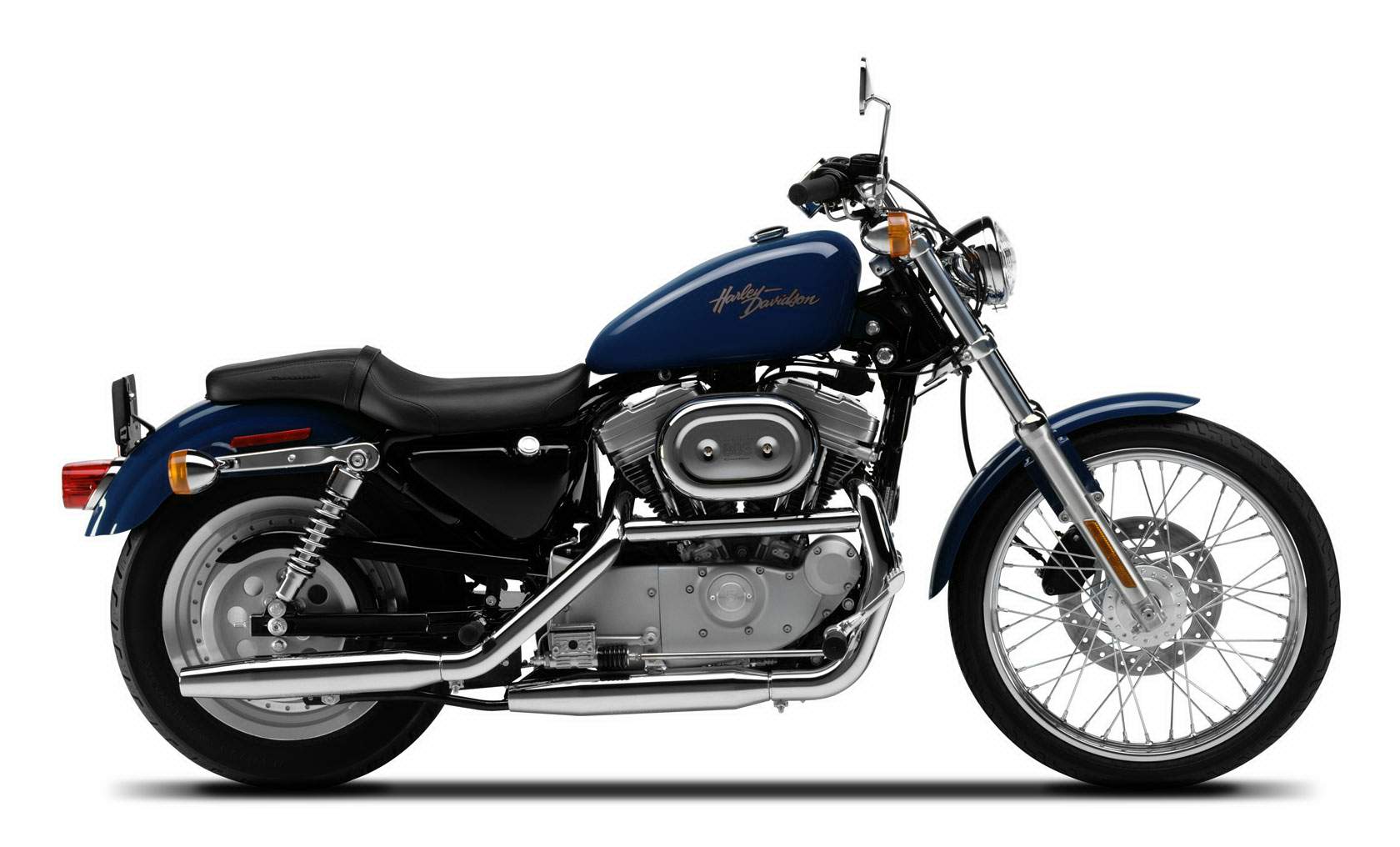
XL 53C Sportster Cuustom

|
Make Model |
Harley
Davidson
XL 53C Sportster Cuustom |
|
Year |
2000 |
|
Engine |
Air cooled, four stroke, 45° V-Twin, OHV, 2
valves per cylinder. |
|
Capacity |
883 |
|
Bore x Stroke |
76.2 x 96.8 mm |
|
Compression Ratio |
8.8:1 |
|
Induction |
|
|
Ignition /
Starting |
- / electric |
|
Max Power |
53 hp 38.6 kW @ 6000 rpm |
|
Max Torque |
67 Nm @ 4100 rpm |
|
Transmission /
Drive |
5 Speed / Belt |
|
Front Suspension |
|
|
Rear Suspension |
|
|
Front Brakes |
Single 292mm disc 2 piston calipers |
|
Rear Brakes |
Single 292mm disc 1 piston calipers |
|
Front Tyre |
80/90-19 |
|
Rear Tyre |
130/90-16 |
|
Dry-Weight |
235 kg |
|
Fuel Capacity |
12.5 Litres |
|
Overview |
American-v.co.uk |

The Sportster custom was never on my list of
priority bike to test because it failed at every hurdle for me.
Firstly it was a Sportster. Secondly it was a Sportster that was trying not to
be a Sportster. Lastly it was an 883 Sportster. Oh dear.
I can forgive Sportsters usually because at least they are pure in spirit, even
if I don’t actually think I’ll ever park one in my shed for anything other than
road-testing purposes, but as soon as one tries to be something it’s not … oh
dear, oh dear.
Still, it needed doing not least because the Stage One 883 we’d had out the
previous week was not happy and we needed confirmation of that. That the only
other 883 available was a bog-standard 53C did nothing to improve my mood, but
the sun was out and you’ve got to take the rough with the smooth.
I’d given the XLH883 one last chance to come good on the run down from South
Cheshire to Northampton but apart from an increasing certainty that it was set
up badly, somewhere down the line, it didn’t. I handed it over, muttering
something about checking the timing, at least, and went out to give the 53C the
once-over.
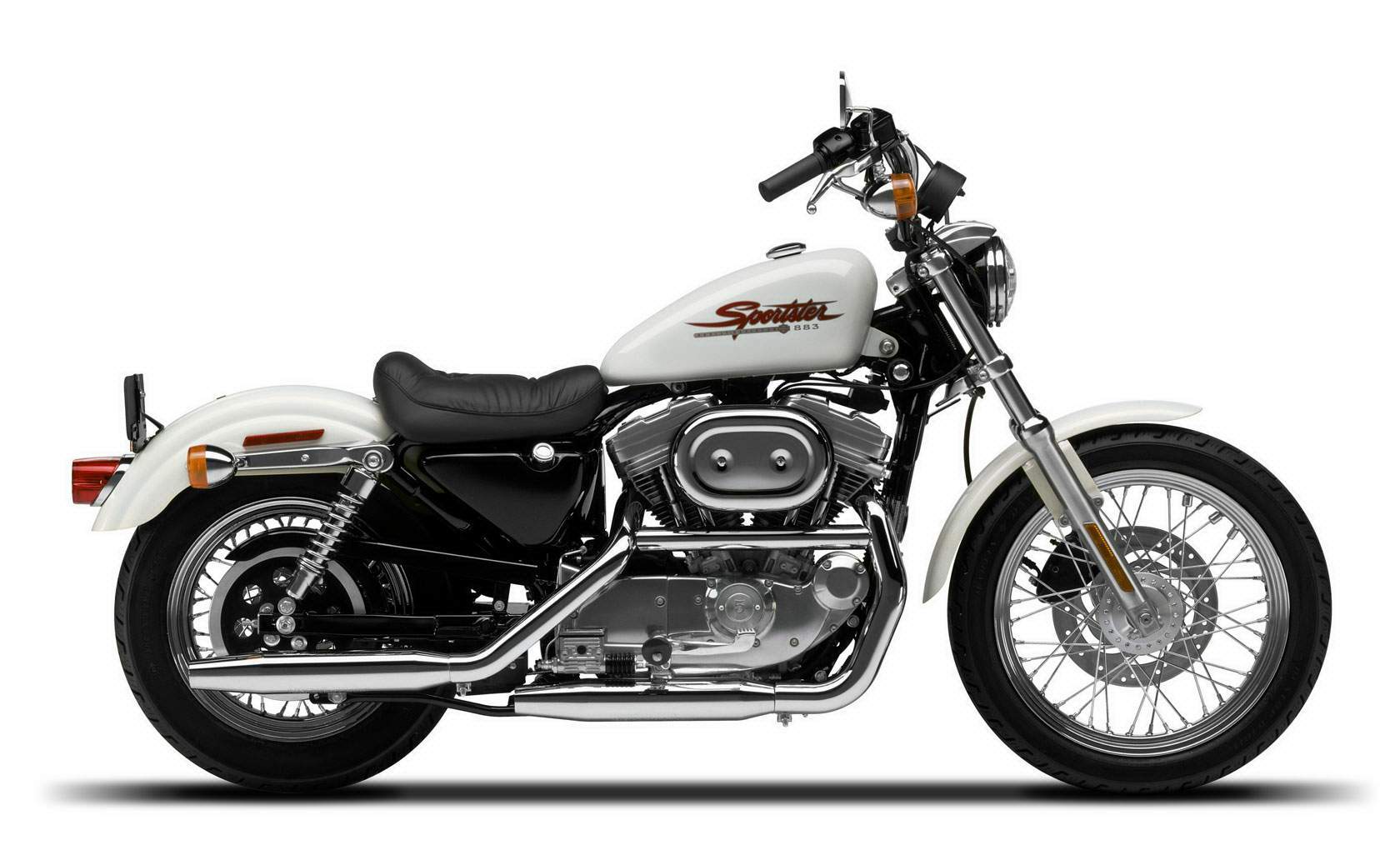
No chance of being inconspicuous, was my first reaction on sight of the pearl
white baby custom, but I did look at it properly for the first time. Solid rear
wheel from the parts bin, twenty-one inch front wheel from the same source. The
bastard offspring of a Night Train and an 883 was the immediate thought: shame
it wasn’t black, we could do something with that in the feature’s title. I slung
the throw-overs across the saddle and thumbed the starter, straining to hear the
noise from the silencers and remarking on the lack of top end squeaking that had
typified my miles with the Stage One 883. Sufficiently warm for a clean pull
away, we rejoined the A5 traffic heading back North and I finished warming the
diminutive bike before giving it chance to redeem its family name.
By the time we’d cleared the traffic from resurfacing roadworks outside Wayside,
the motor was good and warm, and ready to roll so it was time to lay the spectre
to rest. I wasn’t surprised to find it revved as well as it did, because I’d
been disappointed that the 883 didn’t. This was more like it: a stifled, but
happy little revver that didn’t amaze with its gutsy deep down power in the way
that a big twin would, or even quick responsive revving power beloved of its
bigger 1200cc sibling, but it wasn’t especially stressed, and it didn’t become
uncomfortably vibrant.
The shorter shocks, shared with the Hugger, meant that the tarmac was always
closer than it had been on the stock model, but the frame was the same, and as
stiff as both it, and the 1200S demanded: the lower seat height of both the 53C
and the Hugger take their toll of the cornering clearance but it still ranks up
there with the sportier Dynas - courtesy of extra long shocks - and the
surprising Deuce which gets its extra from the low-profile rear tyre. I never
ran out of clearance on either side, it has to be said, or at least not in a way
that sticks in my mind, but then as a rider of big twins, I’m used to the sound
of scraping metal, and only at the point where the frame touches down is it time
to look for a hole in the hedge. Until that point arrives, the weight is more
than up to the job of keeping the wheels in contact with terra-firma. On any
Sportster, the frame is tucked so far in that the engine cases will touch down
first, and if that happens, you’ll be on your side. What would touch down on the
53C would be the side-stand and the exhaust brackets.
The confidence-inspiring cornering and revvier motor knocked back any concerns
regarding the oversteer of the 883, but then corners were arriving more quickly,
and the weight and balance of the steering were well suited to the role. It
still required something of a run-up to overtake traffic comfortably, but that
was now traffic travelling close to the speed limit rather than agricultural
machinery that had strayed onto the highway.
Just as the tight chassis inspired confidence, so too did the brakes, being the
twin-pot items fitted to everything nowadays - a single front and rear - were
more than up to the job, as indeed is the same combination on a surprising
number of big twin models.
This was the bike I expected the XLH883 to be and I was glad to have buried the
experience of the poorly set-up example. What I really want to know now is how
the Stage One should have felt, because this was showing real potential.
I bimbled around for a week on the 53C before handing it to Rich, taking every
opportunity to hack around on it: exorcising the ghost of recent memories, and
found it to be both practical and pleasant in a variety of roles - although I
didn’t venture onto a motorway with it: that would’ve been asking too much. I
don’t think I’d be too keen to cover more than fifty miles at a stretch
voluntarily, although was obliged to more than double that at least once. At its
worst - notably after a hundred and fifteen miles - I found that it was still
more comfortable than the Night Train with which it shares a large number of
components, but that’s condemning it with faint praise.
I still wouldn’t actively seek a Sportster for distance work because there are
so many better bikes without leaving the Harley stable, and I’d be happy to pay
the higher price, but for all that the little custom grew on me immeasurably
during that week, which was something I noticed when I finally knelt down with
my camera to photograph it. There were so many bits that were right, and made
for quite a looker in a strange sort of way. The solid rear wheel didn’t look as
overpowering as it should’ve done, and the tall skinny wheel up front was quite
well at home in the upright forks that contrasted markedly with such a hoop’s
normal resting place. The chrome shroud round the risers, that serves to hide
the wiring for the idiot lights and provide a platform for the speedo, became
more attractive with familiarity, not least because the almost flat bars set it
off so well, and the deep-dish headlamp shell is a favourite of mine in custom
applications and finished off the front end in grand style.
Slightly more Heath-Robinson were the rods that linked the control levers to
their original locations: heavy and not especially pretty, and something akin to
that which I’d have made, but much more likely to survive long term use and not
at all delicate. Hardly a criticism, because I’d far rather it worked.
The only regrets are that we didn’t have the 1200C alongside to compare and
contrast the feel of the engines one after the other - which is the only way to
make an objective observation - and indeed that the original XLH883 with Stage
One kit was so bad, because I’d love to know how much difference to the engine
the free breathing carb and pipes made.
Still, all-in-all, and despite earlier misgivings, the 53C lives in my memory as
the Sportster that I could imagine owning … but not in white, and only if I
didn’t need a bike to do any serious distances on.
Second Opinion:
Words: Rich
Back in 1998 Harley-Davidson launched two new models into the European theatre,
designed to appeal much more to European taste than to their home market. One of
those models was of course the mean black Softail dubbed the Night Train, which
so astonished the public that the other model launched as its Euro-specific
stablemate was very much left in its shadow. That model was the XL53C Sportster
Custom 53, a mealy mouthful that is now more usually referred to as the 53C.
Though overshadowed by its bigger companion, in no way would I like to infer
that the 53C has in any way been a failure. There are a lot of them about - in
Britain at least - and it’s not too difficult to understand why: the 53C is a
handsome piece of kit. An 883cc, it asks an extra £800 over the price of the
base model, making it the most expensive ‘baby’ Sportster in 2001, but that
extra money offers a much higher level of trim. With forward-set front pegs,
unmistakable solid rear wheel, that single riser tower gripping the fairly flat
bars and a sleek gunfighter type seat, the 53C does cut a dash. But whether
Harley-Davidson caught the European taste with this machine as they so obviously
managed with the Night Train is definitely debatable. Had the 53C been offered
just in black, as the Night Train initially was, with perhaps a lot less rear
mudguard I’d’ve said a reserved ‘yes’. However I’d also argue that the new
sportier looking 883R is closer to tapping into that ephemeral European ethic
when it comes to smaller neater machines like Harley’s Sportster range.
Nevertheless, the 53C feels much more of a finished concept than it’s cheaper
brothers, the XLH & Hugger 883s, both of which offer a better blank canvas for
potential owner modification. If the 53C floats your boat, then a stage one or
two on the motor and that’s about it, Bob’s your Auntie. If the 53C doesn’t
float your boat, then there is absolutely no point in buying one, get a plain
old XL and your ‘extra’ £800 is better spent on taking it the direction you
personally want your Sportster to go.
Out on the street the53C doesn’t feel quite so nimble as the XL883 and I missed
the surefooted wider tyre on the 19inch front wheel. The 53Cs skinnier tyre on
the laced 21-inch looks the part, if you like that sort of thing, but I’m more
of your chunky kind of guy. The narrow drag bars sat high above the top yoke
worked okay out of town, but weren’t really quite so suited to town work. Making
the rider have to work much harder to physically steer the machine through the
traffic. Which is a problem, because the 53C isn’t really at home out in the
sticks either, although the motor has long enough legs of course, the rider will
soon start to suffer, despite the cruise height ’bars.
A possible improvement over the 1998 53C though is at least the instrument
console on this particular bike didn’t clout the petrol tank on full lock as the
one I tested in ’98 did.
With such a minimal seat and fairly stiff rear low suspension the ride is quite
uncompromising, much like any other Sporty, except a Sportster rider can
normally compensate somewhat by moving around a bit, taking the weight off their
bum. This is by reason of the siting of their front pegs, which although not
right underneath the rider, still allows the rider to transfer some of their
weight through their feet. No such luck with the 53C: legs out in front, you’re
stuck there and that’s that. That the cruising-style forward sets should
actually inhibit comfortable long distance cruising is bonkers - and smacks of
style before useful function.
Best not mention the pillion perch - for perch it is, and should only be
considered for emergencies.
Handling is okay, the frame is still a Sportster after all and is a stable,
stiff and secure platform. But again that ability to handle is marred. Whereas
an ‘ordinary’ XL883 Sportster allows at least some vigourous bend taking before
grinding out, the 53C grinds out all too soon, losing a full two degrees of lean
on the left and a staggering 5 degrees on the right! That makes this fairly
little bike almost as ‘ungainly’ as your average Big Twin.
There’s nothing wrong with either the front or rear brakes, they work just fine
and not really all that surprising given that Harley fit just those same two
stoppers to many of their larger bikes too. The stock 883 motor is underpowered
anyway so the brakes are hardly likely to tested to their limit - but even with
a hint of breathing on, in the shape of a stage one or two conversion, the
brakes should still be more than adequate.
That the engine is so under-utilised is a shame, but inevitable given the unfair
constraints imposed on it by various environment agencies. Luckily much of that
potential can be legally released once purchase has been made, but even so, that
the owner should be asked to cough up another £500 at least on top of that
purchase price to get to it doesn’t really seem all that fair. Having said that
of course, it’s a distinct possibility that many 53C owners don’t bother to
release any more power from the motor! After all, what would be the point if the
53C, set up as it is, doesn’t really allow you to get the best out of all that
extra oomph anyway?
All in all, the XL 53C ends up being a bit of a dog’s dinner, not quite
fulfilling any of the tasks it is asked to handle. It is a nice looking machine,
no doubt about it and the finish is excellent, but it’s a distinctly
uncomfortable long distance machine; doesn’t really cut it on mid-distance
country road ride-outs and is too harshly suspended, the ‘bars aren’t quite
right and it’s too slow turning for really useful town work. It’s as a High
Street bar-hopper that the 53C really cuts it, a head turning style statement.
But whether that is enough use in itself to justify actually buying one is
another question entirely
Source
American-v.co.uk
|