|
|

|
|
|
|
Classic Bikes
Custom Bikes
Individual
Racing Bikes AJP
AJS
Aprilia
Ariel
Avinton / Wakan
Bajaj
Benelli
Beta
Bimota
BMW
Brough Superior
BRP Cam-Am
BSA
Buell / EBR
Bultaco
Cagiva
Campagna
CCM
CF Moto
Combat Motors
Derbi
Deus
Ducati
Excelsior
GASGAS
Ghezzi Brian
Gilera
GIMA
Harley Davidson
Hero
Highland
Honda
Horex
Husaberg
Husqvarna
Hyosung
Indian
Jawa
Kawasaki
KTM
KYMCO
Laverda
Lazareth
Magni
Maico
Mash
Matchless
Mondial
Moto Guzzi
Moto Morini
MV Agusta
MZ / MuZ
NCR
Norton
NSU
Paton
Peugeot
Piaggio
Revival Cycles
Roland Sands
Royal Enfield
Sachs
Sherco
Sunbeam
Suzuki
SWM
SYM
Triumph
TVS
Ural
Velocette
Vespa
Victory
Vincent
VOR
Voxan
Vyrus
Walt Siegl
Walz
Wrenchmonkees
Wunderlich
XTR / Radical
Yamaha
Zero
Video
Technical
Complete Manufacturer List
|
Harley Davidson XR 1000
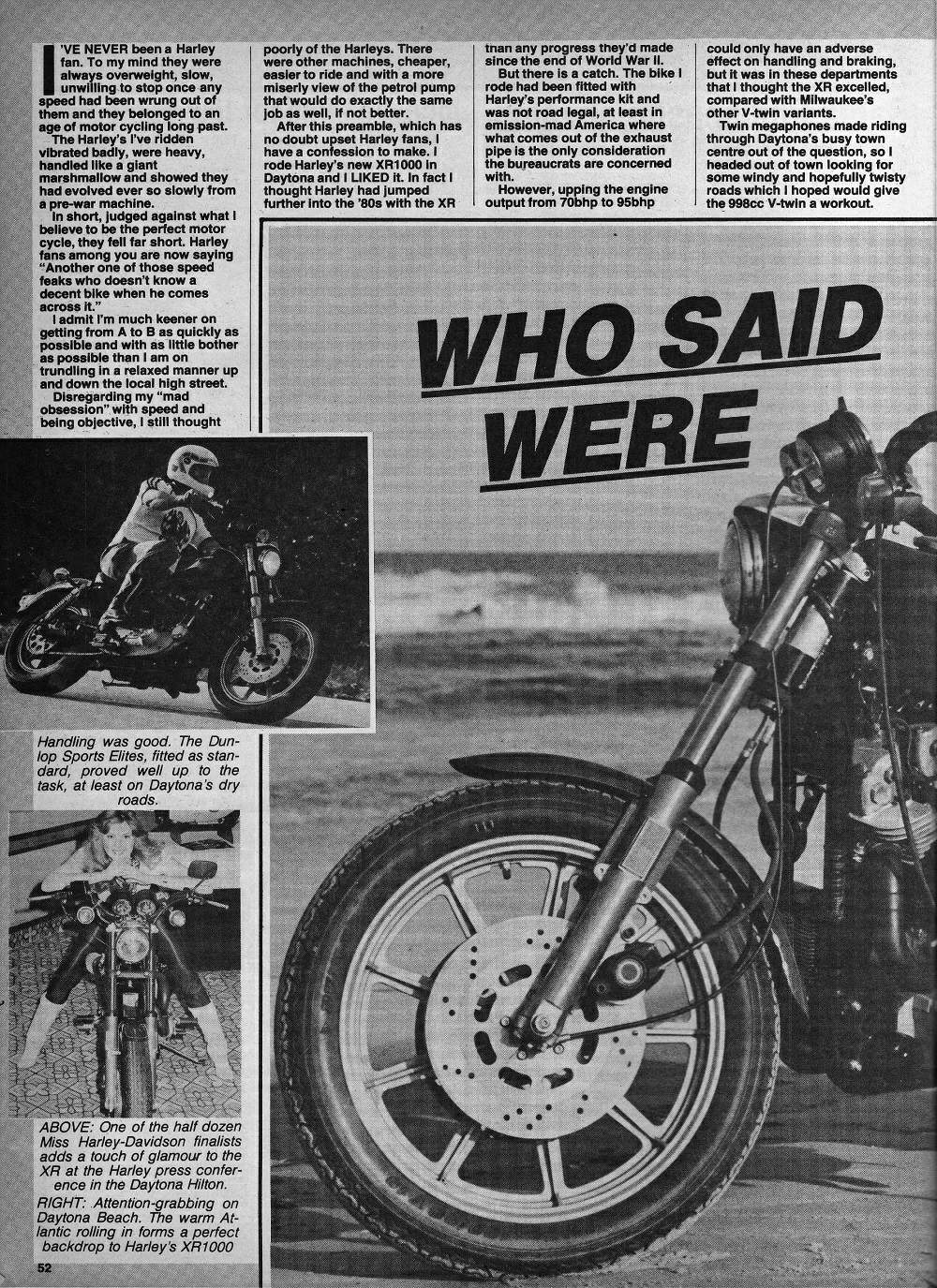
CYCLE Week '83 at Daytona Beach was a milestone in the long and recently turbulent history of the Harley-Davidson Motor Co. Not only was Daytona the venue for the official launch of the new XR1000 street racer but it also saw the return of an official H-D team to road racing. Ten years exactly since a Milwaukee V-twin last appeared on the banking of the Florida Speedway, Harley returned triumphant to score two crushing Battle of the Twins victories on variations of the new street model. Three-time AMA National Champion Jay Springsteen thundered his way to an impressively clear outright win in the Grand Prix class, with more than a hint of flat-track body English in evidence as he drifted his ex-Cal Rayborn XR750 chassis with modified XR1000 engine through the infield turns; while Gene Church cruised somewhat more sedately but no less emphatically to first-time victory in the prestigious Stock category on the track debut of the XR. So, almost from the outset the XR1000 Harley-Davidson has impressive competition credentials in its own right. It's true to say, though, that these are all but superfluous — for H-D's latest model is descended directly from the bike which has dominated US dirt-track racing for the last decade and more: the XR750. Seldom has one machine so totally dominated its class of racing, and for so long, as Harley's overhead-valve mile and half-miler — occasional hiccups from Yamaha and Honda not withstanding. And seldom has the bike-buying public waited so long, and in vain, for a road-going version of the successful competition motorcycle. Now at last Harley have bowed to pressure and produced the XR-with-lights that's seemed inevitable since the mid-70s when Jay Springsteen won the first of his three titles and the XR's dominance of the dirt scene began. Their reluctance to act until now is explained partly by the cost of developing what is seen as a minority interest bike — it's not quite as simple as just sticking brakes, lights and an alternator on to a miler — and partly by politics. In the old days, Harley-Davidson was controlled by AMF, and corporate types are notoriously slow to invest in such a fickle commodity as enthusiasm. Now that H-D is once again in control of its own destiny, the Harley tide has swung in favour of the enthusiast market, and the XR1000 is the first proof of this. At this point I should declare an interest — and some preconceived notions, even prejudices. I've been the fortunate owner of an XR750 for the past five years, albeit not one of the kings of the dirt but one of the dozen or so road-racers built by the factory in the early '70s. It's one of the first alloy-barreled versions, dating from 1972. The iron-jug XR's debut was actually at Daytona in 1970 and it was raced in Europe as well by Renzo Pasolini, number one rider for Harley's Italian subsidiary, Aermacchi. I prize the old lady highly (and have grown to love riding her in British classic races), as much for the calm and unhurried way in which she reaches a quite surprising top speed as for the gobs of low-down torque which makes two out of the four gearbox speeds almost superfluous. The 750's a rare bird in Britain and may even be the only one left in Europe: yet judging by the crowd of paddock shutter-snappers she attracts, Harley have deep reserves of loyalty, as yet largely untapped, among a British public for whom Cal Rayborn became a folk hero thanks to his heroic rides in the 1973/74 Match Races. Hard-nosed racing fans will get misty-eyed when they recall Cal's do-or-die duels with Triumph team leader Ray Pickrell on tracks he'd never even seen before. Yet much as I love racing Paso's old XR, nothing could have persuaded me to consider investing in a Harley road bike — till now. Milwaukee seemed much more interested in catering for its traditional market of Wide-Gliders and Fat-Bobbers than in widening its horizons by producing a performance-orientated sports bike a la Ducati, even though they had all the makings of one in the shape of the XR750. Instead, we got half-hearted triumphs of styling over design (you take your Café racer black, don't you, Sir) or Sportster variants which were neither fish nor fowl.
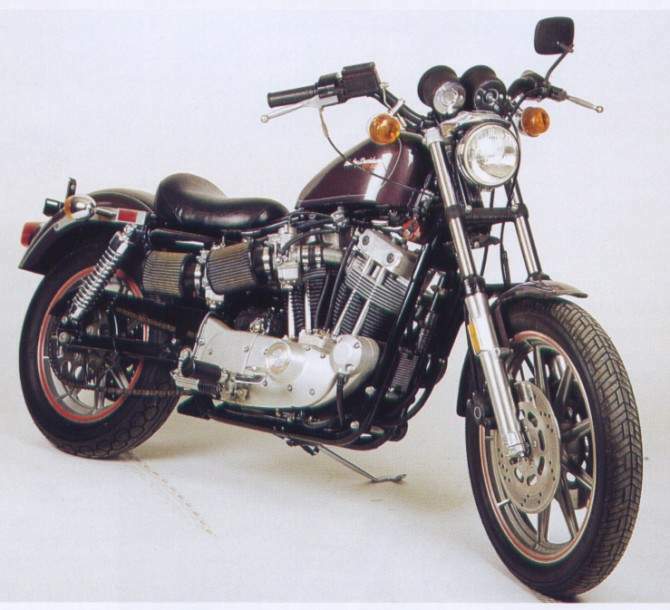
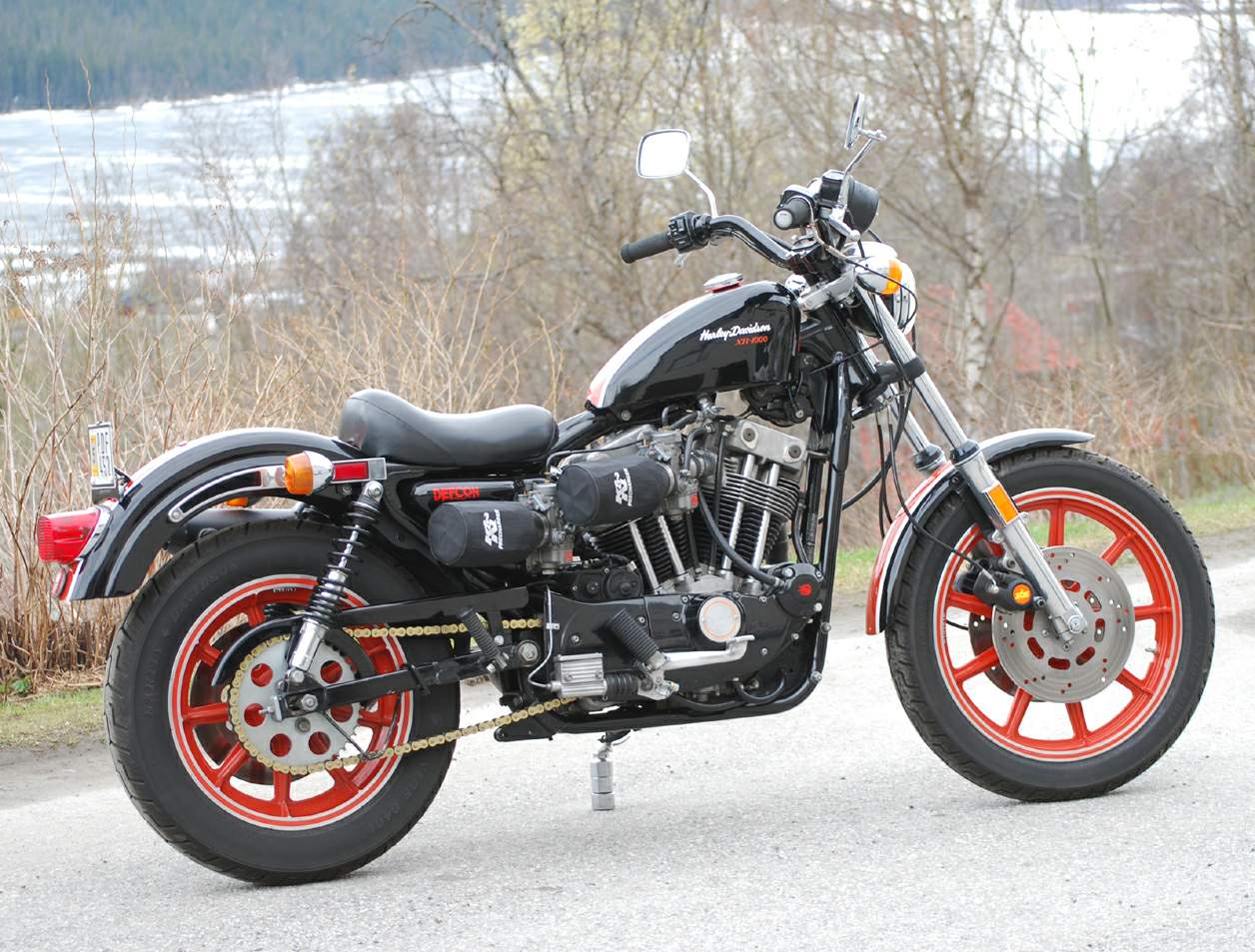
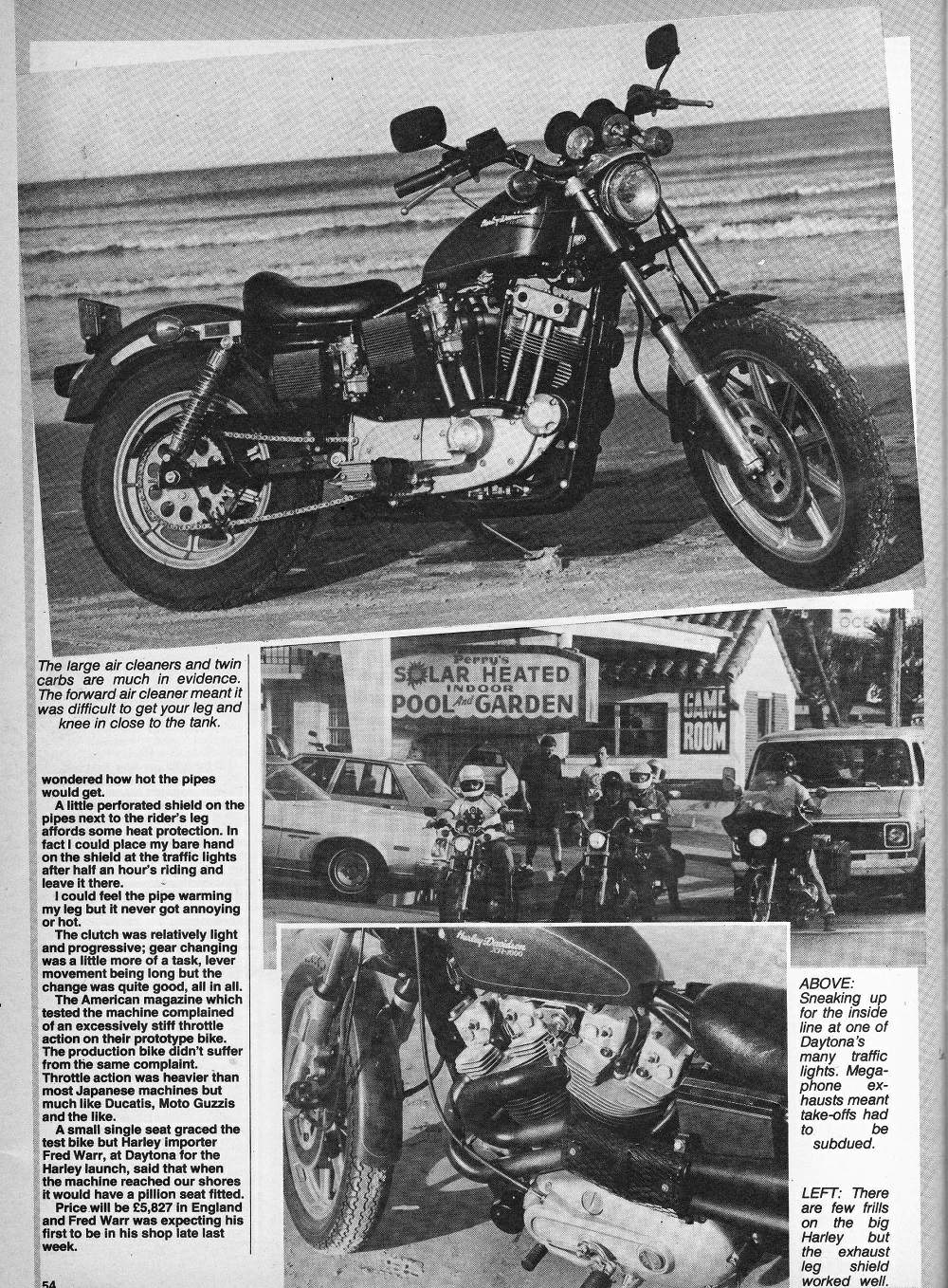
I've had occasional tryouts on street Harleys from time to time over the past ten years, both as potential customer and blagging journalist. In the latter case, I have to admit that I've never written a story by way of follow-up — for one very good reason. Whatever they may pretend, bike manufacturers don't mind you criticising their products provided you find more good things to say about them than you do bad. Figuring that sooner or later Harley were going to come up with a bike I'd really want to ride, I kept stum about all those experiences with brakes that didn't, suspension that wouldn't, vibration that shouldn't and engines that couldn't. And boy, am I ever glad that I did. Because otherwise I might not have been able to persuade Len Thomsen, head of H-D's international division, to prise one of the scarce press XR1000s at Daytona loose for me to spend a whole afternoon with (maximum time limit per journalist otherwise: one hour. Wonder how many of them will own up to that in print?). Covering 100 miles or so in the time available on everything from the Interstate to the only bit of racer road within 50 miles of Daytona Beach — and I don't mean the Speedway infield — only whetted my appetite for more. Due to the non-arrival of the press fleet XRs, it was actually the private bike of one of H-D's own employees which he'd ridden down from Milwaukee for Cycle Week to break it in. Apart from the really neat bum pad he'd made and put on the rear fender (how 'bout it, Willie G?), it was a completely standard bike with the 70.6bhp engine. Having been more than slightly impressed with the performance of Church's XR1000 in the BoT race — he actually out-accelerated my Modified Production Ducati 900 when I came up behind him in the infield — I also wanted to try an XR1000 with the optional factory performance kit, which in its most extreme form brings engine power up to around the 95bhp mark. Since the bike I managed to find with all these goodies on wasn't street-registered, its owner had better remain anonymous but thanks to him I had a chance to try out one of the ultimate fun racing/road bikes of the 1980s. When I rode my poor old XR750 a week later in the gloom of the British springtime (just like winter only with colours), it seemed so slow in comparison I thought something was wrong. For with the XR1000 and its three levels of tuning kits, Harley have produced a bike that's so much fun to ride, you can hardly believe it. I'll admit my first look at the XR1000 was disappointing. The motor consists of a Sportster bottom end (as did the original XR750, as it happens) surmounted by XR heads, with special barrels, induction and exhaust systems all slotted into a restyled version of the latest (1982-type) Sportster frame. Instead of producing a Jay Springsteen replica, complete with orange and black paint, XR tank and the like, Harley have given us in appearance at any rate a racerised Sportster. That explains the peanut tank — out of keeping with such a machine — the rather drab steel grey paint job, and the sort-of-hot-rod appearance. But then you take in the massive K&N air filters, the heftily-finned barrels, twin matt-black boomer exhausts sweeping back along the left flank, the opposite side to most Harleys, the well-padded but unashamedly solo seat. Sure, a 16in rear wheel combined with an 19in front comes straight from the Low Rider book but there's no disguising the XR1000's heritage. When you throw a leg over the seat — easily done, by the way: seat height is only 29in — and thumb the starter button you just know where the XRI000's coming from: San Jose, Ascot Raceway and all those countless dirt tracks of Middle America, that's where. Thunder Road is the XR's back yard as the twin megaphones boom into life, the engine spits and pops and lumps unevenly 'til it's warmed up.
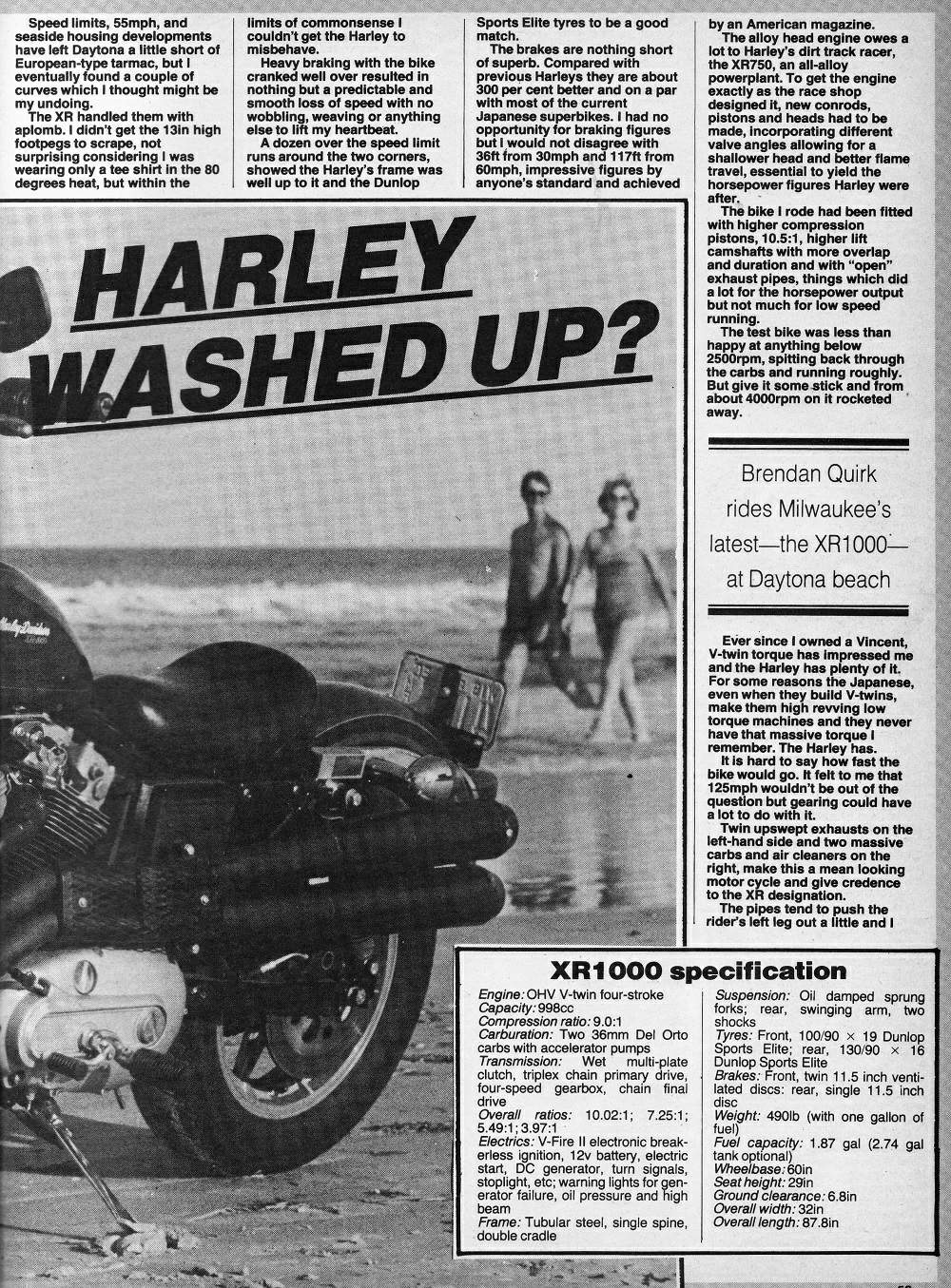
The riding position is comfortable, with relatively flat, wide bars, and footrests directly below the neck of the seat inducing a Springsteen-like riding position, with flat back, slightly kicked-out elbows, even slighter forward body lean, and knees stuck out In The Wind. Seat and riding position are comfortable over extended distances but after a short time your left leg begins to be cooked to a nice turn because of the inadequate heat shielding on the exhausts. An alloy plate or a wire mesh grille would be better than the present arrangement. Your right leg tucks cosily into the front cylinder's air filter, which seems not to resent the intrusion, but try bracing your knees against the tank when you hit a series of bumps and you'll be rubbing them against each other before you succeed. Practically as well as stylistically, the peanut tank is out of place on this performance bike. Vibration is unexpectedly low — even on the hot version with its lumpier cams and tuned engine. Rubber-mounted bars cushion much of the 45° V-twin's intrinsic shake, rattle and roll — no power-sapping balance shafts or Honda-style offset crankpins here, just good old H-D knife-and-fork conrods sharing a common big end. The engine's obviously been very carefully balanced, a result perhaps of its race-shop heritage, for the XR1000 is in everyway a direct descendant of the XR750. It was designed, and the prototype built, in the company's racing department under the direct control of Dick O'Brien, long-time H-D competition chief who should really take all the credit for the XR's creation in the first place. Having been given the task of producing an XR-with-lights, O'Brien and his band of merry men created the finished, tested article in less than 60 days. And you thought only the Japanese could move that fast? Listen, two months is a long time in racing ... so here we have a cobby, sporty-looking H-D with a generally comfortable riding position and vibration no worse than, say, a Ducati. Ah, you say, but wot'll she do, mister? Well, getting her to do anything at all involves coping with a ludicrous combination of a typically fat Harley twistgrip with a completely smooth surface, and a set of throttle springs you could pogo with in the twin 36mm pumper Dellortos The throttle action has to be so stiff to counteract the massive suction effect of the draughty 45mm intake (and 38mm exhaust) valves. That of itself wouldn't be so bad if it weren't for those crazy smooth grips which render throttle control difficult in the extreme. This made the first few miles on the XR a series of on/off bursts of acceleration and deceleration until I gradually learned to cope. As for gearchanging — well, let's say it's an acquired art. Which it shouldn't be because the XR's gearbox is everything you'd expect from a sports bike's transmission. Positive selection of all four gears with a medium length lever throw and a smooth change action. Neutral is hard to find, though — as you might expect from a race-bred engine, coming from an environment where neutral is the last ratio you want to select unexpectedly. This might not be a problem but Harley have, for some unaccountable reason, dispensed with a neutral light amongst the row of three oil/beam/generator idiot lights beneath the 8000rpm tacho and 110mph speedo, so hitting neutral at lights and intersections is largely a matter of guesswork. Only four gears? Well, yes — though a very few five-speed XR gearboxes were made in 1973, the factory's withdrawal from the Hard Stuff rendered them unnecessary 'cos you just don't need them for dirt mile races, even at 100mph average speeds for the same reason that a fifth speed would be superfluous on the XR1000 — the engine's huge reserves of torque. The revcounter's red line at 6200rpm invites you to try to spin the engine up that far, yet peak power is produced (on the standard engine) at 5600 revs and maximum torque is at 4400rpm. Stock Sportster cams are used, but with eccentric rocker adjusters in the XR heads. The heads are sent by the factory to Jerry Branch in Los Angeles for porting and finishing before being shipped back to Milwaukee for final engine assembly. The 998cc mill gives power from practically anywhere you want it: there's huge gobs of poke from 2000rpm upwards and the XR will actually pull cleanly away from as low as 1500 revs in top gear. There's absolutely no point in even approaching the redline in the lower gears — just short-shift and let the massive torque pull you along surprisingly quickly to the accompaniment of a fabulous (but quite legal) booming exhaust note.
The XR1000 Harley will let you ride it in the way that suits your mood. It's also a safe bike to have fun with, because for the first time on any Harley I've ever ridden the brakes are truly excellent. I was beginning to think I'd never be able to say that about a Milwaukee motorcycle but now at last Harley have turned the corner. The XR's twin 11 and a half inch front discs provide smooth, progressive stopping power of a type that up to now has been associated with Italian machines, lust squeeze the lever and it stops, with very little front end dive even when one of Florida's numerous octagenarians pulls out in front of you in a rusting '63 Mercury. It's one of the most dramatic — and unexpected — areas in which the XR1000 excels. The steeper head angle in comparison to other street Harleys gives quick steering and excellent handling over smooth surfaces, especially with the box section swing arm and grippy Dunlop Sport Elite covers. Even the bumps on the Daytona banking didn't appear to unsettle Church's bike when I came up behind him in practice one day but on the road bike I tried with the same suspension (practically no changes can be made to BoT Stock class machines) it was a different story. The rock hard rear suspension tosses you up in the air over any rough surfaces such as railway tracks or road construction ridges, and though the rebound damping was reasonable, the springing certainly wasn't: some playing around with spring rates by a prospective owner would appear to be in order here. Another quirk of the Harley is that it leans slightly to the left when at rest, and at really low speeds you have to consciously steer right to correct this imbalance, apparently caused by the shifting of the relatively heavy exhaust system from the right to the left side as on the racing XRs — except the chassis and engine location belong to the Sportster, which has the pipes on the right. It's not any real kind of problem, more a curious idiosyncracy. Riding a standard XR1000 can be summed up in just one word: fun. It's the sort of bike you'd find yourself inventing reasons to go for a ride with, preferably along the curviest piece of road you can discover. Hustling the Harley through the twists and turns in the Florida sunshine, short-shifting away from traffic lights and letting that oomfy engine pull you along is what bike riding should be all about. And when I tried the street racer with the performance kit fitted, though low-speed idle was irregular and tootling round town something you'd be better off not doing, the fire-eating characteristics of the 95bhp engine in a bike weighing around 480 pounds meant rubber-laying was the order of the day. Quick — go buy an XR1000 before someone bans them because they're too much fun. And there's the rub. For having fun with the XR1000 is in the same financial category as holidaying in the Bahamas in winter or eating caviare for breakfast: it's expensive. Harley have listed the standard model at $6995 in the USA, with correspondingly high export prices especially in light of the current strength of the US dollar abroad. Initial production plans call for 1000 bikes to be built before the end of the company's 1983 model year at the beginning of July but Thomsen stresses that there are no plans to limit production to try to make the bike 'exclusive'. Harley will build what the market wants, and provided dealers are prepared to let potential customers try the bike out on a test run beforehand, it won't only be committed H-D fans who'll end up buying one. The XR1000 delivers more or less what it promises — and that's hard for a street version of any racer to do, especially when its progenitor is as famous a machine as the XR750. In truth the bikes share precious little in common: the all-important alloy heads with the Branch treatment is about all. Iron barrels with massive finning replace the racer's alloy ones, and valve sizes, conrod lengths, cams and so forth are all specially designed for the XR1000. The relationship between the two bikes is one of concept: the same people thought them up and the same people developed them using the same basic engineering philosophy. All the XR1000 needs to make it one of the world's great bikes is for Harley to rethink some of the few disappointing areas: get a proper XR fuel tank, painted in traditional H-D racing colours, on the bike; replace those crazy grips with something your hand won't slip on and at the same time try to improve the run of the throttle cables. If they also provide adequate heat shielding on the exhaust without sacrificing the styling and add a neutral light they'll have a motorcycle people will line up to buy — even at seven grand US. I know— if I could only persuade the Ed to pay me what I'm really worth, I'd be one of them! Source Bike 1983
|
|
|
Any corrections or more information on these motorcycles will be kindly appreciated. |