|
|
|
|
Classic Bikes
Custom Bikes
Individual
Racing Bikes AJP
AJS
Aprilia
Ariel
Avinton / Wakan
Bajaj
Benelli
Beta
Bimota
BMW
Brough Superior
BRP Cam-Am
BSA
Buell / EBR
Bultaco
Cagiva
Campagna
CCM
CF Moto
Combat Motors
Derbi
Deus
Ducati
Excelsior
GASGAS
Ghezzi Brian
Gilera
GIMA
Harley Davidson
Hero
Highland
Honda
Horex
Husaberg
Husqvarna
Hyosung
Indian
Jawa
Kawasaki
KTM
KYMCO
Laverda
Lazareth
Magni
Maico
Mash
Matchless
Mondial
Moto Guzzi
Moto Morini
MV Agusta
MZ / MuZ
NCR
Norton
NSU
Paton
Peugeot
Piaggio
Revival Cycles
Roland Sands
Royal Enfield
Sachs
Sherco
Sunbeam
Suzuki
SWM
SYM
Triumph
TVS
Ural
Velocette
Vespa
Victory
Vincent
VOR
Voxan
Vyrus
Walt Siegl
Walz
Wrenchmonkees
Wunderlich
XTR / Radical
Yamaha
Zero
Video
Technical
Complete Manufacturer List
|
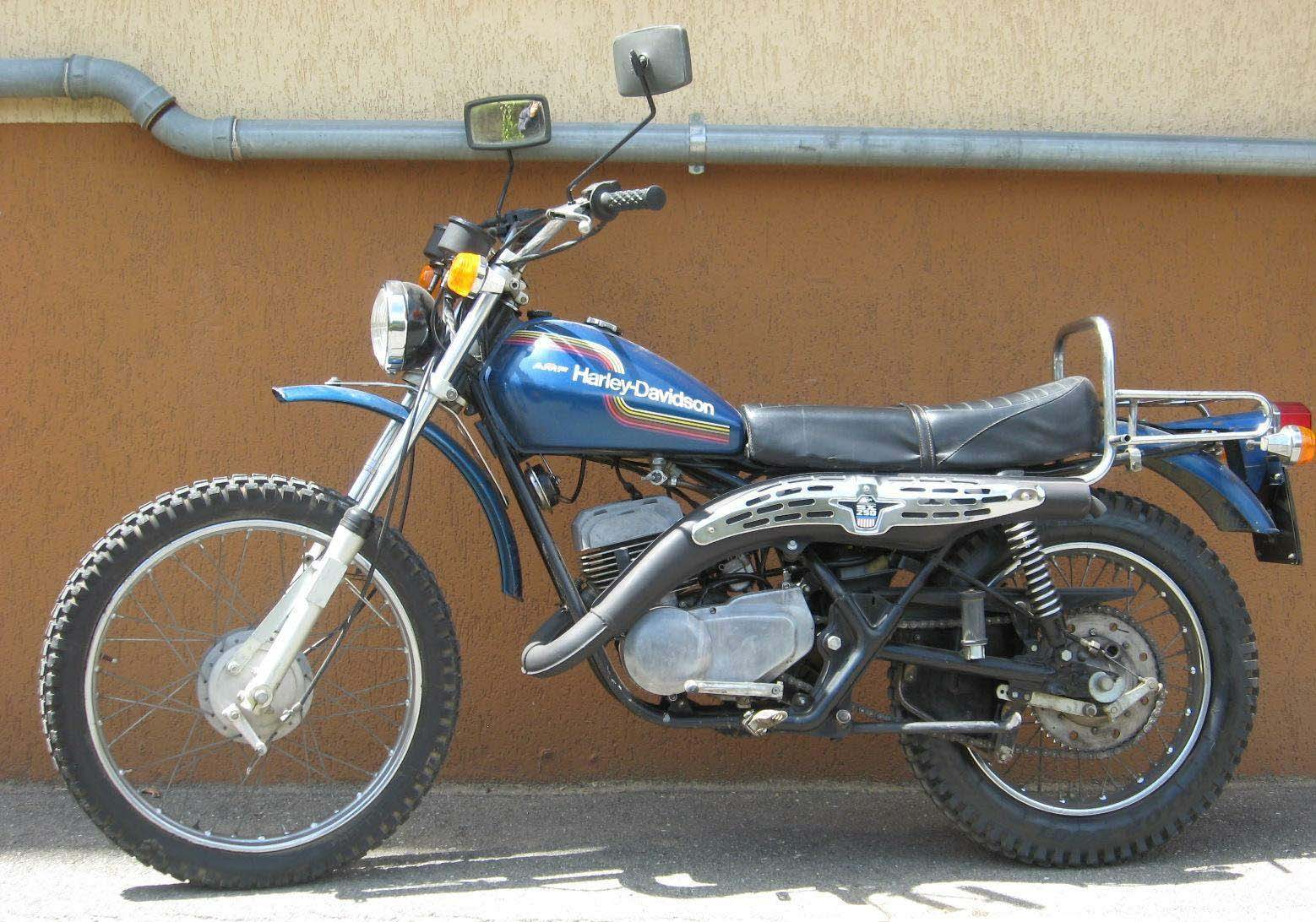
Aermacchi / Harley Davidson SXT 250
Hoping to draw even larger groups of riders into the Harley-Davidson fold, the Motor Company continued to explore the options offered by smaller, more nimble machines. The SS-250 was a larger version of the earlier SS-175 and was meant for use on the street. For those wanting on-and off-road capabilities, the SX-250 was at their avail. The two-stroke motor displaced 250 cc, and rowed through a five-speed gearbox for maximum flexibility and eager response. Not a huge hit in its first year, the SS-250 still filled the needs of many riders. Review Suzuki GT250 vs CZ 471 vs Honda CB250 vs Ducati 250 vs Harley SS-250 vs Yamaha RD250 IT REALLY wasn't intended to turn out this way. we reflected as the test hung rag geclly only halfway to completion and tense 'phone calls from harassed importers began pointing out that most of the bikes were already overdue for return. The rush of mail after the six bike 125 cc Giant Test in the January issue had suggested that a similar venture with 250s would be welcomed, so we set out to assemble up to half - a • dozen quarter litre roadsters. But at that stage there was no intention of billing the project as any kind of biggest and best in motorcycle testing, as that kind of sanctimonious breast - beating is generally better left to the Daily GetsMuch Worses of Fleet Street. However, matters began to change complexion once we drew up a list of potential victim machinery. For Giant Testing purposes, bikes often fall into neat and obvious little groups of twos and threes, viz. the Trident v Commando Brit bikes in last month's issue, or the Suzuki v DkW Wankels in February. But in the 250 class, life turned out to be not so easy for hack scribes seeking clean-cut solu tions. The four Japanese factories obvi ously had to be included, for the simple reason that a lot of people bu\ their 250s. either because they like them or because thev think that's all there is. MORE VARIETY But it was felt that more variety was needed, so onto the list was pencilled MZ, who really had to be included after their unexpected success as value - for - money winners of the January 125 bash. But if the low priced MZ was to get in. so should the even cheaper CZ. And a Ducati too, as these fuel-conscious four stroke singles are apparently being snapped up faster than car factories are laying off workers. That made a total of seven bikes, and it seemed a good time to call a halt. In any case, they represented every manufacturer attempting lo sell 250 cc road bikes in quantity in the UK. Note that on this occasion we'd avoided trail bikes or dual purpose street / trailers, making 250s intended for pure road use the strictest parameter of the test. The next step was to send out letters or 'phone calls requesting the various bikes. It's at this stage of a Giant Test intro that we usually lapse into slightly paranoid tirades against the mypoic state of the motorcycle industry in the UK for frequent unwillingness and/or inability to allow the public to sample their products via the vicarious medium of road tests. So to give the trade the least possible excuses for avoiding the shoot-out. the begging letters were despatched no less than four months before the time you're reading this in other words, a clear two months before testing was due to commence. But as it turned out. the expected wrestling match in procuring certain of the bikes didn't materialise, and most of them were promised almost by return of post. Then, with lest time rapidly approaching. Harley stepped in to offer us the first British ride on the SS 250. the new street version of their two-stroke single trail bike. Now' this is the point at which things got really serious and heavy. We suddenly realised that we had on our hands the most comprehensive motorcycle test ever attempted in Britain. It may not be modest to say so. but it's a plain fact that Bike holds all the records anyway, starting with the seven-bike trail test back in Spring '72, followed by an eight-machine moped squirt in the summer of '72, and the aforementioned 125 cc session earlier this year. Now although this test includes the same number of bikes as the moped buzz, it's obvious that full-blooded motorcycles demand a lot more attention and riding time if meaningful results and conclusions are to be drawn. So we felt justified, if only we could keep the eight would-be suppliers up to their promises, in banging the can about this being the biggest test session ever compiled in British biking journalism. Right, now the riders. A venture of this magnitude was clearly too cumbersome for the mag's full-timers of Hay lock. Mather and me to undertake alone. Fortunately, we're blessed with the support of a number of capable, if eccentric, freelances (for evidence of quixotic behaviour, check this and past issues for A History of Project Bikes I Have Bodged / Forgotten About / Changed at the Last Minute, as compiled by Martin '"Don't Worry 'bout a Thing" Harrison). So in they came. Harrison himself, the unrelated Williamses. Mark and Barney, and Graham Sanderson, who deserved something more pokey to ride in return for past support in compiling moped and 125 cc sessions. Plus Pete Ward, who was once gullible enough to ride to the Elephant Rally for Bike and who now races vintage grass track machines, but there, we all make mistakes some time in life and those are just some of his!a few minor breakdowns occurring, some bikes not being run in at the time of collection, and the lengthy business of having to cart all eight to the test strip, and taking them back again if for some reason they'd malfunctioned the first time, it became obvious that we'd bitten off more than we could digest easily. That's why we were forced to hang on to the bikes for a long while, and we can only hope it didn't cause that much inconvenience to suppliers — we'll find out the next time we ask 'em for machinery. Meanwhile, in the following pages there'll hopefully be pertinent information for anyone owning or contemplating the purchase of a 250 cc motorcycle, and wholesome entertainment for those who can't afford one or wouldn't even bother to spit dirt at one with the rear Metzeler of their R90S. Mike Nicks CZ 471 WHAT YOU SEE is most definitely what you get with the CZ. Don't be fooled into thinking that because it's a two-stroke twin just like the Yamaha and the Suzuki, you're buying into some kind of secret society bargain that'll put a smirk on your face every time you go riding with your Jap mounted buddies. The truth is. the smile will fade when they disappear over a faraway hill and you're still waiting for the CZ to peak in third gear. However, that's not to say that Commie biking is all shattered illusions, merely to point out that the £200 difference between the CZ and the Japanese products is a pretty accurate reflection of their respective values, and the kind of biking fun you'll get from them. In any case, Skoda GB are honest enough to maiket the CZs as low cost commuter machines, so there's no reason for potential buyers to expect anything more. Budget biking in the case of the 471 consists of the aforesaid twin-cylinder motor cradled in a single loop frame, and driving through a four speed gearbox. It must be almost unique these days in being a twin with only a single carburettor (a 24-mm Jikov). although that's entirely in keeping with the CZ's prosaic style. Lubrication is by messy old oil - in - the - fuel, and electrics are only six volt. Items you don't expect to find on a three hundred quid 250 include alloy rims and a fully enclosed rear chain, the latter making it easy to keep things clean. But the handlebar switches are as shoddy as on any Italian bike, and the one on the right controlling the indicators works in the confusing up and down plane. The dip and the horn button are on the left. A two-tone paint job is evidence of CZ's attempts to get on terms with the decadent West, which makes it even more of a shame that they should have chosen sickly shades of either green or brown. Overall, the CZ's appearance is, shall we say, ruggedly sturdy. As the motor puts out a modest 17 horsepower, it's hardly surprising that the Japanese and Italian competition, and even its MZ Commie bedmate, will leave the CZ well behind in the performance stakes. That's an observation rather than a complaint, however, as when one cocks a limb over something that's obviously designed as a utility machine, the blood tends to cool and you even begin to enjoy motoring at a more sedate pace, watching the landscape and the cities you're passing rather than frantically trying to outbrakc a line of 47 Ford Cortinas into the next roundabout. Suffice to say that the CZ has adequate acceleration, and progress is assisted by the lulling lack of vibration at medium engine speeds. On the subject of roundabouts, and indeed bends in general, I slowed down a lot for the first one on the CZ. allowing for the worst just in case lousy handling went with the low price. But it seemed to track well, and after swinging through the next two a little deeper and harder, it became obvious that CZ put into their road bikes what they've learnt from their famed dirt bikes that clean up every year in the International Six Days Trials. A pity then, that the brakes on the 471 were so feeble in contrast. A stopping distance of 176 feet from 60 mph comes perilously close to earning the kind of abuse we heaped on the Russian two-strokes we had the misfortune to lest last year, both of which were so disgustingly under braked that they were potentially lethal in Western Traffic conditions. It's a mystery really, as I don't recall previous test CZs being that bad in stopping qualities, and the 471 does have the benefit of a twin-leading shoe front anchor. While they need belter brakes, what CZ ought to junk is that appalling arrange ment of the clutch being operated by both the clutch and gear levers. The clutch lever only has to be worked if you're engaging gear at rest, pressure on the gear level doing the work automatically during on the - move changes. But really, all it achieves is to fuzz up even further an already long and clunky gearbox action. Really earning its keep, the gear level also doubles as the kickstart once you tap it lightly in the direction of the crankcase. allowing it to be swung up and back for action. You then find that the CZ is one of the. easiest two-strokes lo start, always burbling to life within two or three swings even after days of inactivity. A steady flow of approving readers' letters would seem to indicate that most CZ owners don't get stuck by the roadside too often, which made it more surprising when the lest bike started wheezing asthmati-cally one day. A knackered head gasket was speedily repaired while I attended the press opening of Skoda's big new distribution and service plant at King's Lynn for their tractors, cars and bikes, which served to indicate that they are serious indeed about selling their products in the UK. Would-be owners need have no fears about being left with obsolete and unrepairable machines on their hands in future years. With the gasket job done, it was back to finishing off the running in session before taking the bike to the test strip for performance tests. But time was running out too, so we had to lake 'er up there still with only 800 miles on the clock. By most two-stroke standards that's a reasonable mileage, but CZs seem to need longish running in periods, and the test bike more or less told us so when the motor seized up with an anguished yelp just as I was doing my Kenny Roberts bit up the strip and only 50 yards from the speed trap. So. although we had acceleration figures by that time, you'll see in the Checkout panels only an estimated figure of 75 mph for the bike's top wack. This seems realistic for a bike with a cruising speed of around 55 to 60 mph. A pity she locked up. though, because an event like that always seems to end a test on a sour note, even though it was in a way our own fault through not having the lime to do more preliminary miles with the motor. Still, by that stage I'd already decided that £308 was about as much as one can be asked to pay for a bike with lousy brakes and a bad joke for a gearbox. Mike Nick Ducati 250 MkIII IT'S A FINE day and a cheerful
whistling floats from the door of the bike shop. The sunlight glints on the
well greased hair of the boss as he makes his morning inspection of the
assembled machinery, checking tyre pressures with practised kicks. Enter a
kid just turned 17. Nuts on bikes, his FSlE is propped against the wall
outside, its barrel glowing cherry red. Now for the purpose of this story. Mr. Brylcreem turns out to be the kid's fairy godfather, forming his opinion and guiding his choice with the expertise and wisdom of 20 years in the trade. "Jap crap." "Yer can't get no spares." and "Sold." dispenses with Honda. Suzuki and MZ. So the pair reach the end of the row, and there proudly displaying its £519 inc. VAT price tag is a Ducati Mk 3. For a few moments the kid's future is poised on a knife edge. It's only got one cylinder, and no winkers, no disc brake, and no flash paint job. and it looks little. At this point the fairy godfather waves his wand, seems it's special offer week and if the kid signs now he'll get an extra thirty bob trade-in on his FSIE. The spell is cast, the kid buys the Ducati. A few months later he's back for the Desmo SS 750. Now the point of this fable is that 1 really think it could happen — naive kid in danger of ignoring the Ducati unless someone who knows better is on hand to tell him to look deeper than surface flash and glitter on other products. When I picked up the Duke I suddenly remembered there were a lot of pleasant things in motorcycling I'd forgotten about, so for todav's teenager the situation is pretty serious because if he starts on an overweight Japanese 250 he's never likely to realise that there is a choice of alternative forms of biking. First of all. the Ducati feels like a real motorcycle when you come to start it. There's real compression that threatens to break your ankle if it kicks back, though the test bike never did. and when it does start (usually after two or three kicks) it sounds like a proper bike, too. When it's warm you can close the throttle and it'll tick over with a gentle thump from the exhaust and the rev counter showing nil. So it sounds good and it looks
good. With a bike like the Ducati.
though, it seems petty to moan about minor failings because once you get on
it and find that favourite stretch of windy road, it's a real dream.
Flicking through S-bends. going up and down that sweet five-speed box. I
realised that this is genuine fun biking. I The hard suspension means you feel every bump and dip in the road, yet it was almost a pleasure to meet a bump halfway round a bend and well cranked over. Your backside might leave the saddle, the rear wheel might step out a bit. but that was it, no snaking or weaving for the next 500 yards, just line it up for the next bend. For those not familiar with Ducatis. the Mk 3 model has an overhead cam engine with the valves closed by springs in the normal manner, unlike the Desmo jobs where the valves are opened and closed mechanically. Either way you get lots of revs: 8.000 rpm is recommended peak buzzing point for the Mk. III. The 250 Desmo. which costs £599. goes to 8,500 rpm. Essentially, the Ducati is a pokey motor in a lightweight chassis that steers and brakes really well. But for what it is it's not cheap — and some things about the bike are almost trashy, particularly the six-volt lighting system, the usual junk Italian switches, and the weird forward siting of the footrests that need to be replaced with rear-sets. Some aspects of the Ducati marketing organisation also give cause for concern. Certain of the bikes appear to arrive in this country incorrectly geared. The 450 Desmo tested in April was originally badly undergeared before the fault was corrected, and the importers also had to gear up the 250 test bike before we received it. Then it wouldn't rev in top gear. Ever helpful Mick Walker at Wisbech found the bike had been fitted with an incorrect plug and was wildly under-jetted. Hmm. But having got that problem sorted out the motor really buzzed, and in the hands of the wily editor himself the Duke turned out to be the fastest of all eight bikes tested. Peter Ward Harley Davidson SS-250 IT*S ALL very well bragging about racing successes when advertising motorcycles, but acclaiming one's new single-cylinder roadster as the hottest thing ever to grace tarmac simply on the basis of some rather limited racing fortunes is a little, well, rash. Nevertheless that's exactly what the British division of AMF Harley-Davidson are doing with their new quarter litre bolide name of SS-250. and it fell to me to contribute to this Giant Test fantasy aboard those very same wheels. This is the first Italian built Harley I've ridden and it was just like I imagined an Italian built Harley would be — more Italian than Harley. Which isn't at all a bad thing I s'pose. But the typically annoying peculiarities found in most Italian bikes haven't been eradicated by American design, which I find disappointing. Take my favourite beef: electrics (actually my favourite beef is sirloin, but enough of that). Italian manufacturers CEV have produced an alternative to the mediocre tin snuff boxes that most Italian 'cycle builders frivolously refer to as switches. My hopes were raised when I saw them on the SS-250, but in use they proved just as cumbersome and ineffectual as their forefathers. So why bother redesigning them, eh? Specifically, the horn button only worked if your thumb hit it fairly and squarely from a 90-dcgree angle, the headlamp flasher didn't and virtually none of the individual switches could be flicked or pressed without a fumble. Bad show chaps. But enough of this introductory bitching, you want to know how the damn thing goes, right? Well it does. Quite nicely. Unfortunately Harley-Davidson had in lime honoured tradition provided a road tesi bike which wasn't run in (and the lady secretary who showed me lo AMF's basement garage wondered why some magazines returned lest bikes thai appeared to be in "obviously second-hand condition". Well. well, well... So the bike was lighter than Bike's accountant when it came to generous throttle opening. With just over 100 miles on the speedo I was unable to coax anything out of the conventionally ported 2-stroke above six grand except a little indignant misfiring. I was also unhappy about the bike's starting abilities, which were decidedly lacking when cold. The Harley uses a 32-mm Dell 'Orto which is fitted with a strictly on-or-off choke arrangement a la the Morini I tested last month. Students of advertising copy will know that the SS-250 comes complete with chrome bore, oil injection and an integral oil reservoir in the top tube of its twin downtube frame. If you want to know anything more like what sort of main bearings or crankshaft it has. how often it should be serviced or anything else mildly technical, before you buy this machine, then you'd better go out and steal one. strip it down and work it out. Because the London HQ of AMF H-D may not be able to tell you. In fact all they were interested in when I 'phoned up to enquire about such trivia was when they were going to get it back. And this was the day after I picked it up! See penultimate paragraphs for evil suspicions thereof. I was also unexcited about erratic firing which, in my naivety, I believed CD ignition was s'posed to eliminate. This proffered itself most readily at the lower end of the rev range. However, the thing accelerated briskly enough whilst I had it. and the Peterborough boys managed lo coax some very respectable times out of it through the traps (after Nicks had rushed it around the East Midlands for a day to knacker it, er, I mean loosen it up a bit). In fact, the 80 mph top end was recorded from just one run through the lights, in deference to the meagre 400 miles still on the clock at that stage. The top clout of a fully run-in SS must be in the mid eighties, and this, together with very sharp acceleration times (partly a result of the SS being lightest of the bikes on test, at just 267 lb) makes it most definitely a Quick One. The handling was also a good deal. The SS-250 is set up like a trail bike and indeed it shares its frame with trail bike counterparts, so at first I was a little nervous about slinging it hard into bends. Familiarity bred confidence however, much of which must be down to the grippy Pirelli MT boots which did their thing come rain or shine (remember sunshine?) Shocks V forks courtesy of Betor aided and abetted no doubt, but the price paid for the Harley's love affair with the tarmac was a ride that bordered on the harsh side of firm. The generously sized and padded seat partially compensated for this, though. Gearbox and drive train married
a positive stop five-speeder with helical geared primary drive, and I found
the ratios a And straight on to no-no number four, inaccessibility to vital organs and lack of tool kit and a place to store it. Sec. the seat is bolted on. as is the nearside side panel, and neither can be removed to reveal battery, wiring etc.. without a wrench. And she don't come with any wrenches. As a token gesture you can remove the plastic panel on the offside to get at the air filter, but that's all. Sorry lo be bitchy AMF (but I'm told your Baja 90 is a gas and I love your V-twins, by way of compensation) but to put tiny single leading shoe drum brakes on a bike you claim to be a world beater, in the roadster stakes seriously challenges my credibility — 54 inches of drum front V rear is all you get kids, and it ain't enough. At low speeds it'll slop without drama, but grabbing anchor in a hurry from, say, 60 em-pee-aitch is strictly a brown trouser affair. For a town bike the SS-250 has promise, great promise, that it never quite lived up to. In my hands anyway. As this was a test bike designed to impress cynical 'cycle hacks. I'm afraid aclual punters may have to put up with even less fulfilment. However I've heard it said in the trade that importers don't give a damn about what the press says anyway. If by some remote chance that should be the case, then I thought the bike was a disgustingly prepared travesty of what a test bike should be and Harley-Davidson deserve to go the same way as the importers of WSK, Bridgestone and all those other gentlemen who were only interested in shifting the largest number of motorcycles for the biggest possible financial reward in the shortest possible lime and screw the consequences. Me? I'm going to give H-D the benefit of the doubt and say better luck next time. Mark Williams Honda CB250 IN THE INTERESTS of fair, unbiased and sober(??) journalism I feel I must declare a minute interest in the vast Honda Motor Company, namely that I own one of their delightful CB 125"s. However. I assure readers of this glossy toilet paper that this fact will have no bearing whatever on the underwritten epistle which, in the manner of most Bike tests, will be down-to-earth, occasionally cynical and maybe even mildly amusing. For your £540 you will get a machine which will be labelled mild tempered by Honda fans and downright gutless by those who continue to swear at Japanese engineering. The businesslike appearance of the hefty G5 with its racey upswept silencers, front disc and powerful looking motor, somewhat belies the machine's mediocre display in the performance stakes. But there is a logical explanation. Honda earn several dimes flogging two-wheeled exotica to down-town American college kids and at the moment President Ford is in the process of sweeping pollution, and particularly exhaust fumes, into his environmental dustbin, which has led to a tighlening-up of pollution laws. Restrictions on exhaust gas have led to reductions in performance, for the time being at least, and so the once quick K4's have developed into the much slower but more refined G5's. Anyway, less of the science and let's get kitted-up and go for a spin. This machine took some riding, especially in the early part of our association when the rear shocks were set on the softest of five positions. It was mentally and physically exhausting slipping in and out of six gears, picking a way through bumpy corners and praying to the Heavens that the still rather hopeless Japanese tyres wouldn't give up their task in protest at a normal day's work. The bike would buck and leap ov'er bumps, wallow and skip and generally sap every ounce of confidence. These protests at cornering were
pretty well remedied when the rear units were set at the stiff end of the
scale. This transformed the handling into a bike that was happy, but still
not overjoyed, about negotiating bends. Selecting first gear was often a noisy affair that was soon put into order when things had hotted up. One improvement over earlier models is that you don't have to give the G5 quite as many beans. Despite the be-careful mark at 9,200 rpm it will pull quite happily from around three grand and there seems little to be gained by buzzing the motor over eight thou. The last 1,200 revs merely prompt reactions of "Cor" and "Coo" from tartan-scarfed youths. Acceleration is little more than mundane, but just enough to keep the rider interested and enough to put miles between you and the inevitable 35 mph Sunday afternoon clot of four-wheeled crawlers on twisty roads. It's no good grabbing handfuls of throttle, either, when the same result can be achieved by using a modicum of revs. However, speeding over 75 mph requires much stoking of fires but somehow I got the feeling that this is really a 70 mph machine which, despite lack of umph in the upper reaches of the speedo, performs 70 mph duties one or two up without fuss. Two bodies on board did seem to take its toll on petrol consumption, and one 70 mph two-up run accounted for one gallon in 45 miles. But just to prove that Bike testers are not always throttle bending psychopaths, a sane one-up run using between six and 74. thousand revs achieved the highly respectable figure of 68 miles for one's 74 pen'orth. The bike averaged 63 mpg throughout the 500-mile test. Snicking through six gears is a novelty at first but gets rather laborious after the first hundred miles. Top is really a back-wind overdrive, although on odd occasions the motor would hold and even increase revs for a few miles at least. Handlebars are just too wide and consequently the rider is formed into a human parachute. Wind pressure is unpleasant at first and exhausting after 20 miles in moderate breezes. Controls provide no hassle but main beam in the illumination stakes fails to reach expectations. It's virtually the same as dip but condensed into a smaller area, penetrating the darkness only marginally better than dip. Both settings are safe for 60 mph. Braking at the front end is
excellent, with the well-mannered disc exuding confidence. Tentative use of
the rear drum, which soon locks under a heavy boot, is the order of the day,
but when used in unison it was quickly goodbye 70 mph and hello railway
gates. Graham Sanderson Kawasaki S1 MY STREET seems to have a fatal attraction for loony bikers. It has a sharp bend at the bottom with plenty of adverse camber, broken glass and the occasional abandoned mattress, so you crawl around at a snail's pace until wham 300 yards of straight road strewn with cars, coaches, kids on tricycles, sniffing dogs and little old ladies with shopping baskets on wheels. It's the nearest thing to a drag strip quarter this side of Hackney — or so the casual passer-by would imagine. 'Course I know different, because every once in a while one or more of these loonies squeals to a tyre shredding halt right outside my front door to take in the latest machine propping up the fence. Doubtless some of them think I'm an eccentric bike freak who buys a new cycle every other week, but those who know The Truth hang around prodding tyres, bouncing on dual seats, until I poke me nose around the door. Naturally, word of the up-coming eight bike extravaganza spread through this neighbourhood biking fraternity like wildfire, so I got plenty of gratuitous advice when they heard (all right, I boasted) that I was going to get the Kawasaki. Fast? You bet: fastest 250 on the street. Burns rubber in every gear. Mind you. wouldn't like to run one with the price of petrol these days — they won't be selling many now, just you see. Hmmm ... yet something somewhere wasn't quite right, as a quick burst on the Yamaha just prior to my collecting the Kawasaki found me a rather disappointed young man as I tooled the triple down the road from Davick's Long Eaton showroom. The Yam's pokey powerband had given me a taste for that sudden surge of speed as the tacho swung past five grand but the Kawasaki has no such characteristic. Sure it was fast enough once
under way, and cruising over long distances it was as tireless as a big
capacity tourer, but coming off the line was not the heady experience I had
expected. There had to be some explanation, but I couldn't find one. According to the publicity blurb the only major change for '75 is the colour scheme. There's a new rider's handbook clip under the seat and a spare spark plug holder for three plugs. And one key now works all three steering, seat and fuel locks. Obviously nobody's giving away any secrets. So whatever happened to the
98mph top wack recorded on our test session back in 1973? Gone the way of
all good things I don't doubt. The 250 S1 is now "a luxury you can afford";
it's only the big triples, the 500 and the 750. that get the "handle with
care" treatment. The press release reads like an apology, brimming with
toadies like "connoisseur's choice", "discerning riders" and "ultimate in
sopii.stication". "Kawasaki", it says, "have an established reputation for
not making unnecessary changes." Funny, but that's not quite the reputation
that springs immediately to my mind. Looking at the current 250 line-up the SI is undoubtedly good value. It weighs quite a bit more" than you'd expect for a machine of its size, which must lend something to its glued - to - the - road handling, and the brakes — a drum front anchor being something of a rarity these days — are more than adequate. I'm not too happy with the way the centre exhaust crosses beneath the motor to the offside, though. It's nothing to do with the looks, but Jap bikes are sods to clean and the SI is no exception. The front wheel flings all manner of road grot onto the pipe and the only way to get it off is to grovel around underneath. A good dose of rock salt and you can kiss your chrome goodbye. There's no electric starter; so who needs it with a bike you can turn over by hand? One unique feature when firing up is the choke lever mounted on the underside of the left handlebar grip. It's spring loaded so you have to hold it on when kicking from cold and keep holding it until the motor warms through. Obviously it prevents you shuddering to a halt two minutes down the road with a flooded engine that's going to be a bitch to re-start. By the same token you don't have to fumble madly for a stray lever to save a dying fire, but I'm one of those people with a strange aversion to things that snap shut the moment you let go. The seat tail compartment has
become something of a Kawasaki trademark, a neat touch to the machine's
styling as well as a functional hidey-hole for stroker lube, the tool kit
that comes as part of the set and has its own securing strap, and anything
else you care to lob aboard. Phil Mat MZ TS250 NEVER MIND the speed my boy, just feel the quality. The MZ 250 Sports may nOt be the most exciting bike in our line up. cither on looks or performance, but you can't help being impressed by how well it's made. Without doubt, the East German two-stroke single comes out on lop for quality of construction. Its paintwork and smooth shiny cast alloy makes Japanese machinery costing £200 or more look cheap, ond ihc durability of its chrome puts the Italian contenders to shame. Let's take a close look at the long list of goodies you gel for a pretty miserly price of £351 inc VAT. For starters there's alloy wheel rims (the cheaper CZ is the only other bike similarly equipped), neat alloy hubs enclosing some of the best brakes I've encountered on a lightweight, rubber mounted engine, fully enclosed chain, locking petrol cap, comprehensive tool kit (including a First Aid outfit, would you believe!) the list goes on and on. Take a look at the way it's all held together too — none of yer pigeon crap welding on this bike. Having told you about fantastic workmanship, it's a shame the MZ's a little bit of a let-down when it comes lo the riding. Trouble is. it looks so well made that you come to expect more from it than you should from a pretty basic economy bike. But the handling leaves something to be desired. It ain't quite frightening "lively" is the politest description I can think of, trying hard to suppress the obscenities. Soggy suspension and vague steering gives the bike all the cornering precision of a lump of jelly. The other blemish is the gear
change rather than the idiosyncratic engine speed clutch which road testers
have bitched about for years. MZ seem oblivious to the criticism and MZ
riders go on crunching through the gears and kangarooing from the traffic
lights. The clutch is mounted on the left hand end of the crankshaft, just
outboard of Ihc main bearing, and is supported by an outrigger bearing
behind that circular plate in the engine casing. Being directly mounted on
the crankshaft it spins about 2j limes as fast as a conven tional clutch
mounted on the gearbox mainshaft. and this results in the action being much
fiercer, and makes smooth, noiseless gcarchanging impossible. Although the single cylinder, petroil lubricated motor is very conventional in design, it looks modern in comparison with most other Communist bikes with neat polished casings and wide finned alloy barrel and head. The motor's got the performance to match it's sharp looks loo. Power output quoted among the amazingly comprehensive facts and figures in the owner's handbook is 21 bhp at 5,200 to 5,500 rpm, enough to propel the MZ at speeds up to almost 80 mph in test conditions. Peak power is developed at relatively low revs, and the motor noticeably runs out of urge at the top end of the range. Unfortunately there isn't a great deal of torque low down either, and a fifth gear is badly needed at times when you want optimum acceleration for overtaking. Rubber mountings insulate engine vibration from the frame, and the bike is remarkably smooth for a single much smoother than the Harley, for example. The motor hangs by the cylinder head from a large block of rubber boiled to the massive spine tube of the backbone-type frame. The frame design could be partly responsible for the doubtful handling it certainly doesn't look a very rigid construction. It also contributes to the bike's weird appearance. The styling looks ungainly and strange to western eyes due to a lack of proportion between major components. Tiny 16 inch wheels only help to accentuate the spindly forks and massive humpbacked fuel tank. The headlamp too. is enormous, while the lack of frame downtubes leaves an obtrusive emptiness between the engine and front wheel. It's a shame, because the quality of the finish is superb and the chrome had a deep shine which looked like new. despite the fact that our test bike was several months old. Getting back to the endearing points of the bike, which certainly do outweigh the doubtful aspects, everything does its job remarkably well. The brakes are one example of this efficiency —■ despite their modest appearance those single leading shoe drums made the MZ the fastest stopping of the 250s, apart from the Suzuki with its massive front disc. Lights, although only 6 volt, are perfectly adequate with a powerful 45/40 watt headlamp. It always seems to be the case
that the cheaper the bike, the better the toolkit, and the MZ's tools,
stored in a locking compartment under the well padded seat, were of good
quality and comprehensive. Not only that, there was a First Aid kit too,
tucked away behind the side panel, with sticking plasters, safety pins and
bandages — and instructions printed in German! In fact the bike is
remarkably well equipped at the price which includes indicators and even a
rear view mirror, although instruments and switches are pretty sparse. BIIIHaylock Suzuki GT250 I MAY BE wrong, but I've never thought of Suzuki as being anything but ordinary in their approach to bikes. Of the Japanese that is. A certain lack-lustre, un petit peu ennuyeux, the machina plebis (for those of you who like to feel educated ede stercus). Anyway, they try a lot. with three cylinders, odd numbers of cubes and all that "'Ram Air" stuff, but never quite seem to make it all come right like the other lads. Generally up to around 500 cc. if it's four-stroke it's Honda, go fast a Yam. go faster and get scared it's a Kawasaki ... but what do you do with a Suzuki? Well first of all you have to own one for a while. They do seem to grow on you — no yarroo. pow, instant wheel ies and 100 mph cruising to get you all excited, just a kind of gradual feeling that maybe it's not such a bad bike. That's about how it felt with the 380 and 550 we had a while back, and this 250 was the same. If a 250 can be anything but dull that is. As the first thing to do with a new bike is look at it, I'll start by suggesting that Suzuki sack their present design department for a kick-off. I can't think of a single proper road Suzuki that has any element of taste, whether classy or mean, right down to the pin stripe. And apart from its shape and lines, things like the silencers, that look as though they were designed for something else and had to have an extra hole in the mounting bracket to fit the 250, do not help. What are they playing at with those bits of bent alloy round the cylinder heads? It can't possibly do anything but look disgusting, and if it docs, there's something mighty wrong with a two-stroke twin that only matches the top speed of a 1953 BSA CI I. No. I reckon it's those
designers again, like they imagine they've come up with what every
motorcyclist needs; not tractability, torque or good handling but ... Ram
Air. Smart. They really do some amazing stunts on the whole; pretty soon So. whatever your opinions, here
stands another 250 that has to be judged against the others so that you can
make up your minds whether to buy it or not. I wouldn't have the Suzuki
because I didn't like the way it looks, though it's still a reasonably good
bike if you like spending that kind of money on toys. At the rear of the engine is
another piece of extraneous equipment, the six-speed gearbox. Mechanically,
that was the only part of the bike I fell out of favour with. Apart from
sixth being useless, had the ratio's been widened on five gears like any
sensible design, far more use could'vc been made of the nice little engine,
including more top end. Well, that is what L plate riders want isn't it. if
this area's anything to go by (and I'll shoot the Because of the sixth gear (it's only use was on a flat road cruising around fifty at half throttle), the other five are so close it got to be a real drag. There's a lot of fun in rushing into corners and changing down and then screaming out again, but although we had the bike for a month, the number of times I set me and the bike up for a hasty exit, only to find I was in a gear too high and would get thrown off balance got extremely boring. Thrown off balance? Must be a lead into cycle parts and handling. Suspension wise, the bike's very comfortable to ride. All the controls suit a five foot seven rider and it was quite a pleasure to be be in or out of town 'long as the road was straight. Not that it was that bad through corners, but it did pitch around a bit on fast bumpy curves. Nothing like as bad as a Honda mind, the Suzuki at least stays on line. Once that was established, I
found it really easy to lay into corners by just tensing the muscles of one
thigh. Had the same system with a schoolgirl last summer. The really dumb thing was that I
kept going down with a conscience and holding on to the bike, so it never
got damaged but I wore through a pair of Levi's, a denim jacket, one shoe
and sock and an elbow, knee and foot. Lovely, that's eighteen quid more than
the test is worth. I took off the plug cap and wedged the HT lead somewhere, not being stupid enough to hold it and get dragged to my knees by eight million volts like last time, and kicked. Nothing. Kicking a few more times and looking down for the elusive spark, my helmet knocked the horn button. Brum, brum went the right cylinder, crackle went the HT lead, aaarrgh! went the horn — that's right, it jammed on. Cackling into the wind I set off — horn blasting, old ladies scattering, cars in front swerving off the road, what a scene. Three miles later the engine died again. End of test, because then it just wouldn't run again and Suzuki's had to rescue it. Martin Ha Yamaha RD250 MY INITIAL feelings about the Yam were not good, mainly because I happen to hold a personal bias against small machines and all two-strokes. So from the point of view of objective road testing, it was probably fitting that I ended up with the RD. as it shares with the Kawasaki triple a reputation as the hot street 250 for the kid who knows what's what in biking and would sooner not ride at all than punt round on a Russian two-stroke. At least I wasn't going lo go all wobbly at the knees at the prospect of handling the RD chores. Sure enough, getting astride it the first time it felt like a smelly, shrill fairy cycle. The twin mirrors that come as standard had somehow been removed along the line, so I couldn't keep a good eye out for the cops, and I swear I'd have died of shame if one had arrested me in the first ten miles. But after an hour or two of
riding the RD began to evolve as a highly respectable device indeed. It's
rather plain to look at the Kawasaki is better styled by far. as are
the Harley and the Duke. But like a plain girl in her best kit, it's neatly
trimmed out not too much chrome, the motor nicely finished in alloy
and black, a functional instrument housing, and a clean look about the front
forks and mudguard. That I found really superb, for the simple reason that one of my first bikes was a relation of the 250, the old 200, and that had a little drum brake that was about as much use as dragging your heels up the road. The disc is just great, and on the day of the photo session when the whole eight of us were barrelling round London, it seemed to stop the RD as well as anything else managed. Some 250s can be as exciting in
terms of performance as a lukewarm, rice pudding, but the Yam is an
exception, as one might expect. It pulls away well, and then The handling can best be described as "uneasy". Although quite good, it never provoked perfect trust, and the bike had a habit of breaking into a soggy weave on fast sweepers, a curious sensation for a 250. It's probably nothing that thicker oil in the front forks and Konis on the back wouldn't cure, (if that don't work, try a new frame). Round town, though, the RD's fine, able to change direction quickly to get round the No. 15 bus and still avoid the beer lorry coming the other way ten yards oil'. If you've gathered by now that
the RD is a thoroughly good, zippy bike, with the kind of performance and
handling that tempts you to toss it about a bit through the traffic, then
you're quite right. It is all Having said this. I can hear the chorus arising from tight-fisted geezers all over the nation. 'Knockin' Bridgestones again are they? Nuffink wrong wiv 'em mate.' — Satisfied of Bognor. All I can say. Satisfied, is that you must ride like a toad, and you don't go out in the wet. These tyres are really lethal. It wouldn't be so bad if they only put them on commuter style machines, although maybe that's cruel enough, but to fit them to a bike like the RD 250 is lunacy. The Yam is going to be bought because of its performance qualities, and mostly by young lads of 17, so that they've got something respectable to ride while they're passing their tests. Almost without exception, these kids will act for a while like loonies, till they get to learn what biking's about. And with a bike fitted with Bridgestone Nylon tyres, they'll not only drop it first time they brake hard in the wet, they'll also stand a good chance of losing it in the dry the first time they try braking late and deep for a corner, and tossing it in. If they pick a left hander, the beer lorry'll probably get them. If a right hander, the kerb will. Either way, it's a bit hard to have to learn that roughly. A bit of a slide that frightens
but doesn't bring down is a far better way of teaching. Good rubber allows
you the occasional slide and you can still get away with it. Out on the strip, the RD was easily the quickest bike through the quarter, burning off the distance in just 15.7 seconds. Now that's good for a 250, and to get it in perspective it's in the bracket that much vaunted automobiles such as the Porsche Carrera will manage. At just over 90mph, the Yam wasn't as fast flat out as we'd expected, particularly as an identical bike hit exactly lOO.OOmph through the traps when we tested it back in the Dec/Jan '74 issue. Maybe it just shows how identical bikes differ, but splitting the difference between the two speeds obtained would indicate that the average RD will hit the mid-90s with the rider prone on the tank, which merely proves how much it's holding in reserve when you're cruising at today's puny speed limits. The Yamaha is comfortable and well finished, but mainly it'll be bought because it's fast. It's a two-stroke, so you'd better not mind about leaving a trail of blue fog behind you. Ecology isn't a subject likely to worry its potential owners, so this probably doesn't matter. Fuel consumption is average, I got 44mpg, ridden hard. It isn't going to be ridden any other way. Just change the bloody tyres first. Barnaby W Summary WHEN ALL the miles had gone by, the final speed trap session had been logged, and the last overdue bike sent packing, it was time to think not only about what came out best and why. but to assess also the delights that 250cc biking itself has to offer. It was then that a feeling of something gone Bat began to surface. For. with the possible exception of the Kawasaki and the Yamaha, there wasn't one natural born stand-out winner. All the eight had flaws, even if in some cases the failings were only minor. But it did begin to seem as though whoever created these bikes in the first place hadn't got their design parameters fully sorted, were not quite sure what job they wanted their bike to do, or exactly who they wanted to sell it to. The Yamaha, for example, is the ultimate hard charging 250cc street bike — so why hasn't the job been finished with the quirky high speed handling smoothed out. and decent tyres fitted to contain the power? Likewise, the MZ. with that amazingly refined specification, is hardly a plodding economy bike. Yet the weirdo clutch and, again, the suspect handling won't let it become the light 'n' lively sports bike it could so easily be. However, after all the ifs. buts and second thoughts, it eventually became pretty clear that the Japanese are still closest to finding the pulse beat of the 250cc street market. The four Jap bikes are shiny, glossy and . . . well, it just looks like there's a whole lot more motorcycle to them. And of the Japanese contenders, the Kawasaki and the Yamaha arc clearly the best. So there you have our joint winners of the great eight bike 250cc Giant Test. A dead heal? Well, if Kawasaki hadn't taken some of the fangs from the Si's performance, maybe we'd have had no problem in finding an absolute winner. But although it's been slowed down a bit, it's still the most sophisticated package in the 250 class, the third cylinder doesn't cost you any extra in either price or fuel consumption, and it handles. Which the RD250 doesn't — at
least, not as well as that magnificent motor deserves. And it's this flaw,
plus the peaky characteristics of the motor, that keep the Yamaha from the
clear overall winner's spot. All we can say is. note the
conditions listed for each bike in the Checkout panel, and make the
necessary allowances.) To prove that Bike's Giant Tests are not just about power and speed, bear in mind that when we made the humble MZ winner of the I25cc session earlier this year, it was against Japanese twins a full ten mph faster. But in the 250 section, the Commie bikes find the competition harder. We've already mentioned the 250 MZ's confusing image — a pity, because it's the best built of all East European brands, and it has to represent the best value for money in this test. But biking's about riding pleasure even more than value, and on this count the MZ falls down for reasons already explained. The CZ is likeable enough, but somehow one feels that even three hundred quid ought to arouse something more than tepid acceptance. If you picked up this test
hoping that it would show up a neat handful of perfect lightweight
motorcycles that you could sift and choose from, we're sorry, but it hasn't
worked quite that way. There are good buys among the 250s, but what this
test really proved is that as a class, it's getting stale. Look, for
example, up the scale a bit at what's on offer in the 400cc range, which has
become a highly indivi- The consolation is that most of the bikes in this test have been around a few-years now. and maybe new designs, or more competent rehashes of the existing ones, are in the pipeline. If that is the case, here's our humble advice to the manufacturers on how to improve their products, although we're bright enough to know by now that these words are unlikely to reach anyone's chief designer. First. Japanese manufacturers
should stop plastering over their bikes smug little stickers urging almost
childishly inane safety advice on the biking public. Then they might find
time to follow their own guidelines and start with what should be the simple
job of making their lightweights handle predictably. Still more important,
they should fit to their bikes tyres that can live with some of the rather
fine engines they produce. If only it were possible to statistically
calculate how many motorcycle accidents might have been avoided over the
years but for Japanese rubber, the results could make chilling reading. Quick-peeling chrome on Ihc
Harley's exhaust pipe, cruddy switches on almost all of them, agricultural
gear changes on the MZ and CZ — small points, but they can take a lot away
from a bike. Source Bike magazine
|
|
|
Any corrections or more information on these motorcycles will be kindly appreciated. |