Air-cooled, V-Twin, push-rod activated valves with self-adjusting lifters,
two valves per cylinder
Capacity
1584
Bore x Stroke
95.25 x 111.25 mm
Compression Ratio
9.2:1
Induction
Electronic Sequential Port
Fuel Injection (ESPFI)
Ignition /
Starting
Single-fire, non-wasted, map-controlled spark
ignition / electric
Max Power
Max Torque
124.7 Nm 92 ft. lbs @ 3000 rpm
Transmission /
Drive
6 Speed / Belt
Front Suspension
49mm telescopic forks, 127mm wheel travel
Rear Suspension
Horizontal mounted, 86.3mm wheel travel.
Front Brakes
Single 292mm disc 4 piston caliper
Rear Brakes
Single 292mm disc 2 piston caliper
Front Tyre
90/90-19
Rear Tyre
240/40R18
Dry -Weight
313 kg (wet 326 kg)
Fuel Capacity
18 9 Litres
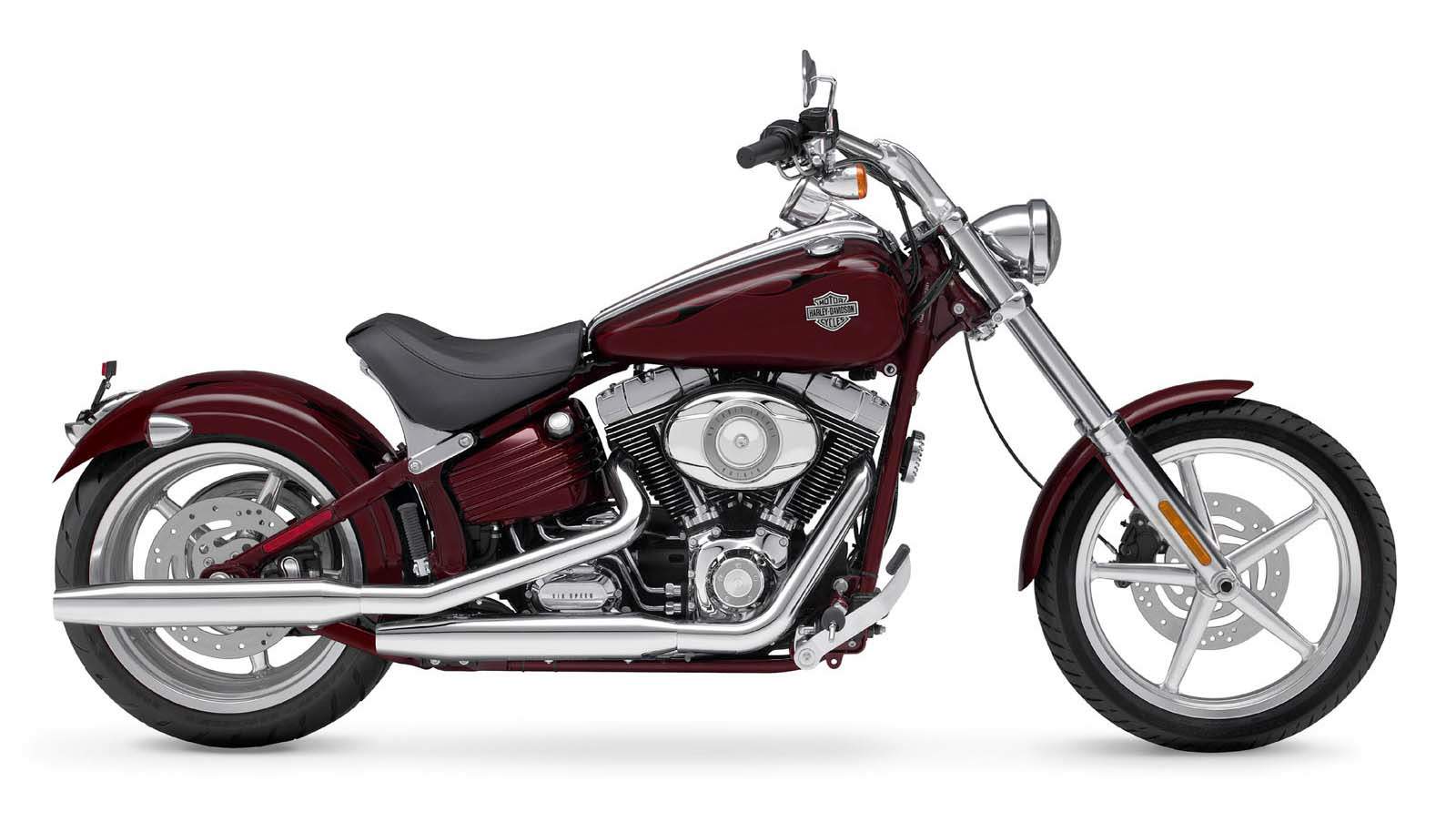
The chromed-out cousin to the Rocker, the Rocker C
features an industry first with the Trick seat design, which conceals a
passenger pillion and struts under the solo seat cushion. To accommodate a
riding partner, simply lift off the seat and the pillion folds out to deploy
over the Rockertail rear section. Brilliant chrome plating replaces most
components finished with Satin Stainless Metallic powdercoat on the Rocker,
including the headlamp and triple clamps, the handlebar riser, the fork lowers,
and the tank console and speedometer. The finned aluminum oil tank, frame and
swingarm are color-matched to the sheetmetal, which features a swirling
pinstripe flame from fender to fender. (See separate release for more details on
the Rocker C).
FXCWC Rocker C features:
Rigid-mount, 1584cc Twin Cam 96B balanced engine
6-speed Cruise Drive transmission
Black powdercoated engine with chrome covers
Chrome Shorty Dual mufflers with slash-cut outlets
Finned cast-aluminum oil tank
240 mm-18 rear / 90 mm-19 front tire
Polished Cast Aluminum Tapered Five Spoke 19-inch front/18-inch rear wheels
Rockertail rear section
Stretched fuel tank with recessed cloisonné medallion
Trick seat with concealed passenger pillion
Independent V-Bar handlebars on five-inch curved risers
Console-mounted speed shop style speedometer
Color-matched frame, swingarm and oil tank
Chrome fork lowers, headlamp, console, speedometer and other components
Integrated LED rear turn indicators/tail/brake lamps
Deluxe pinstripe flames standard
Optional Smart Security System
Test Ride
Harley's built a full-on chopper!
That’s my first impression as I walk around the new FXCW Rocker at the 2008
Harley-Davidson new-model launch in Baltimore.
And after I get over that revelation I think: What took so long?
For decades Harley sat on the sidelines as custom builders took Harley's own
engines (or clones thereof) and built what chopper buyers demanded—bikes with
low seats, stretched tanks, long forks and rear fenders that hugged massive rear
tires. In the past, folks who went the custom chopper route sacrificed handling,
reliability, comfort, a bank account, and often, a warranty.
All that has changed with the introduction of the new Rocker. The MoCo’s factory
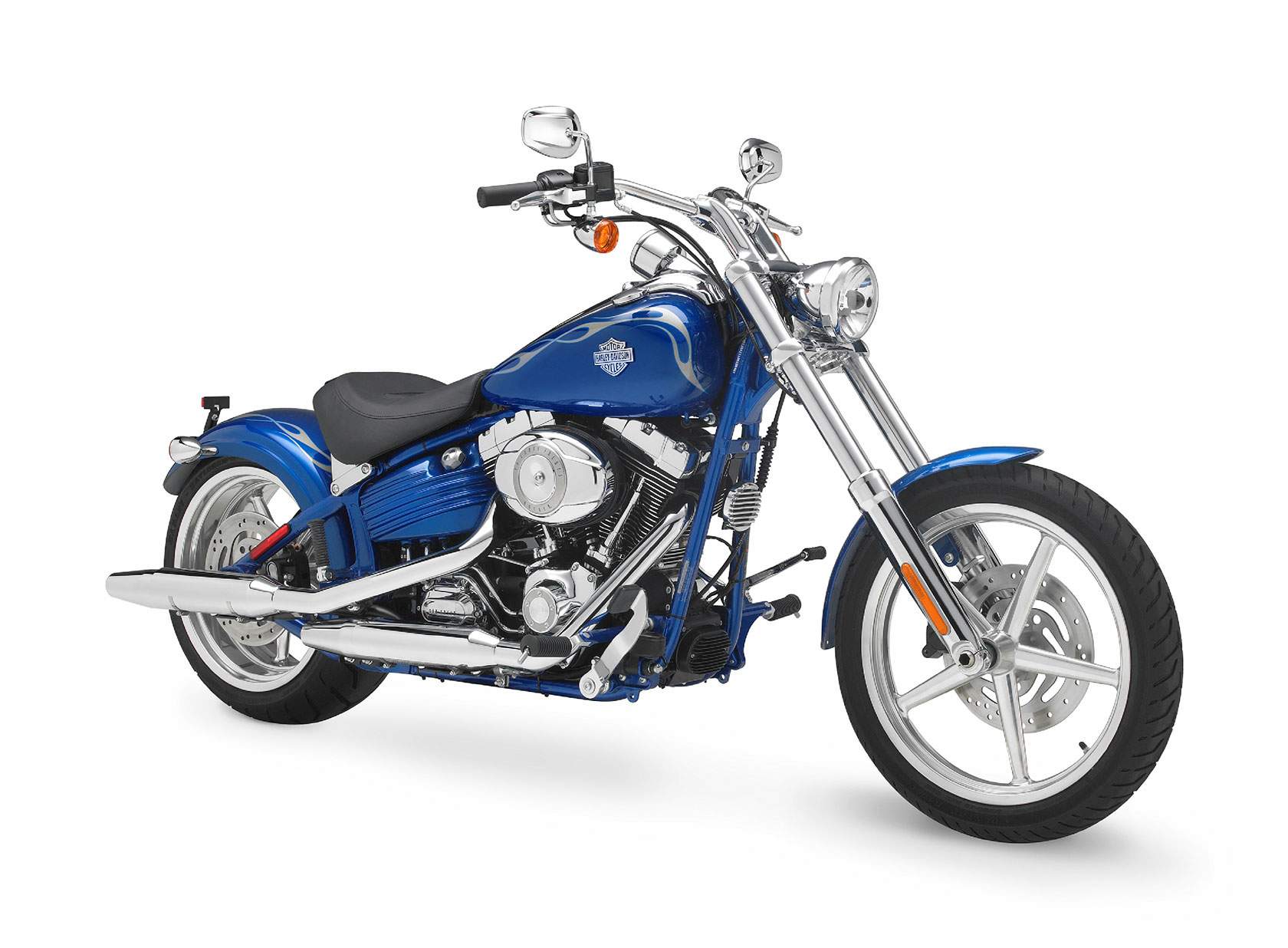
chopper comes in two flavors, the rugged solo-only FXCW for $17,295 (above,
right) and the FXCWC, which comes with a passenger seat, a host of chrome
accents and a lot more “bling” for $2,200 more (left). The “CW” suffix stands
for “Custom Wide,” while the “CWC” appropriately indicates “Custom Wide Chrome.”
DXDF Fat Bob joins the Dyna line
Designed to look like an urban assault vehicle, the new Dyna Fat Bob features
dual headlights, chunky tires and a “Tommy Gun” 2-1-2 exhaust with a heat shield
slotted like a Russian submachine gun that allows you to see the discoloring of
the actual pipe. The 16-inch, 130mm front tire fitted to the Fat Bob is the
biggest ever from the MoCo and the aggressive tread pattern, which looks like
something normally found on a dual-sport bike, was designed by the styling team
specifically for this model. Other styling touches include pre-Evo-era “Full
Metal Jacket” chrome shock absorber covers and a big 5.1 gallon Fat Bob fuel
tank crowned by V-shaped drag bars set on roughly five inch risers. The Fat Bob
is available with either mid- or forward controls from the factory. And, like
all Dyna models for ’08, it comes with black stainless steel brake lines and a
redesigned air-cleaner cover.
DXDF Fat Bob MSRP: $14,795 - $15,140
Other models get upgrades for 2008
VRSC’s get more oomph and a slipper clutch
The bore on the liquid-cooled Revolution engines goes up 5mm to provide a
displacement of 1,250cc—first seen on the pricey CVO version a couple years ago.
Harley claims the new limited slipper-clutch (above) fitted to the ’08 VRSC line
helps avoid rear wheel lock-up during aggressive downshifting and reduces clutch
effort by 20 percent. In practice, though, I discovered a small chirp in mildly
aggressive downshifting (which the factory said to expect), and it was possible
to still lock-up the rear wheel in absurd downshifting (read as: a drop all the
way to first from fifth). Overall, though, the new clutch works quite well in
the environment it was intended.
As a factory installed option, all ’08 VRSCs and Touring models can be ordered
with the company’s new ABS (Anti-Lock Braking System).
The Touring bikes also get a new six-gallon fuel tank and electronic throttle
control—no more cables running back to the ESPFI.
For other model upgrades, see: Road King CVO: High tech and high style coexist
in beautiful harmony
The Rocker project started three years ago, as increasingly more manufacturers
offered bikes mimicking the Softail design, making the look appear more
commonplace.
“We wanted to expand the Softail to the next degree of custom,” said Motorcycle
Product Development Director Bill Davidson, great grandson of founder William A.
Davidson and son of styling guru Willie G., describing the genesis of the Rocker
project.
Though nominally based on the Softail line, very little of the Softail remains.
An all-new chassis and drivetrain were developed specifically to accommodate the
Rocker’s extra 4.5 degrees of rake and massive 240-spec rear tire.
Hovering a mere finger’s width above the tread is a fender that has no visible
means of support. In fact, it’s attached directly to the swingarm and “rocks”
with the tire, hence the name Rocker, short for Rocker Tail. In order to
withstand the 100+ g’s of force that Harley claims can be exerted on it over
bumps, the stainless steel outer fender is bonded to a steel inner fender for
increased strength.
Stop/turn/tail lights, which were first used on the Nightster, are integrated
into a magnesium housing to reduce unsprung weight. They also keep the rear end
clean by eliminating the need for a conventional tail lamp. Durable LEDs provide
illumination, as conventional bulbs would surely fail from the constant thumps
from the road.
Throwing a leg over the low seat—at just 24.5 inches from the pavement, Harley
claims that it’s the lowest of any production motorcycle made today—I notice my
heels at the end of my 31-inch inseam just reach the ground on the standard
model. On the “C” model I’m just about a half-inch away from flat-footing it,
due to a thicker seat that conceals a passenger pillion. Why such a stretch on
so low a bike? Thank the pushed-out primary and drivetrain used to clear that
240 rear tire.
That extra inch of seat height on the “C” model is a small price to pay for a
truly trick passenger seat setup. Going from solo to passenger mode literally
takes seconds: Lift up the solo seat, roll back the passenger struts, and then
attach the passenger pad which is stowed in a compartment underneath the solo
seat. You’ll want to choose your passengers carefully, though — the load limit
on those elegantly molded struts is 250 pounds.
The standard version of the Rocker accepts a passenger seat/luggage rack system
(costing a little over $500 from the H-D catalog), but it’s a bolt-on item that
doesn’t conveniently fold away like the one on the “C” version.
Below the seat is a new aluminum horseshoe style oil tank with raised ribs that
Harley says aids in cooling and offers “old-school styling.” The powdercoated
tank matches the Satin Stainless Metallic of the powertrain on the standard,
while the tank matches the bodywork on the “C” version. In both versions, the
frame is powdercoated to match the bodywork.
Doug Clarkson, principle stylist on the project, said they wanted owners to be
pleasantly surprised by the level of detail they would discover at the end of
the day, even months after their purchase. These include nestling the
hand-grenade-shaped coil/ignition cover between the cylinders on the left side
(right). Currently a barrel key is used, but designers hope the final production
bikes will have a key that looks like a pin.
The gas tank is the stretched five-gallon version off the discontinued Deuce,
with a console painted the same as the powertrain and oil tank. The “C” version
gets the same parts but with the chrome treatment.
A raised speedometer cup (no tachometer) sits atop the console and houses a
gauge that looks remarkably like the Sportster speedo. You can toggle through a
variety of information on the LCD display at the bottom of the speedo, including
two trip meters, a clock and a fuel countdown gauge that reports how many miles
you’ve got until empty. A computer measures each squirt from the ESPFI along
with remaining fuel in the tank to calculate mileage. According to the factory,
the system is so accurate that when you hit zero you'd better have a gas station
in sight.
Reaching forward to grab the V-style handlebars, I take notice that the wiring
is hidden internally—another nice custom touch. The right and left bars are
actually separate pieces clamped together at the V junction, and can be rotated
to suit the rider.
Then there’s the front end.
Beefy 49mm forks reach out at a 36.5 degree rake to new sculpted oval fork
lowers that straddle a 19-inch, five-spoke wheel. Thanks to that rake, the
overall wheelbase is 69.2 inches—the longest in the Motor Company’s history. So
long, in fact, that the roll booth where completed bikes are tested at the
Harley assembly plant in York, Pennsylvania, had to be redesigned to accommodate
it.
The Rocker features the balanced version of the new 1,584cc engine. Power from
the Twin Cam 96B is transferred through a six-speed transmission and primary
modified to accept the Rocker’s wider tire and fender.
I turn the key and fire up the balanced twin and discover that the slight clunk
from the compensator I used to hear in the TC96B is gone. The redesigned primary
includes different ramping on the compensator that eliminates most of the
reverse loading that occasionally caused that sound.
Rolling away, I’m amazed at how the MoCo designers were able to make this long
bike with such a big rear tire so well-balanced. I let go of the bars at 25 MPH
and the bike remains dead stable.
All-in-all the Rocker is a very easy to handle machine, especially considering
its radical geometry. Handling is slightly chopper-like, requiring a slight push
in the direction you want to go and then full-on countersteer to complete the
turn. Tighter turns at speed require a constant push on the bars, but it’s easy
to lean the big bike over until the feelers on the ends of the forward pegs make
initial contact. At that point, you still have a degree or two to go before
harder stuff starts to scrape, but it’s not wise to push it that far.
Slowing things down, the single disk, four piston caliper up front can haul the
690-pound machine down in a hurry, which is good because the rear brake on the
forward controls on both models was a bit of a reach, so much so that
inseam-challenged riders may not even be able to engage it fully.
After about 15 minutes of riding the “C” model, I start to really notice the
back edge of the saddle. I try to slide forward, only to have the dish of the
seat roll me back to the same spot. Admittedly, I may be a little larger in this
area than the younger, fitter crowd this bike is aimed at. Still, I found the
standard Rocker to be the more comfortable of the two, thanks to its deeper
seat.
The TC96B engine and six-speed transmission work in concert to provide plenty of
grunt at low RPM. Sixth gear is so tall, in fact, that running it at speeds less
than 70 mph will only bog the engine.
With the Rocker, Bill Davidson said 2008 will be “a year to reestablish our
leadership in the custom motorcycle market.”
It’s hard to argue with that statement. Here’s a factory-built chopper that
handles better than anything this size should, is guaranteed to be a head-turner
right out of the box, costs thousands less than comparable custom choppers, and
comes with a two-year warranty.
Knowing full well that Harley customers are never satisfied with leaving well
enough alone, though, Davidson said he’s looking forward to seeing what
creations come out of this radical new model.
NOTE: Some of the photos on
Motorcycle Specs are owned by somebody. If you see any of your
photos, you can let me know so that I can acknowledge it, or if
you object to it, I can remove it altogether. If any copyright
holder objects to their articles being placed on Motorcycle
Specs, it will be removed upon request. Any correction or more
info on these bikes will kindly beappreciated
Contact MePrivacy
Policy
Website Stats