HOME   CONTACT  |  TECHNICAL  |  CONVERTER  |  VIDEO  |  LINKS  


Classic Bikes
Custom Bikes
Racing Bikes


AC Schnitzer
AJS
Alfer
Aprilia
Ariel
Arlen Ness
ATK
Bajaj
Bakker
Barigo
Benelli
Beta
Big Bear
BigDog
Bimota
BMS Choppers
BMW
Borile
Boss Hoss
Boxer
Brammo
Britten
BRP Can-am
BSA
Buell
Bultaco
Cagiva
CCM
Confederate
CR&S
Daelim
Deus
Derbi
DP Customs
Drysdale
Ducati
Dunstall
Exile Cycles
Factory Bike
Fischer
Foggy Petronas
GASGAS
Ghezzi Brain
Gilera
Harris
Harley Davidson
HDT
Hesketh
Highland
Honda
HPN
Horex
Husqvarna
Husaberg
Hyosung
Indian
Italjet
Jawa
Kawasaki
KTM
Kymco
Laverda
Lazareth
Lehman Trikes
LIFAN
Magni
Maico
Matchless
Matt Hotch
Megelli
Midual
Mondial
Moto Guzzi
Moto Morini
MotoCzysz
Mr Martini
MTT
Münch
MV Agusta
MZ
NCR
Norton
Oberdan Bezzi
OCC
Paul Jr. Designs
Piaggio
Radical Ducati
Richman
Ridley
Roehr
Roland Sands
Royal Enfield
Rucker
Sachs
Saxon
Sherco
Suzuki
Terra Modena
Titan
TM Racing
Triumph
Victory
Vincent
Viper
VOR
Voxen
Vyrus
Waken
Wrenchmonkees
Wunderlich
Yamaha

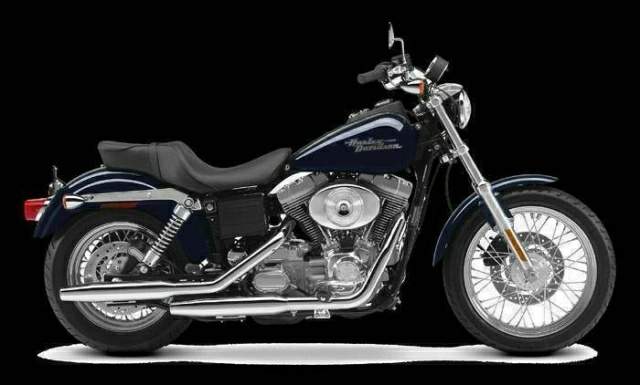
Harley Davidson FXD Dyna Super Glide


Make Model

Harley Davidson FXD Dyna Super Glide

Year

1998

Engine

Air cooled, four stroke, 45° V-Twin, OHV,

Capacity

1449
Bore x Stroke 95.3 x 101.6 mm
Compression Ratio  

Induction


Ignition  /  Starting

- /  electric

Max Power

67 hp  48.8 kW @ 5200 rpm

Max Torque

110 Nm @ 3100 rpm

Transmission  /  Drive

5 Speed  /  Belt
Frame  

Front Suspension

Rear Suspension

Front Brakes

Single 292mm discs 4 piston caliper

Rear Brakes

Single 292mm disc 4 piston caliper

Front Tyre

130/90-16

Rear Tyre

130/90-16

Dry-Weight

277.8 kg

Fuel Capacity

19 Litres
Overview Motorcycle.com

Let's start another urban myth. A lady named Sheila Boyle once told us a story of her 1975 Super Glide. She said way back in the mid-seventies Willie G. Davidson (H-D's vice-president of styling and member of the royal family) paid a visit to her then-husband's Harley shop, Harley-Davidson West, at that time the world's largest. Allegedly, when Willie G. saw her customized Super Glide with shorter shocks, cut down seat and other custom goodies his jaw dropped. Sure enough, a year or two later the Low Rider was born.
Myth or not, in 1977 Harley-Davidson's Low Rider was introduced at Daytona Bike Week. Dubbed the FXS, it was the first of Harley's "factory customs" that would later include the Bad Boy, Road King, Fat Boy and the epic Heritage Springer. In addition to a low seat height, features on that first Low Rider included raised white lettered tires, drag bars, mag wheels, and an oft-copied two-into-one slash-cut exhaust. The bike was an instant hit, inspiring Willie G. and his staff to create even more custom models - a trend that continues today.

The eighties saw a rise of H-D's rubber-mounted FXR chassis to replace their aging solid-mounted FX line. Naturally the Low Rider followed with the FXRS model. This Low Rider was graced with dual disk brakes, a pop-up seat for easy battery access and low rise bars. With the migration to the FXR platform came the more significant development of the Evolution engine.
Harley was plagued throughout the seventies with a rapidly deteriorating powerplant - the Shovelhead. In 1984, the introduction of their all-alloy Evolution (or Blockhead) engine solved virtually all of the Shovelhead's woes (with more advanced features like better oiling, tighter seals through newer tooling and easier maintenance), while still retaining the same general look. It took awhile to drop the stigma of Harleys being oil-leakers and prone to breakdowns, but their image seems to have swung 'round full circle.
Welcome to the nineties, and the Dyna chassis. The Dyna was Harley-Davidson's first CAD-designed model, and featured an advanced engine isolation system. The new set-up allowed more engine shake at idle, but less at speed, resulting in vibration-free mirrors (and seat) during highway cruising. This is opposed to the FXR's slightly-damped, but ever-present vibes. When the FXR fell into extinction in 1995, the humble Low Rider was re-christened the FXDL Dyna Low Rider and given a new skin.
For those of you familiar with the current Dyna platform, you may want to skip the next few paragraphs. For the rest of you Dyna neophytes, pay attention. The Low Rider's chassis shares all of the features and flaws of its siblings. The Dyna frame is sort of Harley's version of a perimeter frame. Differing from all other H-D frames, it has no center tube crossing between the engine and transmission -- just a wreath of steel encircling the entire powerplant/transmission. In stock configuration it performs beautifully, but how many Harleys remain stock?
In performance-modified form, the Evo engine will tend to break inner-primary cases, due to stresses placed on this piece in the "fully isolated" configuration of the bike. Luckily, the aftermarket has developed a workaround in the form of a brace for the bike's right side to spread the torque produced by a bored, stroked, or otherwise modified powerplant.
Another customizer's nightmare can be found in the beautiful full fender that extends almost all the way to the swingarm. When lowering a Dyna, the fender has to be cut and re-painted to avoid catastrophic damage to this piece when you hit a bump. Other nit-picks include a goofy key position behind the seat on the right side, passenger footpegs that look like an afterthought and excessive vibration at idle from the very loosely isolated engine.
On the up side, the Dyna chassis has greater rigidity that its FXR predecessor for better handling, increased vibration damping at speed (as mentioned earlier), plus a hidden crossover tube on the rubber-mounted exhaust pipes and easily accessed electronics.
The Low Rider was a motorcycle made to buck tradition when it was first introduced in 1977, and it remains so today.

"We conducted an informal online survey on the topic of buckhorns vs. no buckhorns. The results from our daily news."
Other than a narrow front end there is little of the original FXS in the FXDL. The mag wheels, once thought to be trick in the seventies, are blase today so the FXDL sports laced wheels.
The FXS had sporty drag-style handlebars, while the Dyna comes equipped with buckhorns.
A quick survey of everyone in our office revealed that not one of us likes buckhorns, while Harley's PR department maintains they are the number one accessory item sold.
What gives? Maybe you can help.

What remains of the original Low Rider is attention to detail. Wrinkled black paint and chrome adorn most surfaces of this motorcycle. Handy highway pegs add comfort on the interstate. A detachable passenger seat doubles as a driver backrest, offering a little extra comfort - or a different look. A fuel gauge tops the dummy gas cap on the left side of the tank, hitting empty after around 180 miles of riding.
The new-for-97 spring rates are perfect for a blast through the twisties, with only the limited leverage from those buckhorns impeding the fun. On the open road suspension is smooth and supple, allowing hours to pass unnoticed.
Popular add-on item or not, we just didn't care for the buckhorn handlebars, and we were also less than enthusiastic about the mid-mount foot controls. However, all agreed that as a customization platform, the Low Rider was untouchable. Maybe put some of Harley's cool forward controls and a set of drag bars on it, and you'll have a machine to envy.
Is this the Low Rider of old, updated for the ninties? Absolutely not. In fact about the only thing Harley's 1997 Dyna Low Rider has in common with the original FXS is a low seat height and the Narrow-Glide front end that, incidentally, has grown in fork size from a spindly 35mm to a more modern 39mm. What they do share is Willie G.'s flair for style and that wonderful potato exhaust note.

Source Motorcycle.com


NOTE: Some of the photos on Motorcycle Specs are owned by somebody. If you see any of your photos, you can let me know so that I can acknowledge it, or if you object to it, I can remove it altogether. If any copyright holder objects  to their articles being placed on Motorcycle Specs, it will be removed upon request.  Any correction or more info on these bikes will kindly beappreciated                                          Contact Me      Privacy Policy     Website Stats