|
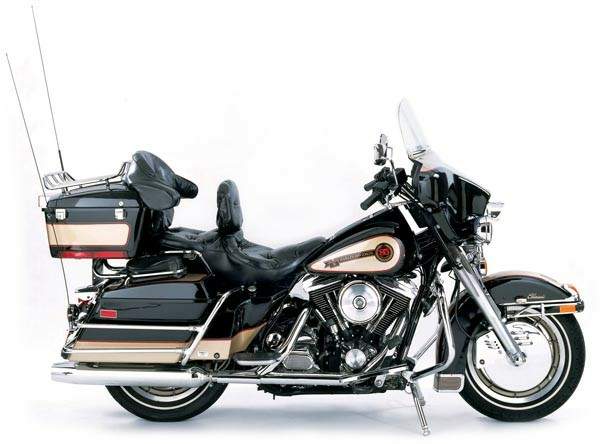
Harley
Davidson
FLHTC 1340 Electra Glide Classic

|
Make Model |
Harley
Davidson
FLHTC 1340 Electra Glide Classic |
|
Year |
1988 |
|
Engine |
Air cooled, four stroke, 45° V-Twin, OHV, 2
valves per cylinder. |
|
Capacity |
1337 |
|
Bore x Stroke |
88.8 x 108.0 mm |
|
Compression Ratio |
8.5:1 |
|
Induction |
|
|
Ignition /
Starting |
/ electric |
|
Max Power |
50 hp @ 4000 rpm |
|
Max Torque |
69 ft-lb @ 3000 rpm |
|
Transmission /
Drive |
5 Speed / |
|
Frame |
Double-downtube, full-cradle frame box-section
steel swing arm |
|
Front Suspension |
Center-axle fork with 41mm tubes and 4.6 in.
(117mm) of travel |
|
Rear Suspension |
shock absorbers, adjustable for'spring preload,
producing 3.8 in. (97mm) of rear-wheel travel |
|
Front Brakes |
2x 292mm discs 4 piston calipers |
|
Rear Brakes |
Single 292mm disc 4 piston caliper |
|
Front Tyre |
90/90-16 |
|
Rear Tyre |
150/85-16 |
|
Fuel Capacity |
19 Litres |
|
Dry-Weight |
332 kg |
|
Average fuel consumption |
1.9 mpg |
Need the biggest touring bike on the block? Climb aboard the
Electra Glide Classic—but you'd better have a thick wallet too.
This is a motorcycle for the Faithful, the Rich Faithful. The Faithful will
ogle the FLHT because it looks Big Twin Traditional; the lines and lineage
are unmistakable, triple-distilled Milwaukee classic. The Faithful must be
rich because the Electra Glide Classic tops $8600, making this a Harley-Da-vidson
for those who own both the rainbows and the pots at their ends.
For about $11 a pound, the FLHT owner gets a big touring
motorcycle, 781.5 pounds wet, with accommodations for two, their gear, and
accessories. Big touring motorcycles are heavy (Honda's Aspencade is 766
pounds). To be roomy enough for rider, passenger and accessories, these
machines have to be big, and an FLHT can't be this big without being heavy.
The FLHT can handle a 400-pound payload. Even after counting in fairing,
saddlebags, King Tour Pak and so on, a tubby rider and passenger would have
75 pounds available for luggage and gear. That's impressive. If you can't
manage a tour on 75 to95 pounds,you'd better try motorhoming.
The FLHT running gear is a variant of that found on the
FXRS. The FLHT steering head is quite different, since the T-series
motorcycles use Harley-Davidson's reversed triple clamps, which position the
fork tubes behind the steering pivot when the front wheel points dead ahead.
The FLHT fork, however, appears Harley-Tradi-tional. The object of the
assembly was to lighten the force the old FLH-series motorcycles required at
the bars. Motorcycles that weigh over 900 pounds on the road, that have long
(62-inch) wheelbases, and that carry 90/16 front tires, demand truck-driver
muscles. Even with its reversed triple clamps, the FLHT still calls for
manly effort at very low speeds.
Those accustomed to Japanese motorcycles will find other
maneuvers awkward. At rest, the rider's feet get planted on the pavement
between the footboards and passenger pegs. Since heavy machines encourage a
rider to delay lifting his feet, occasionally our staffers would scrape the
backside of their legs on the passenger pegs. To use the rear brake the
rider must pull his foot off the floorboard to reach the pedal. Again, for
our staffers, that's an unnatural move. The shift lever, however, can be
worked with the left foot on the board.
Rolling down the interstate, the FLHT puts its rider in armchair comfort.
Indeed, it's more chairlike than you might suspect. The rubber-mounted
floorboards place the rider's feet forward, having them carry less weight
than on other motorcycles, and the seat/handlebar/floorboard relationships
put the rider bolt-upright, which is just fine because the fairing takes the
majority of the wind pressure (a small bit of wind does channel up off the
lower fairing). Rubber separates the rider's body everywhere from the engine
and its vibration.
The engine, handlebar and floorboards are rubber-mounted,
and the seat is foam deep in rubber. Despite the insulation, the rider can
notice upper end engine noise and the passenger will feel the footpegs
vibrate. For non-adjustable units, the front and rear suspension components
work very well on the interstate, the place for which they're calibrated.
It's exactly in the "features" and "adjustability" areas that Milwaukee must
play catch-up. Some Japanese touring-bike built-ins—such as fender-mounted
compasses and digital dashboard displays—are gadgetry in the grand tradition
of pendulum-powered kitchen-knife-sharpeners. Other items, such as
multi-function communication centers, are important features or electronic
trivia, depending upon the rider's point of view. Still other features, such
as air forks and shocks with onboard pumps and variable damping, define the
upper limits of engineering state of the art for big touring bikes. Although
Harley-Davidson has dealt successfully with several basic areas—vibration
control, final-drive durability and reliability (H-D's answer was a fully
enclosed oil bath chaincase) clearly its next priority should be suspension
tunability.
The FLHT gives its riders lots of lights, not all of them on
the instrument panel. Both fenders have running lights, as do the Tour Pak
and saddlebags. Twin spots complement the single headlamp. The FLHT can be
seen and its rider will never lack candlepower for the road ahead.
Packing space is likewise no problem. The King Tour Pak is a good place for
light, bulky items because the recommended weight rating is 25 pounds; the
saddlebags offer space to balance out loads at a recommended 15 pounds per side.
Bags and Tour Pak mount on the bike with QD Dzus fasteners. In order to remove
Pak or bags, the rider may have to shuffle through or remove the contents to
unfasten the carriers, and then unplug the light lines. The bags must be removed
to adjust shock spring preload. Both bags and Pak sealed perfectly in a day-long
downpour.
The ignition may be operated keyless, though it takes the key to lock the
fork. The lid to the gas-cap compartment is also key-operated; thus it's
possible to ride off without keys, as long as your trip doesn't exceed your gas
supply. The range is about 130 miles. The FLHT's average fuel consumption was,
at 31.5 mpg, surprising since the FXRS (tested January 1981) has the same engine
and returned an average near 50 mpg. But the FXRS is lighter and doesn't push a
large fairing around.'
Though the Harley-Davidson front brake improved with mileage, by contemporary
standards the brakes reached an unimpressive level at best. The hand-lever
requires substantial pressure, and even a gorilla grip yields barely mediocre
retardation. Big touring bikes rolling 900-odd pounds down the highway need
absolutely first-class brakes; in many ways touring heavyweights test brakes
more severely than smaller, lighter sport motorcycles chased pell-mell into
corners. Back-road friskiness is best avoided on the FLHT— and, for that matter,
on any big touring rig, though the H-D's non-adjustable suspension underscores
this point. Suspension, ground clearance and weight all work mightily against
such behavior.
The FLHT is a very expensive motorcycle in a class of very expensive
motorcycles. What makes all these motorcycles doubly costly is their
one-dimensional nature, dictated by size, weight and comportment. As a class,
big touring bikes lack versatility; they're fun only on open highways as
ultimate, two-wheeled convertibles. In this respect, the FLHT is a good example
of the genre: one full day in the saddle shows a rider both the strengths and
weaknesses of big, heavy touring motorcycles. Presumably, Milwaukee believes
there's little room for further development and elaboration of the FLH/FLHT
concept. Elaboration such as multi-function communication centers and infinitely
adjustable suspension would only make such bikes more expensive absolutely, and
more expensive relative to, for example, the American-assembled Gold Wing
Aspencade. Maybe Harley's recent introduction of the FXRT suggests that
decision-makers in Milwaukee think lighter, more nimble touring motorcycles hold
greater future promise for Harley-Davidson. With that, we'd agree. ■
Source Cycle 1983
|