In the previous two issues of American Rider, we considered a
"convertible" Dyna Super Glide (February issue), and a couple of models in the
Softail line (April issue) as all-around motorcycles capable of touring,
cruising, and just looking good while sitting still. Each had its benefits and
limitations. In fact, every motorcycle has certain built-in limitations. Sport
bikes offer high-speed fun and adrenalin rushes, but they torture us on the open
highway; touring bikes cuddle us on the long haul, burden us on tight twisting
roads. So the question becomes, what's the best compromise?
For me, it's a Dyna;
I like its lightweight, sporting nature. Clement Salvadori prefers the Electra
Glide, and Reg Kittrelle owns and loves his Road Glide. For you, maybe it's a
Heritage Softail or a Sportster. But let's not immediately make up our minds
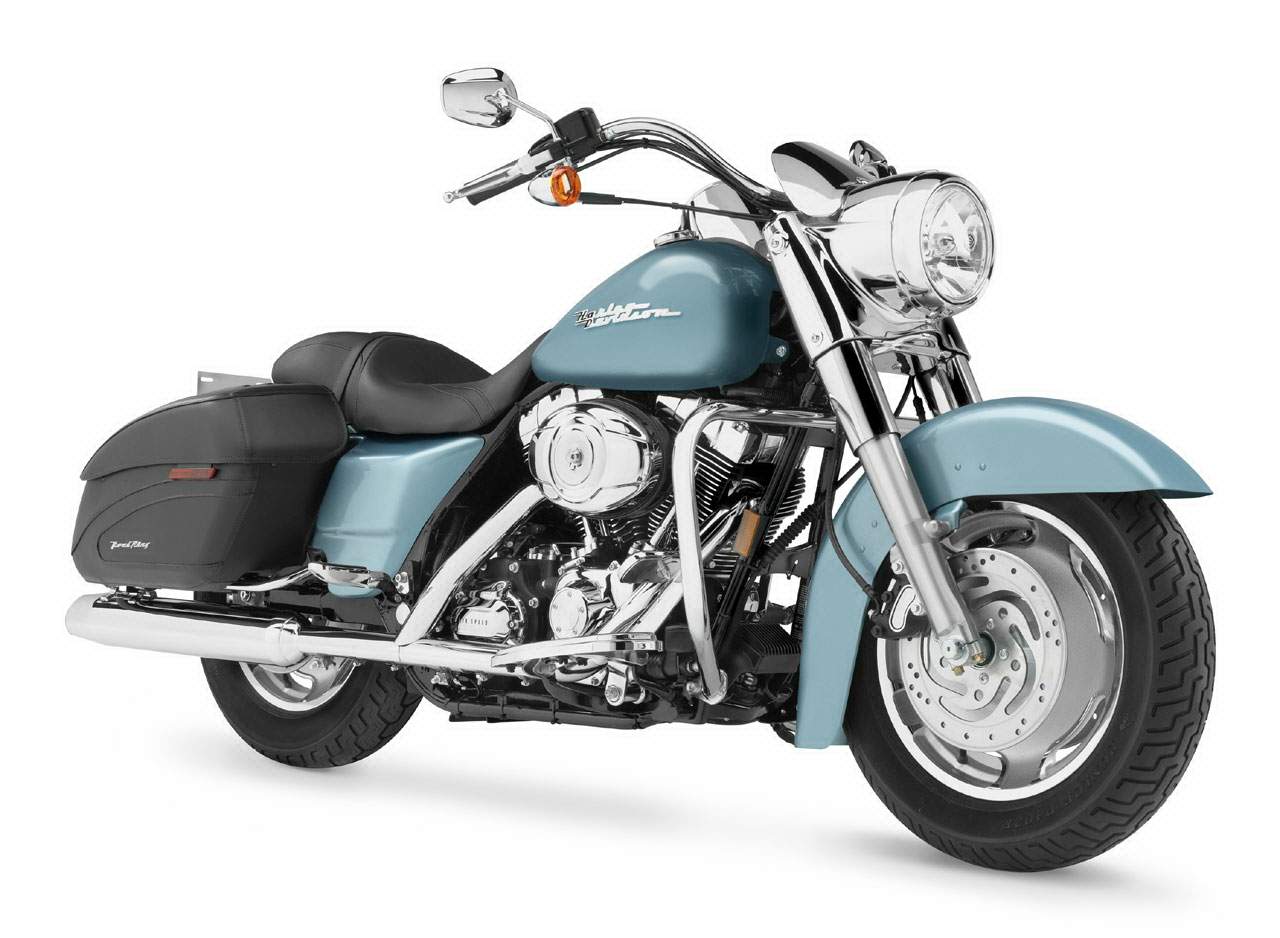
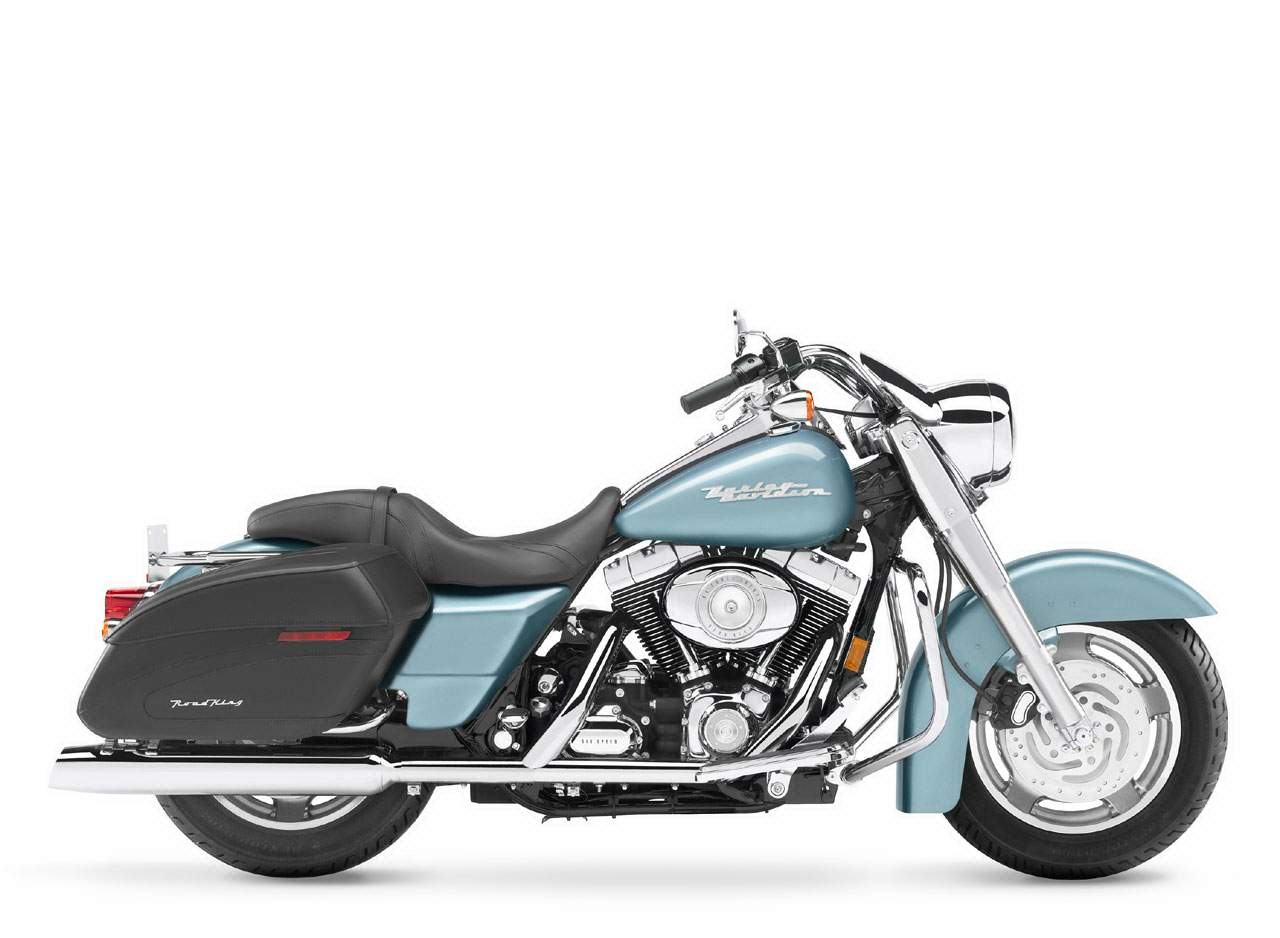
without first considering the minimalist FLH touring model, the 2007 FLHR Road
King. It's not a full-on bagger but has plenty of untapped load-carrying
potential; and it is not a sportbike but, being unencumbered by a large fairing,
is nimble enough to hustle around in tight environments. Let's call it the "Town
& Country Glide."
At first glance the Road King appears
to be styled like the original Electra Glide of 1965. Fact is, this "era look"
actually dates to the original dual-shock Duo-Glide of 1958, the first big
Harley to sport twin rear suspension struts. Combined with its Hydra-Glide front
fork and 16-inch balloon tires, the King harkens back 50 years, to an era when
parents were sure their kids' minds were being corrupted by that new
rock-and-roll music.
As far as converting the FLHR from a touring configuration to a stripped
cruiser, the only item that's readily removable is its Detachable pop-off
windshield. Surprisingly, with this removed, the King takes on a pleasant
old-time feeling, clean and low. Re-install the shield and the bike looks
awkwardly tall and more cluttered, although as the miles and the bugs build up,
the screen becomes more desirable.
For some inexplicable reason, the Road King's basic black MSRP is $1,250 more
than the Electra Glide Standard's, which comes equipped with a fully laden "bat
wing" fairing that contains a tachometer, something missing from the King. The
King does, however, have the ability to strip the frontal protection, and it is
endowed with a powder-black-and-chrome engine, transmission and primary cover
rather than the Standard's powder-silver-with-chrome finish. For comparison, the
King lacks a cigar lighter, pre-wiring for an antenna, gas-cap lock (it's a
side-located screw cap); and it has a two-piece seat instead of one-piece, which
is either good or bad depending on your attitude. Speaking of MSRP, the red
pearl paint on our test bike costs $335 more than Vivid Black.
What the Road King offers that other FLH baggers lack is a more naked appearance
and more nimble handling. As mentioned, without its windshield the thing even
looks like it's more manageable, and it also feels lighter when hoisting it off
its sidestand...which belays Harley's claimed dry weight of the Road King at 737
pounds, only one pound less than the E-Glide Standard. Go figure.
Enough of these comparisons, let's look at our Universal candidate. The latest
Twin Cam 96 supplies power through the compliant 6-speed Cruise Drive
transmission. This is without question the best engine/gearbox combination that
Harley has ever offered for its regular production bikes. The engine delivers a
peak of 92 pounds-feet of torque and more than 90 pounds-feet over a 500-rpm
range. This is perfect for keeping the engine in its strongest torque range, as
shifting gears keeps the engine speed within this window of pulling power.
With its direct-drive sixth gear, transmission gear noise is non-existent while
cruising in top gear; however, the straight-cut fifth gear churns and clamors.
While you may wonder which gear you've engaged between first and fourth, because
they are so noise-free, there's never a question about being in fifth. A green
"6" light glows on the speedometer face when in top gear. Selecting gears is a
dream, and neutral is easy to find.
Other control systems operate without significant glitches.
The cable-actuated clutch engages progressively and smoothly, and the lever
offers useful feedback, although you will may notice a feint "chirp" sound as
the clutch fully hooks up. Brakes are top-notch, with very strong power up
front. The rear is noticeably effective, although I have never been comfortable
about the FLH's rear brake in near-lock-up panic stops because it offers little
feedback through the pedal.
All the electrical switchgear, warning lights and the speedometer are standard
Harley issue. One hand switch that was obviously missing was the cruise control
buttons, as this is an option not supplied on the test bike. It was sorely
missed; be sure to ante-up for this very convenient option. The FLHR is
pre-wired to accept it.
The FLHR is also pre-dispositioned to accept a huge array of touring options
from Harley's Genuine Parts and Accessories catalog. For long-distance
exploring, most riders will no doubt opt for a passenger backrest and a rack -
or a Tour Pak - and possibly the rider backrest. Beyond that, the choices are
endless (see sidebar).
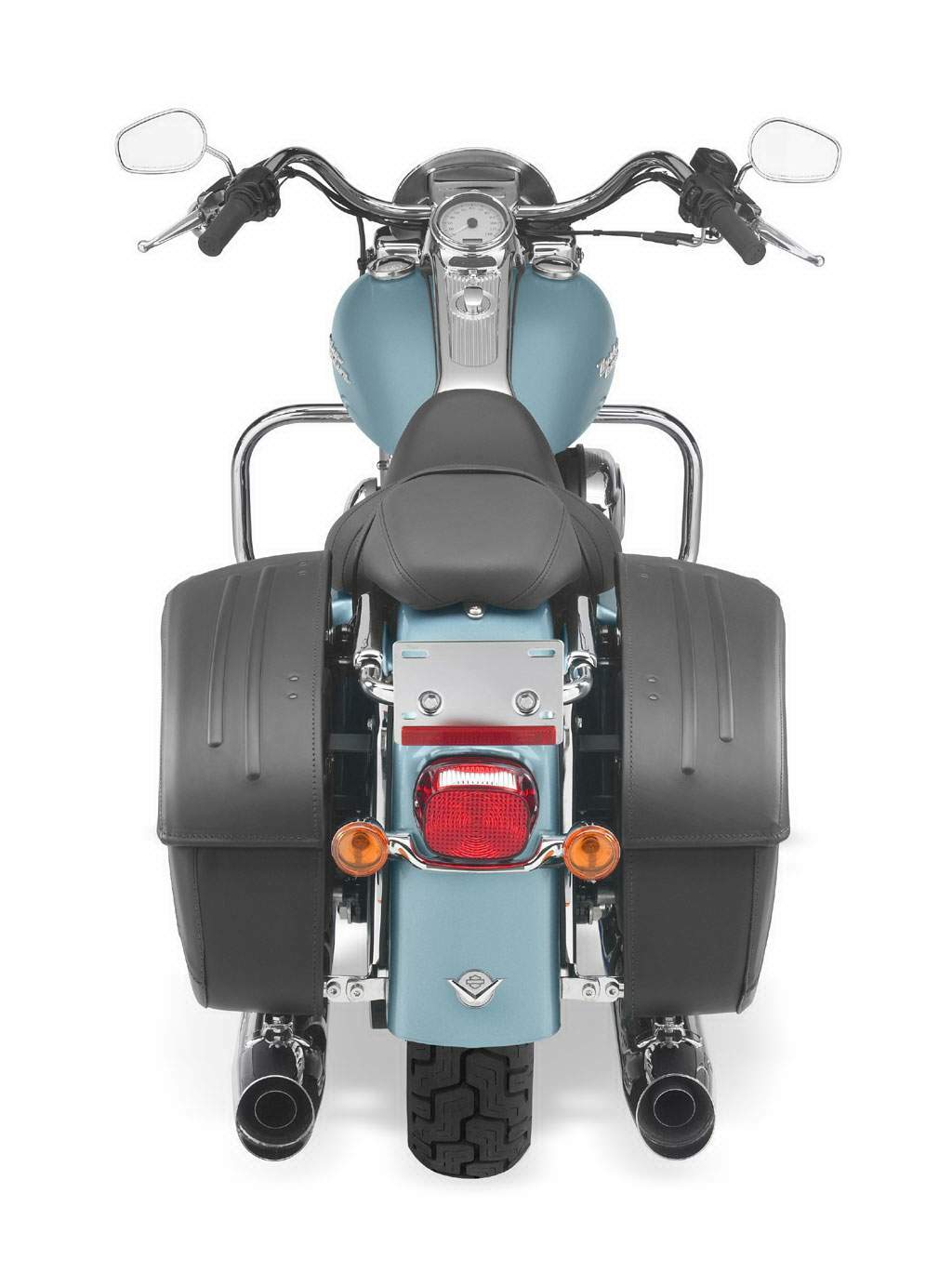
Luckily you won't have to purchase optional hard-shell saddlebags because they
come standard have with convenient ignition-keyed locks. At 64 liters (2.26
cubic feet), they hold plenty of gear and add immense convenience. The
floorboard height is adjustable, and the passenger gets floorboards, too. (The
FLH models are the only Harleys equipped with passenger boards.) The rider's
seat measures a comfortable 14 inches across and offers very good bucket-shaped
support. The pillion, at 12 inches long and 11 inches wide, promised to coddle
the passenger's bottom.
The floorboard-to-seat relationship is the same as the Electra Glide and Road
Glide, although the bucket seat locked my rear in one place and did not allow me
to adjust the seating position. The King comes equipped with Harley's "Buffalo"
handlebar, which has a semi-buckhorn shape. While many riders might like this, I
found that it placed my hands in such a position to cause discomfort in the
shoulder area on longer rides.
The front suspension is sprung slightly taut, which, for my 160-pound weight,
gives a mild hobbyhorse ride over concrete expansion joints. Heavier rider will
likely experience a better ride. The rear shocks are air-adjustable so a nice
compromise setting could usually be found for most road conditions. Very little,
or no air gave me the best highway ride; pumped up they provided what seemed to
be a competent setting for riding tight, twisty roads.
There is one flaw in the Road King's manners, one that may be the deal-killer
for some riders. With its two-point powertrain stabilization system, the bike
lacks real stability when ridden hard. It has a tendency to dance and wobble
when hammering over fast roads, and sometimes the bike becomes unsettled over
dips and bumps when leaned in a turn. This can be mended with an aftermarket
stabilizer, such as the True Track we tested in our last issue; however, as
delivered the bike's high-speed competence suffers. The irony of this situation
is that although the FLH models have more cornering clearance than the Heritage
Softail models, the Heritage has a rigidly mounted powertrain and feels much
more secure when ridden hard.
Another minor complaint - one that is common to all Harleys equipped with a
fairing or windshield - is the engine noise that is reflected by the windshield.
Remove the shield and much of the engine's clattering commotion disappears; in
place, the shield seems to amplify every mechanical click.
One of the standard features that will please '07 FLHR owners is the Smart
Security System. Triggered automatically by a key fob, it locks out the ignition
and fuel system whenever the fob is located more than a few feet from the bike.
Just walk away and the Road King is secure as a Tweety Bird in a cage.
The FLHR Road King is an easy machine to whip around in parking lots and to back
into awkward parking spaces. It has proven to be a versatile traveler and is
equally at home around town and out in the country. The only question the
potential buyer will have to ask is, "With its classic 50-year-old "era" style,
is the Town & Country the bike for me?"
NOTE:
Some of the photos on Motorcycle Specs are owned by somebody. If you see any of
your photos, you can let me know so that I can acknowledge it, or if you
object to it, I can remove it altogether. If any copyright holder objects
to their articles being placed on Motorcycle Specs, it will be removed upon
request. Any correction or more info on these bikes will kindly be
appreciated.
Contact MePrivacy
Policy Website
Stats