|
|
|
|
Classic Bikes
Custom Bikes
Individual
Racing Bikes AJP
AJS
Aprilia
Ariel
Avinton / Wakan
Bajaj
Benelli
Beta
Bimota
BMW
Brough Superior
BRP Cam-Am
BSA
Buell / EBR
Bullit
Bultaco
Cagiva
Campagna
CCM
CF Moto
Combat Motors
Derbi
Deus
Ducati
Excelsior
Fantic
GASGAS
Ghezzi Brian
Gilera
GIMA
Harley Davidson
Hero
Highland
Honda
Horex
Husaberg
Husqvarna
Hyosung
Indian
Jawa
Kawasaki
KTM
KYMCO
Laverda
Lazareth
Magni
Maico
Mash
Matchless
Mondial
Moto Guzzi
Moto Morini
MV Agusta
MZ / MuZ
NCR
Norton
NSU
Paton
Peugeot
Piaggio
Revival Cycles
Roland Sands
Royal Enfield
Sachs
Sherco
Sunbeam
Suzuki
SWM
SYM
Triumph
TVS
Ural
Velocette
Vespa
Victory
Vincent
VOR
Voxan
Vyrus
Walt Siegl
Walz
Wrenchmonkees
Wunderlich
XTR / Radical
Yamaha
Zero
Video
Technical
Manufacturer List Contact
|
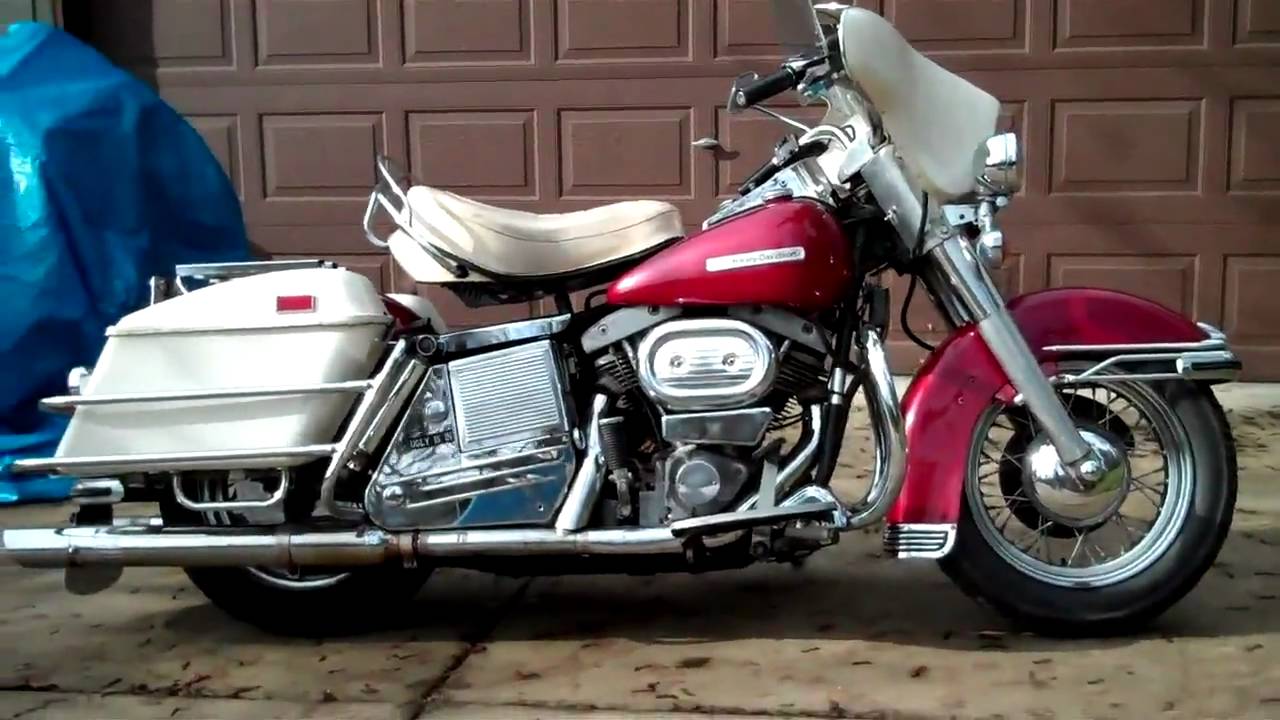
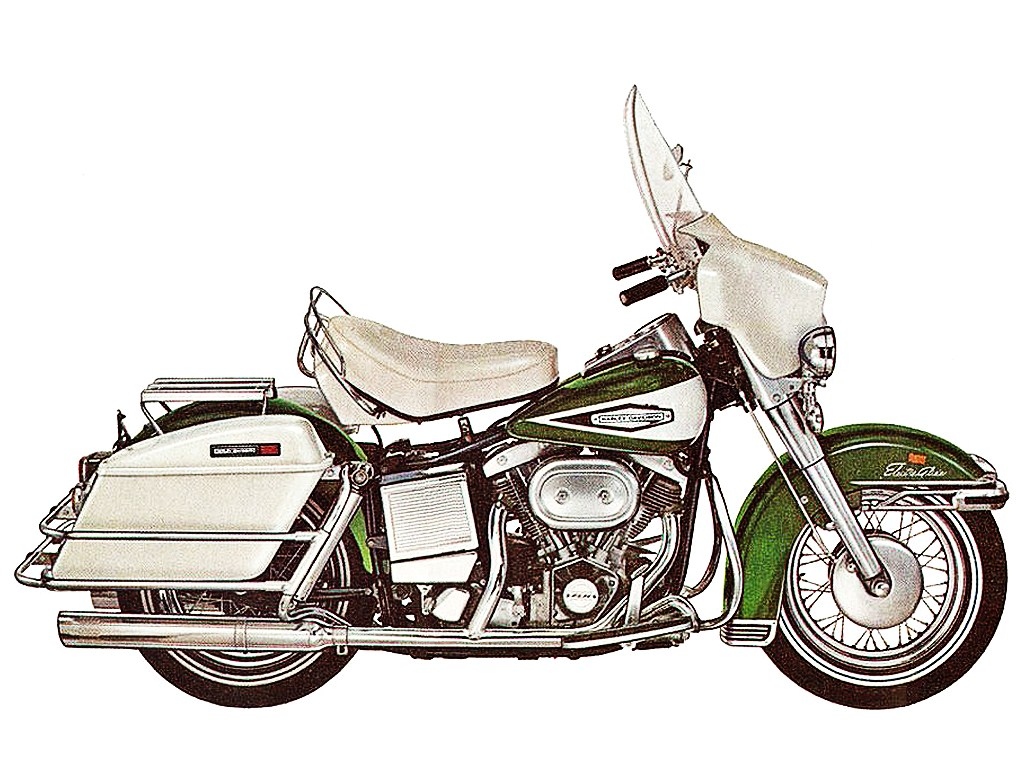
Harley Davidson FLH 1200 Electra Glide
Cycle Guide of 1970 Well folks, here it is, the one, the only, the undisputed king of two wheel touring. World(?) Yesiree, the Harley Davidson 74 inch Electra Glide is unmistakable in any crowd. There are few motorcycles indeed that have such a fervent and dedicated group of owners. And, few also are the machines that have taken such verbal maligning over the years. Our experience with this new Electra Glide was an enlightening experience on how to take a trip. It's been a while since we last had the opportunity to ride one of the 'king of the out-performers,' and there is a lot that perhaps we have been missing. We even became reserved in using the term "Road Testing" in regards to the 74, we often wondered if it wasn't the Harley that was testing us. Actually the big V twin engine hasn't changed a whole lot over the years. After all, if a couple of wars, a depression and mini skirts haven't been able to stop the sales of the big 74 cu. in. twin, maybe it isn't all that bad. The big Electra Glide isn't just a machine, it's an image. In these days of the super quick two stroke lightweights and high revving multis, the 74 can be considered another dimension in motorcycling. Upon receiving a phone call that one ready to go Harley Davidson FLH was waiting for us at Harley of Fullerton, our first decision had to be made. How would we bring the 74 back to the office? We normally load the test machines into one of our trucks, but this is not the average motorcycle, at least not in size. But, the service manager at Harley of Fullerton informed us that there would be no problem in loading the FLH in our truck. (What an understatement!) The loading ramp for the 74 is no exception. It weighed in at no less than seventy-five pounds and was wide enough to accept any two Oriental lightweights at the same time. It fit the 74 like it was mated to it. The loading and unloading procedure required no less than three hearty and muscular grunting men. This operation quickly assured us that should we incur any difficulties such as a flat tire or a spill, the Auto Club tow service would be our only hope for assistance. Throughout each year we have the opportunity to road test most of the new machinery on the market, and also some prototype models on occasion. Some of the real high performance machinery can really put chills up the back of even the most stout of heart. In the goose bump department, the big FLH has it hands down over just about any motorcycle for a first timer. The goose bumps begin long before the engine even fires, like about the time the riders, leg swings over the saddlebags and luggage carrier and his toes hang up on the seat, and the Milwaukee bomber is hoisted off the side stand. This is when you start to feel the massiveness of the FLH. It took us a few moments to find that right position of balance. The wiggling of the rubber mounted handlebars caused some concern also. The next step is to come down into the enormous saddle and relax a minute before lighting off those 1 200сс's. It's here that we first acquired the feeling of real saddle comfort. Kind of like falling into the arm chair at home after a day spent on a wooden stool. Yes sir, if it's one thing that the H-D engineers know, it's the American rider's hindquarter. For a while now the big twins have been using electric starters. In fact, an auxiliary kick starter is not even included on the engine. There was never any need for such an item during our testing. Starting the FLH is one of the more conventional tasks that we had. Just flip on the petcock, press the choke lever, turn the key, put it in neutral and push the starter button. Immediately the growling of the' starter motor erupted from somewhere in the confines of the engine. Action erupts from the engine all but instantaneously. The unmistakable rumbling tone of the big V twin has been one of the trademarks of the Harley Davidson heritage. It is at this point that a neophyte Harley rider finds that those goose bumps have quadrupled and probably covered most of his body. The next step is to put it in gear and get ready to aim it down the road. There are a few major features of the big Electra Glide that set it apart from other machines, as far as feel and handling characteristics are concerned. Until sufficient momentum is gained, the weight (pushing 800 pounds), wide automobile type tires, saddle and any of the larger accessories (windshield, fairing, etc.) really make the 74 feel awkWard at slow speeds. When you put the Electra Glide in gear there is an audible clunk. This clunk is apparent when shifting up through all four gears. This is one of those inherent features that has been passed on down through the years. We weren't too wild about it either. (Our test machine was equipped with a foot shift, although hand shift versions can be ordered.) The clutch functioned perfectly and it's doubtful that any amount of punishment could seriously damage it. It is a dry multi-plate type unit, and therefore engaging and disengaging gears was never a problem, hot or cold. As mentioned before, the 74 is out of place in the tight and slow in-town traffic. Rather like driving a semi on a go cart track. As we aimed (and this is the right word) the machine at one of the freeway on-ramps, like Jekyl and Hyde, the beast changes its style. As the machine straightened out, the throttle was rolled on. At this moment a series of chain reactions began to occur. Like the rumbling of a jet climbing overhead during take off, a thundering sound resounds inside our helmet. The thunderous roar is the exhaust note of those seventy four Milwaukee inches working ever so surely to propel the machine into the fast flow of traffic. Each time the throttle is rolled on in second and third and fourth the riders weight is gradually but smoothly pushed down into that armchair like seat. The whole seat assembly pivots at the front of the saddle frame (the horn) and the riders body rocks down a few inches. Hmmm, not too bad. Different, but very comfortable. As the speed of this highway cruiser increases, the rumbling sound of the exhaust falls into the background. Suddenly the rider realizes that the 74 is zipping past all the traffic very quickly. The throttle is rolled back to what feels like the idling position, and the speedometer says that we're still pushing 80 miles an hour. One sometimes associates the 74 with something that will hardly get out of its own way. This is maybe a misnomer. We're not saying that the FLH is some sort of an acceleration champ, but it does move out surprisingly well. Actually, anyone who has been nabbed by a motorized gendarme will attest to the fact that those big Harleys can indeed move right along. The windshield and fairing afford the rider with an extremely valuable pair of accessories for long or short trips. With these two items on the machine (they are not considered to be standard, but optional items that are ordered with the majority of 74s) the rider is not subjected to the buffeting wind and tiring job of fighting wind resistance at cruising speeds. (If you haven't ridden a machine with these items you are really missing a treat out on the open road.) While yore cruising along in that comfortable saddle and behind the big wind-shield/fairing you all but lose the idea that you're whipping along at seventy-five per. There's no wind buffeting noise in your helmet, no bugs landing on your windburnt lips and no tired arms from holding your body erect in the breeze. Yesiree, comfort and relaxation are the words of the day here. It takes a few miles of riding the Harley Davidson Electra Glide to see why this machine has as many staunch supporters as it has. It's kind of like cruising along in a glass bubble and watching the traffic and scenery go by. After about ten or twenty more miles you feel pretty relaxed and a strange sense of confidence begins to come forth. As the big twin rolls alona the power plant exhibits a certain amountof vibration. With the saddle being as thick as it is, and mounted like a rocking chair, the road conditions and engine vibration have almost no effect on the rider. The handlebars are mounted in thick rubber, and at a stop can be moved virtually inches at the handgrips without changing the direction of the front wheel. The factory feels this is a necessity to keep the V twin's vibration out of the rider's hands. At cruising speed it doesn't af- fect the control of the machine much (as long as you're going in a straight line) under normal conditions and we guess you slowly become accustomed to this. But we didn't care for it. The Electra Glide is undoubtedly the biggest production motorcycle in the world. The wheelbase is long, the tires look like they belong on a car and the engine is bigger than some automobile powerplants. While riding, (or piloting) the big twin you might wonder if you're really controlling the machine or if it's just the opposite. It's a strange feeling. The handling is altogether different from just about any other machine on the road. The rubber mounted handlebars tend to accentuate the slow handling feeling. When you turn them they move excessively to one side or the other before the machine moves in the desired direction. They tend to give the neophyte Harley rider an insecure feeling. There are some other comfort type items included on the Electra Glide that are completely foreign to other motorcycles. Footboards are standard with the big twin, rather than conventional pegs. These are a comfortable feature at slower riding speeds. As soon as you get above fifty the combination of vibration and wind resistance pushes the rider's feet back and off the footboards. This did become irritating. What would appear to most as being conventional foot pegs are actually for the passenger. We found that these pegs worked well for the pilot at highway speeds. The shift arm is rather conventional, with both a toe and heel lever. On the right side is the brake pedal, not a lever. Operating this item takes a bit of habit breaking as you don't just put pressure downward with your toe, but rather you have to lift your foot from the footboard up to the pedal, just like a car. The rear brake is a hydraulic actuated item with conventional internal expanding shoes. The front brake has a new type lining this year to increase braking ability. As a whole, the 74 still, as in the past, is a slow stopper due to the weight factor and brake lining area Source Cycle Guide of 1970
|
|
|
Any corrections or more information on these motorcycles will be kindly appreciated. |