|
|
|
|
Classic Bikes
Custom Bikes
Individual
Racing Bikes AJP
AJS
Aprilia
Ariel
Avinton / Wakan
Bajaj
Benelli
Beta
Bimota
BMW
Brough Superior
BRP Cam-Am
BSA
Buell / EBR
Bullit
Bultaco
Cagiva
Campagna
CCM
CF Moto
Combat Motors
Derbi
Deus
Ducati
Excelsior
Fantic
GASGAS
Ghezzi Brian
Gilera
GIMA
Harley Davidson
Hero
Highland
Honda
Horex
Husaberg
Husqvarna
Hyosung
Indian
Jawa
Kawasaki
KTM
KYMCO
Laverda
Lazareth
Magni
Maico
Mash
Matchless
Mondial
Moto Guzzi
Moto Morini
MV Agusta
MZ / MuZ
NCR
Norton
NSU
Paton
Peugeot
Piaggio
Revival Cycles
Roland Sands
Royal Enfield
Sachs
Sherco
Sunbeam
Suzuki
SWM
SYM
Triumph
TVS
Ural
Velocette
Vespa
Victory
Vincent
VOR
Voxan
Vyrus
Walt Siegl
Walz
Wrenchmonkees
Wunderlich
XTR / Radical
Yamaha
Zero
Video
Technical
Manufacturer List Contact
|
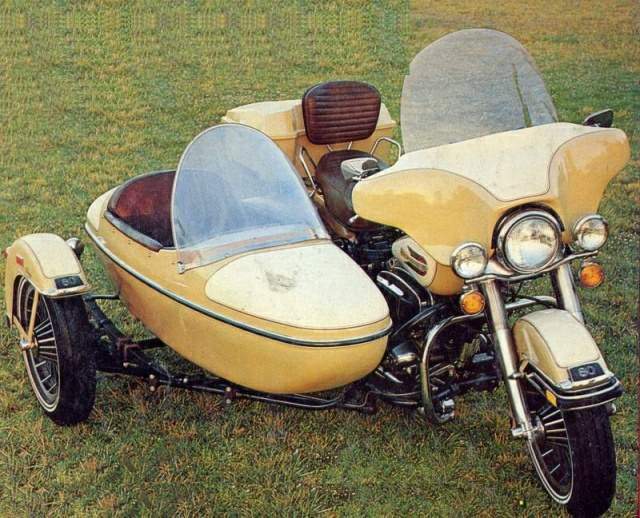
Harley Davidson CLE Classic Sidecar
Road Test Cycle Guide 1979 There are just not enough opportunities these days to look glamorous while riding a motorcycle. Once you're buckled into your leather battle armor, you feel more like a boulevard terrorist than one of the beautiful people. The folks you meet at parties might be slightly in awe of whatever hyperfast hardware you might be riding, but they're usually far more thrilled by someone else's Pierre Cardin belt buckle. Since bike people have as much right to feel upwardly mobile and status-conscious as anyone, this situation seems a little unfair. There are a couple of alternatives open to any biker who lusts after some glamour. You can buy a hot tub. Or you can wangle a luncheon with the editor of Wet, the Magazine of Gourmet Bathing. You can purchase a Bill Blass-signature Lincoln Continental. But if you're really after the kind of elegance that will rile up your friends and draw gasps of astonishment everywhere, what you need is a Harley-Davidson CLE Classic Sidecar. Yes friends, you heard right. A freaky, three-wheeled rig can be your ticket to a whole new lifestyle of Hollywood premieres and wild parties. Harley-Davidson sidecars just drive them wild in glamour-land. It's got the romance of the open road. It's as exciting as any rare vehicle. And the fact that a sidecar, especially this one, looks perfectly frivolous, enchants just about everybody out there in Main-Street America. It's a fairy tale on wheels, like owning a zeppelin. Harley-Davidson has some fairly prosaic reasons for building this limited edition of 200 CLE sidecar rigs, largely to do with reminding the public that Harley has always been in the sidecar market. Yet something more than just another cooking H-D three-wheeler is at hand here. This little rig cranks up Harley's touring act up about as far as it will go. You've got badges. You've got bags. You've got a two-tone sidecar. You've got spotlamps and flashers. It's as if Harley scoured its parts bins for every last gimcrack and chrome gee-gaw in a bid to make this the most glamorous Harley-Davidson ever. The CLE functions as a celebration and a reminder of every sidehack H-D has built since the Twenties. In fact, this fiberglass hack with its semi-elliptical leaf springs, cast wheel and third-wheel drum brake carries pieces with parts numbers identical to those used 50 years ago. The car attaches to a standard four-speed FLH in just two places and it's meant to be mounted and dismounted at the owner's whim. The motorcycle itself has been modified with an oil cooler and lower gearing to help it withstand the strain of dragging a 300-pound chair down the highway. An adjustable lower triple clamp reduces trail to 2.6 inches to make steering (that's how you turn, not by leaning) the sidecar rig easier, while a steering damper soothes the shimmy that a three-wheeler is prone to. A sidecar looks as peculiar as spats in 1979, but Harley-Davidson passes its creation off as a genuine touring machine anyway. And after all, that is the vision an English cartoonist had in 1903 when he proposed the concept (already invented in France) as a genuine transportation alternative. The sidecar made perfect sense at a time when few people could afford automobiles, since it held out the possibility of cheap motorized transport. Indeed, Thomas Watson acquired leadership in the sidecar field by manufacturing a folding sidecar which could be dismounted and stored along with your motorcycle in the parlour. From the Twenties to the Fifties, the sidecar provided a genuine alternative to the automobile. Something over 18 companies were building sidecars in Great Britain alone during the mid-Fifties while the Watsonian concern turned out 200 units a week. But once cheap automobiles like the Austin Mini appeared, the sidecar market quickly withered. Three-passenger sidecars with convertible tops and little doors no longer made sense. Sidecars still don't make much sense to motorcyclists, but as the motorcycle has become a purely recreational device, so too the three-wheeler has become a vehicle for fun. Harley-Davidson's example sure gives you a lot more fun for your $8000 than just a convenient place to park the groceries. This is an instant classic, the closest you can come to owning a newly-minted Pierce-Arrow. It's as much fun to look at as it is to ride in. This sidecar amounts to nothing less than motorized sculpture. You've got broad-shouldered fenders with chrome trim. You've got reflectors and lights everywhere. You've got cast wheels and fat tires. There's two-tone paint. There's 12 square feet of chrome. There's Harley-Davidson badges and logos in every possible quarter. It looks larger than life, as if time had swept by and left it behind amongst Deusenbergs and other cars of the gilded age. The mechanical bits and pieces of this rig also recall a time when industrial design seemed less confused. These days a relentless emphasis on function demands that every piece perform several tasks. But during the simpler era in which the Harley was designed, each piece was intended toprovide just one function. So the CLE isn't cast from a single lump of metal, it's composed of lots of little pieces. There's chrome covers for the exhaust crossover, separate left and right turn signal controls, intricate linkage bits for the heel-and-toe shift lever, a chrome band and cap for the oil tank. And each piece has its own peculiar shape, as if components had been slowly added to a single motorcycle for 50 years.
The sensations the loping 80 cubic-inch twin delivers are classical as well for every rasp, clatter and whine represents mechanical soul. No other manufacturer would consider or could get away an engine that might have been hammered out at a blacksmith's forge. But these sensations are the signature of the raw power this engine is supposed to deliver. Throttle response is indifferent, high-rpm power almost nonexistent and EPA-lean carburetion makes the engine spit back every once in a while. But no other engine can duplicate the steady locomotive-like quality of a Harley-Davidson. Stomping the transmission into gear may feel crude, but it's consistent with the engine's elemental character. With all this architecture and mechanical force at your disposal, you're to be forgiven if you begin to feel like a flight engineer instead of just a rider. You sit on top of this motorcycle, not in it. Body- work extends in every direction. If you holler "clear prop" just before you engage the electric starter, everyone will under- stand, because the whine of the starter, the throb from the engine and the cloud of blue smoke from the twines eloquently recalls the radial engine of Errol Flynn's World War I SPAD. Maneuvering this much machinery also calls for the talents of a pilot. You can't rely upon bicycle-bred instincts to get you around corners. When you want to turn this hunk of metal you yank the bars and point the front wheel in the direction you want to go. You're not a rider; you're a driver. The fact that the Harley seems set-up for Interstate use makes the steering feel even heavier. You need Hulk-size biceps to wrestle this creature on a mountain road, especially because the rubber-mounted bars are located too low for much leverage. Riding most sidecars resembles barn- storming an airplane. You don't just corner you perform stunts. Because of the layout of the tire patches, a sidecar prefers to drift around corners. So you do all your braking before the turn and then accelerate through it, rolling off the brake and onto the throttle gently to keep the screwball dynamics of a three-wheel de- vice under control. On acceleration the CLE tugs to the right because the sidecar wheel isn't powered. On deceleration, the rig drifts to the left without engine braking because the sidecar wheel tries to pass you. If you want to turn more sharply to the left, you apply a little rear brake to let the sidecar wheel pivot around you. When you turn right, you must insure that the sidecar doesn't lift up so the trick is to use a little front brake to settle the hack on the road and simultaneously roll on the throttle. To tighten your arc you just apply a little more front brake. Unfortunately most of these antics are denied to the Harley-Davidson rig. First of all, the big brake pedal operates a drum brake on the sidecar wheel as well as the FLH's rear disc brake. So while the added braking power is welcome in a straight line, you can't induce the kind of dynamics which can increase your cornering speed. In addition, the car shows a stub- born tendency to lift off the road, even when you've got a beefy passenger in place. This flaw tends to reduce enthusiasm for right-handers in a big way. Part of the CLE's unhappiness with corners may stem from the amount of compliance built into the hack. The semi- elliptical leaf springs and two-point chassis attachment let the car bob up and down at will. As a result, the car digs in around left-handers, killing any drifts. Around right-handers the car seems to spring into the air. While the functional content of this rig proves lower than other sidecars, no other motorcycle contraption redlines the enthusiasm of Americans quite like it. Little kids are forever pawing the CLE with their sticky hands and smearing ice cream on the fiberglass. It's a prize from a Crackerjack box come to life. Sober-sided businessmen weave from lane to lane on the freeway in their Mercedes Turbo-Diesels trying to get a closer look. Motorcyclists laugh and giggle. Best of all, women find the CLE irresistible. Boogie vans and conventional motorcycles might also thrill some females, but a sidecar somehow seems more socially acceptable. Park this rig anywhere in the vicinity of a shopping mall and soon the smell of bubblegum and perfume will be in the air, each young girl begging for a ride more plaintively than the last. And why not? Riding in a sidecar is like owning your own life-size Tonka Toy. You're the envy of everyone within hearing distance of the Harley's chuffing exhaust, riding in a motorized rickshaw, bounding over the bumps with your nose in the air. Even the Matterhorn ride at Disneyland was never this good. The wind curls around the lip of the windshield and tugs at your hair while the cacophony of the engine just inches from your ear drowns out everything. Once you overcome your fear of riding in an exposed bathtub without a handlebar to determine your fate, a sidecar becomes the perfect sightseeing device, a deck chair on wheels. After a while, though, the experience gets a little intense, especially when the exhaust fumes begin to plague you and the vibration seems to resemble that of a runaway magic-fingers unit. Yet afterwards, the sheer kinesthetic thrill of it all ripples through your nervous system. But the aspect of sidecar driving which proves truly habit-forming lies in the glamour the Harley-Davidson hack brings to motoring down the highway. Two pistons rattle up and down inside cylinders the size of water buckets, every piece of brightwork threatens to rattle off in the next few seconds, but you're in control. And the arch and swoop of fiberglass and chrome marks you as an individual of uncommon taste and individuality. People mistake you for someone seen in the Book Review section of Time. Your female companion is thought to be a starlet seen in the latest Steven Spielberg movie. Every trip around the block becomes a promenade. Finally—in the eyes of your neighbors at least—you are as remarkable as you feel. The Harley-Davidson CLE is not a motorcycle. If you approach it with the same expectations as a motorcycle, you will be disappointed. But if you accept this piece of work as pure, gorgeous frivolity, an amazing combination of seat-of-the-pants sensations and the thrill of the open road, every ride will be an event. Soon you too will feel like one of the glamorous, beautiful people. After all, what other reason could lie behind the smiles that follow you wherever you go? RIDE REVIEWNow I know how celebrities must feel when they venture out in public. I got a free sampling of maximum notoriety every time I rode the Harley sidecar rig anywhere there were people present. I'd be the center of attraction, like a movie star at a world premiere. Actually, the sidecar was the real dignitary, but I felt eminent just being part of all the commotion. And inevitably I would have to field a mixed bag of questions, compliments and flat-out proposals to engage in activities ranging from the innocent to the illicit. That's why it's hard for me to regard the Harley as a clankety, clumsy, inefficient anachronism, even though it is. Because I don't think of it as a motorcycle. To me, it's a nostalgic entertainment center, surrounding me with memorabilia of the past while taking me places I otherwise never would have visited.—Paul Dean I've had it up to here with behind-the-back snickers and whispered jokes about mobile barbecue grills. I'm even more fed up with monologues delivered gratis on the CLE's unsuitability for fast runs through the canyons. All the purists who in the past month have sniffed at me from behind the anonymity of their tinted visors have nothing but my sympathy. I'm not attracted to the big three-wheeler as some kind of competition for the motorcycle or just because it's flat beautiful (although anyone who can walk by the thing without stopping to admire the shape of at least one of the pieces has no soul and deserves whatever he gets). My fascination isn't tied to something that would surface in a bench-racing session. I just figure that as far as uncovering roots, Alex Haley has nothing, absolutely nothing on Harley-Davidson.—Larry Works I've always hated sidecars. Stuck midway between automobiles and motorcycles, they always seemed like grotesque hybrids from some hideous laboratory in the nastier section of Detroit. Adding fuel to my natural dislike of the things was my experience as a roadracer; whenever sidehacks were on the track, they spread oil and rubber all over the racing line. I hated 'em. Enter the coffee-and-cream H-D Classic, and, almost immediately, exit old grudges and hatreds. I love this thing. I love to look at it, to ride in it, to listen to it, and, God help me, to drive it. Not because it's fast, not because it's comfortable (it's anything but that) but because it's like an uncontrolled Disneyland ride. I wouldn't buy it for that reason alone, but I know that if I had it long enough, I'd eventually find reasons aplenty to park it in my driveway forever.—Steve Thompson Source Cycle Guide 1979
|
|
|
Any corrections or more information on these motorcycles will be kindly appreciated. |