Fork in die cast aluminium, Boge single shock
absorber fork in die cast aluminium, Boge single shock absorber
Front Brakes
Single 260mm disc
Rear Brakes
Single 240mm disc
Front Tyre
100/90-16
Rear Tyre
120/80-16
Wet-Weight
132 kg
Fuel Capacity
17 Litres
Consumption average
22.3 km/lit
Braking 60 - 0 / 100 - 0
14.0 m / 40. m
Standing
¼ Mile
15.7 sec / 132.9 km/h
Top Speed
157.3 km/h
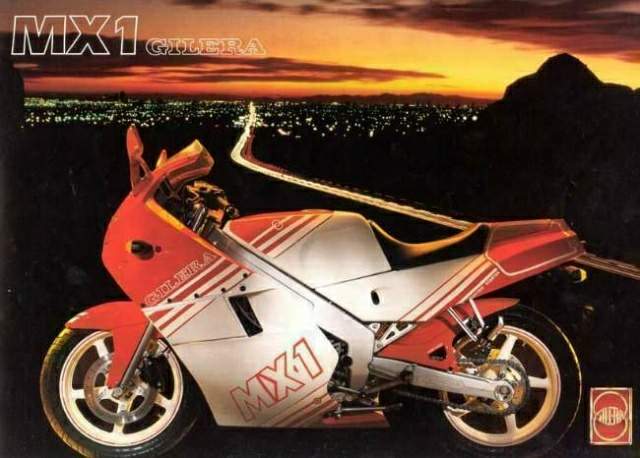
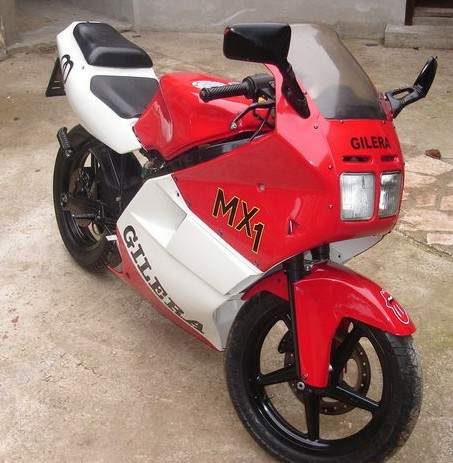
Presented at the Milan Show in 1987 and marketed
since April 1988, the Gilera MX-1 is in effect a new bike, simply to share with
her glamorous predecessor KK, best-selling sports cars of 1987 the motor and the
wheels 16 ".
The 1988 was undoubtedly a crucial year in the market of the 125 sports bike
which saw the birth of gifted technically and aesthetically: Aprilia introduced
the wonderful fact summary, the aggressive and carenatissima Cagiva Freccia C10R
Italy and Honda's revolutionary and scarenata NSR -F. If the RV of 1984 and
subsequent KZ / KK, Gilera was completely caught off guard competition by real
milestones in the evolution of 125, in the context described above, it is now
much harder to think of the MX-1 as a revolutionary movement. Accomplices
choices techniques such as conventional steel frame and wheels 16 "and a line
perhaps less original than the new products introduced by competitors, the MX-1
is more like an interesting alternative to KZ and KK, which is curiously
supports without replacing them, rather than its competitors.
The MX-1 remained in production until the end of 1989, when it was replaced by
the MX-R.
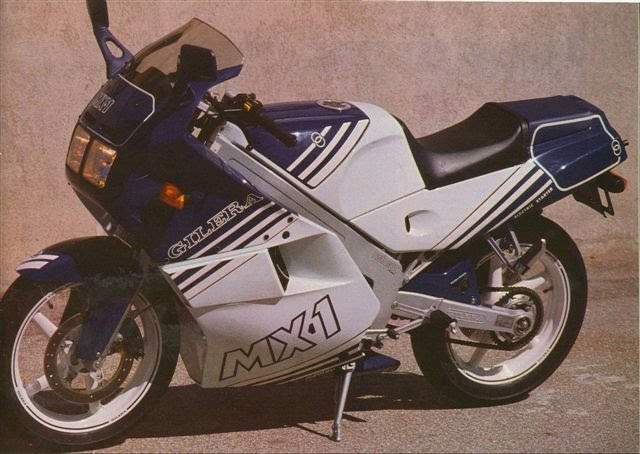
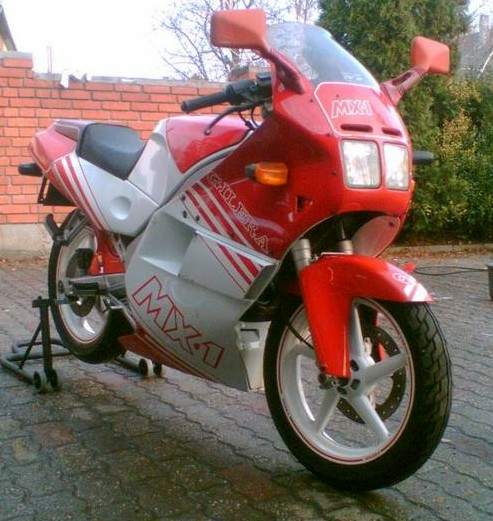
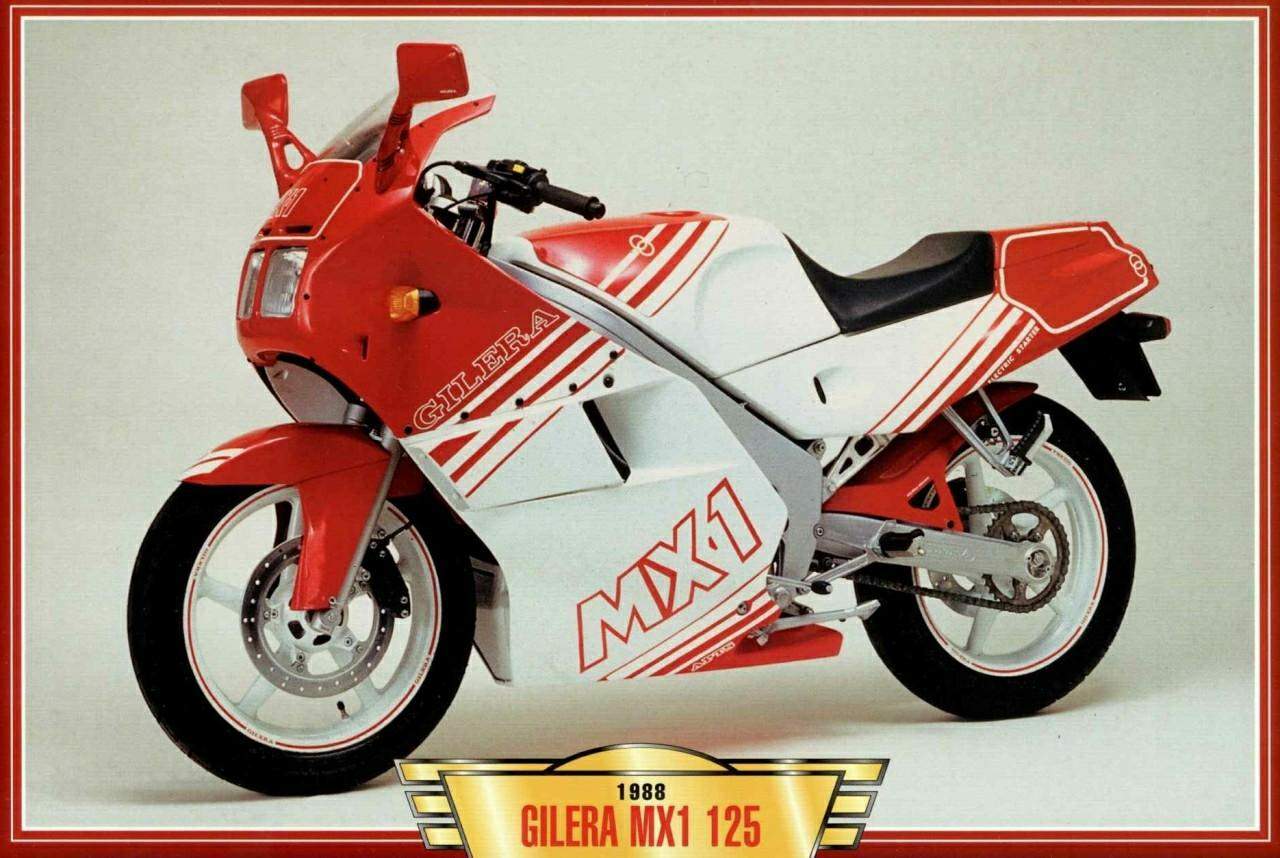
Colour: White / Red White / Blue
Price in 1988: 4,955,000 lire (295,000 lire electric start, although de facto
standard)
Other versions:
MX-1 Record
During 1988 was also presented the MX-1 record, characterized by a special
coloring to celebrate the four speed records obtained on the Nardo track.
The bike soon
As for KZ and KK, the line of MX-1 is the result of the drawing pencil Luciano
Marabese, although the design of the fairing was not only defined by the
inspiration of Marabese, but also by numerous tests in the Pininfarina wind
tunnel . In this regard, the trial has affected the fairing that goes to the
upper end of a small flap to reduce pressure on the pilot and the positioning
and sizing of air intakes power and cooling to improve not only the engine
cooling, but also the exit of hot air to the benefit of performance. The
headlight beam split and 'practically the same as that seen on KZ Endurance and
fit well to the lines of the fairing. Very beautiful too snug, but streamlined
front fender and matching mirrors.
A particular deserves the massive reservoir, well
developed upward, and that in fact 'a generous compartment oddments: a solution
previously adopted on KK and then also followed by the Cagiva Freccia C10R.
Compared to KK who adopted a little 5-liter tank top and a larger placed under
the engine, the true reservoir of less than 17 liters of MX-1 is entirely
underneath the engine and protected by a bulkhead antiheat It is obvious. The
real filler protected by lock and 'placed on the right side inside the fairing
and naturally' provided an electric pump that connects the tank with the
carburetor. With this new solution, engineers have Gilera then got a double
advantage over KK: further lower the center of gravity of the bike to the
advantage of handling and create enough space for a large storage compartment
suitable for containing even a full face helmet. All accompanied by excellent
build quality and clear from details like the faux filler type aircraft by
allowing the lock to open the compartment door-objects and the control spring to
keep up when open. Also in place are the battery compartment, the suction
openings of the filter case and a handy hole opened to access the spark plug.
The oil tank and 'placed inside the fairing on the left side and then on the
other side of the fuel nozzle.
As seen on KZ / KK, the band-tail side panels based on an aluminum shelf with
integral seat and therefore not be opened. Less successful line of codon that is
decidedly underpowered compared to the overall size of the bike, although a
pleasing racing comes from the double staining of the saddle, so to make up a
car and split the exhaust coming out the sides of the rear light. Finally,
always well made and treated the CEV instrumentation complete new design also
features digital clock and always beautiful electrical controls common to KZ /
KK
Cycling
Abandoned solution used on the KZ / KK double cradle beamed square tubes made of
steel, the chassis of the MX-1 It is a modern type Deltabox double side box-beam
high-strength steel. Sin Gilera technicians have not thought about the most
'noble and lightweight aluminum, used only for the swingarm and the rear seat
shelf Hold-halves in aluminum and the common KZ / KK. The Marzocchi fork has a
diameter of 35mm and 'adjustable compression and in three positions and' with a
stiffening plate. The rear suspension and 'Power Drive Note Gilera Boge
monoshock with adjustable spring preload only. The braking and 'produced by
Grimeca the front and there is a 260mm disc with a new four-piston caliper
differentiated, while the 240mm rear disc served as a caliper with two opposed
pistons. The wheel spokes are both 16 "and mount tires Pirelli MT75 in the
following dimensions: 100/80-16 front and 120/80-16 rear.
Engine
The engine of the MX-1 is the third generation of engines Gilera born with a RV
of 1984 and maintains the same structure, although compared to KK propeller
mounted on the main differences are:
New exhaust valve APTS 2 with different settings and new control unit (also
mechanical centrifugal) to improve the reliability
New exhaust system more preformante
Recalibration of the carburetor (Dell'Orto always PHBH 28)
Carter redesigned external
Gearbox and primary drive reviewed
With regard to performance, the MX-1 a good check that they result confirms the
work done by technical refinement Gilera. With a maximum power to the wheel to
26.01cv 9600giri (25.71cv 9500giri to KK) and a top speed of 156.600 (157.600 km
/ h KK), the benefits observed were lower than the more 'recent competition. For
the final shot, however, the Gilera engine shows its best quality ', proving
very docile and popping in the tests taken in the 400 meters to 50km / h, a time
of 20.587 seconds and a speed of 91.370 km output per hour (22.184 sec 80.720 km
/ h KK)
NOTE: Some of the photos on
Motorcycle Specs are owned by somebody. If you see any of your
photos, you can let me know so that I can acknowledge it, or if
you object to it, I can remove it altogether. If any copyright
holder objects to their articles being placed on Motorcycle
Specs, it will be removed upon request. Any correction or more
info on these bikes will kindly beappreciated
Contact MePrivacy
Policy
Website Stats