|
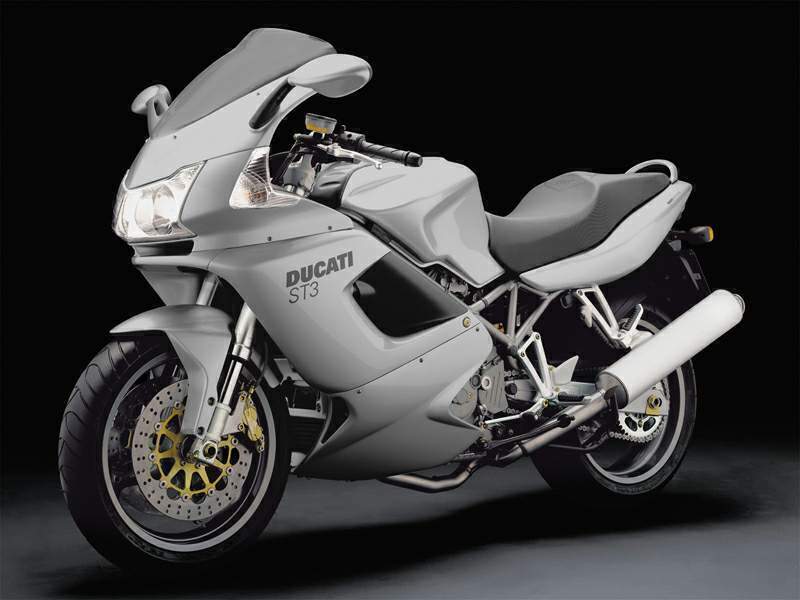
Ducati ST3

|
Make Model |
Ducati ST3 |
|
Year |
2004-05 |
|
Engine |
Liquid
cooled, four stroke, 90°“L”twin cylinder, DOHC, desmodromic 3 valve per
cylinder. |
|
Capacity |
992 |
|
Bore x Stroke |
94 x 71.5 mm |
|
Compression Ratio |
11.3:1 |
|
Induction |
Marelli electronic fuel injection, 50 mm throttle body |
|
Ignition /
Starting |
- / electric |
|
Max Power |
102 hp 75 kW @ 8750 rpm |
|
Max Torque |
93 Nm 9.5 kg-m @ 7250 rpm |
|
Transmission /
Drive |
6 Speed / chain |
|
Frame |
Tubular steel trellis Wheelbase 1430 mm /
56.3 in
Rake 24° |
|
Front Suspension |
Showa 43 mm adjustable preload upside-down fork |
|
Rear Suspension |
Progressive linkage with fully adjustable Sachs monoshock |
|
Front Brakes |
2 x 320mm discs 4 piston calipers |
|
Rear Brakes |
Single 245mm disc 2 piston caliper |
|
Front Tyre |
120/70 ZR17 |
|
Rear Tyre |
180/55 ZR17 |
|
Seat Height |
820 mm / 32.3 in |
|
Dry-Weight |
203 kg / 447.1 lb |
|
Fuel Capacity |
21 Litres / 5.5 gal |
|
Consumption average |
22.1 km/lit |
|
Standing
¼
Mile |
11.3 sec |
|
Top Speed |
236.6 km/h |
|
Reviews |
Motorbikes Today
/
Motorcycle.com
|

The classic European Gran Turismo tradition is the inspiration for the
Ducati Sport Touring family. The 2005 ST family offers maximum handling,
rider comfort and style in three models – the ST3, with 3-valve Desmo
engine, and the flagship ST4S and ST4S ABS. The advanced Anti-lock Braking
System on the ST4S ABS offers enhanced safety and confidence in all riding
conditions.
With its ideal riding position, optional saddlebags and two of
our most powerful Ducati Desmodromic 90° L-twin engines, the ST family
excels on both weekend get-aways and longer cross-country journeys.
Classic Grand Turismo Tradition. The 2005 ST family offers maximum
handling, rider comfort and style.
Features & Benefits
The ST3 sports a powerful, 3-valve, Desmo L-twin engine. Matched with its
Superbike-derived trellis frame, adjustable suspension, comfortable two-up
riding position and optional colour-matched luggage, the ST3 is at ease on
both twisty mountain roads and cross-country motorways.
Improved reliability and low emissions make the ST3 a confident choice to
tackle wild mountain passes and endless stretches of highway. Producing 107
hp at 8750 rpm, the ST3 has more than enough power for the long haul and
inspires confidence, even when two-up and under the full weight of luggage.

ST3 sporttouring
Okay, I'll admit it - I'm biased.
You see I used to have a Ducati ST2 that I bought about four years ago to take
myself and my daughter touring around France and Spain. I used it for a couple
of years until my daughter passed her bike test, then decided that going on
holiday with the parents "wasn't cool" anymore, and anyway I needed the space in
the garage. But I was sorry to see it go because it was utterly reliable and for
2-up press-on traveling with luggage it was hard to beat. Alright, the engine
was a bit asthmatic over 7,500 rpm, the headlights weren't the greatest on the
planet, and at low revs the vibes almost had the clocks jumping out of the
cockpit. But it was supremely comfortable, handled well around the twisty bits
and pulled like a train even when loaded up with the veritable kitchen sink.
click for a larger imageBack in 1997, the idea of going touring on any Ducati
was thought by many to be an act of complete lunacy. The words "Ducati" and
"Reliability" were not often found in the same sentence and even dEVOtee riders
of the Italian marque seldom ventured far from home on their own. Having a mate
following behind was considered essential to collect 'freedom-seeking' parts,
and you never knew when you might need a lift home. Breakdown cover was a
mandatory part of ownership.
So when Ducati launched the ST2 under the label "Sport Tourismo", many people
thought the company had finally cracked or maybe developed a sadistic sense of
humour. But the bike worked, and it gave Honda and its VFR a bit of a wake-up
call. Over the next few years it spawned both the ST4 and ST4S with bigger and
more powerful engines, until at the end of 2003 it got a complete makeover and a
new 3-valve engine, and metamorphosed into the ST3.
The most striking thing about the new ST3 is the front fairing which is much
sharper and angular than the old design, but still houses separate projector
headlamps for main and dip beam which are much improved over the originals, and
can even be adjusted electrically when you're sitting on the bike. And in the
saddle the other thing you notice is the size of the fairing which at first is a
bit like sitting behind a glass barn door. Strangely enough it doesn't seem to
offer any more wind protection than the smaller original when you're on the
move, although I wasn't able to test its rain-deflecting properties as amazingly
it didn't rain the whole time I had the bike on test. The rest of the bodywork
is unchanged, and I wouldn't be surprised if the old panels weren't
interchangeable with the new. However, underneath the fairing panels the ST3 now
sports an acoustic waistcoat, no doubt as a result of the ever more stringent
environmental regulations that regularly appear from Brussels.
click for a larger imageLike some of their Japanese counterparts, Ducati have
started to improve bike security, and the ST3 uses a coded ignition key and
immobiliser like the Honda HISS system. The test bike even had a U-lock carried
under the seat, although I'm not sure that this is standard equipment. Anyway, a
turn of the ignition key lights up the Multistrada-like instrument display, and
the multi-function lcd panel goes through a test sequence, tells you that this
is an English ST3, and then settles down to display speed, fuel level, coolant
temperature, distance traveled and the time.

By pressing a couple of buttons at the top of the
unit, the odometer will also show trip distance, average speed, instantaneous
and average fuel consumption, fuel used, the number of miles before you need to
fill up, and the number of gallons left in the tank. Unfortunately, whatever
kind of display you choose, the system resets to show total miles traveled
whenever the ignition is switched on. But on the plus side it's easy to switch
the display between miles and kilometres for those continental jaunts.
Thumb the starter button and the engine turns over in a typically lazy V-twin
manner that makes you think the battery's gone flat. But after a couple of
seconds the engine rumbles into life and then settles down to a strangely
erratic tickover, that could indicate a problem with the fuel injection system.
Pull in the clutch, which is surprisingly light for a Ducati, snick it into
first, and you immediately notice the difference in the engine. This is a really
willing unit which pulls hard right the way through the rev range. The extra
inlet valve on the 3-valve head really does the business. Gone is the old
wheeziness in the upper part of the rev range and yet it still develops masses
of torque from low revs that makes overtaking a breeze. Pick up is good at all
revs and the engine never really seems to be working hard. In fact it's so
relaxed that its quite easy to be cruising along at three-figure speeds and then
suddenly realise there's another cog in the box. There's very little vibration
at any speed, just the usual V-twin rumble to remind you that this is a Ducati.
click for a larger imageThe gearchange itself is no great shakes, and requires a
firm prod with the left boot to select a gear. On a number of occasions I also
managed to find a false neutral between 4th and 5th, which was something you
don't really expect to find on bike these days.
The other surprise on this bike was a wet clutch. Yes! - you heard right - a
Ducati with a wet clutch! This was a severe shock to the system. No more
rattling like a bag of rusty nails in neutral, no more embarrassing stares in
traffic queues, no more having to explain to the uninitiated "they all do that",
I can tell you it takes some getting use to. It turned out that this ST3 was a
2005 model, and Ducati UK believe that the ST4 and ST4S will also have wet
clutches next year. But if you buy a 2005 bike, you'll still have to remove the
right lower fairing panel to top up the oil level, as Ducati haven't taken the
opportunity to move the oil filler plug from its old "dry clutch" position to a
more accessible location on the clutch cover.
On the road the ST3 still has the good handling characteristics of its
predecessors. For normal riding the suspension is firm and reasonably
well-damped and the bike turns well and holds a good line through the corners,
although it does need a firm hand to get it well leant over. Stability is
excellent and the bike never feels as though its going to get out of shape
through the corners. This is a bike that likes to be ridden, although it's
equally comfortable clocking up the miles on the motorway or autoroute, just so
you can get to the good bits a little bit sooner. The new lighter clutch also
makes it a much better experience to ride around in towns and in traffic,
although the typically limited Ducati steering lock means that you still need a
very wide piece of tarmac for that feet-up U-turn.
click for a larger imageThe problems only come when you start to up the pace,
and then the budget front forks begin to lose the plot. They are far too softly
sprung and under-damped for real sporty riding, and with only preload adjustment
to play with there's not a lot you can do about it. The situation is compounded
by the excellent Brembo front brakes, which although having the power to haul
the bike's speed down very quickly with a two-fingered pull on the lever, also
have an alarming tendency to grab. This momentarily surprises the soft front
suspension and causes the bike to pitch forward dramatically. It's even worse
when you're riding 2-up, and you'll need to be very careful with the brakes if
you don't want your pillion hitting you in the back every time you try to slow
down. Unfortunately, using the rear brake to balance the bike is not going to
help you here, as the pedal has no feel at all and appears to contribute nothing
towards slowing the bike down - until it locks the back wheel!
Although the height-adjustable clip-on bars are a nice feature for a touring
bike that's designed to be sporty, I'd much rather have some properly sprung,
adjustable front forks that allowed me to quickly set up the bike for either
2-up touring or solo press-on riding. How about transplanting the forks off the
ST2? And before you get too carried away with those adjustable bars, Ducati
forgot to include the tool to loosen the clamp bolts in the toolkit!

The rear suspension is a much better sorted affair,
but even here there are some anomalies. The spring rates are good and
everything's adjustable - if only you could get to it! The compression adjuster
is masked by the left-hand heel plate, you'll need to remove the right side of
the tailpiece fairing to get to the rebound adjuster on the remote reservoir,
and adjusting the preload is something else. Ducati thoughtfully provide you
with a C-spanner to do the job, but the adjuster ring is masked by the remote
reservoir on one side and the frame tubes on the other. You can't even change
the preload by altering the length of the tie-rod like you can on the ST2 and
ST4, as this is a one-piece casting on the ST3. The only practical way left is
to use a drift and a large hammer, so make sure you pack these in your tank bag
every time you head off on holiday.
click for a larger imageThere's a new engine management system to go with the
new 6-valve engine, which uses the same CAN-line technology as Formula 1
racecars. According to Ducati, this is the first time such a system has been
used on a bike and has allowed them to simplify much of the electrical system
and save 3.5kg in weight. So it's surprising that the ST3 is 5kg heavier than
its predecessor, although the extra weight is not really noticeable.
What you do notice though is the way the engine hunts and shakes on a closed
throttle below 4,000rpm. It's as though there's unwanted droplets of fuel
leaking out of the injectors, or the throttle butterflies are vibrating slightly
or are out of sync. On its own this wouldn't be too bad, but when you add it to
the soft forks and the snatchy front brakes, the whole "coming to a halt thing"
becomes something of a jerky experience. Sure, with a bit of practice you can
ride around the problem, but in the 21st century should you have to?
I started out on this test, looking forward to riding an EVOlution of a very
capable bike that had been such a pleasant experience to own, but after two
weeks of living with the new ST3 I wasn't too sorry to see it go back. Now it
could well be that the injection problems and the grabby brakes were a one-off
on the test bike, which after all had probably been given a hard time by fellow
journalists who are not known for lavishing loving care and tenderness on the
bikes that they use. However, there's no getting away from the fact that the
suspension set up on the ST3 is a step back rather than an improvement on the
ST2, and is less than you'd expect from a bike that's targeted at the sporty
side of touring.
DH
Source
Motorbikes Today
|