|
|

|
|
|
|
Classic Bikes
Custom Bikes
Individual
Racing Bikes AJP
AJS
Aprilia
Ariel
Avinton / Wakan
Bajaj
Benelli
Beta
Bimota
BMW
Brough Superior
BRP Cam-Am
BSA
Buell / EBR
Bultaco
Cagiva
Campagna
CCM
CF Moto
Combat Motors
Derbi
Deus
Ducati
Excelsior
GASGAS
Ghezzi Brian
Gilera
GIMA
Harley Davidson
Hero
Highland
Honda
Horex
Husaberg
Husqvarna
Hyosung
Indian
Jawa
Kawasaki
KTM
KYMCO
Laverda
Lazareth
Magni
Maico
Mash
Matchless
Mondial
Moto Guzzi
Moto Morini
MV Agusta
MZ / MuZ
NCR
Norton
NSU
Paton
Peugeot
Piaggio
Revival Cycles
Roland Sands
Royal Enfield
Sachs
Sherco
Sunbeam
Suzuki
SWM
SYM
Triumph
TVS
Ural
Velocette
Vespa
Victory
Vincent
VOR
Voxan
Vyrus
Walt Siegl
Walz
Wrenchmonkees
Wunderlich
XTR / Radical
Yamaha
Zero
Video
Technical
Complete Manufacturer List
|
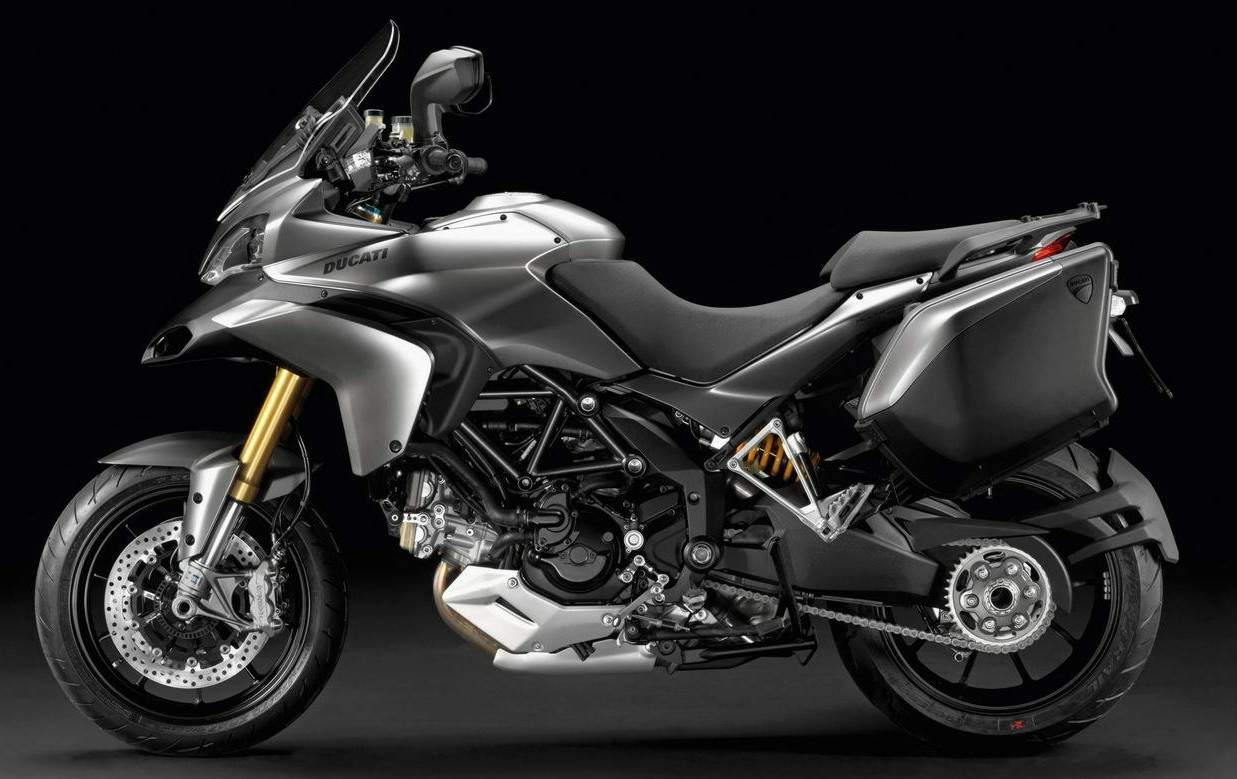
Ducati Multistrada 1200S
|
|
Make Model |
Ducati Multistrada 1200S |
|
Year |
2012 |
|
Engine |
Four stroke, 90° “L” twin cylinder, DOHC, desmodromic 4 valves per cylinder |
|
Capacity |
1198.4 cc / 73.1 cu-in |
| Bore x Stroke | 106 x 67.9 mm |
| Cooling System | Liquid cooled |
| Compression Ratio | 11.5:1 |
| Lubrication | Wet, multiplate clutch with hydraulic control. Self-servo action on drive, slipper action on over-run. |
| Exhaust | Stainless steel muffler with catalytic converter and 2 lambda probes, alluminium tail pipes |
|
Induction |
Mitsubishi electronic fuel injection system, Mikuni elliptical throttle bodies |
|
Ignition |
Marelli electronic |
| Starting | Electric |
|
Max Power |
110.3 kW / 150 hp @ 9250 rpm |
|
Max Torque |
118.7 Nm / 12.1 kgm / 87.5 lb-ft @ 7500rpm |
| Clutch | Light action, wet, multiplate clutch with hydraulic control. Self-servo action on drive, slipper action on over-run. |
| Transmission | 6 Speed |
| Final Drive | Chain #530, front sprocket 15; rear sprocket 40 |
| Straight Cut Gear Ratio | 1.84:1 |
| Gear Ratio | 1st 37/15 / 2nd 30/17 / 3rd 27/20 / 4th 24/22 / 5th 23/24 / 6th 22/25 |
| Frame | Tubular steel trellis frame |
|
Front Suspension |
Sach 48 mm fully adjustable USD forks. Electronic compression and rebound damping adjustment with Ducati Skyhook Suspension |
| Front Wheel Travel | 170 mm / 6.7 in |
|
Rear Suspension |
Progressive linkage with fully adjustable Öhlins monoshock. Electronic compression and rebound damping adjustment. Electronic spring preload with DSS aluminium single-sided swingarm |
| Rear Wheel Travel | 170 mm / 6.7 in |
|
Front Brakes |
2 x 320 mm Semi-floating discs, radially mounted Brembo calipers, 4-piston, 2-pad. ABS as standard equipment |
|
Rear Brakes |
Single 245 mm disc, 2-piston caliper |
| Front Wheel | 10-spoke light alloy, 3.50 x 17 |
| Rear Wheel | 10-spoke light alloy, 6.00 x 17 |
|
Front Tyre |
120/70 - ZR17 |
|
Rear Tyre |
190/55 - ZR17 |
| Rake | 25° |
| Trail | 110 mm / 4.33 in |
| Dimensions |
Length: 2200 mm / 86.6 in Width: 945 mm / 37.2 in Height: 1310 mm / 51.5 in |
| Wheelbase | 1530mm / 60.2 in |
| Seat Height | 850 mm / 33.4 in |
|
Dry Weight |
192 kg / 423 lbs |
| Wet Weight | 220 kg / 485 lbs |
|
Fuel Capacity |
20 Litres / 5.3 US gal / 4.4 Imp gal |
|
Consumption Average |
6.0 L/100 km / 16.8 km/l / 39.5 US mpg / 47.5 Imp mpg |
|
Standing 1/4 Mile |
11.8 sec |
|
Instruments Multifunction digital dashboard of two displays with white backlight. Main LCD display: odometer (total, trip 1 and trip2), speedometer, rev counter, clock, gear indicator, coolant temperature; fuel level. Circular LCD dot-matrix display: trip computer (riding style set-up, active riding parameters, remaining fuel/distance, current fuel consumption, average fuel consumption, average speed, air temperature, trip time), maintenance intervals indicator (Km), signaling alarms and errors detection (diagnosis), setup menu and customization functions. Interface for the management of Riding Modes (control power curve and throttle response power, traction control, ABS). "Parking" and "Steering lock" indicators. Lights: oil pressure, neutral N, fuel warning, turn signal, EOBD (diagnosis), high beam, DTC intervention (Traction Control) and deterrent immobilizer (in Key-Off). Headlight control: auto switching-off during engine start, auto turning-off after 60 seconds from Key-On without starting the engine. The key management of the various function menus are integrated in the left and right switch controls. |
|
The Ducati Multistrada will be available in a new "race titanium matte" colour
scheme and carry an upgraded seat.
The new colour option will include a "racing black" frame, while the seat has
been lengthened for added comfort. The Multistrada will still be available in
both red and white, and will come in the standard, Sport, Touring and Pikes Peak
Special Edition guises.
A dream Ducati - 4 bikes in 1. A sport bike, long-distance tourer, urban and
road enduro are now separated by just one click.
All versions come with an additional kit of optional larger rear hugger and
front fender rear section extension.
Multistrada 1200
• Bosch-Brembo ABS braking system
• Riding Modes
• Ride-by-Wire
• Ducati Traction Control
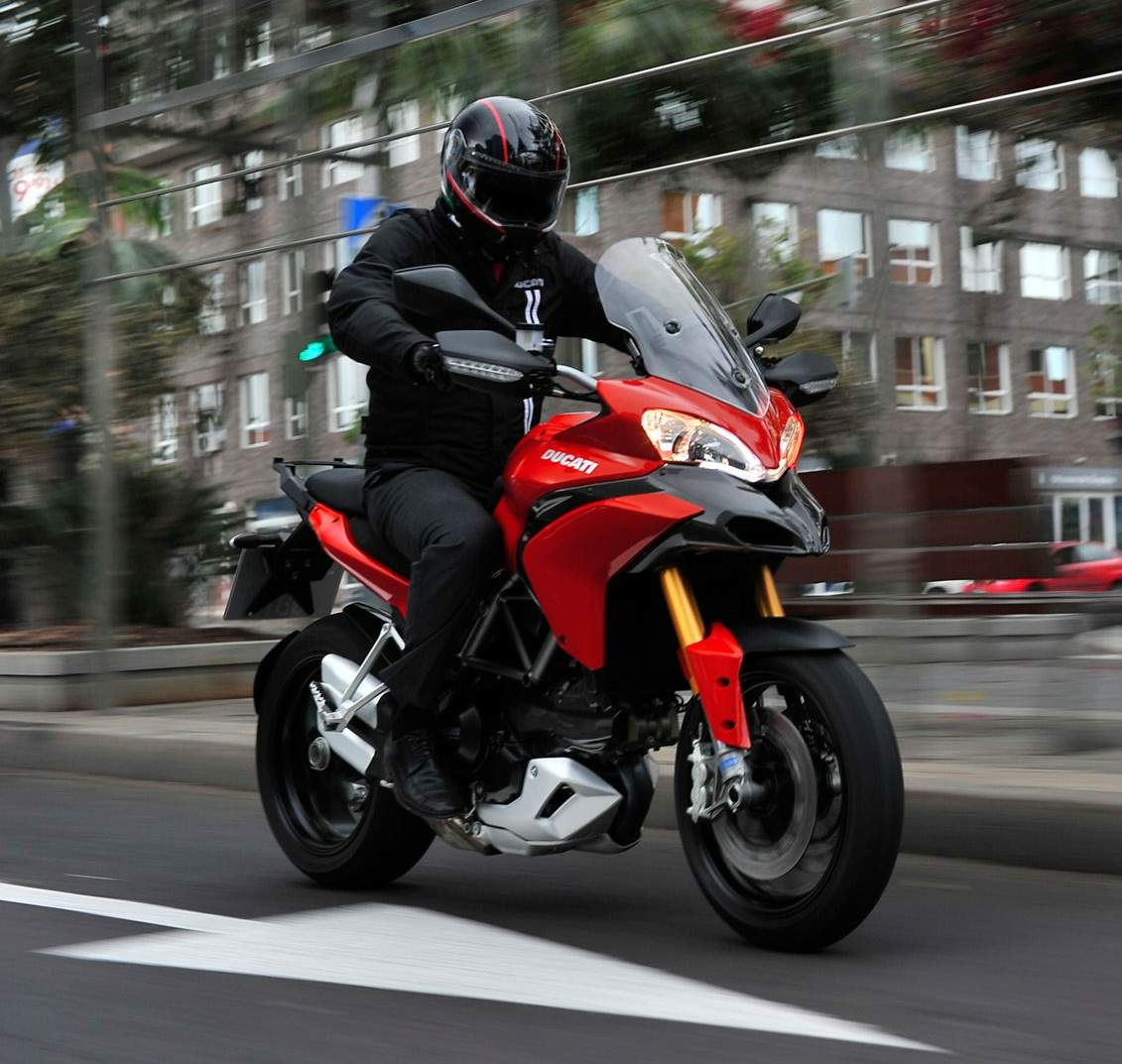
Endless transformations
The Multistrada family presents everything that has made it Ducati’s
award-winning and top selling motorcycle and adds subtle refinements that
further underline its quality as a true multi-tasking motorcycle with genuine,
everyday practicality.
Having more than proved its innovative concept and established itself as a new
industry benchmark, the Multistrada 1200 family moves into its third year with a
confident range that introduces the very latest software updates, an enhanced
seat shape, a new “race titanium” colour scheme and the stunning and celebratory
Pikes Peak Special Edition.
Combining ground-breaking design and unprecedented technology, the Multistrada’s
Sport, Touring, Urban and Enduro Riding Modes enable a truly enjoyable and
customisable riding experience separated by just one click. The
four-bikes-in-one concept makes instant adjustment to power and torque delivery
in addition to electronic adjustment of suspension settings and traction
control, transforming the Multistrada 1200 to suit its rider and environment.
Hailed as a true ‘game-changing’ motorcycle, the technologically-advanced Multistrada 1200 has attracted all types of riders by opening up the borders between motorcycle categories. With the 150hp Testastretta 11° engine, a class-leading dry weight of just 192kg (423lb) and the application of advanced ergonomics, the Multistrada 1200 is not only powerful and playful, but also a comfortable and versatile adventure on two wheels.
The range includes the Multistrada 1200 with the Riding Mode technologies of Ride-by-Wire (R-b-W) and Ducati Traction Control (DTC) in addition to ABS and the Multistrada 1200 S with Ducati Electronic Suspension (DES) by Öhlins, R-b-W, DTC and ABS. The 1200 S is available in ‘Sport edition’ with carbon fibre components or ‘Touring edition’ with side luggage, heated grips and centre stand. The Multistrada 1200 S Pikes Peak Special Edition represents the flagship model for 2012, celebrating victory in the famous mountain race in Colorado that spectacularly proved the model’s multi-terrain capabilities.
Ducati Multistrada 1200 Key Features and Benefits
CONCEPT
Endless transformations - The new Ducati Multistrada 1200 combines innovative design and unprecedented technology to unleash four-bikes-in-one. Sport, Touring, Urban and Enduro riding modes now enable a truly enjoyable and customisable riding experience separated by just one click. The ground-breaking design makes instant adjustment to power and torque delivery in addition to electronic adjustment of suspension settings and traction control, transforming the Multistrada 1200 to the rider’s needs, and not the other way around. Hailed as a true ‘game-changing’ motorcycle, the technologically-advanced Multistrada 1200 introduces the new 150hp Testastretta 11° engine, and advanced ergonomics to be powerful, playful and a comfortable and versatile adventure on two wheels.
Enduro - If the route leaves the beaten track, the Multistrada 1200 is ready to take it in its stride. Agile, lightweight and with high, wide handlebars, serrated footrests, stylish sump guard and specially designed tyres, the Multistrada also features an Enduro riding mode which instantly delivers a smooth 100hp. With DTC reset to an off-road suitable level for less intervention and the all-mode option to disable the ABS.
Sport - The Sport riding mode delivers an adrenalin-filled 150hp ride with sports-oriented throttle response . In character with its Superbike bloodline, DTC immediately adjusts to a level for expert riders whose ‘comfort zone’ is a little closer to the limit. Ducati's racing experience combined with first-rate components makes riding the Multistrada 1200 a pure motorcycling thrill and a dream come true for those searching for best-in-class performance as well as comfort.
Touring - While the Touring riding mode is also programmed to produce 150hp, the power characteristics are designed in a configuration that delivers a smoother and more user-friendly throttle response. Active safety is already available with the advanced ABS system, but in Touring mode it is further enhanced by increasing DTC intervention to a level specifically intended for a relaxing ride.
Urban - As navigation of the urban jungle can require an even more user-friendly motorcycle, the Urban riding mode instantly transforms the Multistrada 1200 into the most manageable, practical and desirable everyday transport. Power output is adjusted to 100hp and DTC is further enhanced to provide increased intervention during the most chaotic of stop-start traffic.
ENGINE
Vacural® crankcases - The Testastretta 11° features vacuum die-cast crankcases,
formed using Vacural® technology, a process that achieves a significant weight
saving and ensures consistent wall thickness and increased strength.
Testastretta 11° - A desire to make the World Superbike engine accessible to everyone resulted in the design and creation of the brand new Testastretta 11°, a motor that's a racer at heart and yet ready for long-distance touring or everyday urban use. So named because of its minimised 11° of ‘valve overlap’ - the interval of crankshaft rotation during which both intake and exhaust valves are open at the same time - the new Desmodromic power plant not only transforms the Testastretta Evoluzione’s world championship-winning 41° configuration into a super-smooth motor for sport touring, but also improves fuel efficiency, emissions and cost of scheduled maintenance. The Testastretta 11° is an engine for all environments and the perfect ‘game-changer’ for the four-bikes-in-one concept.

Sump-guard - The bike is suitable for off-road riding. Off-road use is enabled by the extra-long travel, reduced-weight suspension, as well as a robust and effective structural sump guard in aluminium which protects the oil sump from bumpy ground.
15,000 mile major service intervals - The Multistrada 1200 has been subjected to the most intensive development program ever. With the goal of setting the bar even higher, Ducati developed revolutionary new features for the 4-bikes-in-1 concept and took aim at industry benchmarks to create a model that would go the distance, both figuratively and literally.
Overdrive - The gearbox and final drive ratios have also been optimised to enable reduced fuel consumption and achieve increased riding comfort by reducing vibration. If the 1198 Superbike reaches its top speed in 6th gear, the Multistrada 1200 is able to reach it in 5th gear and maintain it effortlessly in 6th.
Emissions - On the new Testastretta 11° engine, this angle has been reduced from 41°, used in the Testastretta Evoluzione engine which powers the 1198, to just 11°. As a result, the fresh inlet charge flow is less compromised by the exiting exhaust gases, resulting in a much smoother combustion in addition to improved fuel economy and lower exhaust emissions. Unburnt hydrocarbon emissions (pre-catalyser) are reduced by up to 65% and specific fuel consumption (and consequent CO2 emissions) by up to 15% (Euro3).
Torque assisted slipper-clutch - The Multistrada 1200 features an oil bath clutch with ‘slipper’ function and super-light feel at the lever. Its design uses a progressive self-servo mechanism that presses the plates together when under drive from the engine, enabling the reduction of the clutch spring rates. This results in a much lighter clutch lever at the handlebar, ideal in stop-start traffic or long journeys. When the drive force is reversed (over-run), the same mechanism reduces the pressure on the clutch plates, enabling them to provide a race-like ‘slipper’ action, which reduces the destabilizing effect of the rear-end under aggressive down-shifting and provides a much smoother feeling when closing the throttle or down-shifting under normal riding conditions.
Ride-by-Wire - The Ride-by-Wire RbW system is an electronic interface between the twistgrip and the engine which decides the ideal power response depending on the riding mode selected and according to the rider’s throttle input. The twistgrip no longer has a throttle cable connected directly to the throttle body butterflies, but instead delivers a signal to a control unit, which in turn operates the butterfly opening. The RbW system uses three different mappings to regulate the power delivery. The three maps offer 150hp with a sports-type delivery, 150hp with a progressive delivery suitable for touring and 100hp with progressive delivery for city or off-road use.
Exhaust system - For Ducati, design is not just creating an attractive look. It
is about knowing how best to combine exciting appearance with intelligent
function and outstanding performance. Even the Multistrada 1200’s exhaust tail
pipes are a feature that perfectly demonstrates this concept. Their innovative
design is well integrated with the motorcycle’s overall shape and the
positioning of the exhaust system improves overall weight distribution. The
tailpipes are short so they do not impinge on the space needed for the side
luggage. The internal structure of the silencer is designed to achieve the
characteristic Ducati sound without compromising compliance with sound and
hydrocarbon emission standards (Euro3).
CHASSIS
Seat - The Multistrada 1200 seat immediately transmits a sense of comfort.
Constructed in two separate sections for the rider and passenger, the design
focussed on form and cushion density to ensure maximum comfort during long
journeys and user-friendly lateral shaping to help give sure-footed ground
contact when stationary. A confidence-inspiring passenger grab-handle offers a
secure and comfortable grip.
Ergonomics - The Multistrada 1200 was subjected to an extensive ergonomic study using both CAD and repeated prototype testing, guaranteeing a high level of comfort with a fully loaded motorcycle for long-range touring. The ‘ergonomics triangle’ of handlebar, seat and footpegs has been designed for both the rider and passenger, optimising comfort while providing a commanding and upright riding position. The Multistrada 1200 feels spacious and accommodates both rider and passenger in complete comfort, even with the top case and side luggage in place. Its 1530mm (60.2in) wheelbase ensures that not only the weight of the passenger remains inside the wheelbase length, but also that of the side luggage when loaded, a considerable contribution to the motorcycle’s dynamic performance. Underlining its multi-tasking intention, ergonomic attention was even applied when designing the riding position while standing on the footpegs, off-road style.
Fuel tank - The fuel tank has been developed using a new moulding technology which enables a favourable balance between capacity and weight. Subject to riding style, the 20 litre (5.3 gallon US) capacity can provide up to 400km (250 mile) of motorcycle pleasure between fuel stops by returning approximately 47mpg (US) (56mpg UK) at a constant 75mph (120km/h).
Magnesium front subframe - The high pressure, die-cast, magnesium front subframe reduces the high, frontal weight and contributes to chassis feel and control.
Lightweight construction - Constantly reducing weight is part of the design brief for all Ducati models. Less weight enables maximum performances both in terms of dynamic behaviour and safety. A lighter motorcycle will brake in a shorter distance, accelerate faster and be easier to steer. Every single component of the Multistrada 1200, therefore, has been designed to achieve weight reduction without compromising its load-bearing capacity. With a dry weight of just 189kg (417lb) the Multistrada 1200 is lighter than any other road enduro, touring or sport touring bike currently available in this category. The lightweight and excellent chassis set-up ensures exceptional handling, a key factor for Sport, Touring, Urban or Enduro riding.
Marzocchi forks - The Multistrada 1200 uses 50mm Marzocchi front forks, featuring a special forged fork bottom and full adjustability in spring pre-load, compression and rebound damping. Front forks have 170mm of travel, the extra-long movement providing excellent comfort even when fully loaded and even if the rider decides to leave the asphalt for an off-road route.
Trellis frame - The Ducati signature Trellis frame uses large diameter, light gauge tubing with two central cast aluminium sections and a Trellis rear subframe. The frame has 19% more torsional rigidity than the Multistrada 1100.
Single-sided swingarm - The single-sided rear swingarm is also a good example of
Ducati’s blend of design and functional engineering. It is made using a single
piece casting, with fabricated and welded sections creating a strong, hollow and
lightweight component that contributes considerably to the Multistrada’s
sure-footed handling.
Sachs rear suspension with adjustable preload - The rear is controlled by a Sachs monoshock adjustable in spring pre-load, and rebound and compression damping. Rear suspension has 170mm of travel, the extra-long movement providing excellent comfort even when fully loaded and even if the rider decides to leave the asphalt for an off-road route.
EQUIPMENT
Stowage - Two handy onboard stowage areas are built into the motorcycle, one
suitable for mobile phones or toll road tickets situated in the right cockpit
side panel and a larger 3 litre area situated under the passenger seat.
Pirelli Scorpion Trail - Ducati’s technical partner, Pirelli, worked alongside the Multistrada’s engineers throughout the project, developing the new Pirelli Scorpion Trail tyres specifically for the Multistrada 1200. The new tyres represent the first ever dual compound for on/off road use with a harder compound central section. Combined with a special tread design and carcass structure, their 190/55 section delivers racing performance on the road in terms of grip and lean angles, while ensuring high mileage for touring and good off-road performance. The new generation tyres are purposely designed for the Multistrada’s four-bikes-in-one concept.
Adjustable screen - The Multistrada 1200’s screen is designed with 60mm of
vertical adjustment to ensure efficient wind protection for all rider heights
and effortless high-speed riding over long distances.
ABS - The Multistrada 1200 offers a Bosch-Brembo ABS system, which is fitted as
original equipment. It delivers outstanding braking performance in all
conditions and provides a major contribution towards performance safety. An
option to disable the ABS is available via the instrumentation, but is
automatically reactivated at the next ignition-on.
Lighting - The headlight is a characteristic feature of the face of the Multistrada 1200, its symmetrical layout uses four halogen lamps, two for low and two for high beam to provide excellent illumination. In addition, the front and rear side lights use LEDs, and feature a special shape of intense light guidance, making the motorcycle more visible to other road users.
Power sockets - Two 12v power outlets situated on either side of the area below the rider’s seat can be used to power up to 8A (fused) accessories such as thermal apparel, intercoms or mobile phone chargers. In addition, a special connection point for powering the GARMIN satellite navigator (optional feature) is situated near the instrumentation.
DTC - The racing-derived DTC is a highly intelligent system which acts as a filter between the rider’s right hand and the rear tyre. Within milliseconds, DTC is able to detect and then control rear wheel-spin, considerable increasing the bike’s safety and performance. The system offers eight ‘levels of sensitivity’, each programmed with a level of rear wheel-spin tolerance in line with progressive levels of riding skills classified from one to eight. Level one is programmed to offer the least amount of interaction while level eight uses the most amount of interaction. DTC is an integral part of the pre-programmed Riding Modes on the Multistrada 1200; however, its setting can be customised by the rider.
On-board computer - The on-board computer system is made up of a large, high visibility LCD with the main data and a dot-matrix circular LCD which visualises various functions according to whether the bike is stationary or moving.
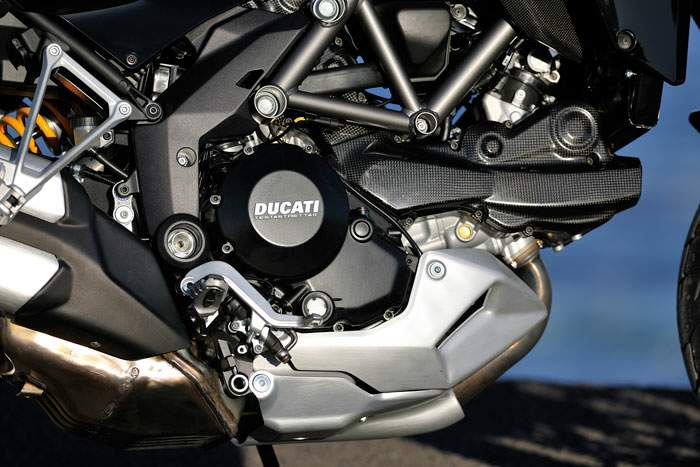
The ‘S’ version of the Multistrada 1200 is equipped with the latest generation 48mm Öhlins forks featuring the innovative Ducati Electronic Suspension (DES). The new fork technology enables rebound and compression damping adjustments electronically controlled via the instrument panel. The top of the range Öhlins TTX rear monoshock is also adjusted electronically in both spring pre-load and rebound and compression damping.
The electronic suspension adjustment can be made easily by using the pre-set
riding modes, which have been developed by Ducati test riders, or independent
mode, which allows riders to use their own personal settings. Adjustments made
electronically send a signal that initiates electronic actuators mounted on the
suspension units.
In addition to the Riding Mode of Sport, Touring, Urban and Enduro, there is
also an option to quickly change the suspension setting to suit ‘rider only’,
‘rider with luggage’, ‘rider and passenger’ or ‘rider and passenger with
luggage’.
Hands-free ignition
The Multistrada 1200 ignition is not actuated with a normal key. Instead, an
electronic key in the rider’s pocket communicates with the Multistrada when
within a distance of approximately 2 metres (6.5ft), recognising the dedicated
key code and automatically enabling the motorcycle’s systems. Pressing the keyon
switch then activates all systems to ‘on’ and the engine is ready to be started.
The electronic key, which internally consists of a radio circuit, externally
doubles as a mechanical flip-key, required to open the seat and fuel tank cap.
When parking the motorcycle an electronic locking device can be actuated on the
steering simply by applying full steering-lock and pressing the ignition-off
button a second time.
Ducati Traction Control
The racing-derived Ducati Traction Control (DTC) is a highly intelligent system
which acts as a filter between the rider’s right hand and the rear tyre. Within
milliseconds, DTC is able to detect and then control rear wheel-spin,
considerably increasing the bike’s active safety and performance.
The system offers eight ‘levels of sensitivity’, each programmed with a level of
rear wheel-spin tolerance in line with progressive levels of riding skills
classified from one to eight. Level one is programmed to offer the least amount
of interaction while level eight uses the most amount of interaction. DTC is an
integral part of the pre-programmed Riding Modes on the Multistrada 1200.
The system uses front and rear wheel sensors to compare speed differential and
sense when rear traction is being broken (wheel-spin). DTC then decides the best
combination of two different types of instant electronic adjustment, calculated
with data supplied from multiple sources.
The first 'soft' stage of system interaction is executed by high speed software
that makes instant electronic adjustment to the ignition timing, administering
varying amounts of ignition retardation to reduce the engine's torque.
If the DTC software detects that the first 'soft' stage of system interaction is
inadequate to control the wheelspin, it continues to administer ignition
retardation and, in addition, instructs the engine ECU to initiate a pattern of
constantly increasing injection cuts until, if necessary, full injection cut.
Red lights around the circular Riding Mode section of the instrumentation
illuminate to indicate the interaction of the DTC system. As soon as the system
recognises the gradual return of equal wheel speeds, it incrementally
re-establishes normal power delivery. This seamless interaction is key to the
super-smooth operation of the system.
The real innovative thinking behind the DTC system is how the various range of
sensitivity levels decide precisely how to react to excessive wheel-spin by
understanding the bike's exact 'dynamic situation'. From slow mid-corner
acceleration with considerable vehicle inclination to high speed corner exits
while almost upright, this 'system intelligence' is achieved by processing a
mass of data in a matter of milliseconds.
DTC levels are factory pre-set in each of the four Riding Modes, but can be
individually customised and saved to suit the rider by accessing the set-up menu
within each one. A ‘Default’ option is available to easily return all settings
to factory pre-sets.
Instrumentation
The instrumentation has a large, high visibility LCD showing all main data and a
dot-matrix circular LCD which displays the Riding Modes, additional data or
set-up menus depending on whether the bike is stationary or moving.
The main LCD displays data for speed, rpm, gear, total mileage, trip1/trip2,
engine coolant temperature, fuel level and time. When the motorcycle is in
motion, the dot-matrix LCD displays the selected Riding Mode, remaining
fuel/distance, current fuel consumption, average fuel consumption, average
speed, air temperature, trip time, and ‘freezing conditions’ alarm. When
stationary, it enters a setting menu from where adjustments to the various
functions can be made including personalised DTC set-up and, on the ‘S’ version,
suspension settings.
The Sport, Touring, Urban or Enduro Riding Modes can be changed while either
stationary or in motion, as well as load settings for ‘rider only’, ‘rider with
luggage’, ‘rider and passenger’ or ‘rider and passenger with luggage’.
MULTISTRADA POWER
Testastretta 11°: The ideal travelling companion
The heart of the highly complex and innovative Multistrada 1200 project is the
engine and, as a prestigious model, the motorcycle had to be powered by an
advanced and evolved twin-cylinder engine - the Testastretta Evoluzione engine
that powers the world-beating 1198.
The challenge, however, was to produce an engine that would be enjoyable to use
in all conditions and able to adapt to the rider’s character and not the other
way around. Making the race-derived L-Twin engine performance smoother and more
user-friendly was a challenge, but Ducati’s innovative designers and engineers
met the challenge by designing the revolutionary Testastretta 11° engine. Their
achievement succeeded in harnessing the immense power of the Superbike engine,
making it smooth and adaptable to suit to any occasion, a significant step
forward in balancing performance with usability.
For a motorcycle intended for touring, the smoothness and user-friendliness of
the engine is key to achieving an effortless and comfortable ride and the main
engine characteristic that enabled this configuration was the revision of the
valve overlap angle.
The overlap angle is defined as the interval of crankshaft rotation, measured in
degrees, during which both the intake and exhaust valves are open at the same
time. This overlap occurs between the end of the exhaust stroke and the start of
the intake stroke. On the Testastretta 11° engine, this angle has been reduced
from 41°, used in the Testastretta Evoluzione engine which powered the 1198
Superbike, and as a result, the fresh inlet charge flow is less compromised by
the exiting exhaust gases, resulting in a much
smoother combustion, improved fuel economy and lower exhaust emissions. Unburnt
hydrocarbon emissions (pre-catalyser) are reduced by up to 65% and specific fuel
consumption (and consequent CO2 emissions) by up to 12% (Euro3).
With its 150hp and 12.1kgm (87.5lb-ft) of torque, the Testastretta 11° set a new standard for Ducati twincylinder engines. Fluid dynamics testing on ports and combustion chambers resulted in a modified power delivery profile, specifically the torque. New intake and exhaust ports combined with a radical adjustment of the cam timing and slight reduction of the compression ratio have enabled Ducati to achieve a favourable torque curve at low rpm, which remains strong through a wider range. This particular characteristic considerably enhances the Multistrada 1200’s effortless ridability.
The Multistrada 1200 features an oil bath clutch with ‘slipper’ function and
super-light feel at the lever. Its design uses a progressive self-servo
mechanism that presses the plates together when under drive from the engine,
enabling the reduction of the clutch spring rates. This results in a much
lighter clutch lever at the handlebar, ideal in stop-start traffic or long
journeys. When the drive force is reversed (over-run), the same mechanism
reduces the pressure on the clutch plates, enabling them to provide a race-like
‘slipper’ action, which reduces the destabilizing effect of the rear-end under
aggressive down-shifting and provides a much smoother feeling when closing the
throttle or down-shifting under normal riding conditions.
The layout for the exhaust system, which is simple and minimalistic, uses two
primary manifolds flowing directly into the triple chamber single silencer. In
addition to carrying out the 2-1-2 compensator function, the silencer contains
the catalyser and sound-absorbent materials. The two compact and lightweight
aluminium alloy end pipes depart in a low, lateral configuration to keep the
overall weight to a minimum. More strada between major services.
Constant investment in quality by design, advanced materials and engineering
techniques, has enabled the distance between major service intervals (valve
clearance check) to be doubled to a highly competitive 24,000km (15,000 miles).
This has been achieved partly by the introduction of a new valve seat material
and partly by the improved combustion efficiency and temperature management
designed into the Testastretta 11° engine.
INNOVATIVE DESIGN
192kg (423lb) Multistrada sets the benchmark
Constantly reducing weight is part of the design brief for all Ducati models.
Less weight enables maximum performance both in terms of dynamic behaviour and
safety. A lighter motorcycle will brake in a shorter distance, accelerate faster
and be easier to steer. Every single component of the Multistrada 1200,
therefore, has been designed to achieve weight reduction without compromising
its load-bearing capacity.
With a dry weight of just 192kg (423lb) the Multistrada 1200 is lighter than any other road enduro, touring or sport touring bike currently available in this category. The lightweight and excellent chassis set-up ensures exceptional handling, a key factor for Sport, Touring, Urban or Enduro riding.
Ergonomics and comfort
The Multistrada 1200 was subjected to an extensive ergonomic study using both
CAD and repeated prototype testing, guaranteeing a high level of comfort with a
fully loaded motorcycle for long-range touring.
The ‘ergonomics triangle’ of handlebar, seat and footpegs has been designed for
both the rider and passenger, optimising comfort while providing a commanding
and upright riding position. The Multistrada 1200 feels spacious and
accommodates both rider and passenger in complete comfort, even with the top
case and side luggage in place. Its 1530mm (60.2in) wheelbase ensures that not
only the weight of the passenger remains inside the wheelbase length, but also
that of the side luggage when loaded, a considerable contribution to the
motorcycle’s dynamic performance. Underlining its multi-tasking intention,
ergonomic attention was even applied when designing the riding position while
standing on the footpegs, off-road style.
The wide, tapered steel handlebars have been designed for maximum comfort and
ensure a commanding riding position enhanced by a generous steering lock of 76°
(38° left and right). In addition, the handlebars have been mounted on
anti-vibration isolators, specially designed to balance riding comfort with a
precise road ‘feel’.
The Multistrada 1200 seat immediately transmits a sense of comfort and for 2012
has been further enhanced with more length front and rear for the rider.
Constructed in two separate sections for the rider and passenger, the design
focussed on form and cushion density to ensure maximum comfort during long
journeys and user-friendly lateral shaping to help give sure-footed ground
contact when stationary. A confidence-inspiring passenger grab-handle offers a
secure and comfortable grip.
The footpeg position represents part of the optimum ‘ergonomics triangle’ for both the rider and passenger with added consideration to ground clearance during maximum lean angle and position of side luggage. The footpegs have rubber inserts that insulate vibration, removable to expose a motocross-style serrated edge that provides enhanced boot grip when riding off-road.
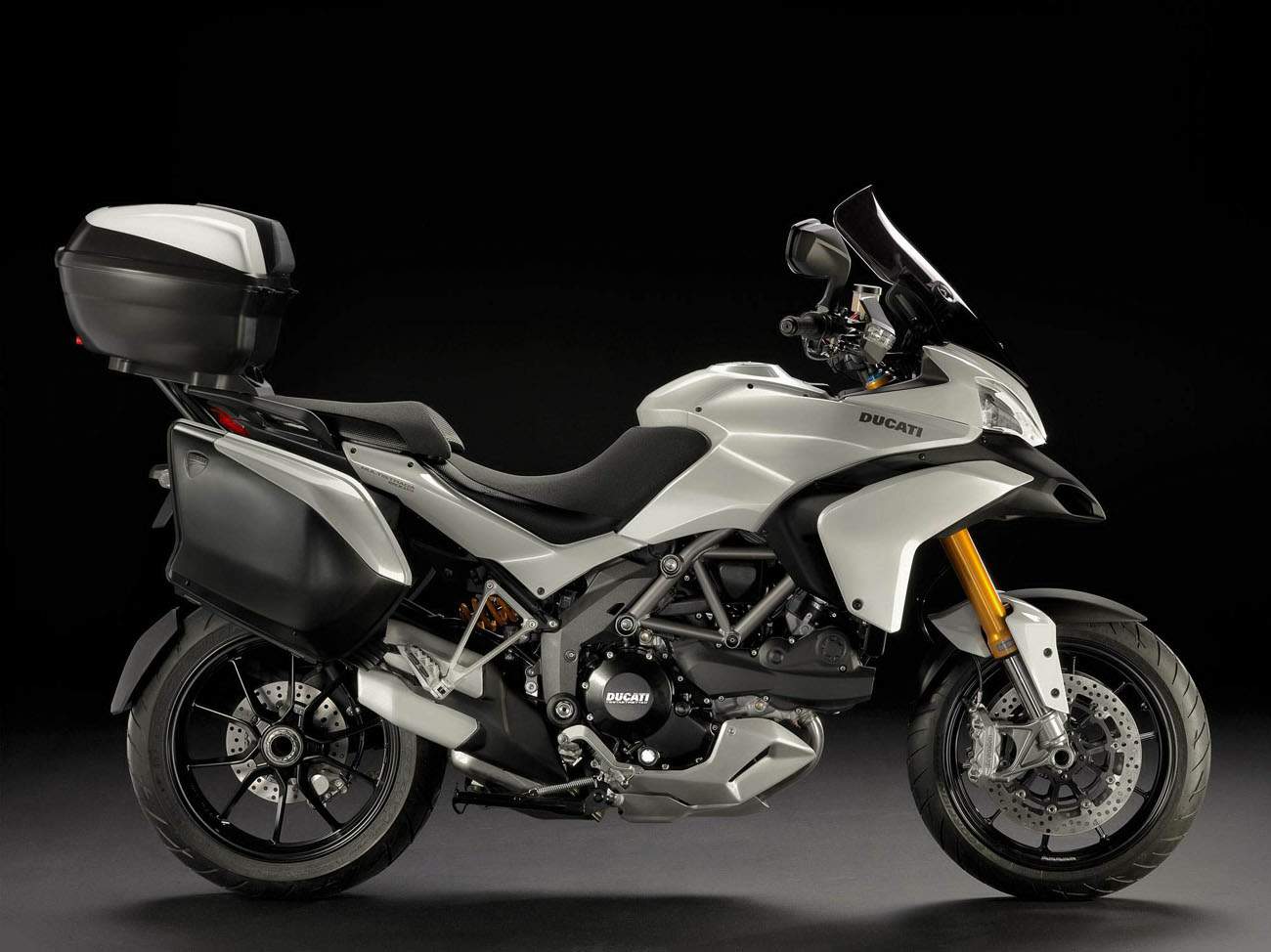
The Multistrada 1200’s rear view mirrors have both vertical and horizontal
adjustment and increased surface area to provide the most efficient visibility.
Two handy onboard stowage areas are built into the motorcycle, one suitable for
a mobile phone or toll road tickets situated in the right cockpit side panel and
a larger three litre area situated under the passenger seat.
Ideal for long journeys
The Multistrada 1200’s screen is designed with 60mm of vertical adjustment to
ensure efficient wind protection for all rider heights and effortless high-speed
riding over long distances. Two 12v power outlets situated on either side of the
area below the rider’s seat can be used to power up to 8A (fused) accessories
such as thermal apparel, intercoms or mobile phone chargers. In addition, a
special connection point for powering the GARMIN satellite navigator (optional
feature) is situated near the instrumentation.
The Touring edition of the Multistrada 1200 S adds even more comfort and
convenience. Easily controlled heated grips, which have a revised power feed to
the twistgrip for 2012, are ideal for journeys where adverse weather conditions
threaten rider comfort, while stylish side luggage offers a load capacity of 57
Litres
and a fast and secure attachment system that blends perfectly when
removed. In addition, a centre stand provides parking confidence when fully
loaded and essential security in the event of tyre maintenance during long
journeys.
Character
For Ducati, design is not just creating an attractive look. It is about knowing
how best to combine exciting appearance with intelligent function and
outstanding performance. Even the Multistrada 1200’s exhaust tail pipes are a
feature that perfectly demonstrates this concept.
Their innovative design is well integrated with the motorcycle’s overall shape
and the positioning of the exhaust system improves overall weight distribution.
The tailpipes are short so they do not impinge on the space needed for the side
luggage. The internal structure of the silencer is designed to achieve the
characteristic Ducati sound without compromising compliance with sound and
hydrocarbon emission standards (Euro3).
Components that are far more than just aesthetic detail, include the frontal air
intakes that characterise the face of the Multistrada and also deliver air to
the oil cooler and airbox, and the beautifully formed aluminium sump guard and
side plates that help to protect the engine off-road.
The single-sided rear swingarm is also a good example of Ducati’s blend of
design and functional engineering. It is made using a single piece casting, with
fabricated and welded sections creating a strong, hollow and lightweight
component that contributes considerably to the Multistrada’s sure-footed
handling.
The headlight is a characteristic feature of the face of the Multistrada 1200,
its symmetrical layout uses four halogen lamps, two for low and two for high
beam to provide excellent illumination. In addition, the front and rear side
lights use LEDs, and feature a special shape of intense light guidance, making
the motorcycle more visible to other road users.
MULTISTRADA CHASSIS
Design
All components used in the construction of the Multistrada 1200 are of the
highest quality. Their selection and subsequent assembly is the result of a
design brief based on uncompromised performance.
Chassis geometry, such as wheelbase, swingarm length, and rake, trail and offset
is the result of a quest for the best balance of stability at high speeds and
dynamic agility. The chassis is designed to achieve lean angles of up to 45° and
the combination of reduced weight and generous steering lock of 76° (38° left
and right) makes tight manoeuvres at low speeds easy to manage.
Frame
The Ducati signature Trellis frame uses large diameter, light gauge tubing with
two central cast aluminium sections and a Trellis rear subframe to achieve
optimum torsional rigidity. The high pressure, die cast, magnesium front
sub-frame reduces the high, frontal weight and contributes to chassis feel and
control.
Suspension
The standard version Multistrada 1200 uses 50mm Marzocchi front forks, featuring
a special forged fork bottom and full adjustability in spring pre-load,
compression and rebound damping. The rear is controlled by a Sachs monoshock
adjustable in compression and rebound damping and in spring pre-load by using
the handy remote manual adjuster.
The ‘S’ version features the front and rear Ducati Electronic Suspension (DES) system by Öhlins. The 48mm Öhlins forks are adjustable electronically in compression and rebound damping while spring pre-load is manual. The Öhlins TTX rear unit features twin tube technology to offer totally separate damping adjustment in compression and rebound and uses experience gained in racing to minimise friction and reduce the risk of cavitation under extreme conditions. In addition, the unit is fully adjustable electronically in compression and rebound damping as well as spring pre-load. The front and rear suspension of both versions provide 170mm of travel, the extra-long movement ensuring excellent comfort even when fully loaded or if the rider decides to leave the asphalt for off-road routes.
Braking system & ABS
The front brakes use twin radially-mounted Brembo four piston, two pad callipers
actuated by a master cylinder with an adjustable lever. The fronts grip 320mm
discs, while a single 245mm disc on the rear is gripped by a single Brembo
calliper. Typical of all Ducatis, these components ensure high performance
braking and set the standard in this segment.
The Multistrada 1200 and 1200 S are both fitted with a Bosch-Brembo ABS system
as standard equipment, delivering outstanding braking performances in all
conditions and providing a major contribution towards performance safety. An
option to disable the ABS is available via the instrumentation, but is
automatically reactivated at the next ignition-on.
Wheels and tyres
Ducati’s technical partner, Pirelli, worked alongside the Multistrada’s
engineers throughout the project, developing the new Pirelli Scorpion Trail
tyres specifically for the four-bikes-in-one concept. The tyres represent the
first ever dual compound for on/off road use with a harder compound central
section.
Combined with a special tread design and carcass structure, their 190/55 section
delivers racing performance on the road in terms of grip and lean angles, while
ensuring high mileage for touring and good off-road performance. The Multistrada
1200 rides on lightweight 10-spoke lightweight alloy wheels, 3.50x17 front and
6.00x17 rear. All colours of Multistrada 1200 use wheels finished in black.
Colours
The Multistrada 1200 is available in red or arctic white while the 1200 ‘S’
Sport is dedicated to red and the ‘S’ Touring offers red and arctic white, all
with frames finished in racing grey. The ‘S’ Touring schemes are now extended
for 2012 with the new matte race titanium with racing black frame. Released
early as a model year 2012, the Multistrada 1200 S Pikes Peak Special Edition
comes proudly dressed in the Ducati Corse official colours of red, white and
black with red frame. All models in the Multistrada family roll on wheels
finished in black.
Multistrada 1200 S PIKES PEAK SPECIAL EDITION
Race proven on all terrains
Ducati built the Multistrada 1200 S Pikes Peak Special Edition in celebration of
Greg Tracy’s famous victory in the 2010 Pikes Peak International Hill Climb race
in Colorado. The Special Edition underlines the racebred heritage that exists
deep inside every Ducati and follows a massive success for the award-winning
Multistrada 1200.
The model year 2012 Multistrada 1200 S Pikes Peak Special Edition is dressed in
stunning replica Ducati Corse-style paint scheme with passenger foot-peg hangers
and engine guard anodised in black finish and sport red pin-striping on the
wheels. In addition to the original equipment silencer and screen the Pikes Peak
Special Edition arrives with an EU approved Ducati Performance carbon fibre
silencer by Termignoni* and a race-derived low screen in carbon fibre. A Ducati
Performance carbon fibre front mudguard, and custom made seat detailed with red
stitching complete an enhanced specification well worthy of a race-winning
replica.
The Pikes Peak International Hill Climb, or “Race to the Clouds”, is situated in
a range of the Rocky Mountains, 16km west of Colorado Springs and races 20km
from a start line altitude of 2,862 metres to a finish line at 4,300.
Winning the highly challenging and multi-surface Pikes Peak race, which climbs a mountain track through 1,438 metres of altitude change, further underlined the exceptional all-terrains versatility of the Ducati Multistrada by demonstrating how its four different Riding Modes immediately adapt the motorcycle to any environment. *Not all countries.
Versions
All versions come with an additional kit of optional larger rear hugger and
front fender rear section extension.
Multistrada 1200
• Bosch-Brembo ABS braking system
• Riding Modes
• Ride-by-Wire
• Ducati Traction Control
Multistrada 1200 S Sport edition
• Bosch-Brembo ABS braking system
• Riding Modes
• Ride-by-Wire
• Ducati Traction Control
• Ducati Electronic Suspension system
• Front air intakes, cam belt covers, rear hugger and lateral air extractors in
carbon fibre
Multistrada 1200 S Touring edition
• Bosch-Brembo ABS braking system
• Riding Modes
• Ride-by-Wire
• Ducati Traction Control
• Ducati Electronic Suspension system
• Heated grips
• Side luggage
• Centre stand
Multistrada 1200 S Pikes Peak Special Edition
• Bosch-Brembo ABS braking system
• Riding Modes
• Ride-by-Wire
• Ducati Traction Control
• Ducati Electronic Suspension system
• Front air intakes, cam belt covers, rear hugger and lateral air extractors in
carbon fibre
• Termignoni carbon fibre silencer (EU) (Supplied in addition to original
equipment)
• Screen in carbon fibre (Supplied in addition to original equipment)
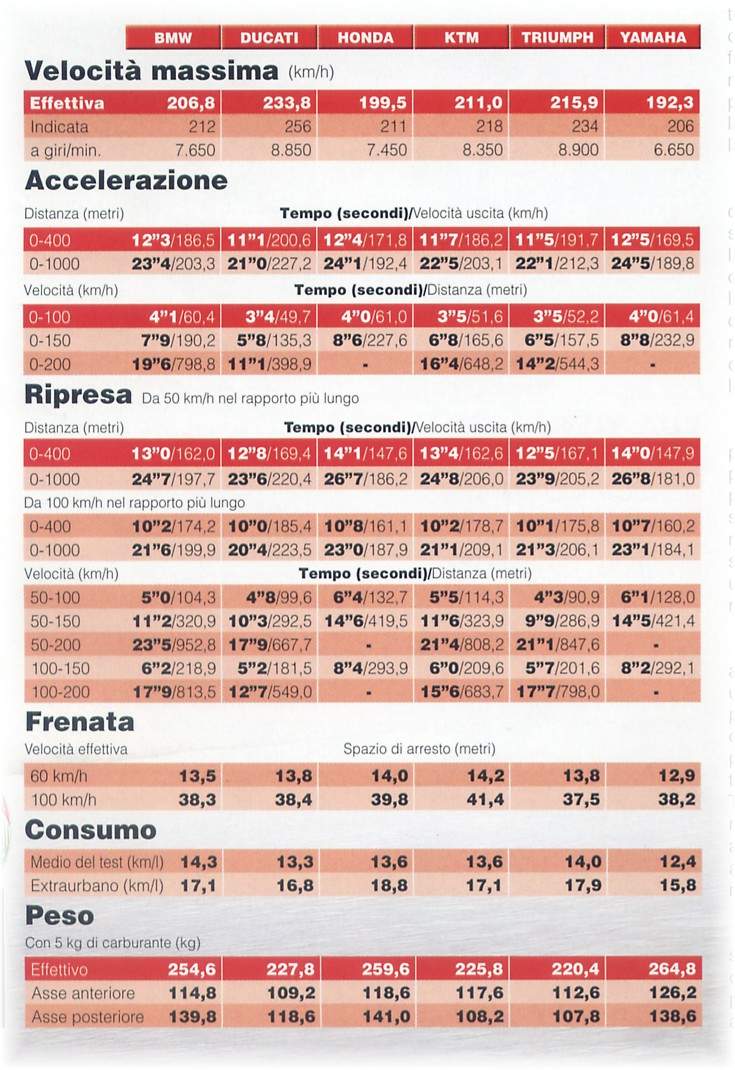
Giant adventure tourer showdown
With the release of the 2010 Yamaha Super Tenere and the
Ducati Multistrada 1200, there's now five serious adventure tourers competing
for your round-the-world budget. We've broken them down by their performance
figures to help you decide which one's best.
All these numbers come straight from the manufacturers. We've chosen to use dry
instead of wet weights since the relatively large difference in tank sizes would
artificially skew the comparisons. While these aren't the weights you'll
experience as you try to navigate across a sandy slope, they do lead to the
fairest comparison possible. We've italicized what we feel is the winner in each
category; in the case of rider aids, this is a bit subjective, feel free to
decide which setup works best for you. We've thrown the originator of the
current adventure tourer archetype, the 1980 BMW R80G/S into the mix just to
give you an idea how far things have come.
|
Power BMW R1200GS: 110bhp @ 7,750rpm Ducati Multistrada 1200 150bhp @ 9,250rpm Yamaha Super Tenere 110bhp @ 7,250rpm KTM 990 Adventure 105bhp @ 8,250rpm Suzuki V-Strom 1000 98bhp @ 7,400rpm '80 BMW R80G/S: 50bhp @ 6,500rpm Torque BMW R1200GS: 88lb-ft @ 6,000rpm Ducati Multistrada: 88lb-ft @ 7,500rpm Super Tenere: 85lb-ft @ 6,000rpm KTM Adventure: 74lb-ft @ 6,250rpm V-Strom 1000: 74lb-ft@ 6,400 rpm '80 R80G/S 41lb-ft @ 5,000 rpm Tank Size |
Dry Weight BMW R1200GS: 203kg (448 lbs) Ducati Multistrada: 189kg (417lbs) Super Tenere: 244kg (538lbs) KTM Adventure: 209kg (461lbs) V-Strom 1000: 207kg (456lbs) '80 R80G/S: 186kg (410lbs) Power to weight (bhp:kg) BMW R1200GS: .54:1 Ducati Multistrada: .79:1 Super Tenere: .45:1 KTM Adventure: .50:1 V-Strom 1000: .47:1 '80 R80G/S: .27:1 Torque to weight (lb-ft:kg) Rider Aids |
As you can see, the new Multistrada comes out on top in
terms of performance, but its 17" front wheel, street-biased tires and lack of
engine or frame protection means its off-road capability is extremely limited.
This comparison is very unflattering for Super Tenere; it's the heaviest bike
here by 77lbs and, thanks to the strong Yen, it'll likely be the most expensive
too. That weight, combined with the 19" front wheel and non-defeatable ABS is
also going to limit its ability off-road.
All that means the BMW R1200GS and KTM 990 Adventure are, in our minds at least,
still the leaders in this category. Both are genuinely capable off-road, fast on
it and comfortable over long distances. If the high prices put you off, the
Suzuki V-Strom looks like a bargain. Sure it'd need a couple grand in
modifications before it could hit the dirt, but even with the add-ons, it'd
still be the cheapest of this group.
Source Hell
For Leather
1200 S Roadtest
Surrounded by razor sharp volcanic rock formations, and with a thundering
big Desmo twin underneath me, I feel satisfied with things. Ducati anno 2010
is a completely different company than it used to be. It takes blood, sweat
and tears to come up with something as good as the Multistrada 1200. The old
air-cooled Multistrada, the ST4 and ST3 lie dead in the ground. Rising from
their ashes come a completely different beast, a beast that can do
everything they did and more.
When Ducati launched its full-race traction control on the '08 1098 R WSBK
homologation superbike, nobody suspected just how fast Ducati would apply
this technology to ordinary road bikes. Then Ducati launched the 1198 S,
followed by the Streetfighter in 2009, both with a road-adjusted version of
its eight-stage traction control (DTC). In 2010, we've come full circle in
the Multistrada 1200 S, which is a sport touring dream come true.
The traction control, a superbly powerful 1198cc L-twin engine, a
three-stage ride-by-wire system and electronically adjustable suspension
equals superiority in at least two different motorcycle segments--I'm
thinking sport touring missile and urban assault vehicle first and foremost.
When I first take a seat in the comfortable saddle, there are a few new
things to remember. First obstacle for new owners will be the keyless
start-up procedure. Harley-Davidson owners will be familiar with the whole
keyless operation, but on the Multistrada the start-up procedure is
different. The "key" needs to be within six feet of the bike, and when in
that proximity the Multistrada is ready to be started by sliding the
ignition on/off button down, then up, to reveal the starter button. The
hands-free ignition also includes a conventional key for the fuel filler cap
and panniers. The actuation of the steering lock is electronic on the
Multistrada, so all you need to do is to place the handlebar fully to either
side and slide the off button a second time.
That sorted, I'm off riding in the Touring mode. This enables the full 150
horsepower, but with a smoother torque curve than in full on Sport mode. I
find myself in a commanding seat position, due to the wide handlebars and
leg-friendly 33.5-inch seat height. The soft and very un-Ducati-esque mild
clutch operation allows me to move from first gear with great ease. Out onto
the motorway, I'm accelerating my way through the six-speed gearbox in a
smooth manner. The adjustable windscreen gives me quite a lot of buffeting
to my helmet in its lower position at high speed, but at its highest level
this improved a great deal. The hand guards with integrated indicators
protect from the cold morning breezes, whilst the three-step heated grips
provide extra warmth until the sun starts warming.
We had lots of side wind during the day touring the
island, and even with the panniers on I had no problems pointing the
Multistrada to where I wanted to go--it wasn't a struggle fighting the winds
even at high speed. I am immediately impressed by the practical elements of
the Multistrada 1200 S Touring Edition package. I will mention this straight
away, as all content in this test involves the Multistrada 1200 S, which is
a whole lot more than the standard version than what's usual from Ducati.
For instance, you don't get electronic suspension at all and ABS is only
optional, which renders the four riding modes toothless compared to the S
model.
What also impressed me was the immense power available from as early as 4000
rpm and superb acceleration from 5000 rpm up to the redline. When
approaching the mountain roads, I changed from Touring to Sport mode, which
is done by scrolling through the modes using the indicator cancel button.
When Sport was selected, I closed the throttle and held the button in for
around three seconds. I could then attack the many corners with a more
aggressive throttle than in Touring mode.
With all this power and great handling to go, it feels like the Multistrada
1200 S could take on the most serious sport tourers and win with ease. As
you all know Ducatis 1198cc engine is its top-shelf liquid-cooled
superbike-derived powerplant. The detuning of the full on superbike motor
involves reducing the degree of valve overlap angle to 11 degrees compared
to the full on 41 degrees on the superbike. As the low-end power delivery is
more important than the top end on the Multistrada 1200, this was done to
provide a rich and meaty midrange that is a lot smoother when shifting up at
lower rpm figures.
Despite the Multistrada 1200 S being a smooth customer, it'll also do a fine
wheelie or two. After all, there's 150 horsepower on tap and the claimed dry
weight is only 417 pounds. The smart-looking exhaust and double mufflers are
Euro 3 approved with a good margin (also helped by the 11 degree valve
overlap). The mufflers that only stretch slightly in front of the rear tire
have been specially designed to provide ample space for the pannier on the
right hand side. To be on the safe side, Ducati has also protected the right
pannier with a heat-absorbing layer. The powerful Testastretta II engine
sucks air into the airbox via two ram-air ducts at the front that double as
the obligatory Adventure-style front beak. This latest version of the
Testastretta engine provides a touring worthy 15,000-mile service intervals,
which Ducati is very proud of.
The traction control and three engine mappings enable me
to swap with ease between four different riding modes on the go. After
playing with the Sport and Touring modes, which both provide 150 horsepower
but with different suspension, engine (aggressive or smooth throttle), and
traction control settings, I switch to Urban as we enter a village. When I
hit the Urban button the suspension softens up a bit, the engine mapping
changes to the 100 horsepower one and the traction control changes to
setting 6 (5 in Touring; 4 in Sport) which is a high intrusion for maximum
safety over manhole covers and dusty patches.
Add the powerful ABS brakes to this, and the Multistrada 1200 S turns into
one very safe city center vehicle. Over little bumps, curbs, and speed bumps
the Multistrada behaves like a supermoto on steroids with all safety
features known to man, bar only a seat belt. I was a bit worried at first
that the engine might feel completely sedated in 100 horsepower mode, but it
didn't, It was more than enough as there are so many other things to
concentrate on riding in the city.
I took the Multistrada for a very short off-road section.
When selecting Enduro, which I did miles in advance to see how it worked on
the road, the engine map stays on 100 horsepower, just like the Urban mode.
The suspension however softens further and the traction control setting
automatically changes to level 2. On the road, the Multistrada in Enduro
mode changes character completely. When switching from the Sport mode to the
Enduro mode, the feeling is almost as if you suddenly had a tire
puncture--that's how much the suspension softened.
When hitting the gravel, trying to do a few slides, the traction control
kicks in way too early, even on level 2. If I were to ride off-road over a
longer period, I would head on deeper into the menu and customize the Enduro
setting to level 1 or turn traction control off all together. It's important
to know that you can personalize the four different riding modes to your
liking. If you find that you have messed up the settings that you liked, you
can return to the default settings with a click of a menu button.
What I would do for off-road riding is to turn off both DTC and ABS. ABS will turn itself on again automatically after turning the ignition off and then on again though, which is a required safety feature from one or more of Europe's babysitting governments. This is awkWard if you're in the middle of Africa with days and days of graveled roads. For that reason, I'd like a separate ABS button, as on the BMW GS, to make it easier to re-de-activate ABS. I'm not suggesting that the Multistrada 1200 S would be suitable for such a trip, but I'd be willing to try.
Interestingly Ducati have worked with Pirelli to come up with the world's first 190mm trail rear tire. I spoke to Fabio Sabbioni about this and several other technical features on the Multistrada 1200 S. The main reason the Multistrada 1200 features a 190 section rear tire is that the engine produces 150 horsepower and anything less than 180 would simply not be safe riding on the extreme side in Sport mode. These new Pirelli Scorpion trail tires have a ZR rating safe up to 168 mph.
Back on the gravel, the rear tire would slide at half-
throttle. But, as soon as I applied full throttle and held it there,
traction control kicked in, even at level 2. The Enduro standard mode is
only suitable for complete newbies on the rough stuff, but for everybody
else I'd recommend turning all electronic aids completely off for the best
off-road experience. The automatic suspension setting I'd like to keep,
though. Another useful enduro feature is the solid aluminum engine
protection should you bottom out the suspension jumping out of one of those
dried out river beds or similar.
On top of the trail-spec superbike tires sits fully adjustable and even
electronic rebound and compression Ohlins suspension. The fork is a 48mm USD
version, with a small electric motor fitted to the top of each fork-leg.
When changing modes on the menu whilst riding, these tiny electronic wonders
changes rebound and compression damping according to a preset setting
suitable for that particular riding style. I was looking for the sensation
of this actually happening and as I changed from Sport mode to Enduro mode,
which are the two extremes.
The shock is a high spec TTX electronic version that does
the same as the front, but with mechanical preload. Both front and back
suspension carries an adventure worthy 6.7 inches of travel. Within the menu
system you can even set up whether you're riding solo, with passenger, or
with passenger and luggage--the electronics will do the rest for you. The
system results in much more noticeable the changes than on a BMW.
Nearly needless to say, the results are of a Multistrada handling supremely
well under a variety of conditions dictated by the roads you want to ride.
The tubular trellis frame is in place, as always, and the Multistrada
handles easier than its more-hardcore sport siblings. Having a wide
handlebar obviously helps with the directional changes, but just as
important is the sheer lightness of the whole package. The radial Brembo ABS
brakes work well in all situations apart from off-road where the ABS should
be turned off.
The 2010 Ducati Multistrada 1200 S should be every sport touring riding
motorcyclist's dream bike--that's just how good it's at the touring bit.
There are many different features and modes to play with, but it doesn't
take long to learn how to use them. The instrument panel is packed with
easily read information. The capacity both when talking about the engine,
load, and capability on all surfaces known to man and ace suspension is
truly unrivalled. BMW GS watch out, shaft drive and dealer network may be
your only advantages now.
By
|
Any corrections or more information on these motorcycles will be kindly appreciated. |