HOME   CONTACT  |  TECHNICAL  |  CONVERTER  |  VIDEO  |  LINKS  


Classic Bikes
Custom Bikes
Racing Bikes


AC Schnitzer
AJS
Alfer
Aprilia
Ariel
Arlen Ness
ATK
Bajaj
Bakker
Barigo
Benelli
Beta
Big Bear
BigDog
Bimota
BMS Choppers
BMW
Borile
Boss Hoss
Boxer
Brammo
Britten
BRP Can-am
BSA
Buell
Bultaco
Cagiva
CCM
Confederate
CR&S
Daelim
Deus
Derbi
DP Customs
Drysdale
Ducati
Dunstall
Exile Cycles
Factory Bike
Fischer
Foggy Petronas
GASGAS
Ghezzi Brain
Gilera
Harris
Harley Davidson
HDT
Hesketh
Highland
Honda
HPN
Horex
Husqvarna
Husaberg
Hyosung
Indian
Italjet
Jawa
Kawasaki
KTM
Kymco
Laverda
Lazareth
Lehman Trikes
LIFAN
Magni
Maico
Matchless
Matt Hotch
Megelli
Midual
Mondial
Moto Guzzi
Moto Morini
MotoCzysz
Mr Martini
MTT
Münch
MV Agusta
MZ
NCR
Norton
Oberdan Bezzi
OCC
Paul Jr. Designs
Piaggio
Radical Ducati
Richman
Ridley
Roehr
Roland Sands
Royal Enfield
Rucker
Sachs
Saxon
Sherco
Suzuki
Terra Modena
Titan
TM Racing
Triumph
Victory
Vincent
Viper
VOR
Voxen
Vyrus
Waken
Wrenchmonkees
Wunderlich
Yamaha

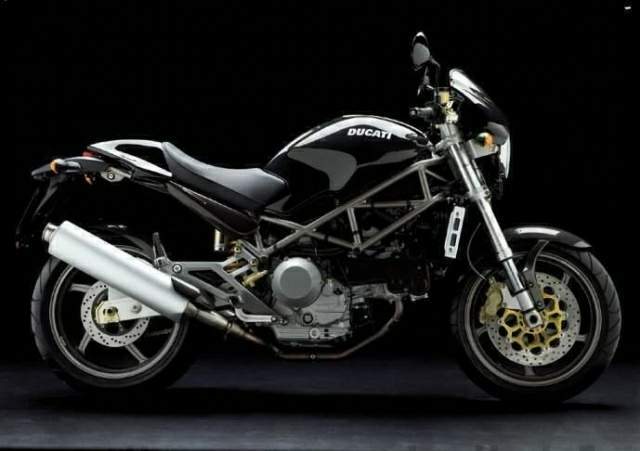
Ducati Monster S4


Make Model

Ducati Monster S4

Year

2001-03

Engine

Liquid cooled, four stroke, 90°“L”twin cylinder, DOHC, desmodromic 4 valve per cylinder. 

Capacity

916
Bore x Stroke 94 x 66 mm
Compression Ratio 11:1

Induction

Marelli electronic fuel injection.50mm throttle body

Ignition  /  Starting

-  /  electric

Max Power

101 hp 74 kW @  8750 rpm

Max Torque

92 Nm 9.3 Kg-m @ 7000 rpm

Transmission  /  Drive

6 Speed  /  chain
Frame Tubular steel trellis 

Front Suspension

Showa 43mm upside-down fully adjustable fork. 120mm front wheal travel

Rear Suspension

Progressive linkage with fully adjustable Sachs monoshock with piggy back aluminum swing arm. 148mm rear wheal travel

Front Brakes

2x 320mm discs 4 piston calipers

Rear Brakes

Single 245mm disc  2 piston caliper

Front Tyre

120/70 ZR17

Rear Tyre

180/55 ZR17
Seat Height 800 mm

Dry-Weight

193 kg

Fuel Capacity (res)

15 Litres  (3.5L)

Consumption  average

18.7 km/lit

Standing ¼ Mile  

11.1 sec  /  198 km/h

Top Speed

239 km/h
Overview Motorcycle.com 
Manual Ducati.comS4_ENG_MY04.pdf


By 2000, the 900 Monster was suffering attacks from several rival models, all with stronger powerplants. Cagiva's Raptor 650 and 1000 in particular were potent threats to the air-cooled Monster range.

So Ducati launched a new Monster, based around the engine and chassis from the ST4 sports-tourer. A re-tuned 916 engine gave the S4 the power it needed to take on its rivals, while a strong chassis with typical Ducati handling gave the S4 accomplished track handling.


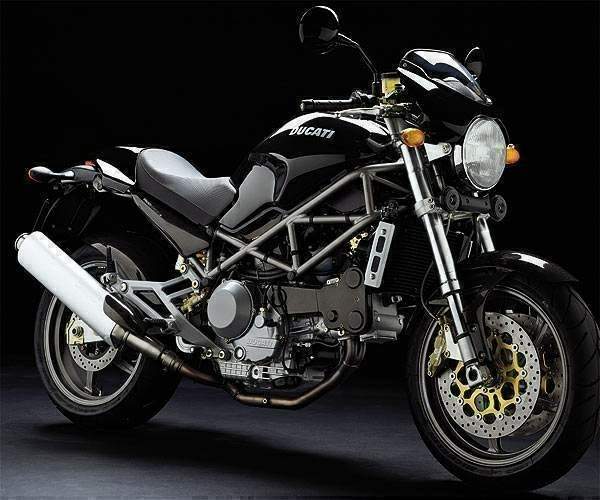
The trademark Monster styling remained, only slightly marred by the large water radiator slung below the steering head, and many detail changes have tidied up the normally enclosed 916 engine.

New, higher-specification suspension units were also fitted. Fully adjustable Showa 43mm (1.7in) upside-down front forks and Sachs rear shock gave the new flagship Monster the sort of first-class damping and springing typical of a luxury Italian sports machine. The Brembo front brakes are common to the other Monsters, but are very effective on this faster machine.

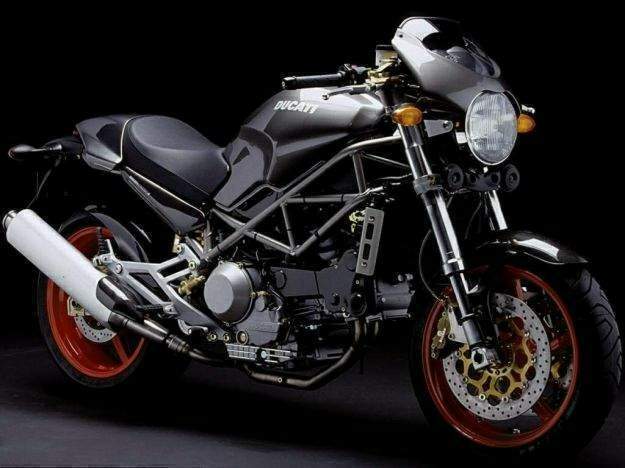
While the new Monster S4 retains the same basic styling of the classic Monster range, there are several detail cosmetic changes. A neat headlight flyscreen offers little practical wind protection, but looks very stylish. Lightweight carbon-fibre

parts abound, including exhaust heat shields, sidepanels, mudguard and timing belt covers.


On the road, the S4 offers much more satisfying performance than the air-cooled 900. The engine is flexible and strong throughout the rev range, combining the muscular mid-range of the air-cooled engines with prodigious top-end power. The sports suspension gives a firm ride, which can be choppy over poor road surfaces, but is ideal on smooth racetracks. The S4 matches its competitors on styling and handling, although its 916cc engine just falls short of Cagiva's Raptor 1000 unit.

Review

Let face it, even back in 1993, when the 900 cc Ducati Monster was unveiled, there was nothing monstrous about the 80 horsepower that the old air-cooled mill produced. Even back then, dinosaurs like GSX-Rs, FZRs and ZX-11s roamed planet earth, and the name "Monster" seemed a bit presumptuous to say the least. Nevertheless, the not-so-aptly named bike turned out to be Ducati's salvation. Tens of thousands of Monsters in various displacements became a Ducati staple and opened new markets for a factory that has always been identified with uncompromising hyper-sport torture racks.

The story of the original Monster is nothing short of a miracle. One day, a young designer named Miguel Galuzzi started to play with a left over 888 frame, a big front headlight from the backyard parts bin, and a clay modeled gas tank. That first prototype was something that Ducati's management just couldn't - or wouldn't - approve of. But the Argentinian-Italian designer was onto something. It looked ugly enough to be called "Monster" but it was a captivating bike with rugged, street-fighter looks.

We've always had a soft sport for Ducati's Monster. The swap to a 916 motor only makes our yearning for the bike even stronger.

Amazingly, the original bike from '93 has made it into the new millennium without major changes in it's eight year life, save for the introduction of digital fuel injection last season. But new kids on the block like Triumph's Speed Triple, Cagiva's Raptor 1000 and Honda's X1 started to cast menacing shadows over the under-powered Monster. It wasn't a moment too early to slot the 916's water-cooled power unit into the Monster.

The heart transplant has required quite few changes in the frame. Most notable to the naked eye is the sturdy new swing arm that incorporates a totally different rear suspension linkage. It looks just like the one on the ST4 tourer, but with the rear cylinder's exhaust pipe routed right through it. Rests of the changes simply makes room for the different dimensions of the engine and a higher seat. To further distinguish the S4 from its lower siblings, the bike is packed with shiny carbon fiber parts. Front and rear mud guards, cam belt covers, side panels and silencer protectors play games with the sunlight and make you feel like a Stealth Bomber pilot. A factory-mounted bikini fairing, rear seat cowling and red wheels set the S4 farther apart.

As impressive as all these parts are, there are still a few unpleasing, out of place details. The cheap looking mirrors don't belong here. Then, the left-hand side-mounted water pump is a bit of a sore thumb, sticking out notably from the frame's smooth plane. Ditto for the lower, black rubber water pipe that goes from the pump to the radiator. Just make sure to park your S4 next to a wall when possible.

The engine itself has been detuned from its original Superbike state to better match the requirements of street-fighting. Milder cams bump the torque curve towards the midrange and, of course, slash top end power somewhat. Other than that, little has been changed in the basic power unit that brought Ducati quite a few WSBK championships and, indeed, the feeling of exhibiting this fine piece of engineering all over town is very satisfying.

Italy is quite full of Monsters, but at the stop lights you can see other Ducati owners casting envious looks on the S4's race-bred engine. Thankfully, in the case of the S4, there is substance behind the pose and it is really the power that grabs your immediate attention. One hundred or so horses at the rear wheel might not sound that much nowadays, but coupled with the shorter gearing of the S4, this easily supplies superb acceleration. From 4,000 rpm onwards, the S4 flies into the rev limiter at 9,500 with ease, catapulting the rider into the 100-plus mph range with a force that the old monster could only dream about. No less impressive than the acceleration is the fluidity and smoothness of the 916 mill. Compared to the old unit, the new one gets the job done with much less fuss and clattering. Sure, the trademark rattle of the dry clutch is still there, but that's about it.

Thankfully, there is a definite improvement in the ergonomics too. My memories of the old model where of a seat that was too low and foot pegs that were too high. The new Monster has gained more than an inch in seat height and my knees did not have to bend to race replica angles.

The founders of Ducati sure knew where to build their factory. The amazing and hilly playground of Tuscany begins at Bologna and that's where I decided to head towards upon picking the bike at the factory. As impressive as the engine is, on these mountain roads, there is still something that I don't like about the handling.

Steering is very precise and stable, but the bike seems to squat down on its rear end too much, giving an uneasy feeling when pitching it into turns. This also creates a bit of under-steer during the exits. Later on, I decided to check the suspension settings only to discover that they're way off. Front preload was way too high and at the rear was just the opposite. I had been riding with at least one degree more rake than planned and the rear suspension damping was at 8 instead of 16. Somebody has been trying to turn the bike into a chopper!

Source Motorcycle.com 


NOTE: Some of the photos on Motorcycle Specs are owned by somebody. If you see any of your photos, you can let me know so that I can acknowledge it, or if you object to it, I can remove it altogether. If any copyright holder objects  to their articles being placed on Motorcycle Specs, it will be removed upon request.  Any correction or more info on these bikes will kindly beappreciated                                          Contact Me      Privacy Policy     Website Stats