|
|
|
|
Classic Bikes
Custom Bikes
Individual
Racing Bikes AJP
AJS
Aprilia
Ariel
Avinton / Wakan
Bajaj
Benelli
Beta
Bimota
BMW
Brough Superior
BRP Cam-Am
BSA
Buell / EBR
Bultaco
Cagiva
Campagna
CCM
CF Moto
Combat Motors
Derbi
Deus
Ducati
Excelsior
GASGAS
Ghezzi Brian
Gilera
GIMA
Harley Davidson
Hero
Highland
Honda
Horex
Husaberg
Husqvarna
Hyosung
Indian
Jawa
Kawasaki
KTM
KYMCO
Laverda
Lazareth
Magni
Maico
Mash
Matchless
Mondial
Moto Guzzi
Moto Morini
MV Agusta
MZ / MuZ
NCR
Norton
NSU
Paton
Peugeot
Piaggio
Revival Cycles
Roland Sands
Royal Enfield
Sachs
Sherco
Sunbeam
Suzuki
SWM
SYM
Triumph
TVS
Ural
Velocette
Vespa
Victory
Vincent
VOR
Voxan
Vyrus
Walt Siegl
Walz
Wrenchmonkees
Wunderlich
XTR / Radical
Yamaha
Zero
Video
Technical
Complete Manufacturer List
|
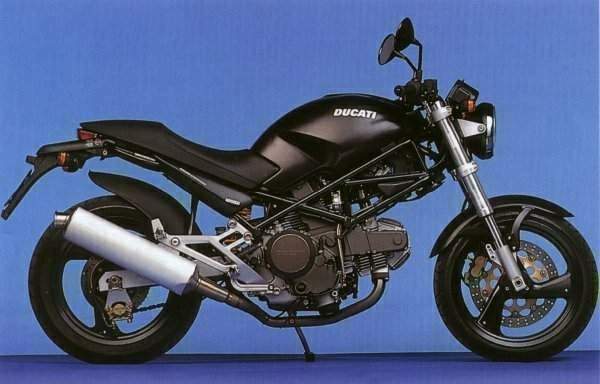
Ducati Monster 900ie Dark
Ducati’s Monster, the company’s biggest seller yet, started
life in 1992 as a parts-bin special, a cheap way to get into the
“street-fighter” naked bike class. Now comes a fuel-injected Monster Dark. It became a cult icon, an urban legend in its own lunchtime, and it set a trend. It had flaws – with such a mix-and-match pedigree it was bound to have – but it had presence, it had attitude and it had Style. With a Monster you could make a statement without the commitment demanded by
Ducati’s sports machinery. So what if it runs out of steam over 8000rpm? This motor is all about accessible, muscular midrange torque to pull you effortlessly through and beyond the traffic – it comes as no surprise that the Monster will also pull spectacular wheelies with ease, particularly as it has shorter gearing than the SS from which the motor is borrowed - in this case a 39-tooth rear sprocket as compared to 37 on the sport bike. The Monster’s Weber Marelli set-up, while not as butter-smooth as the Sagem system on the latest Triumphs, is well damped and suffers very little from the dreaded spritzer snatch at small throttle openings. In many ways, even outdated as it is, the motor is the bike’s best feature. There’s no secondary vibration and even the primary shakes are just enough to remind you that you’re on a V-twin. It starts and idles easily, hot or cold, without an external enrichening device – there’s no choke lever – and will run way beyond its power peak of 60kW at 7500rpm without sounding or feeling stressed. Maximum torque of 76Nm comes up at just over six, but most of it seems to be there from 3500rpm. The transmission is just as good; the clutch is remarkably forgiving for a multiplate dry unit, so much so that I felt compelled to check that it really was a race-spec item, and the gearbox is well up to Ducati’s usual high standard - light, slick and positive with a commendably short lever throw. Clutchless changes within 10 minutes of collecting the bike highlighted the almost complete lack of driveline snatch, although there was a faint but definite clonk from the final drive when taking up the power. Seems to be standard on all Bologna products. The 888 frame was designed to handle a lot more punishment than the air-cooled motor can dish out. It’s about as flexible as Margaret Thatcher’s policies but was designed as a racing frame, to be ridden with most of the rider’s weight directly over the steering head. With the more rearward- biased seating position and much wider bars of the Monster the front end sometimes seems a little unsettled when pushing hard into a corner. The steep 23º steering-head angle and superbly competent 41mm Showa upside-downies combine to make the bike very quick-steering indeed; it can be flung around on tight corners like few other bikes of its capacity without losing its composure but never feels quite as planted as its racier brothers - especially on less than smooth surfaces. The twitchy front end, in combination with the total lack of protection for the rider, also hampered our top end runs. The Monster becomes unstable above 200km/h as the front wheel dances around, even on the smoothest of roads; Ducati claims a terminal velocity of 210 but I didn’t try for it – that’s not what this bike was built for anyway. The racing frame also has a downside: for what is supposed to be a city bike the Monster has an absurdly limited steering lock, so much so that the bike sometimes gets stuck in traffic simply because it can’t turn tightly enough to get between two cars and it can take a five-point manoeuvre to turn it round in a suburban street. Monster owners tend to plan where they park with this in mind. The bike benefits, however, from the World championship-winning chassis’ elegant rising-rate suspension linkage and adjustable Boge monoshock. It’s firm without harshness, keeps the rear wheel firmly in contact with the tar no matter what, and refuses to bottom despite its relatively short travel. The brakes are lifted straight from the 900SS – four-pot calipers on big 320mm discs up front with a little single-piston caliper on a 245m platter at the rear. The front stoppers feel a little wooden and need high lever effort before anything happens but they’re immensely powerful, overwhelming the underdamped front suspension under hard usage, pumping it down and causing more misbehaviour, which is probably the reason for the front end’s lack of composure under pressure. The rear brake is typical sport bike tackle, totally lacking in feel and feedback – as well as outright power; still, it’s about right for hill-starts and steadying the bike in rain. The bodywork is motorcycling’s most succinct minimalist statement, proof that less is more. The fully triangulated trellis frame is openly on show, as is the big L-twin motor; the rest of it consists of an undersized (steel) fuel tank, twin seat, minuscule side covers and an abbreviated rear mudguard. The pilot’s seat is more comfortable than it looks, wide and flat with a bit of room to move around, but the convex pillion pad is even worse than it looks. The passenger is constantly in danger of sliding right off the back unless (s)he holds on tight around your waist (there’s no grab rail). The new instrument panel, revised for 2001, has a neatly matched speedometer and rev-counter in a black plastic housing with the warning icons clearly visible in between. It’s the first Monster with a rev-counter and as such it’s a big improvement over previous models. Ducati’s mix-and-match street fighter is still the company’s top seller and it’s not difficult to see why; it has a magnificently torquey L-twin motivator tuned for midrange, superb build quality with top-drawer components and cycle parts throughout and that indefinable something bikers look for in a performance machine - Attitude. Whether throwing it into the tightest twisties I could find or making mincemeat of the evening rush hour – or just posing down to the local biker’s hangout - the Monster Dark always says “Don’ mess wit’ me, man.” It’s an efficient tourer, a reasonable scratcher and a competent commuter – and it looks real mean; what more d’you need? Source By Dave Abrahams
|
|
|
Any corrections or more information on these motorcycles will be kindly appreciated. |