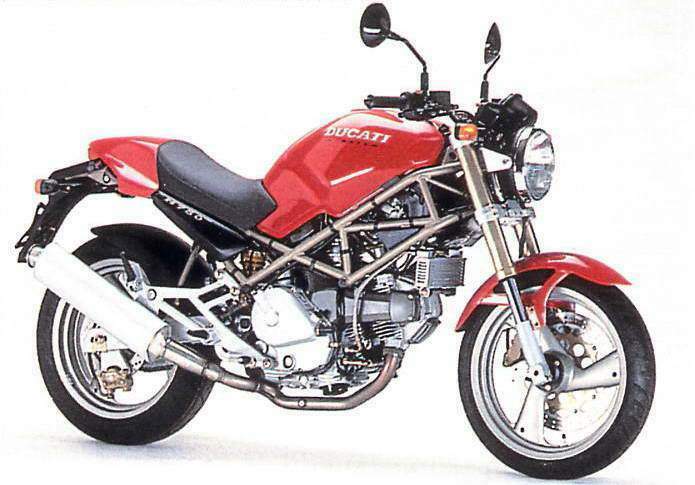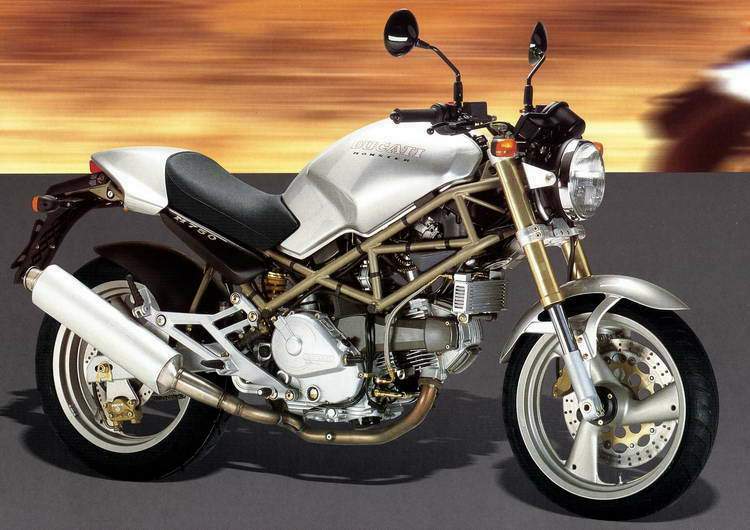
Filling the gap between the Monster 600 and 900, the
Monster 750 uses the 750SS engine in an 888-derived frame and SS suspension
package. Introduced in 1996 with a single front brake disc and carburettors,
the specification has gradually been uprated to the current twin front disc,
fuel injected version. The 750 has all the style and handling performance of
the smaller Monster 600, while its larger engine offers a more satisfying
power delivery, almost as much as the 900, but with lower cost and less
weight. The stiff frame and firm suspension give a sporty ride, and wide
handlebars and a low centre of gravity allow easy, nimble handling. Around
town, the Monster 750 is a handsome performer, but not so composed on longer
trips.
Since it's 1992 introduction in
Cologne, the Monster (Il Mostro), with it's radical styling, has created an
overnight sensation. The list of enthusiastic Monster riders includes F1
Grand Prix drivers Damon Hill, Michele Alboreto, and Clay Regazzoni, as well
as former World Motorcycle Champion Barry Sheene.
With it's short wheelbase,
slightly raised handlebars and lowered foot pegs, the Monster rider sits in
a position similar to that of a flat track racer.
Borrowing frame and engine
technology from DUCATI race bikes, the Monster provides an uncanny blend of
both sport and cruiser motorcycles.
Review
Ducati's first Monster, the 900, was born in
1993 and sired by the Argentinean Miguel Angel Galuzzi. Two years later,
Ducati begat another Monster -- the M600. Now, in 1997, with the advent of
the M750, their family is complete.
If you don't know anything about the eccentric Monster family it will be
very difficult for you, at first sight, to distinguish differences between
the nearly identical looking 900, 600 and 750. Thanks to my local Ducati
dealer here in Barcelona, Spain, I can now offer assistance in
distinguishing the differences between members of this strange family, all
dressed in curious designs and surprisingly easy for anybody to ride.
The M750's signature gold painted multi-tubular trellis frame -- similar in
style to its close cousins the Supersports, 916 and the new ST2 -- is
identical throughout the Monster family. Wheelbase and seat height are
identical as well. This simple design includes a fat, 4.3 gallon fuel tank
and an attractive removable seat cowl. The spartan instrument panel features
a white faced speedometer and a large assortment of indicators -- neutral,
turn signals, oil pressure, high beams, battery charge, fuel and side stand
lights. Unfortunately, due to a defect in the Monster family's genetic code,
the tachometer is missing.
The M750's bodywork and suspension boast of its Italian lineage. Upside-down
Marzocchi forks grace the front end; however, only the spring preload is
adjustable. A single Sachs-Boge shock with spring preload and rebound
damping adjustment forms the rear suspension. A pair of 17-inch Brembo
three-spoked alloy wheels shod with Dunlop Sportmax II tires act as our
road-grip insurance. The M750 stops up front by a single 320 mm front Brembo
rotor -- dual rotors stop the 900 Monster -- and a four-piston Brembo Gold
Series caliper. A single 245 mm Brembo rotor is found at the rear. Unlike
the M900, this little Monster isn't adorned with carbon fiber.
The engine is Ducati's well-known 748cc air-cooled, two-valve, 90-degree
desmodromic V-twin designed by the late Fabio Taglioni. It is equipped with
a pair of 38 mm Mikuni carburetors. The fuel-injection system found in other
Ducati models like the 916 or ST2, has been left out. The middleweight
Monster has the same engine configuration that powers the 750 SS, albeit
with a few horses taken off -- a claimed 64 bhp at 8000 rpm compared with
the 750 SS's 66 bhp at 8500 rpm -- to improve mid-range grunt. Thanks to its
torquey power, it's the kind of engine that allows you to forget frequent
shifting. And in spite of its nearly antiquated design, the M750 engine
sounds sweet and feels almost vibrationless.
The Monster 750 moves nimbly in city traffic, thanks to its light, 388-pound
claimed dry weight, and it lends itself well toward day-to-day commuting.
The only real flaw I noticed in urban conditions is poor steering due in
part to its frame type and the upside-down front fork. Shifting through the
Ducati's gearbox is pleasant and precise, although sometimes you'll miss a
gear. It's a Ducati, after all.
Heading for the twisties, the machine becomes very easy to handle. Its
powerband is delightful through the corners, and if you find yourself diving
in too hot, you can count on the one-finger action Brembo brakes to inspire
confidence. Unfortunately the M750's softly-sprung front fork allows for
terrible front end dive. Rider ergonomics are comfortable, and there is a
good relationship between handlebars, seat and footpegs, but the low-mounted
pegs will drag during spirited cornering. Like most naked bikes,
aerodynamics are poor and windblast is severe at speeds greater than 85 mph.
The little Monster's small details make it unique. You can raise the fuel
tank like a car engine hood to perform most mechanical tasks. In cold
weather conditions you can turn on a petcock found on the oil cooling system
and warm up the carburetors quickly using engine oil. Of course, there are a
few areas that could use improvement: A centerstand would be very helpful
for chain maintenance; a tachometer would be nice to have for keeping an eye
on engine revs; and the passenger seat is small and, needless to say,
uncomfortable.
Ducati's new Monster 750 is a charming, easy-to-ride motorcycle and a
welcome addition to the family. That unmistakable sound, their striking
silhouette and (for a Ducati) relatively cheap maintenance costs are
responsible for much of the Monster family's popularity throughout Europe.
Who knows, now with the M750 in the fold, could Ducati duplicate this
success worldwide?
Note: the Author would like to thank Motos Bordoy, 179 Valencia Street,
08011 Barcelona, Spain, for providing the Monster 750.
NOTE: Some of the photos on
Motorcycle Specs are owned by somebody. If you see any of your
photos, you can let me know so that I can acknowledge it, or if
you object to it, I can remove it altogether. If any copyright
holder objects to their articles being placed on Motorcycle
Specs, it will be removed upon request. Any correction or more
info on these bikes will kindly beappreciated
Contact MePrivacy
Policy
Website Stats