|
|
|
|
Classic Bikes
Custom Bikes
Individual
Racing Bikes AJP
AJS
Aprilia
Ariel
Avinton / Wakan
Bajaj
Benelli
Beta
Bimota
BMW
Brough Superior
BRP Cam-Am
BSA
Buell / EBR
Bullit
Bultaco
Cagiva
Campagna
CCM
CF Moto
Combat Motors
Derbi
Deus
Ducati
Excelsior
Fantic
GASGAS
Ghezzi Brian
Gilera
GIMA
Harley Davidson
Hero
Highland
Honda
Horex
Husaberg
Husqvarna
Hyosung
Indian
Jawa
Kawasaki
KTM
KYMCO
Laverda
Lazareth
Magni
Maico
Mash
Matchless
Mondial
Moto Guzzi
Moto Morini
MV Agusta
MZ / MuZ
NCR
Norton
NSU
Paton
Peugeot
Piaggio
Revival Cycles
Roland Sands
Royal Enfield
Sachs
Sherco
Sunbeam
Suzuki
SWM
SYM
Triumph
TVS
Ural
Velocette
Vespa
Victory
Vincent
VOR
Voxan
Vyrus
Walt Siegl
Walz
Wrenchmonkees
Wunderlich
XTR / Radical
Yamaha
Zero
Video
Technical
Manufacturer List Contact
|
Ducati Monster 600 Dark
|
|
Make Model |
Ducati Monster 600 |
|
Year |
1998 |
|
Engine |
Four stroke, 90°“L”twin cylinder, SOHC, desmodromic 2 valves per cylinder |
|
Capacity |
583 cc / 35.6 cu in |
| Bore x Stroke | 80 x 58 mm |
| Cooling System | Air cooled |
| Compression Ratio | 10.7:1 |
| Lubrication | Wet sump |
| Engine Oil | Synthetic, 10W/40 |
|
Induction |
2 x 38 mm Mikuni carburetors |
|
Spark Plugs |
RA 4 HC |
|
Ignition |
Analogue CDI (Capacitive Discharge Ign.) |
| Spark Plug | Champion, RA6HC |
| Battery | 12V 16Ah |
| Starting | Electric |
|
Max Power |
38.7 kW / 53 hp @ 8250 rpm |
|
Max Torque |
48.00 Nm / 4.9 kgf-m / 35.4 ft-lb @ 7000 rpm |
| Clutch | Wet, cable operated |
|
Transmission |
5 Speed |
| Primary Drive Ratio | 2.28:1 (32/73) |
| Gear Ratios | 1st 2.500 / 2nd 1.714 / 3rd 1.333 / 4th 1.074 / 5th 0.966:1 |
| Final Drive Ratio | 2.6:1 (15/39) |
| Final Drive | Chain |
| Frame | Steel, Trellis frame |
|
Front Suspension |
40 mm Marzocchi inverted telescopic fork |
| Front Wheel Travel | 120 mm / 4.7 in |
|
Rear Suspension |
boge rising rate monoshock |
| Rear Wheel Travel | 136 mm / 5.4 in |
|
Front Brakes |
Single 320 mm disc, 4 piston caliper |
|
Rear Brakes |
Single 245mm disc, 2 piston caliper |
|
Front Tyre |
120/60 VR17 |
|
Rear Tyre |
160/60 VR17 |
| Dimensions |
Length: 2090 mm / 82.3 in Width: 770 mm / 30.3 in Height: 1060 mm / 41.7 in |
| Wheelbase | 1430 mm / 56.3 in |
| Seat Height | 770 mm / 30.3 in |
|
Dry Weight |
174 kg / 383 lbs |
|
Fuel Capacity |
16 L / 4.2 US gal / 3.5 Imp gal |
|
Consumption Average |
5/1 L/100km / 19.7 km/l / 46.3 US mpg / 55.6 Imp mpg |
|
Braking 60 km/h - 0 |
12.9 m / 42.3 ft |
|
Braking 100 km/h - 0 |
39.3 m / 128.9 ft |
|
Standing ¼ Mile |
12.5 sec / 164.2 km/h / 102 mph |
|
Top Speed |
191.9 km/h / 119.2mph |
| Colours | Red, Yellow, Black, Silver gray |
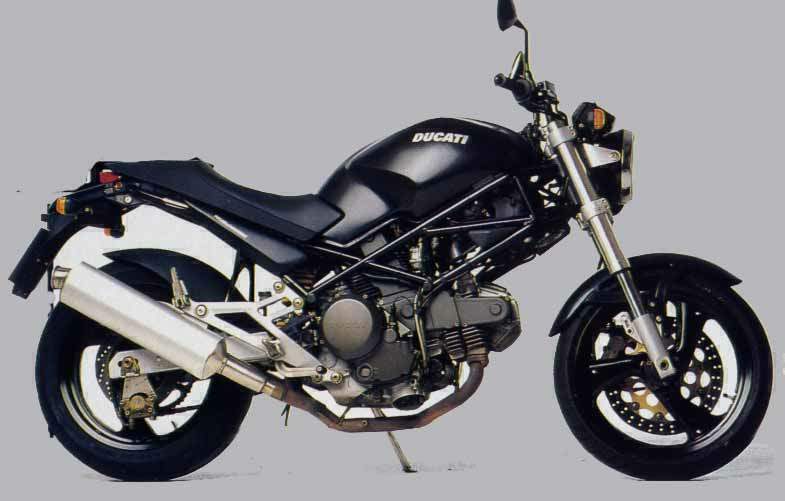
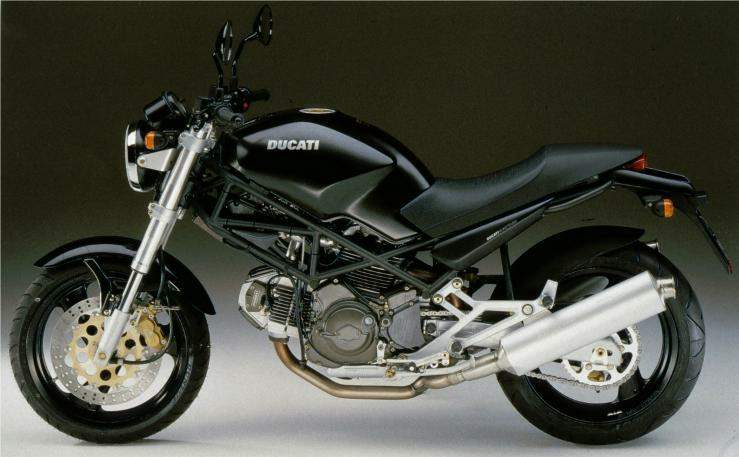
The 600 Dark is a basic, entry-level version of Ducati's Monster roadster. The Monster 600 is powered by a 583cc air-cooled V-twin engine, which has desmodromic valve actuation. This desmo system uses a pair of rockers to forcibly close as well as open the engine's poppet valves, rather than using springs to close the valves. The Dark is a low-spec budget machine. The paintwork is all matt-finish black, rather than gloss, and the unsophisticated chassis is low on equipment, while the engine is rather weak with indifferent mid-range and wheezy top-end power. In its favour though, the Monster 600 steers well, and the single front Brembo disc brake offers acceptable feel and power. The Monster 600 Dark is ideal for novices.
Monster History
When Ducati unveiled the Monster 900 at the Cologne Motorcycle Show in the autumn of 1992, it created an overnight sensation. As a new naked motorcycle, the Monster introduced a unique street fighter attitude to a new generation of Ducati fans.
The look was defined by its essential approach to motorcycle design, with its bodywork pared down to the minimum and its characteristic twin-cylinder engine fully visible. The Monster 900 went into production the following year.
One of the most popular Monsters of all time was the Monster 600, which arrived in showrooms in 1995. The 600 introduced a less intimidating, yet high quality and quality-performance entry into the world of Ducati.
The sales success of this motorcycle, the lightest and most versatile model in the range, was amazing, and it remains an important contributor in creating the iconic status that the Monster enjoys today.
Filling the void between the 900 and 600, the Ducati Monster 750 was made available in 1996.
Growing popularity of the smallest Monster led to the introduction of the Monster 600 Dark in 1998. The idea of the Dark was born based on the observation that so many Monsters were being customized and what better place to start than with the blank canvas of the Dark's black matte paint job. The Monster Dark became a style unto itself, with its understated attitude and even more essential and fashionable look.
At the opposite end of the fashion scale, the Monster Cromo 900, with its amazing chrome tank showed up with the Dark. A long list of accessories meant the Cromo was not just a shiny piece of eye candy.
The next stage in development was a substantial restyling of the entire Monster family in 2000. The fuel tank, seat, tail section, and many other components were reshaped and modernized. The 900 received fuel injection, and the Cromo took a year off.
The Monster got a bit more serious in 2001 with the release of the Monster S4, which was powered by the liquid-cooled 916cc Desmoquattro engine. This gave the Monster the superbike-like performance many had wanted, and red rims made the S4 stand out from other Monsters.
2002 saw the first major re-engineering of the original 600 with the launch of the Monster 620. It was the first middleweight Monster to be fuel-injected, and this was combined with significant engine, frame and suspension advancements and updates. The result was a more powerful, smoother-running bike that achieved new levels of reliability and efficiency.
Displacements grew in 2003, with the appearance of the Monster 800 and Monster 1000. The next year, the S4R rocked the Monster world with a 996cc motor and single-sided swingarm. A year later, an S2R with the 800cc motor takes its place in the Monster line.
Showing no signs of slowing down, the Monster line received a performance boost from top to bottom in 2006. The S4R S Testastretta muscles in, with its 130 horsepower motor and high-end suspension. The next year, a non-S version keeps the motor but runs with less-sophisticated suspension. The Monster 695 replaces the 620, featuring improved performance and styling.
2008 saw a yet another new Monster with more refined style and design, as well as an updated motor--the Monster 696. The new wider tank cover tapers to the thin waistline of a narrower seat. The large diameter hybrid trellis frame blends stylishly into an aluminum sub-frame and swingarm inspired by the 2007 World MotoGP title-winning Desmosedici GP7 machine.
In 2009, the Monster line becomes an all air-cooled affair--the 696, 1100 and 1100 S--with the liquid-cooled naked-bike responsibilities being transferred to the new Ducati Streetfighter line.
Ducati Monster Chronology
1992: 900cc Monster is presented for the first time at the Cologne Motorcycle Show.
1993: 900cc Monster with Desmodue engine (two-valve, air-cooled) is put into production.
1995: Monster family expands with the introduction of the smaller 600 cc model.
1996: Monster family is further expanded with the arrival of the 750 cc model.
1998: Monster achieves sensational success with the introduction of the Monster 600 dark, Monster 900 Cromo, and Monster 900 S.
2000: Monster technology and styling continue to develop. The latest arrival is the Monster 900 with electronic injection, and the styling of the entire range is updated.
2001: EVOlution of sports models continues with the introduction of the Monster S4 with 916 cc Desmoquattro engine and completely new running gear.
2002: Electronic injection is introduced on the smaller models; the entry-level model now has a larger 620cc engine; all models benefit from the new running gear used on the S4.
2003: The Monster 800 and Monster 1000 are introduced, the latter equipped with the new Dual Spark engine.
2004: The flagship of the Monster range is introduced: the S4R with 996 cc engine, single-side swing arm and totally revised styling and technology.
2005: The family grows with the arrival of the S2R powered by the 800 cc Desmodue engine.
2006: The Monster S2R with 1000 cc engine is born; in addition an authentic, no-compromise bike is introduced, the Monster S4R S Testastretta, a true naked Superbike with all the power and grunt of the Desmodromic Testastretta engine.
2007: The Monster family adds the new S4R Testastretta to its already impressive line-up. Another newcomer is the Monster 695, which replaces the entry-level 620, taking a decisive leap forward in terms of handling, riding pleasure and performance.
2008: The air-cooled Monster 696 is born and a new era begins.
2009: The air-cooled Monster 1100 and 1100 S models are introduced. It becomes apparent that the Monster will be the naked air-cooled platform while the new Streetfighter will be the liquid-cooled platform gong forward.
|
Any corrections or more information on these motorcycles will be kindly appreciated. |