|
|
|
|
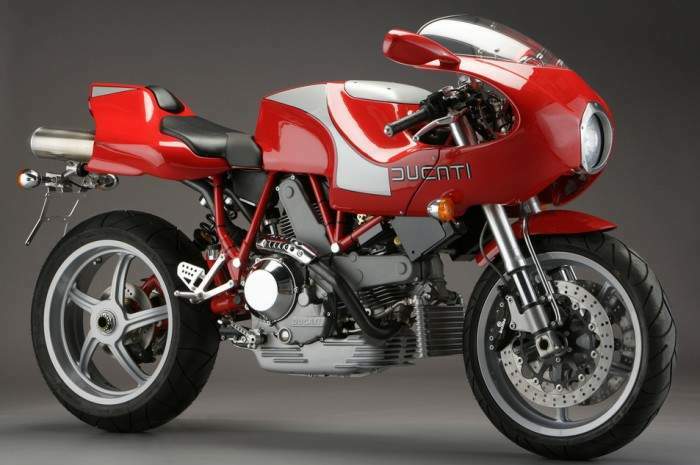
Ducati MHe 900e
The bike that Ducati called the Mike Hailwood Evoluziorve was proof that sometimes even the most improbable of ideas was worth pursuing. This unique blend of old and new superbike began as a sketch by Pierre Terblanche, Ducati's design chief, who was inspired by Hailwood's heroics at the Isle of Man TT in 1978, when 'Mike the Bike' returned from retirement to ride a Ducati to a memorable win.
Terblanche devised a tribute in the form of a V-twin that combined striking, 1970s type styling -including a chrome-rimmed headlight, old-style graphics, and a dummy sump beneath the engine -with modern touches. He convinced Ducati's bosses to build a concept bike, complete with futuristic details including a rear-facing camera instead of mirrors, and rear indicators mounted in sticking-out exhaust pipes. When the MH900e, as it was name d, was unveiled, the response was so positive that Ducati decided to put the bike into limited production. The Evoluzione was deemed ideal for Ducati's first serious attempt at e-commerce. One thousand units of the MH900e went on sale on the Ducati.com web site on the first day of the new millennium, and a few hours later had sold out. Double the originally planned number were eventually built, in a corner of the factory in Bologna.
Stylish and beautifully detailed One glance explained the high level of demand, especially to those old enough to remember 1978. The Evoluzione was stylish, beautifully detailed, and blended old and new with unique flair. The prototype's camera and exhaust-mounted indicators did not make it into production, but bits that did included a stylish white-faced rev-counter with digital speedo beneath, and a single-sided swingarm made from tubular steel instead of the familiar aluminium.
The basis of the Evoluzione was Ducati's 900SS, which donated its 904cc air/oil-cooled V-twin engine. The SOHC motor produced a modest 75bhp, and was held in a traditional Ducati steel ladder frame. This meant that the MH900e was far from a cutting-edge sports bike, but it had a suitably raw, old-fashioned character despite the muted sound from the long silencers beneath the seat. There was plenty of acceleration, too, thanks to the fuel-injected V-twin's generous mid-range torque, combined with slightly lower gearing from the Monster 900. Winding back the throttle from below 5000rpm was enough to get the Ducati rumbling forward, with no need for a downchange. With the rider's head behind the screen and chin on the fuel tank's neat alloy cover, the MH900e stretched its legs towards a top speed of about 130mph (209km/h).
Handling was good, too, combining reasonably light steering with the high-speed stability for which Ducatis had been known in the 1970s. The Evoluzione was not the quickest-steering machine on the block, but it had good suspension and was light enough to make good use of its abundant ground clearance and sticky radial tyres. Brembo's triple-disc brake system gave plenty of modern-day power, too. Less welcome were the poor mirrors, illegible warning lights, tall seat, and the small fuel range dictated by the tiny tank.
Such idiosyncrasies ensured that the MH900e was not the bike for every motorcyclist or even every Ducati fan. Terblanche did not mind that not every rider appreciated a machine that was never intended to be produced in large numbers. 'The people it's aimed at understand it, and I don't care about the ones who don't,' he said. For those who did, the MH900e's traditional Ducati virtues of torque, handling ability and character ensured that it was a very enjoyable motorbike as well as an outstanding piece of design.
|
|
NOTE: Some of the photos on Motorcycle Specs are owned by somebody. If you see any of your photos, you can let me know so that I can acknowledge it, or if you object to it, I can remove it altogether. If any copyright holder objects to their articles being placed on Motorcycle Specs, it will be removed upon request. Any correction or more info on these bikes will kindly be appreciated. Contact Me Privacy Policy Website Stats |