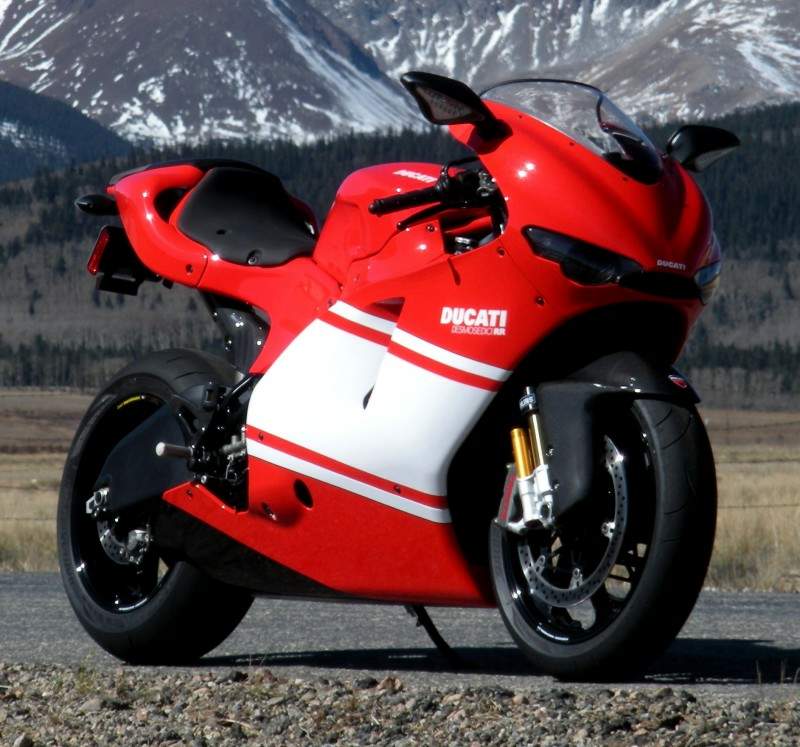
Öhlins 'FG353' PUFF forks USD 43 mm
pressurized, with preload, rebound and compression adjustment, TiN coated
sliders
Rear Suspension
Öhlins rear shock, with rebound, low/high
speed compression adjustment, and hydraulic preload adjustment
Front Brakes
Two Brembo radial "monoblock" calipers with
four 34 mm pistons; two semi-floating 320 mm x 6 mm discs, with
machined flange: the same as GP6 wet race set-up
Rear Brakes
240 mm fixed disc, floating caliper with two
34 mm pistons
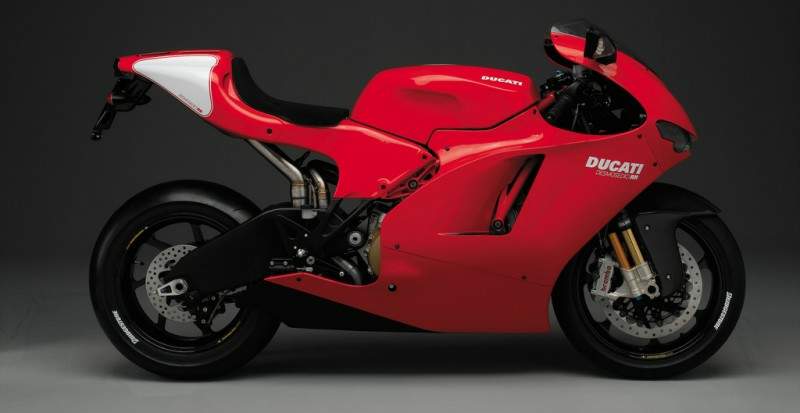
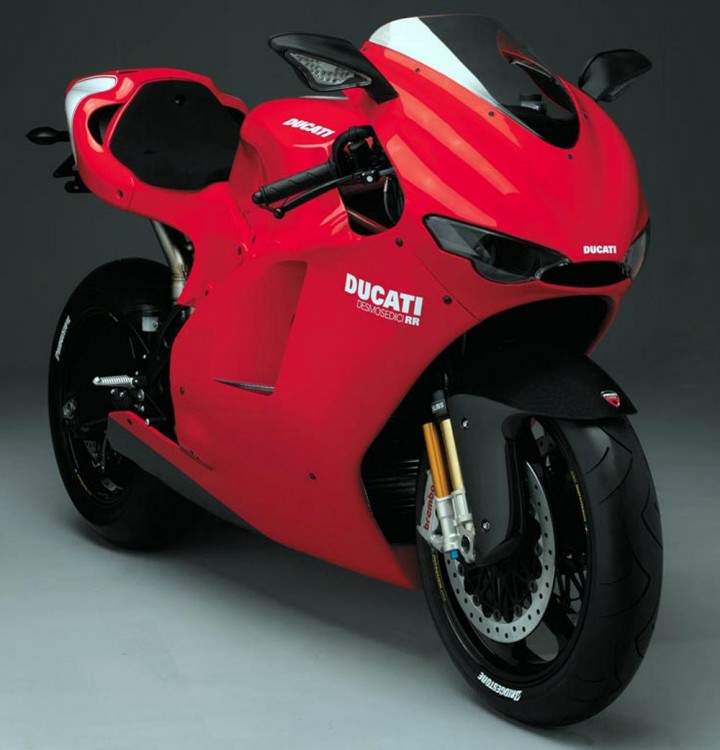
DUCATI DESMOSEDICI RR: THE ULTIMATE DUCATI EXPERIENCE
The dream of a true GP replica has finally come true and the Desmosedici RR
will be the first-ever road-going motorcycle to offer such a stunning wealth
of performance and technology that comes directly from Ducati's experience
in MotoGP. The RR derives from the Ducati Corse Grand Prix racing
Desmosedici GP6, the same bike with which Loris Capirossi and Sete Gibernau
competed with in the 2006 MotoGP World Championship.
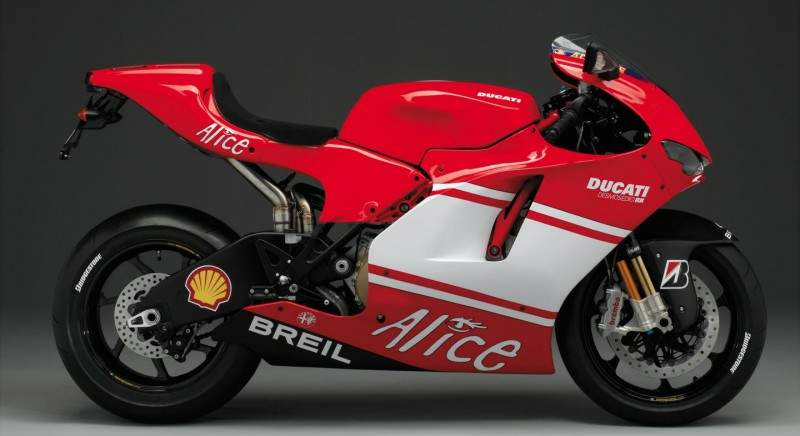
The body design and the aerodynamics faithfully reflect the Desmosedici
GP6. The colour scheme, the fittings, the materials used in its construction
as well as the technical features of the powerful four-cylinder desmodromic
engine built by the Borgo Panigale factory engineers, leave no doubts
whatsoever: the Desmosedici RR is the ultimate expression of the most
extreme MotoGP racing machine today.
This is the new frontier of Ducati technological EVOlution, a dream come
true, demonstrating once again the courage and the passion of Ducati, as
well as the ability to transfer the experience of the racing world to a
machine that is destined for road use.
PRODUCTION AND DELIVERY SCHEDULE
Reservations for the Desmosedici RR have been accepted via the official
Ducati dealer network since 2 June 2006 and will continue to be taken until
31 December 2007. Production will begin in October 2007 and first deliveries
will be made to 999R owners who placed their Desmosedici RR order before 30
September 2006. Production of all remaining orders will be completed by
December 2008.
TWO MORE AWARDS FOR THE DESMOSEDICI RR ON THE INTERNET
The Motorcycle Bloggers International (MBI), the international association
of motorcycle bloggers, has awarded the Ducati Desmosedici RR the “Best
Concept Motorcycle” of 2006 and “Object of Lust”, making this bike known as
the most desired bike of all time. These awards add to the long list of
honours for this model, confirming the great success of Ducati’s “new
creature”.
Features and Benefits:
Vehicle
The engine clearly represents the beating heart of this fantastic
motorcycle, but the technological advancements also extend to the chassis: a
signature tubular trellis hybrid frame, refined components, and a superb
carbon fibre body. This is a motorcycle that is destined for an expert
rider, someone who is always looking for extreme sporting performance, as
well as being an exclusive, esoteric, reliable product that is more than
capable of track racing.
The colour scheme of the Desmosedici RR was the work of Alan Jenkins, the
designer and one of the men behind the Desmosedici MotoGP, who was also
responsible for the aerodynamics package which is aimed at achieving maximum
speed and excellent handling. The bike is totally inspired by the racing
machine, the Ducati Desmosedici GP6, from which it inherits all the
aggressiveness of its lines. It is fitted with a new lightweight
multifunction dashboard, developed in collaboration with Ducati Corse, the
same one that has been fitted to the racing machine, the Desmosedici GP7.
Desmosedici-style digital instrumentation is taken from Ducati's MotoGP
GP7 project. This pure racing, minimalist solution by Digitek has no
switches or buttons to compromise its clean lines. The wide screen allows
the rider to read six values at the same time and to scroll through and
select from various menus by handlebar-mounted switch gear.
Activating the Ducati Data Analyser (DDA) riders are able to acquire up
to 2MB of data (approximately 3.5 hours). The system records several
channels of data including: vehicle speed, engine rpm, throttle opening,
engine temperature, distance travelled, laps and lap times. So riders are
able to compare, analyse and get an inside view of the Desmosedici RR
performance.
The bike's development could not have been made possible without the
significant collaboration of Vittoriano Guareschi, the official Ducati Corse
tester, whose riding abilities and hundreds of hours of track time have made
a fundamental contribution to the EVOlution of the project.
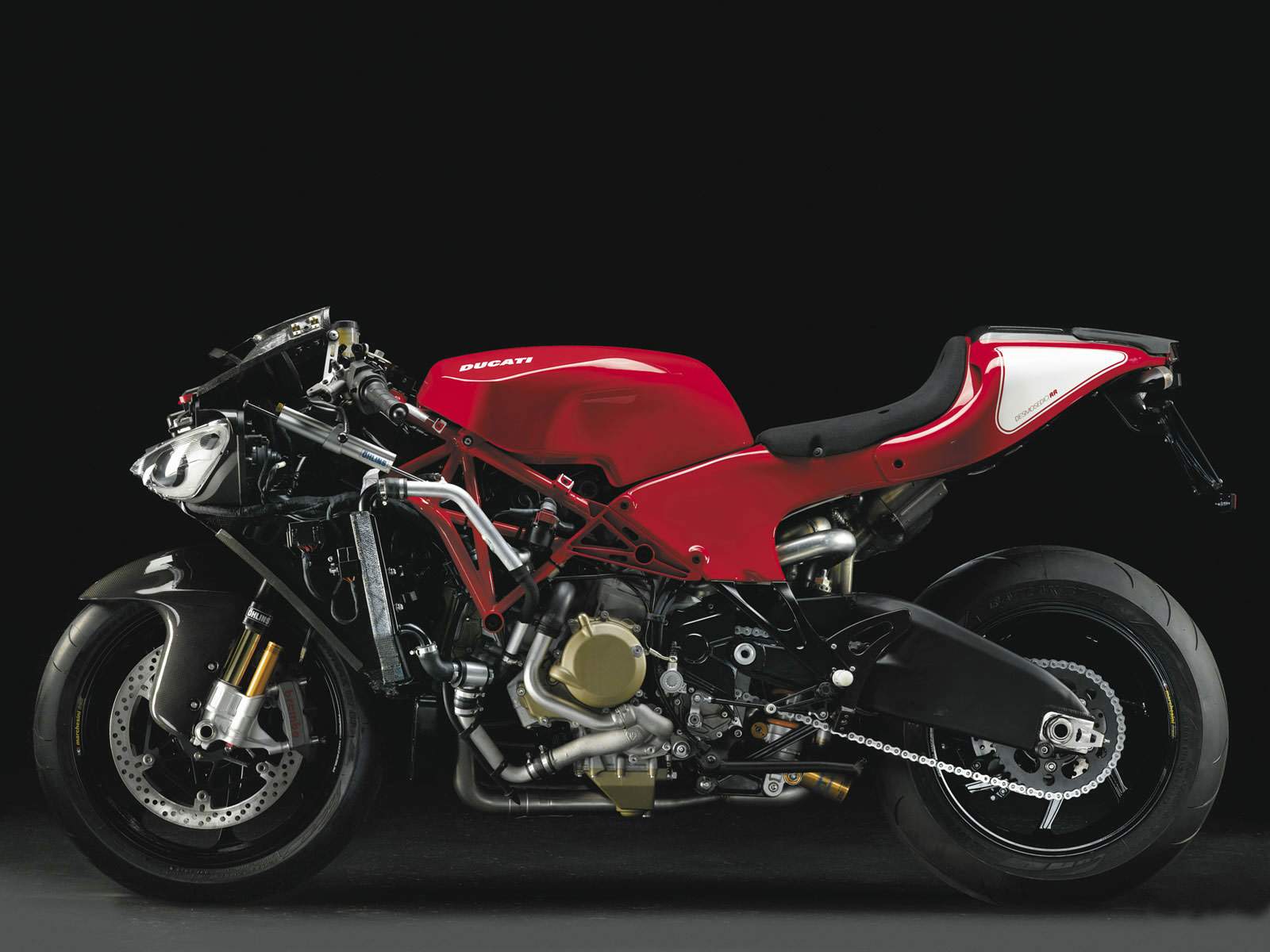
For the first time the Ducati Desmosedici RR uses a new welded tubular
steel trellis hybrid frame (ALS 450) with the frame geometry that is the
same as that of the Desmosedici GP6.
This construction guarantees an excellent stiffness-to-weight ratio,
allowing superior manoevrability and riding precision. Attached to the red
frame is the rear seat support in high temperature resin type carbon fibre.
This material, normally used only on racing bikes, has the characteristic of
being extremely lightweight but exceptionally rigid.
The Desmosedici RR sports a new extra-long, cast, forged and pressed
aluminium alloy swingarm. The geometry and the technology of this component
derive directly from the MotoGP bike, and give the RR a high level of
traction, and excellent weight distribution as well as a superb
stiffness-to-weight ratio.
In the suspension department the Ducati Desmosedici RR features the most
advanced technical components.
The rear suspension geometry and layout is the same as that of the GP6,
with the rear shock attached above the swingarm and to a rocker, which is
hinged to the crankcase.
The front suspension features 43 mm upside-down Öhlins FG353P pressurized
forks (PFF), with TiN coated sliders. The forks, which come directly from
competition use, as well as being pressurized thus ensuring excellent track
performance, are fully adjustable in preload, rebound and compression.
The rear shock is also Öhlins and has rebound, low/high speed compression
adjustment and hydraulic preload adjustment. For the first time ever, this
Ducati production motorcycle features Marchesini forged and machined
magnesium alloy wheels, with a 7-spoke design as on the GP6. This helps to
reduce unsprung weight and inertia, all the while improving handling and
suspension response.
With the aim of producing the ultimate track performance, Ducati and
Bridgestone have developed special tyres for the Desmosedici RR. The tread
pattern, construction and profile are being specially developed and produced
by the Japanese tyre manufacturer.
The numerous racing components of this high-performance machine also
include its Brembo brakes. Up front the Desmosedici RR features a new pair
of radial 'monoblock' callipers with four 34 mm pistons: monoblock
technology, until now only used for racing callipers, allows calliper
stiffness to be increased, thus improving braking response; the front brake
system is completed by a radial master cylinder, with hinged lever and
remote 'quick' adjuster that enables the right brake lever position to be
found during the ride. The pair of front brake discs are two semi-floating
330 mm x 5 mm discs, with machined flange. The Brembo rear brakes are made
up of a 240 mm fixed disc and a calliper with two 34 mm pistons.
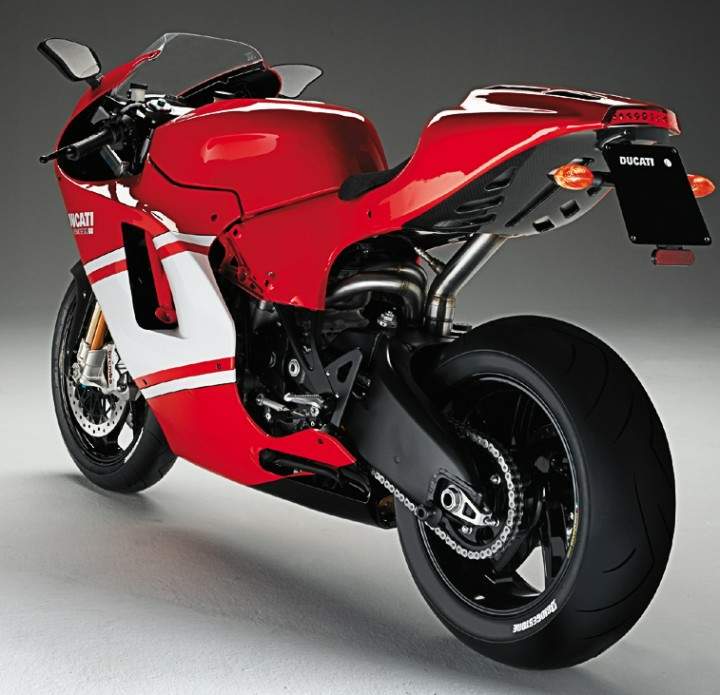
The Desmosedici RR's new exhaust system has been specifically developed to
deliver the best power and at the same time to ensure road riding pleasure.
Significantly lighter, it has been engineered with a power-increasing 4-2-1
layout that uses 42mm diameter tubing with wall thickness of 0.8mm (.030in)
AISI 309. The new exhaust system is equipped with a pass-by valve and ends
with a silencer incorporated in the rear tail that features two exhaust
exits to vertically release the exhaust gas. The upper part of the rear tail
combines a ceramic carbon fibre cover, the same solution as single-seater F1
cars.
The Desmosedici RR will be available with a special race kit that includes a
102 dB racing exhaust, a dedicated CPU, bike cover and paddock stand.
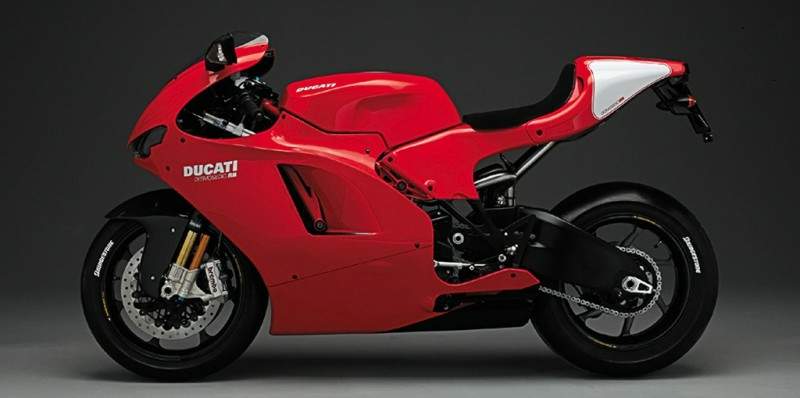
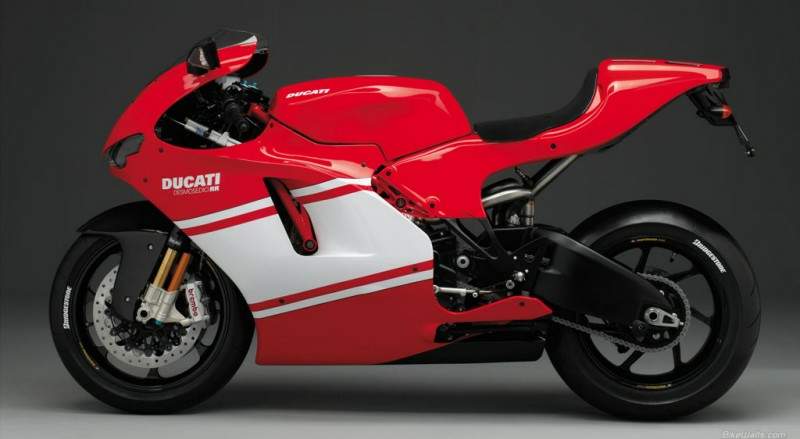
Two versions of the RR will be available: 1) the Desmosedici RR - painted in
'Rosso GP', with a white number plate on the tail section; 2) the
Desmosedici RR 'Team Version' - painted in 'Rosso GP', and as with the
factory Corse bikes, this has a broad white stripe on the fairing. A team
sponsor decal kit will be provided with each bike.
For this exclusive Ducati, a new dedicated service plan is included. Each
Ducati Desmosedici RR owner can benefit from a three-year warranty and three
years of scheduled maintenance, free of charge.
ENGINE
With a power output of 200 HP* at 13,800 rpm and a torque of 11.8 kgm* at
10,500 rpm, the new D16RR engine follows the guidelines laid down by the
Ducati Corse GP engine, a masterpiece of engineering and precision.
Bore and stroke measurements are the same as those on the D16GP6 - 1000
cc (86x42.56), as are the characteristic positions of the Ducati desmodromic
timing system parts (camshaft rotation axis, rocker arm centre and valve
centre distance), valve angle, distance between cylinder centres and pulse
timing, which uses the Twin-pulse solution applied on the racing engine.
As in MotoGP, traditional Ducati desmodromic timing ensures accurate valve
control even at the highest revs and blends perfectly with the modern
architecture of this superb 4-cylinder engine.
As is the tradition at Ducati, the 90° angle between the cylinders is
maintained.
This authentic copy of the GP engine is further endorsed by the use of a
cassette type six-speed gearbox and hydraulically actuated dry multi-plate
slipper clutch.
The aim of producing a light but reliable engine has led not only to a
component design of unrivalled quality, but also to the use of exclusive,
individually-made racing-derived materials.
The crankcase and cylinder heads are sand-cast aluminium while the cam-drive
cover and alternator casing are made of sand-cast magnesium, technologies
that match the lightness of these alloys with the greater mechanical
strength expected from structural components. The oil sump, cam covers and
clutch cover are made by pressure die-casting magnesium alloy, a technology
that allows significant thickness reduction on non-structural components.
A look inside the engine shows how the quest for high performance has led
to the utilisation of racing technologies such as titanium con rods, intake
and exhaust valves - again in titanium alloy with CrN (chromium nitride)
coating - and precision grinding finishing to reduce friction on certain
components such as rocker arms. Even the camshafts have been drilled and cut
to reduce weight.
Lightened through finite-element simulation (FEM), the timing gears are
arranged according to a pattern highly similar to the one used in the GP
engine.
The piston has the classic high-performance engine architecture, with double
ribbed undercrown and a compact combustion chamber that brings the
compression ratio to 13.5.
The crankshaft rotates on brass bearing shells and has the crank pins
offset by 70° to generate soft pulse timing (pulses at 0° - 90° - 290° -
380°). This component is produced via complete precision machining of a
single piece of forged steel.
The cone-shaped end of the crank-webs maximises the use of the available
space below the piston bosses and optimises crankshaft assembly balance.
The sand-cast aluminium crankcases feature integral cylinder bores with
Nicasil lining, and the crankcase halves' separation layout is the same as
on the GP engine. The oil pump is of the trochoidal (Gerotor) type and
controls the water pump according to a cascade arrangement.
Also featured are four 50mm Magneti Marelli throttle bodies with 12-hole
'microjet' above-throttle injectors. A Magneti Marelli 5SM ECU control unit
and high-speed CAN line electronics have been employed to manage the
injection and electronic ignition of the powerful four-cylinder engine. The
throttle bodies, while serving two opposing cylinder heads, lie on the same
plane, resulting in a straight, plunging intake port configuration.
Like its GP counterpart, the engine acts as a connector between the
chassis and the rear swingarm/suspension, thus playing an essential
structural and stiffening role.
This road-going MotoGP bike offers outstanding performance: when in its
racing configuration, that is, with the kit consisting of the supplied
racing exhaust (102 dB) and control unit, it can reach a maximum power of
200 HP.
With its catalysed exhaust system, the Desmosedici RR, type-approved for
on-road riding, is compliant with Euro 3 emissions standards.
Data obtained with exhaust open.
Review
Ducati Desmosedici RR - The
Firebreather
Ducati's Desmosedici RR completely blew away the motorcycle world in its
debut-we put one through a full-on SR road test, including dragstrip, top speed,
dyno, the works
From the May, 2010 issue of Sport Rider
By Kent Kunitsugu
Photography: Kevin Wing
Tweet
|
|
Ducati Desmosedici D16rr Lead Shot
Click to View Gallery
Ducati has always had racing in its blood. And whenever you think of the term
"homologation special" as it applies to motorcycles, the factory from the Borgo
Panigale district of Bologna, Italy, always comes to mind-first and foremost.
The company has a long history of building limited production versions of its
high performance sportbikes whose main purpose is to legalize the usage of
certain parts for sanctioned racing.
Ducati Desmosedici D16rr Left Turn
Click to View Gallery
So when the Desmosedici RR project was officially announced at World Ducati Week
at the Misano circuit in '04-and then the final production version of the bike
unveiled at press day for the '06 Italian Grand Prix at Mugello-there was plenty
of surprise and awe. But beneath all that was almost an element of expectancy;
sure, the Japanese could just as easily build a road-going replica of their
MotoGP machines...but Ducati is the only manufacturer that would, and make it as
close to the real thing as possible. The terms "passion" and "pride" are often a
bit over-used in describing Italy's relationship with its motor vehicles, but
the Desmosedici RR is the perfect example of why those two words really do apply
to the people who work at Ducati.
Desmosedici Myths Debunked
A common belief regarding the Desmosedici RR is that it owes its existence to
MotoGP switching to the 800cc format in '07, thus forcing Ducati to build a
completely new racebike and making much of the 990cc GP06 Desmosedici MotoGP
machine obsolete, eliminating concerns about some proprietary technology
becoming "declassified" after appearing in a for-sale-to-the-public production
version. Not so, according to the upcoming David Bull Publishing book, "Ducati
Desmosedici RR" by Chris Jonnum (see sidebar). In fact, when then-Ducati Corse
CEO (now Ducati Product Director) Claudio Domenicali, then-Ducati Corse
Technical Director (now Ducati Corse General Manager) Filipo Preziosi, and
then-Ducati MotoGP Product Manager Livio Suppo prepared their presentation for
entering MotoGP to then-Ducati CEO Carlo Di Biagio back in '01, the business
plan included producing a race replica as a way of helping finance the endeavor.
The Desmosedici RR engine was already well into the pre-production stage by '04,
long before the idea to drop MotoGP to 800cc displacement was even floated.
Ducati Desmosedici D16rr Left Side
Click to View Gallery
Another mistaken belief is that the engine in the Desmosedici RR is literally a
carbon copy of the powerplant from the GP06 Desmosedici MotoGP machine; just
detuned to lengthen the lifespan of its parts and make its performance more
accessible to mere mortals, along with an alternator and electric starter
grafted on. In reality, however, the only parts shared between the two engines
are the cylinder head base bolts. The RR engine and its entire mechanical makeup
was designed specifically for its production purpose, and is not just a
conglomeration of parts made from the same castings as the MotoGP engine.
Don't misunderstand though-the D16 RR powerplant is indeed a very, very close
replica of the GP06 engine, right down to its "Twin Pulse" firing order
crankshaft. In fact, when the MotoGP racebike switched to this format in '04, it
forced the engineers responsible for the D16RR to drop the standard firing order
prototypes they'd already made and follow suit because of Ducati's desire to
make it as close to its racing cousin as possible. The D16RR engine has the same
architecture (90-degree Vee angle, 86 x 42.56mm bore x stroke, 25-degree
included valve angle, gear-driven desmodromic valve actuation, etc.) and many
parts using the same materials and vendor; for instance, the titanium rods are
made by Pankl, just as with the MotoGP bike, and have the same journal diameters
and eye-to-eye length. The sand-cast engine cases split horizontally just like
the MotoGP unit, along with an extractable cassette transmission that is
faithful in nearly every way to the racebike's-only with beefier gears and
shafts to ensure durability on the street.
Space considerations with the
street-going D16 meant that some portions of the MotoGP design couldn't be used.
One example is that the MotoGP engine uses a dry-sump oil lubrication system,
but the D16RR uses a conventional wet sump setup. The reason? There wasn't
enough room for the dry sump system's separate oil tank. Engine packaging and
maintenance concerns also forced the relocation of the water pump from its
racebike positioning on the right side between the cylinder banks to the left
side below the alternator, forcing engineers to make some innovative yet elegant
designs in order keep the engine narrow for ground clearance. The D16RR
engineers were allowed just 1cm extra width on each side compared to the MotoGP
engine, an enormous task considering the added parts (such as the alternator,
battery and supporting wiring, starter motor) that also added bulk.
Think about that for a minute: a comparatively small company with limited
resources had to design and produce an engine that-although very closely based
on a proven racing unit-was basically built from scratch. And many of the
specialized components had to be produced by skilled vendors who were accustomed
to making small batches for race teams. These engines had to pass all necessary
emissions and noise standards, yet produce serious horsepower, all while being
built in numbers that require some mass production techniques. The words
"incredibly ambitious" come to mind, yet Ducati pulled it off masterfully.
Ducati Desmosedici D16rr Ohlins FG353P Fork
The Desmosedici RR is the...
read full caption
Ducati Desmosedici D16rr Ohlins FG353P Fork
The Desmosedici RR is the only production motorcycle to be equipped with the
GP-spec Öhlins FG353P gas-pressurized fork. Brembo monobloc calipers and 330mm
discs provide outstanding stopping power.
Ducati Desmosedici D16rr 989Cc V Four
The 989cc gear-driven desmodromic...
read full caption
Ducati Desmosedici D16rr 989Cc V Four
The 989cc gear-driven desmodromic valve V-four is a work of art, especially
considering the fact that it was designed and built from scratch. Contrary to
popular opinion, while the engine is very closely based on the GP06 MotoGP
powerplant, it is not an exact replica; instead, it was designed and built
expressly for the D16RR.
Ducati Desmosedici D16rr Water Pump
Packaging concerns with the...
read full caption
Ducati Desmosedici D16rr Water Pump
Packaging concerns with the D16RR engine meant the water pump had to be
repositioned below the alternator cover (instead of between the cylinder banks
as on the MotoGP engine). Note the nicely cast aluminum piping from the water
pump, necessary for ground clearance.
The steel-tube trellis chassis has also been mistakenly reported to be exactly
like the GP06 racebike's frame. Like the engine, while the chassis uses the same
design with the front subframe attaching to the front of the engine along with
the aluminum swingarm in the rear pivoting directly in the engine cases, there
are subtle differences in each component that were made in order to better suit
the D16RR's different performance demands. These changes were arrived at after
extensive testing with riders of varying skills.
The Desmosedici RR also permitted Ducati to let its loyal suppliers showcase
their respective strengths. For example, the D16RR is the first production bike
to utilize Öhlins' GP-spec FG353P gas-pressurized inverted 43mm fork, a very
specialized component that usually costs over $10,000 (and is only made
available to favored race teams). The D16RR is also the first production bike to
be equipped with forged magnesium wheels, with Marchesini supplying special
units that have been subtly beefed up in order to meet the durability
requirements for street use. Even the tires are specific to the D16RR, with
Bridgestone providing new BT-01R "Uno" radials that were specially developed
with the bike during its prototype stages.
(Our thanks to Chris Jonnum and David Bull Publishing for letting us take a
pre-release look at their upcoming book, "Ducati Desmosedici RR", from which
much of this technical information was gleaned. -Ed.)
Ducati Desmosedici D16rr Footpeg Brackets
Click to View Gallery
Because there is no frame...
read full caption
Ducati Desmosedici D16rr Footpeg Brackets
Click to View Gallery
Because there is no frame for the footpeg brackets to attach to (the swingarm
pivots directly in the engine cases), the brackets attach to the self-supporting
carbon fiber seat/tail-section. That they work without excessive flexing is a
very impressive engineering and production feat.
Desmosedici, You're Up
Climbing aboard the D16 reveals a fairly stretched-out riding position, with a
long reach to the low-set clip-ons-basically the same as the GP06 MotoGP
racebike I rode back in November of '06 ("Full Speed Ahead", April '07), in
keeping with its MotoGP replica intentions. The Ducati Performance
self-supporting carbon tailpiece has a racebike-style saddle as well; firm,
one-inch-thick seat foam is basically there to keep your posterior planted and
provide good chassis/rear tire feedback, and nothing else.
Turn the key, and the Marelli LCD dash quickly goes through its diagnostic check
while the whir of the fuel pump signals its pressurization of the fuel system.
The starter will not engage until the various engine parameters are met, which
takes a few seconds. Then once the starter engages, the D16 requires just a
smidge of throttle to light off properly, at which point you are met with a
ferocious bark from the dual exhausts (our bike was fitted with an exquisitely
crafted titanium Ducati Performance exhaust that features one canister
protruding out the rear of the tail section, and one exiting beneath the right
footpeg, just like the GP06) along with a blizzard of mechanical noise from the
valve train. This is definitely no refined and restrained streetbike-the
mechanical noise alone sounds like it would be enough to fail the EPA sound
test.
Ducati Desmosedici D16rr Instrument Panel
Click to View Gallery
The instrument panel and mirrors...
read full caption
Ducati Desmosedici D16rr Instrument Panel
Click to View Gallery
The instrument panel and mirrors are basically the same as current 1198 models.
Note the front brake free-play takeup adjuster cable running just in front of
the top triple clamp.
Clicking the D16 into first gear reveals very little of the transmission
clunkiness you usually find in conventional streetbikes; you only feel the
slightest take-up of drivetrain lash, and clutch pull is much lighter than the
V-twin desmos. The dry slipper clutch is also thankfully more robust than the
units on the V-twins, with little of their grabby and noisy characteristics,
even during aggressive launches.
The D16 runs a little rough just off the bottom, likely a by-product of the
single injector per cylinder setup. In order to have sufficient fuel flow at
high rpm for a 170-horsepower engine, a large capacity injector must be used;
this compromises its ability to control fuel flow at lower rpm where precise
delivery is required for smooth running. The engine quickly clears its throat
once past the 3000-rpm mark however, revealing a powerplant with plenty of
midrange grunt, despite its very oversquare bore/stroke dimensions. The torque
curve is fairly smooth up to 9500 rpm, and we're sure plenty of D16 owners will
happily troll around this section of the powerband in perfect bliss at how
user-friendly its engine is.
Ducati Desmosedici D16rr Ohlins Rear Shock
Click to View Gallery
The Öhlins PRXB single-tube...
read full caption
Ducati Desmosedici D16rr Ohlins Rear Shock
Click to View Gallery
The Öhlins PRXB single-tube rear shock has a huge 46mm piston that enableos it
to provide better and more consistent damping. The fully adjustable (rebound and
high/low-speed compression damping, plus hydraulic spring preload) shock would
normally cost more than $1000, and has been used on many World
Championship-winning bikes. Linkage ratios are identical to the GP06 MotoGP
machine.
Let the revs climb beyond that point at anywhere near full throttle though, and
the beast within quickly surfaces. In the span of just 1000 rpm, the D16
explodes from a docile 116 horsepower to an attention-getting 139 horsepower,
and power continues building exponentially from there as the desmo V-four
ravenously dEVOurs the upper portion of the rpm scale. Spec chart mavens are
probably scoffing at the 169.8 horsepower peak reading from our Superflow Windyn
dyno chart, but what that doesn't take into account is how quickly the engine
revs, plus the fact that it weighs 425 pounds with lightweight magnesium wheels
with less rotational inertia (easier to spin faster-as in accelerate). One need
only look at the D16's scorching 9.49 second at 152.80 mph quarter-mile
time-which could've been much quicker had we not been so wary of abusing the
Ducati's expensive clutch and performed some chassis tweaks such as lowering,
tire pressures, etc.-to get an idea of its accelerative prowess.
Thankfully the chassis and running gear are up to task of harnessing that power.
The race-spec Öhlins suspension handled all manner of bumps and dips that the
Infineon circuit could dish out-provided both ends were set up correctly. Our
first session was a fitful group of laps that had us chattering and bouncing our
way around the track, making us even more paranoid about possibly skittering a
$90K-plus motorcycle down the track on its side.
Ducati Desmosedici D16rr Rear Shot
Click to View Gallery
Luckily, former AMA Pro Thunder class champion (as well as successful Ducati
dealership owner and official Ducati North America tech maven) Jeff Nash was on
hand to help us get near a suitable ballpark setting. The Öhlins FG353P fork
follows the current MotoGP spec of having each fork leg handle rebound or
compression damping exclusively, with the left fork leg handling compression and
the right fork leg dealing only with rebound. Unfortunately, it appeared that
the previous group who tested the D16 mistakenly thought the adjusters were the
conventional variety, resulting in both ends of the compression damping being
far too stiff. Nash softened up the suspension considerably, providing a much
more stable and compliant ride that allowed the Ducati to more readily display
its surprisingly agile steering characteristics despite its 56.3-inch wheelbase.
Ducati Desmosedici D16rr Swingarm
Click to View Gallery
The Desmosedici's extra-long...
read full caption
Ducati Desmosedici D16rr Swingarm
Click to View Gallery
The Desmosedici's extra-long 21.75-inch swingarm is constructed out of cast,
forged, and pressed aluminum sections and weighs just 12 pounds; its overall
geometry and linkage ratios are lifted directly from the GP06 MotoGP bike.
Bridgestone rubber was specially developed with the 6.25 x 16-inch Marchesini
magnesium wheel to replicate the profile of the 16.5-inch rubber that is now
standard in MotoGP.
Turn-in and major directional changes on the D16 are far easier than the vast
majority of sportbikes, and flicking the bike from full lean on one side to the
other in slow or fast chicanes requires less effort than you'd expect. Besides
the well-balanced chassis, surely helping in this regard are the Marchesini
magnesium wheels that have less gyroscopic effect. The extensive suspension
adjustability surely doesn't hurt either; for example, rear ride height can be
easily altered by turning the exposed top shock mount bolt on top of the
swingarm.
Handling the task of scrubbing off all the speed generated by the engine and
chassis are the same brakes found on the 1198 series V-twins. Huge 330mm discs
are clamped by Brembo's latest radial-mount/four-piston M4 monobloc calipers
sporting 34mm pistons, all actuated by a Brembo radial master cylinder providing
unrivaled stopping power and feel. A nice MotoGP-style touch is the manual brake
free-play adjuster on the left clip-on bar; continuous very aggressive braking
over the course of a race wears pad material and causes the calipers' aluminum
pistons to expand, changing the brake lever free play and travel. Turning the
adjuster knob immediately takes up this free play, allowing the brakes to feel
more consistent.
Unfortunately, all this engine/chassis competence exposes the one weak link in
the D16: the tires. The BT-01R "Uno" tires were developed specifically for the
D16 by Bridgestone, with the 6.25 x 16-inch rear wheel sizing chosen to provide
the correct tire profile that more closely replicates the 16.5-inch rubber that
is common in MotoGP. While the BT-01R tires are fine for street use, they never
really came to grips-literally as well as figuratively-with track usage. The
Bridgestone's only average edge grip-coupled with the D16's tremendous
power-contributed to difficulties coming off corners. Any attempts at aggressive
corner exits would easily spin up the rear tire, and great care was necessary
when getting on the throttle early in the corner. Overall bump compliance wasn't
that good either, with a rather stiff carcass feel leading us to theorize that
the tire was developed on smoother pavement than we normally have here in the
States-street or racetrack. And because of the rear wheel's 16-inch diameter,
you're basically stuck with one choice there. We've heard of some D16RR owners
fitting 999-spec rear wheels that allow them to run the more plentiful 17-inch
rubber choices, although we'd imagine if you have the money for a D16, placing a
call to your local Marchesini dealer would net you a proper 17-inch magnesium
wheel to match the front.
Ducati Desmosedici D16rr Exhaust
Ducati Desmosedici D16rr Accessory Exhaust
Instead of the stock exhaust that runs underneath the seat and exits out the top
rear of the tail-section, our test unit was equipped with the Ducati Performance
tail-section and accessory exhaust that replicates the GP06 MotoGP unit, with
one collector exiting from beneath the rear of the tailpiece, and other mounted
flush with the fairing bellypan just below the right footpeg.
A Very Impressive Feat
Even the homologation specials for superbike racing that Ducati has built over
the years pale in comparison to the Desmosedici RR. Although out-of-the-crate
performance may not be a match for the latest V-twin 1198R, the performance
potential is there, and the exclusivity and quality of components is unrivaled.
Just the fact that Ducati had the ambition and drive to build such a bike speaks
volumes about the company's enthusiasm for racing-and its relationship to the
company's products. And while we all love the booming sound of an 1198R at full
song, the distinctive banshee wail of the Desmosedici RR will raise the hair on
the back of your neck.
Make no mistake, if you're lucky enough to own one of these exclusive machines,
you have what amounts to the only real Grand Prix replica sportbike built by any
manufacturer. And it's one that is definitely no poser.
Ducati Desmosedici D16rr Dyno Chart
Click to View Gallery
Ducati Desmosedici RR
Test Notes
+ The first and only real MotoGP replica
+ Monster engine, trick suspension
+ Serious exclusivity
- Severely restricted rear tire choice
- Now only available second-hand
- No traction control
x Face it, don't lie-if you had the money, you'd buy one
Suggested Supension Settings
FRONT Spring preload—3 turns in from full soft; rebound damping—12 clicks out
from full stiff; high-speed compression damping—11 clicks out from full stiff;
low-speed compression damping—11 clicks out from full stiff
REAR Spring preload— 13 turns in from full soft (hydraulic preload adjuster);
rebound damping—15 clicks out from full stiff; high-speed compression damping—24
clicks out from full stiff; low-speed compression damping— 12 clicks out from
full stiff; ride height—7mm thread showing on top shock mount
Ducati Desmosedici D16rr Right Side
Click to View Gallery
Ducati Desmosedici RR
MSRP: $72,500
Engine
Type: Liquid-cooled, 90-deg., 4-stroke V-four, DOHC desmodromic, 4 valves/cyl.
Displacement: 989cc
Bore x stroke: 86.0 x 42.56mm
Compression ratio: 13.5:1
Induction: Magnetti Marelli EFI with 50mm throttle bodies, single injector/cyl.
Transmission: 6-speed
Chassis
Front suspension: 43mm Öhlins FG353P gas-pressurized cartridge inverted fork,
4.7 in. travel; adjustable for spring preload, rebound and high/low-speed
compression damping
Rear suspension: Single Öhlins PRXB shock absorber, 4.7 in. travel; adjustable
for spring preload, rebound and high/low-speed compression damping
Front brake: 2, radial-mount/four-piston monobloc calipers, 330mm stainless
steel discs
Rear brake: Single twin-piston caliper, 240mm disc
Front wheel: 3.50 x 17 in.; forged magnesium alloy
Rear wheel: 6.25 x 16 in.; forged magnesium alloy
Front tire: 120/70ZR-17 Bridgestone BT-01F Uno
Rear tire: 200/55ZR-16 Bridgestone BT-01R Uno
Rake/trail: 23.5/24.5 deg. (adjustable)/3.8 in. (97mm)
Wheelbase: 56.3 in. (1430mm)
Seat height: 32.7 in. (831mm)
Fuel capacity: 4.0 gal. (15L)
Weight: 425 lb. (193 kg) wet; 401 lb. (182 kg) all fluids except gas
Instruments: LCD panel for digital speedometer, bar graph tachometer, clock,
coolant temperature, odometer/dual tripmeters, ambient air temperature, battery
level, lap time, scheduled maintenance, average speed/fuel consumption, fuel
reserve, DDA, EOBD diagnostics; warning lights for neutral, high beam, turn
signals, low oil pressure, low fuel level
Performance
Quarter-mile: 9.49 sec. @ 152.80 mph (corrected)
Top speed: 188.2 mph
Roll-ons: 60-80 mph/2.67 sec.; 80-100 mph/2.77 sec.
Ducati Desmosedici D16rr Closeup
Click to View Gallery
The Real Inside Story On The Desmosedici
Ducati never released very much information on the Desmosedici RR, but it didn't
really have to; the $72,500 MotoGP replica basically sold itself. All 1500 units
that were produced were already spoken for well before production even started.
It was quite an audacious move to produce such a motorcycle, even from a company
known for its penchant of building superbike homologation models.
Ducati's decision to produce the Desmosedici RR becomes even more daring when
you discover its origins, its actual mechanical makeup, and the people behind
its construction. Much of the incredibly intricate and interesting technical
details and history probably would have been left undiscovered-but fortunately
Chris Jonnum, editor of RoadracerX magazine, was commissioned by David Bull
Publishing to delve into the bike and its background as the foundation for the
upcoming hardcover book, "Ducati Desmosedici RR"
Jonnum-who speaks fluent Italian-spent numerous days interviewing over 40 people
at the Ducati factory in Bologna, Italy, plus management at Ducati North
America, as well as personnel at partner companies such as Marchesini, Brembo,
Öhlins, etc. The book is a literal treasure trove of fascinating details,
stories, and history behind the bike that were heretofore unknown beyond the
walls of the Ducati factory, with revealing testimony from key figures behind
the concept, design, prototype research and development, and production of what
is surely one of the most impressive technological achievements in motorcycling.
The quality hardcover book will comprise 228 pages, with more than 350
photographs that reveal everything about the Desmosedici RR and the incredibly
passionate and driven people responsible for building it. This book is not only
a must for any of the lucky 1500 Desmosedici RR owners and any true Ducatisti,
but also for any person-motorcycle enthusiast or not-who loves to read about how
a relatively small factory that loves motorcycles and racing used spirit,
innovation, and creativity to turn what many considered a pipe dream into a
top-shelf performance reality.
The book's release is scheduled for August at the Red Bull Indianapolis GP, and
a price had not been set a press time. Interested parties, however, should log
onto www.bullpublishing.com for additional information, to place advance orders,
and to be put on a notification list.
Opinions
Eric Nugent
When word came from Andrew "curling is a sport" Trevitt that we would get to
ride a few laps on the Desmosedici, my heart almost skipped a beat. Looking at
the bike on the stand was almost just as great as riding it. I'm glad there
wasn't an eight-foot "no molesting" zone that you would normally see around
something so beautiful. The next best thing to looking at the Desmo is hearing
her run, with an exhaust note that is nothing short a full-blown MotoGP bike.
First thing I noticed is just how stretched out I was in reaching for the bars.
The next attention-grabbers are the brakes-one finger is almost too much for
these binders. The speed of the Desmosedici is all that you would expect.
Powerful and fast would not even describe what this thing feels like. And while
I only got on the throttle when the bike was near straight up due to the lack of
tire grip, it has a feel like nothing else you could imagine. Thanks Kento and
Trevitt for a ride I will never forget!
Troy Siahaan
I think I would have had more fun riding the Desmo if there wasn't one figure
running through my mind the entire time I rode it: $100,000, or the amount our
test unit cost as tested. Riding around a racetrack using dollar signs as
braking markers is not conducive to a good time, and neither is riding around on
those terrible Bridgestone BT-01 tires that come standard on the bike.
There's no doubt it's a beautiful motorcycle, but it's nowhere near the top of
my list of motorcycles I've ridden. I couldn't make myself comfortable on the
bike as the saddle is too low and long, and the rearsets could be higher. As far
as the engine is concerned it's actually pretty docile down low. Opened up and
she shoved my eyeballs to the back of my head. Likewise, the super stiff racing
setup on the Öhlins suspension rattled my teeth out of my mouth. More power to
you if you can ride the Desmocedici properly. Me? I'll take an 1198R and pocket
the change.
Kent Kunitsugu
I have to tip my hat to Ducati for having the sfrontatezza to build and market a
bike like the Desmosedici RR. No other manufacturer would be bold enough to go
through all the financial and logistical risks and headaches to produce such a
machine. All the other attempts by manufacturers in the past to produce a Grand
Prix replica sportbike absolutely pale in comparison.
Many detractors would cry that the bike should have the absolute best
performance of any motorcycle for $72,500. Besides the fact that the D16RR only
falls just a bit short of that goal, that is completely missing the point. When
you take a close look at the Desmosedici RR, the lack of compromise in
construction is readily apparent; the only "compromise" (more a necessity,
actually) is that parts were redesigned in order to have the required durability
for street use. And if you know just how much effort went into the bike's
creation, that appreciation becomes even more profound.
NOTE: Some of the photos on
Motorcycle Specs are owned by somebody. If you see any of your
photos, you can let me know so that I can acknowledge it, or if
you object to it, I can remove it altogether. If any copyright
holder objects to their articles being placed on Motorcycle
Specs, it will be removed upon request. Any correction or more
info on these bikes will kindly beappreciated
Contact MePrivacy
Policy
Website Stats