HOME   CONTACT  |  TECHNICAL  |  CONVERTER  |  VIDEO  |  LINKS  


Classic Bikes
Custom Bikes
Racing Bikes


AC Schnitzer
AJS
Alfer
Aprilia
Ariel
Arlen Ness
ATK
Bajaj
Bakker
Barigo
Benelli
Beta
Big Bear
BigDog
Bimota
BMS Choppers
BMW
Borile
Boss Hoss
Boxer
Brammo
Britten
BRP Can-am
BSA
Buell
Bultaco
Cagiva
CCM
Confederate
CR&S
Daelim
Deus
Derbi
DP Customs
Drysdale
Ducati
Dunstall
Exile Cycles
Factory Bike
Fischer
Foggy Petronas
GASGAS
Ghezzi Brain
Gilera
Harris
Harley Davidson
HDT
Hesketh
Highland
Honda
HPN
Horex
Husqvarna
Husaberg
Hyosung
Indian
Italjet
Jawa
Kawasaki
KTM
Kymco
Laverda
Lazareth
Lehman Trikes
LIFAN
Magni
Maico
Matchless
Matt Hotch
Megelli
Midual
Mondial
Moto Guzzi
Moto Morini
MotoCzysz
Mr Martini
MTT
Münch
MV Agusta
MZ
NCR
Norton
Oberdan Bezzi
OCC
Paul Jr. Designs
Piaggio
Radical Ducati
Richman
Ridley
Roehr
Roland Sands
Royal Enfield
Rucker
Sachs
Saxon
Sherco
Suzuki
Terra Modena
Titan
TM Racing
Triumph
Victory
Vincent
Viper
VOR
Voxen
Vyrus
Waken
Wrenchmonkees
Wunderlich
Yamaha

Ducati Berliner Apollo


Back in the early 1960s, Ducati importers in the US, the Berliner brothers asked Ducati to make a machine that would rival the best that Harley-Davidson had to offer at the time – something that could be used by the American police. Berliner were so gung-ho about this, they even agreed to share part of the development costs for the new bike.

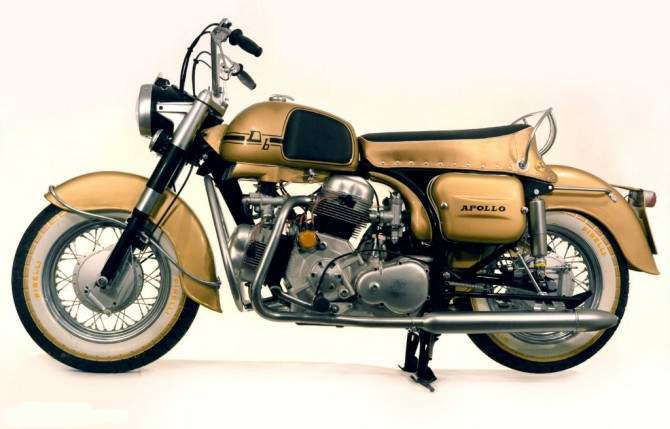
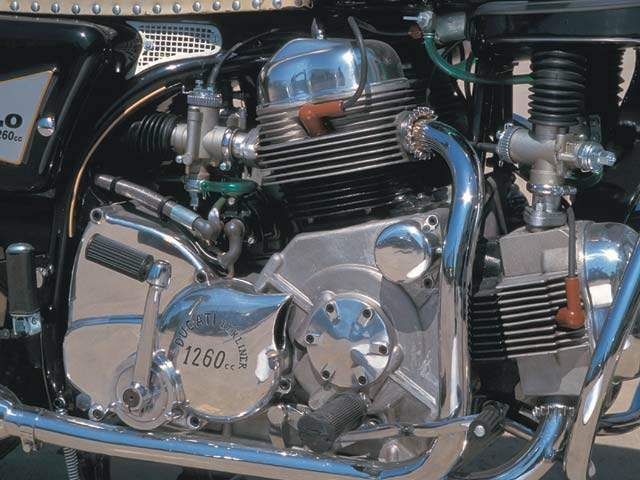
Thus, designed for the American market, the Ducati Berliner Apollo was born in 1964. The bike’s engine – a 1257cc, OHV, 8-valve, 90-degree V4 that churned out 100 horsepower at 7000rpm – was designed by Ducati’s legendary Fabio Taglioni. The air-cooled V4 was fed by a quartet of Dellorto TT 24 carburetors, the gearbox was a five-speed unit, and final drive was by chain.

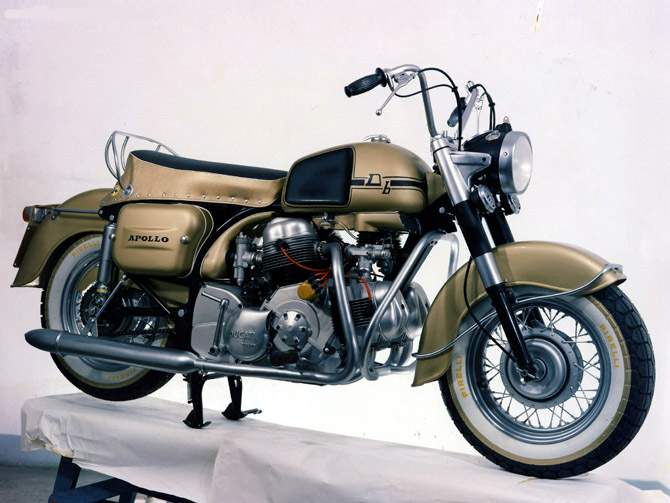
The Apollo’s chassis was made of steel – a mix of tubular and box-section parts – and used the engine as a stressed member. The bike rode on 16-inch wheels, suspension – developed by Ceriani – was a regular telescopic fork at front and twin shocks at the rear, and 220mm drum brakes were used at both ends. The Apollo weighed in 270 kilos dry.

The problem was, the tyres of that era were not able to cope with a 100bhp bike that weighed 270kg – the Apollo simply shredded its tyres to bits. Ducati tried reducing the power output to 80 and then 65bhp, and Pirelli tried making special tyres for the bike, but the Apollo never really worked. Ducati test rider of that time, Franco Farne said the bike handled like a truck.

Ducati and Berliner had hoped to sell the Apollo in the US for $1,500 to $1,800 but the bike never got to the market at all. The Italian government decided that the very limited market for the bike would not justify the costs of tooling and production, and withdrew funding for the project, effectively killing it off. Only two prototypes of the Berliner Apollo were ever made, of which one survives today.

The only surviving Ducati Berliner Apollo belongs to one Hiroaki Iwashita, who bought the bike for $17,000 in 1986 from DomiRacer, a vintage bike parts specialist based in Cincinnati, in the US. Bob Schanz, the man who owns DomiRacer, had purchased the bike from Berliner when the company shut down in 1984.


Bike journalist Alan Cathcart got to ride the Apollo some time back...
Motorcyclist

Bike journalist Alan Cathcart got to ride the Ducati Berliner Apollo some time ago, for Motorcyclist magazine. ‘Once astride the Apollo, you're immediately surprised at how low slung and slim it feels. The high, pullback handlebar is very ’60s, and combined with the well-placed footpegs, delivers surprisingly comfy ergos. Just chill out and cruise,’ says Cathcart.

‘The engine sounds like an American V8 rather than an Italian four, and the Apollo’s exhaust note is quite loud and very unlike that of any Honda V4,’ says Cathcart. ‘I was impressed with how smoothly the Apollo took off from rest, even with the clutch slipping slightly, though upshifting through the gears brought the Apollo's age to light. Once securely in gear, the Apollo thrusts forward eagerly with a long-legged feel, especially in the intermediate gears.’

'Compared with a pre-Isoelastic British twin or any Harley ever made, the Apollo is a sewing machine to a concrete mixer in terms of vibration and riding comfort, with only a BMW Boxer of the era delivering anything close to the same smoothness. Out of respect for the bike's rarity, and the lack of any spares, I didn't rev it out. But even at a higher rpm the same unruffled, lazy-feeling response we came to take for granted a decade later on any V-twin bearing the Ducati badge is evident on the Apollo.'

'At a time when there were no four-cylinder motorcycles of any type on the market, the Apollo would have established a standard of performance and rider comfort that, even a decade later, would set the benchmark for the Japanese. Truly, this was a bike ahead of its time,’ concludes Cathcart.

Source
Faster and Faster


NOTE: Some of the photos on Motorcycle Specs are owned by somebody. If you see any of your photos, you can let me know so that I can acknowledge it, or if you object to it, I can remove it altogether. If any copyright holder objects  to their articles being placed on Motorcycle Specs, it will be removed upon request.  Any correction or more info on these bikes will kindly beappreciated                                          Contact Me      Privacy Policy     Website Stats