|
|
|
|
Classic Bikes
Custom Bikes
Individual
Racing Bikes AJP
AJS
Aprilia
Ariel
Avinton / Wakan
Bajaj
Benelli
Beta
Bimota
BMW
Brough Superior
BRP Cam-Am
BSA
Buell / EBR
Bultaco
Cagiva
Campagna
CCM
CF Moto
Combat Motors
Derbi
Deus
Ducati
Excelsior
GASGAS
Ghezzi Brian
Gilera
GIMA
Harley Davidson
Hero
Highland
Honda
Horex
Husaberg
Husqvarna
Hyosung
Indian
Jawa
Kawasaki
KTM
KYMCO
Laverda
Lazareth
Magni
Maico
Mash
Matchless
Mondial
Moto Guzzi
Moto Morini
MV Agusta
MZ / MuZ
NCR
Norton
NSU
Paton
Peugeot
Piaggio
Revival Cycles
Roland Sands
Royal Enfield
Sachs
Sherco
Sunbeam
Suzuki
SWM
SYM
Triumph
TVS
Ural
Velocette
Vespa
Victory
Vincent
VOR
Voxan
Vyrus
Walt Siegl
Walz
Wrenchmonkees
Wunderlich
XTR / Radical
Yamaha
Zero
Video
Technical
Complete Manufacturer List
|
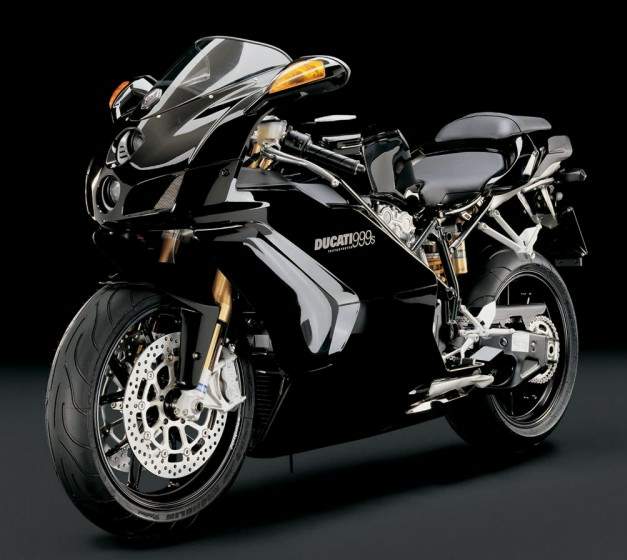
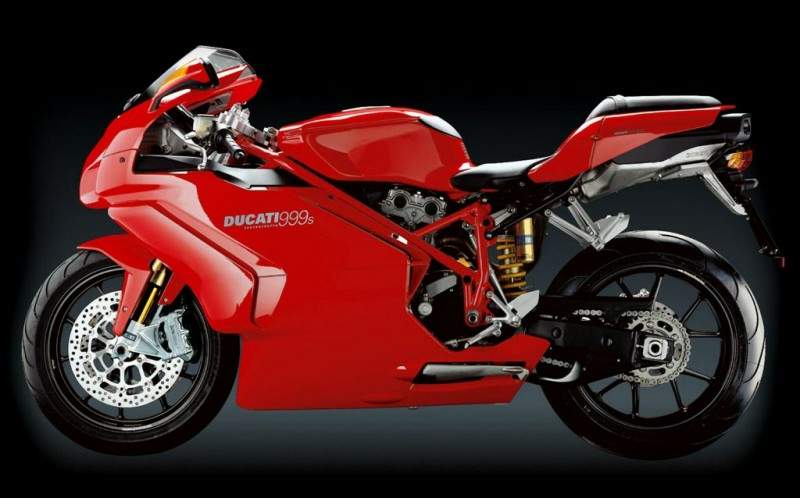
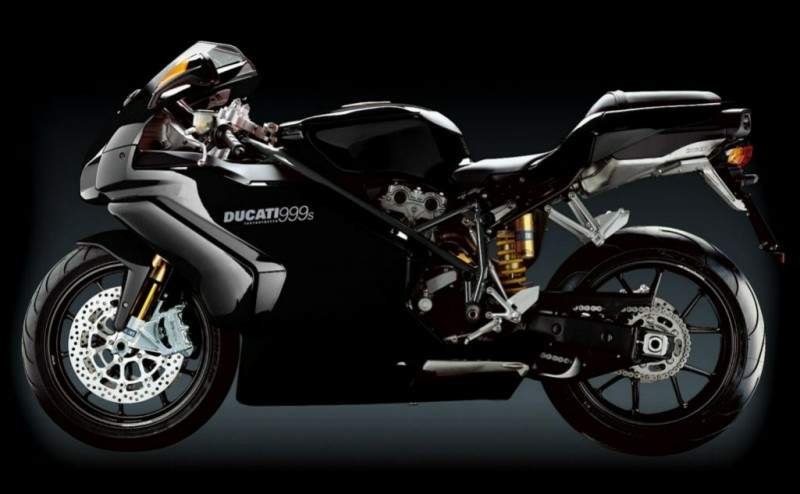
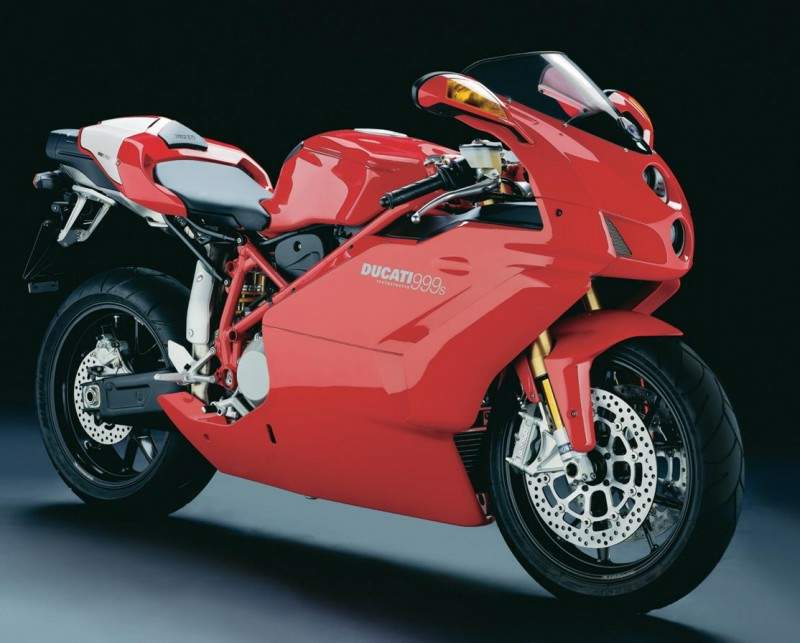
Ducati 999S
Built around the Testastretta engine, the 999s possesses the form of a pure sports bike: low, long, and narrow with exciting componentry and a technical look. Ducati’s experience gained over years of successful racing at the highest levels is evident in the design and technical characteristics of the 999s The 999s combines incredible performance with a linear and tractable power delivery so you are “on the gas sooner” and “shift gears” less. The motorcycle comes with a racing kit that includes a 102 dB Termignoni exhaust half-system with an electronic control unit featuring race mapping and a carbon fibre silencer cover.
Features: 2005 has been an exceptional year for Ducati Superbikes, the range having been completely rEVOlutionised with a series of stylistic and functional refinements and, above all, with a general upward shift in terms of power ratings and performance in both engine displacements and all versions. The 749 and 999 machines have been made more aggressive, edging closer to the dividing line between the street bikes and the official machine used on the world's racetracks. For the Superbikes manufactured in Borgo Panigale, 2006 will be dedicated to digesting the generational shift, which has taken place just two years from the launch of the new series, with the numerous innovations and refinements introduced in 2005. The decision to rEVOlutionise the machines was driven by the return of Ducati to the North American AMA Superbike Championship, which has more stringent rules than European championships with regard to modifications to mechanical parts and chassis: the new model is a result of the efforts aimed at creating a machine that would be race-ready straight off the production line, with a large number of adjustments for attitude and riding position, while also being suitable for use on the road. The result is a superbly contemporary range that is highly sophisticated and able to meet the most demanding sports rider with the basic equipment of the 749 and 999, and gradually approaching the S and R versions in a series of EVOlutionary steps. This brings us to the current state of the art, with the top of the range position occupied by a 999R packing a massive 150 HP, proposed for 2006 also in a Xerox replica version, sporting the colours of the "official" SBK ridden by James Toseland and Regis Laconi.
The Ducati sports machines share aesthetics based on the concept of racing
aerodynamics, with fairings that are highly effective also at extreme
speeds. That's the thinking behind the development of a new upper fairing,
designed to protect the rider's head and shoulders and eliminate air
turbulence. The fairing, which is higher and wider than its predecessor to
increase the level of protection, joining a tapered lower section of the
body, equipped with a pair of sweeping wrap-around and highly effective
deflectors. Protection of the rider is one of the key concepts of the latest
generation of Ducati machines: the absence of air turbulence makes the
cockpit more comfortable - an important factor when riding in traffic and
offering significant benefits on the racetrack because stress and fatigue
levels are reduced, allowing riders to achieve consistently fast lap times
for longer. The unforgiving stopwatch has amply proved this theory. Like the 749S, this machine is the link between the 999 in the road version and the R machine designed exclusively for the race circuit. Equipped with advanced and highly effective suspension systems and an engine that has all the raw power needed to handle any riding situation, this bike is in its element on the racetrack, despite the fact that it is fully homologated for road use. The twin cylinder engine can be given a further power boost by fitting the racing kit supplied with each bike (available in all countries except Japan). Style Like all Ducati Superbikes, the 999S maintains the classic family
appearance. The only visible differences are the brakes and suspension,
which are aesthetically and structurally of a more professional class. In
effect, the S is the link between the road versions and the primarily
competition machines. As an alternative to the two-seater machine, there's
also a solo version with specific rear fairing, stylistically very similar
to the 999 Factory machines. Chassis Homologated for road use, but also perfectly equipped to excel on the race circuit, the 999S uses suspension systems that are rarely found on series production motorcycles. The single shock and upside-down forks are made by Öhlins and are racing specification. The suspensions provide adjustments for spring preload and compression and rebound damping, all functions that are more precise thanks to the use of a check valve that operates on the rebound stroke and makes it possible to obtain clear separation between the various suspension functions with resulting benefits in terms of set-up precision. Also the steering damper is supplied by Öhlins, equipped with an eccentric mount to adapt to the two available Steering Head Angles. The exclusive component parts of the 999S are completed by a braking system with radial callipers. Powerplant The Testastretta twin of the 999S is different compared to the standard 999 thanks to the use of more advanced materials. The difference includes a super lightweight crankshaft and newly designed titanium con rods, all of which are key parts that make for significant increases in terms of power output. And if the power of the production engine is insufficient, for track use riders can install the power booster racing kit, which is included with each 999S. With the kit installed, the power rating increases to 143 HP at 9,750 rpm, while torque reaches 11.4 Kgm at 8000 rpm.
Review You may remember that when we reviewed the Ducati 999 a few months back we were rather impressed. We didn't expect a great deal from the S version - after all at a glance all you get is some designer suspension and a couple of engine tweaks, so what could be so different? Everything. The 999s looks very similar to the base model. Both are available as single or dual seat versions, both are red and both look better in the flesh than in photos. That's where it ends, though. The 999s simply oozes quality. I have never seen a bike get so much attention from other people, even when strapped on a trailer on a rainy M25. It is an extraordinarily good looking bike. The Ohlins forks and rear suspension just give it an aura that the base model lacks somehow. By the time I had got out of town and a few miles into my test route I was hooked. Half way round the route I was in love, and at the end of my route I filled up with fuel and did it all again. The bike really is that good. The engine changes have released an extra 12bhp and a tiny bit of torque, but the numbers tell only a fraction of the story. It's the way the power is released that does it. It's actually very easy to describe. You open the throttle hard and the bike accelerates so fast that the speedo can't keep up. And it carries on doing so until the rev limiter comes in. In pretty well any gear from pretty well any speed. But it's not just huge power and spot-on gearing either. Those pretty forks and shiny shock are so worth the extra money. Turn in and cornering feel are unlike any Ducati I've ever ridden. The bike will turn into a corner without any apparent effort from the rider, and allows mid corner line adjustments with no hassle at all - something most Ducatis would simply refuse to do. The Brembo brakes are unbelievable as well, offering eyeball popping retardation from the pressure of a single finger. Amazing, especially as they appear to be the same as the brakes fitted to the base 999. It just goes to show what serious quality suspension can do. Sitting down, we worked out that the Ohlins forks, rear shock and steering damper alone are worth something around £2500. Add another grand for the engine internals and the price seems pretty reasonable. Running late to deliver the bike to Adrian for a second opinion I was unable to just take the quick way and ride up the motorway. Not because the 999s isn't any good on motorways - it actually handles the boredom very well - but simply because very wide roads with very few corners simply miss the point. The 86 miles from my house to Adrian's took nearly 200 miles to cover. 200 miles braking deeper into corners than I had ever done before, accelerating harder out of corners than I ever had before and smiling so much that my face still hurts. All this with the largest safety margins imaginable as the incredible brakes and beautifully adjustable handling simply allowed me to ride around any unexpected developments with time to spare. There is a but though. This is the type of bike that is likely to be bought by people who don't ride very much and may have limited experience on a modern machine. They may well be buying an image as much as a motorbike. This could be a bad thing. Partly because it is a bike which deserves to be ridden properly and only really works when approached with commitment, and partly because the performance is deceptive and could well see a less experienced rider enjoying some close study of the local hedgerows. The good thing, of course, is that in two or three years time there will be very low mileage never ridden hard examples coming on the market for very keen prices. Riding in town is an interesting experience. The fact that, to all intents and purposes, the mirrors do nothing doesn't help much. Neither does the weight on the wrists or the rather limited steering lock. Oh, and everyone either wants to look, wants to ask what you think of it or wants to beat you off the lights. All this would be more bearable if it wasn't accompanied by the not entirely pleasant sensation of having your thighs and bottom barbecued on the catalytic converter which sits under the rock hard seat. It doesn't smell very nice either. But then again, towns rather miss the point as well. After all this time, I've finally ridden a Ducati on the road which lets me understand how they are able to beat the R1s and GSX-Rs on the track every weekend. And it's great. Tech Specs
Source Motorbikes Today
|
|
|
Any corrections or more information on these motorcycles will be kindly appreciated. |