|
|

|
|
|
|
Classic Bikes
Custom Bikes
Individual
Racing Bikes AJP
AJS
Aprilia
Ariel
Avinton / Wakan
Bajaj
Benelli
Beta
Bimota
BMW
Brough Superior
BRP Cam-Am
BSA
Buell / EBR
Bultaco
Cagiva
Campagna
CCM
CF Moto
Combat Motors
Derbi
Deus
Ducati
Excelsior
GASGAS
Ghezzi Brian
Gilera
GIMA
Harley Davidson
Hero
Highland
Honda
Horex
Husaberg
Husqvarna
Hyosung
Indian
Jawa
Kawasaki
KTM
KYMCO
Laverda
Lazareth
Magni
Maico
Mash
Matchless
Mondial
Moto Guzzi
Moto Morini
MV Agusta
MZ / MuZ
NCR
Norton
NSU
Paton
Peugeot
Piaggio
Revival Cycles
Roland Sands
Royal Enfield
Sachs
Sherco
Sunbeam
Suzuki
SWM
SYM
Triumph
TVS
Ural
Velocette
Vespa
Victory
Vincent
VOR
Voxan
Vyrus
Walt Siegl
Walz
Wrenchmonkees
Wunderlich
XTR / Radical
Yamaha
Zero
Video
Technical
Complete Manufacturer List
|
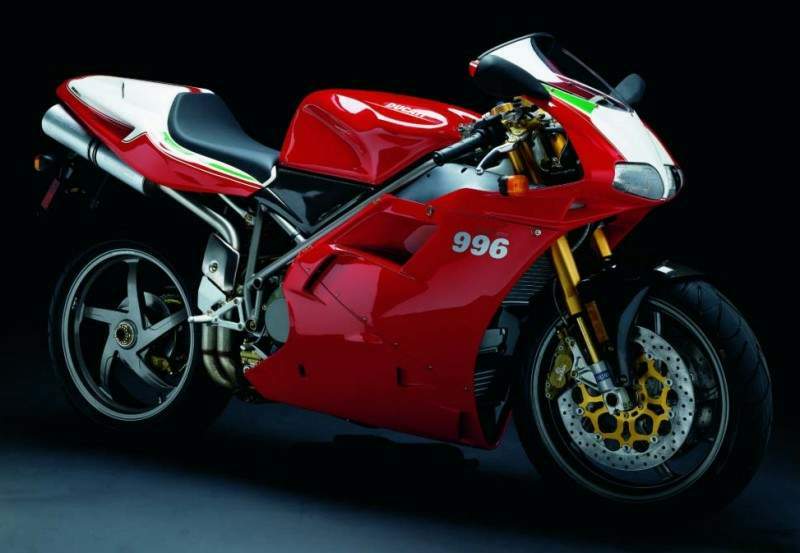
Ducati 996S
the first Ducati Superbike, the 851, was launched in 1987, this bike was followed with the 888, 916, 748 and the 996. The 916 won several worldwide awards including 4 “Motorcycle of the Year” awards from MCN magazine. The 996 replaced the 916 in 1998. An entry into the legend of Italian motorcycling racing, an aggressive, high performance and beautifully designed machines, closely derived from Ducati’s currently competing in the WSB. Aimed at purists who want everything from a bike with its compact design and slim silhouette to provide superior handling at speeds up to 170 mph. Combines advanced thermodynamics of 4-valve per cylinder with unsurpassed efficiency of Desmodromic valve system. By 1998, the 916 was assailed by litre V-twins from several manufacturers, including Suzuki's TL1000R and Aprilia's RSV Mille, both more powerful than the 916. Luckily for Ducati, it had already prepared a larger engine, in the shape of the 996cc engine used in the 916SPS. By the end of 1998, Ducati had released the 996 Biposto, an updated 916 with a 996cc engine. The 996 Biposto engine incorporated some features from the 916 design, and some from the SPS motor, including the pistons and crankcases. Other detail engine modifications included an updated fuel-injection system and more powerful alternator.
The 996 chassis was not dramatically changed from the 916 - there was little wrong with the old bike's handling. Nevertheless, new brakes from Brembo gave even better stopping performance, and other minor chassis modifications refined the handling and cut weight over the 916 by 5kg (1 lib).
On the road, the 996 was much stronger than the 916, although it had less top-end power than the race-tuned 916SPS. And while the Aprilia RSV Mille and Suzuki's TL1000R still offered stronger engine performance, neither offered the mix of styling and track composure to match the Ducati. For 2001, the last year of 996 production, Ducati offered three different versions. The base 996 was similar to the 2000 bike, but with an Öhlins rear shock. A new 996 S was introduced, which had the 92kW (123bhp) 996SPS engine, Öhlins shock and Showa forks. But the most interesting machine was the limited edition 996R, which featured the new Testastretta 'narrow head' engine. Produced to homologate the Testastretta engine for racing, the 996R was a SI7,000 special. Fitted with full Öhlins suspension, carbon-fibre bodywork and the 101kW (135bhp) 998cc Testastretta engine, the 996R was the bike on which Troy Bayliss won his 2001 World Superbike title.
|
|
|
Any corrections or more information on these motorcycles will be kindly appreciated. |