|
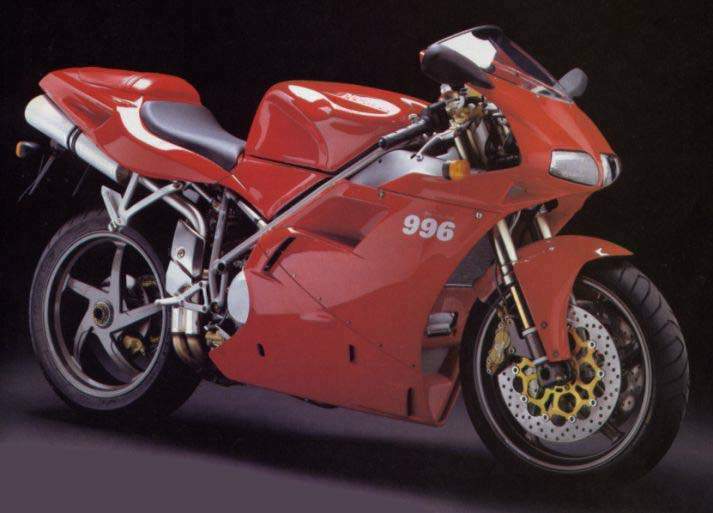
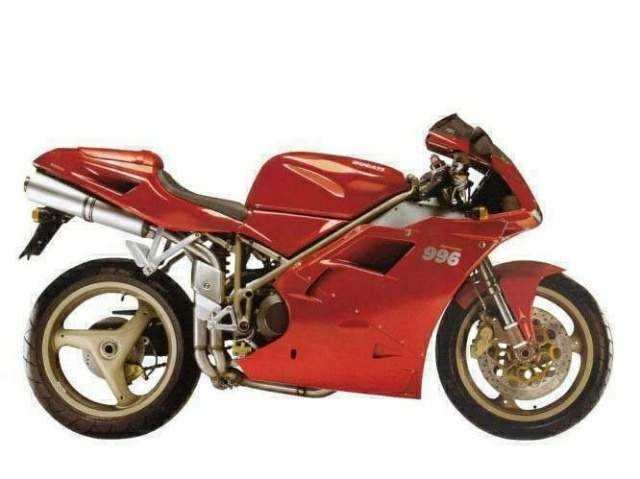
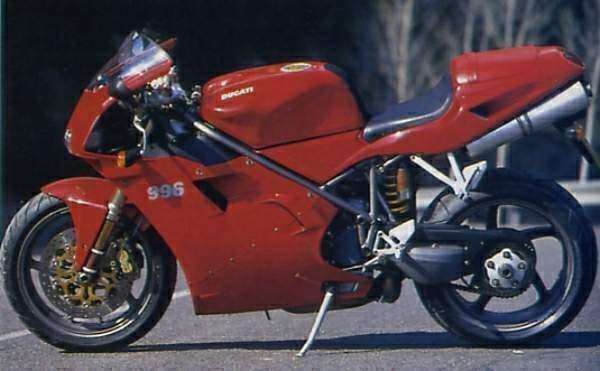
Ducati 996 Biposto

|
Make Model |
Ducati 996 Biposto |
|
Year |
1999 |
|
Engine |
Liquid cooled, four stroke, 90°“L”twin cylinder, DOHC, desmodromic 4 valve
per cylinder. |
|
Capacity |
996 |
|
Bore x Stroke |
98 x 66 mm |
|
Compression Ratio |
9.2:1 |
|
Induction |
Marelli electronic injection |
|
Ignition /
Starting |
- / electric |
|
Max Power |
112 hp 82 kW @ 8500 rpm |
|
Max Torque |
93 Nm 9.5 kg-m @ 8000 rpm |
|
Transmission /
Drive |
6 Speed / chain |
|
Frame |
Steel-tube trellis |
|
Front Suspension |
Showa with TiN upside-down fork fully
adjustable. 127mm front wheel travel |
|
Rear Suspension |
Öhlins progressive cantilever linkage with
adjustable monoshock. 130mm rear wheel travel. |
|
Front Brakes |
2x 320mm discs 4 piston calipers |
|
Rear Brakes |
Single 220 disc 2 piston caliper |
|
Front Tyre |
120/70 ZR17 |
|
Rear Tyre |
190/50 ZR17 |
|
Dry-Weight |
198 kg |
|
Fuel Capacity (res) |
17 litres (4L) |
|
Consumption average |
18.2 km/lit |
|
Standing
¼ Mile |
11.4 sec / 128 mp/h |
|
Top Speed |
162 mp/h |
|
Reviews |
Motocorse /
Motorcycle.com |
|
Manual |
Ducati.com |

Images by heald and friend Well,
it was about damn time.
After six years of watching the svelte, familiar form of Ducati 916/955/996s
storming to victory in races around the world, I finally got the opportunity to
live with one for a couple of weeks.
Of course, I rode a mere street bike instead of race bike. I think. I'd swear
there were lights on the thing, along with a license plate, and the exhaust was
reasonable subdued. Also, I don't recall seeing a numberplate on either the
front or the side, and it was equipped with a sidestand (that thankfully didn't
retract on its own when weight comes off it like previous Ducati moto-props).
But with the possible exception of Suzuki's incredible GSX-R750, there aren't a
lot of bikes out there that are as close to being a full-on Superbike right out
of the crate as the 996. The version I experienced, a 2000 996 Biposto, is what
one would consider the "base" model in that it had a Showa suspension front and
back as opposed to an Öhlins-shock-equipped "S" model (which also has lighter
wheels) or an "SPS" edition which is tricked out even more and ain't
street-legal. But this standard version is still one high-performance Italian
starlet that is built for business, and let's you know from the moment you climb
aboard her.
I've been reading for years about how small the 916/996/748 feels when you sit
on it and I to be honest it didn't seem that way to me at all. I think people
think this because the 996's riding position is so extreme and forward-biased
that you really don't have much motorcycle in front of you; it's all out back.
It's almost as if you're on a ocean liner where the wheelhouse was moved to the
front of the bow (where you're king of the world) as opposed to the usual
position further back.
I'm exaggerating a bit (a first), but there is no question that the ergonomics
of this bike are a tool to help get some of the machine's weight bias up front
where it belongs. Your wrists bear the burden of this forward cant, and the pegs
and seat are quite high which let's you know this is a take-no-prisoners
competition motorcycle.
Because of this, the Biposto is a bike that will make you curse straight
stretches of highway (which isn't necessarily a bad thing). The tall first gear
and limited steering lock also drives home the point that this ain't no city
bike. Paradoxically, the Biposto's glorious 996cc liquid-cooled 90-degree V-twin
is the model of civility in the flat, stop and go world of urban warfare. It
makes smooth, tractable power from as low as 3,000 RPM to just shy of its 10,000
RPM (unindicated) redline.
But enough of this congested roadway crap. Few race tracks resemble your average
turnpike, and therefore the 996 will discipline you physically if you spend to
much time away from the tasty, curvaceous pavement it likes to call home. Once
into the bendy bits, this gorgeous Ducati reveals its mission in life, although
not without showing you a different way of doing things. The extreme riding
position combines with surprisingly slow steering to make the bike feel awkward
at first, but this impression quickly passes once you start learning how to make
these components work for you instead of against you. The fully adjustable Showa
suspension delivers a stiff ride until you get going fast enough to make things
work, and then all is control and composure as you rocket around bumpy corners
and transitions. The top-drawer Brembos do the business on the stopping front,
and while the front four-piston stoppers offer great feel and power the rear is
a trifle woody and tricky to modulate.
And, too, enough of this slowing-down stuff; let's talk motor. As much as I was
impressed with the 996's chassis, it's those big, angry pistons that make this
legendary motorcycle such a moving experience. The two injectors per cylinder
meter out fuel in such a wonderfully controlled way that even though you have
tons of torque and horsepower on tap it's always up to you when (and how) it
gets to the massive 190-series Pirelli Dragon behind you. No wild hits or on/off
nastiness takes place when you roll on the throttle coming out of a corner, and
the complex shock linkage helps keep things stable out back when the power comes
on. Even with all that weight up front it's easy to loft the front tire on
corner exit, and if you land off-center a steering damper is there for you.
Gearing is spot-on with shifting that is smooth and precise, although gear
selection is not as critical as some high-performance machines thanks to the
broad spread of good 'ol Italian grunt.
Overall, it's easy to see how years of development on the track has refined this
beast into such a user-friendly mount on so many levels, and a joyous backroad
companion that reinforces what sporting motorcycles are really all about. Even
the aural part of the equation is exquisite fun; a splendid blend of the desmo
valve train, dry clutch and booming exhaust that gets under your skin in the
best way. Then, there's the whole aesthetics/serviceability/build quality thing.
Even after all these years the 996 is still a striking piece of work, and unique
in the Superbike world with its trellis frame, single-sided swingarm and
desmodromic valve actuation. Getting to things to tweak and service as a snap,
as the bodywork comes off quickly and easily and the seat/tail assembly hinges
at the base of the tank for easy access to things.

Fit and finish is top-notch, right down to the
color-matched pillion seat that is a tad too cramped to really promote taxi
duty.
After spending quality time on Ducati's world-beater in stock form, it's not
hard to see what these things have been so successful and have a legendary
following. This is a very special machine that rewards the rider with joyous
motion every time you assume the position. Uncomfortable? Yes. Very. Worth it?
absolutely. If I had the money, I think I'd have to own one. In fact, if there's
any rich industrialist out there who wants to make sure Ducati's latest (and
possibly final version) of the 916 pedigree gets a good home where it will be
truly appreciated and looked after, I'm here for you.
Which brings us to an interesting question: when will Ducati grace us with a new
platform for their Superbike, anyway? The rumor mill has been churning over this
issue forever, it seems. It's really hard to say. The bike is still doing the
business on the racing front, as long as there's a rider in the saddle who can
deal with its behavior at the limit. For 2001, the 996 tested here gets a
sealed-for-life battery, silver engine and cam-belt covers, and an Öhlins rear
shock for the Biposto (only the Monoposto had one this year). The price will
increase by $300, which, I'm told, is the first real price increase in quite
some time.
And for 2002? As we say around here with nauseating regularity, watch this
space.
ENDS
By bill heald
Superbike Planet
|