HOME   CONTACT  |  TECHNICAL  |  CONVERTER  |  VIDEO  |  LINKS  


Classic Bikes
Custom Bikes
Racing Bikes


AC Schnitzer
AJS
Alfer
Aprilia
Ariel
Arlen Ness
ATK
Bajaj
Bakker
Barigo
Benelli
Beta
Big Bear
BigDog
Bimota
BMS Choppers
BMW
Borile
Boss Hoss
Boxer
Brammo
Britten
BRP Can-am
BSA
Buell
Bultaco
Cagiva
CCM
Confederate
CR&S
Daelim
Deus
Derbi
DP Customs
Drysdale
Ducati
Dunstall
Exile Cycles
Factory Bike
Fischer
Foggy Petronas
GASGAS
Ghezzi Brain
Gilera
Harris
Harley Davidson
HDT
Hesketh
Highland
Honda
HPN
Horex
Husqvarna
Husaberg
Hyosung
Indian
Italjet
Jawa
Kawasaki
KTM
Kymco
Laverda
Lazareth
Lehman Trikes
LIFAN
Magni
Maico
Matchless
Matt Hotch
Megelli
Midual
Mondial
Moto Guzzi
Moto Morini
MotoCzysz
Mr Martini
MTT
Münch
MV Agusta
MZ
NCR
Norton
Oberdan Bezzi
OCC
Paul Jr. Designs
Piaggio
Radical Ducati
Richman
Ridley
Roehr
Roland Sands
Royal Enfield
Rucker
Sachs
Saxon
Sherco
Suzuki
Terra Modena
Titan
TM Racing
Triumph
Victory
Vincent
Viper
VOR
Voxen
Vyrus
Waken
Wrenchmonkees
Wunderlich
Yamaha

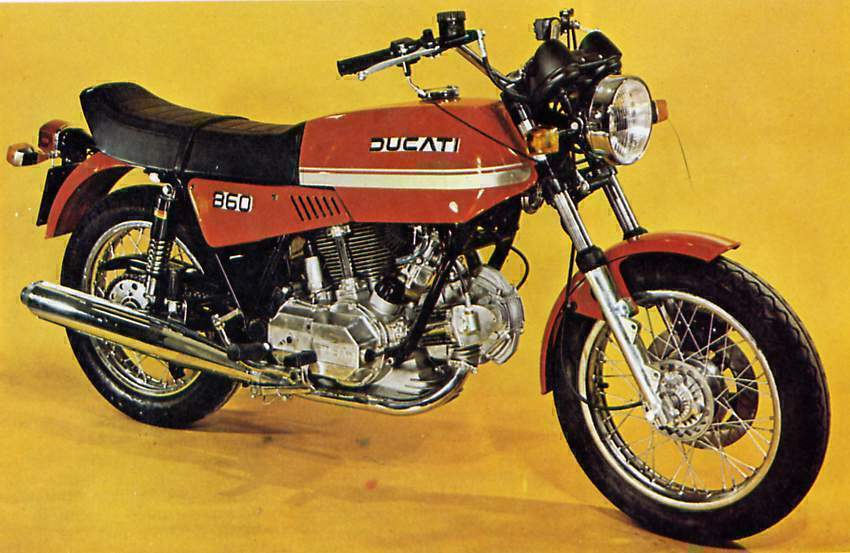
Ducati 860GT


Make Model

Ducati 860GT

Year

1974

Engine

Air cooled, four stroke, 90°“L”twin cylinder, SOHC, 2 valve per cylinder

Capacity

864
Bore x Stroke 86 x 74.4 mm
Compression Ratio 9.0:1

Induction

2x 32mm Dell'Orto PHF carbs

Ignition  /  Starting

-  /  kick (electric starter optional)

Max Power

65 hp 47.4 kW @ 7200 rpm

Max Torque

73 Nm @ 4000 rpm

Transmission  /  Drive

5 Speed  /  chain

Front Suspension

Ceriani  forks

Rear Suspension

Marzocchi dual shocks

Front Brakes

Single 280mm discs 1 piston calipers

Rear Brakes

200mm drum

Front Tyre

3.50 H18

Rear Tyre

4.00 H18
Seat Height 825 mm 32.5 in

Dry-Weight

206 kg

Fuel Capacity 

18 Litres

Standing ¼ Mile  

13.1 sec

Top Speed

107 mph
Manual Bevelheaven.com

It was as the Ducati tipped into a sweeping right-hand curve that it first happened; the slight movement of the handlebars that, sure enough, continued until it was a gentle weave. Nothing serious, you understand, but I was surprised. Plenty of big bikes would have behaved in similar fashion back in the mid-Seventies, but Ducatis had a reputation for high-speed stability second to none.

In fact when looking back through some old magazine tests later, I discovered that the 860GT was criticized for precisely the same thing back in 1975. At least the cause was well known. The bike's tendency to shake its head in fast curves was traced to the high, wide handlebars, which, perhaps surprisingly, were still in place on this clean blue V-twin.

The GT's designer, noted car stylist Giorgetto Giugiaro (creator of the original VW Golf and many others), had combined the new Gran Turismo machine's striking, angular lines with handlebars that not only made sustained high-speed riding uncomfortable, but also created disruptive steering forces that even the Ducati's basically sound chassis could not completely control.

That did not prevent contemporary testers from giving the 860GT an enthusiastic thumbs-up, and concluding that a redesigned riding position was the only thing it needed to become a serious hit. When it was introduced, Ducati's big-bore sports-tourer was the largest-capacity bike the firm had built. And if it didn't match the glamour or sheer speed of the 900SS that would be launched shortly afterward, the GT promised plenty of performance along with considerably more comfort and practicality.

The air-cooled, 864cc V-twin motor was essentially a pair of 450 single top halves on a common crankcase, and shared the single's 86 x 75 mm dimensions. Cylinder angle was 90 degrees, drive to the single overhead camshafts was by bevel gear, and the GT used conventional valve operation. Ducati revealed that peak power was produced at 6900 RPM. No figure was given for the output, which would have been just under 70 BHP at the crankshaft.

Beneath its striking blue bodywork, the Ducati's chassis was a typical Bolognese blend of tubular steel frame and firm Italian-made suspension, with Ceriani forks and Marzocchi shocks. This bike was unrestored and standard apart from its instruments and seat, which were from the following year's 860GTS.

The later seat was slightly thinner, to reduce the GT's seat height. Despite that, the Ducati felt quite tall when I climbed aboard. I quickly became conscious not just of the pulled back bars, but also of the rather forward-set footrests. The right foot-peg made itself felt almost immediately, too, because as the GT had no electric starter (one had been available as an optional extra) I had to kick-start it—and the footrest was perfectly placed to come into contact with my shin.

The pain was forgotten when the big V-twin burst into life with a delightful rustling and rumbling, and proceeded to show just why it was such a superb device for a sports-tourer. Thanks partly to its low state of tune, the engine was very responsive through the midrange, sending the bike trundling rapidly forward every time the throttle was tweaked to open the 32 mm Dell'Orto carbs.

Like modern big Dukes, the V-twin was snatchy below aboL 3000 RPM, but smoothed out from then on. Vibration wasn't problem even up near the 7000 RPM red-line, although the engine felt best between 3500 RPM and about six grand. Generally it was more satisfying to short-shift through the five-speed'box, which was so efficient that I forgave the neutral light's traditional hopelessness.

On a straight road the Ducati rumbled pretty rapidly up to a indicated 90 mph (145 km/h). Although it began to feel slightl; unsteady by that speed, it would have gone on to a top speed just over 110 mph (176 km/h). Those high bars meant you'd have to be strong-necked to hold high speeds for long, howevi and even my steady 80 mph (130 km/h) cruising speed became tiring before long.

That Ducati's tendency to weave at high speed might have t nished its reputation slightly but it was never worrying, and the bike made up for it with its handling the rest of the time. The GT's chassis rigidity and high-quality suspension gave cornering power that few bikes could approach in 1975.

Only the inappropriate and hard-compound Chen Shin tires prevented me from getting carried away and wearing away the footpegs in the corners. At least I didn't have to worry about tr front tire's ability to grip when I used the front brake. The Ducati's single 280 mm (11 in) Brembo disc lacked bite and gav a very wooden feel at the lever. A second disc was available as an extra and would have been well worth having.

Ducati did at least prove that they were willing to listen to cri cism, as the following year the 860GTS was launched with not just a second front disc as standard, but flatter handlebars and i electric starter, too. In many respects the GTS was basically the Gran Turismo machine that the GT should have been all along.

The later model's high-speed stability was excellent (confirming that the original model's problem was simply due to the bars); it was well braked and started effortlessly. Being a Ducati, of course, it still had a few annoying faults, particularly the corrosion-prone paint finish and the switchgear that made it all too easy to plunge yourself into darkness when trying to'operate

Back in the Seventies, Ducati enthusiasts were prepared to put up with that and the high prices because the basic package was generally so sound. And that went for the original 860GT too, even if that high and wide riding position meant the bike didn't quite live up to its high-speed, long-distance potential. The original GT wasn't perfect, but as Ducati's first big sports-tourer, its place in the history books is assured.

Source Superbike of the seventies


NOTE: Some of the photos on Motorcycle Specs are owned by somebody. If you see any of your photos, you can let me know so that I can acknowledge it, or if you object to it, I can remove it altogether. If any copyright holder objects  to their articles being placed on Motorcycle Specs, it will be removed upon request.  Any correction or more info on these bikes will kindly beappreciated                                          Contact Me      Privacy Policy     Website Stats