|
|
|
|
Classic Bikes
Custom Bikes
Individual
Racing Bikes AJP
AJS
Aprilia
Ariel
Avinton / Wakan
Bajaj
Benelli
Beta
Bimota
BMW
Brough Superior
BRP Cam-Am
BSA
Buell / EBR
Bullit
Bultaco
Cagiva
Campagna
CCM
CF Moto
Combat Motors
Derbi
Deus
Ducati
Excelsior
Fantic
GASGAS
Ghezzi Brian
Gilera
GIMA
Harley Davidson
Hero
Highland
Honda
Horex
Husaberg
Husqvarna
Hyosung
Indian
Jawa
Kawasaki
KTM
KYMCO
Laverda
Lazareth
Magni
Maico
Mash
Matchless
Mondial
Moto Guzzi
Moto Morini
MV Agusta
MZ / MuZ
NCR
Norton
NSU
Paton
Peugeot
Piaggio
Revival Cycles
Roland Sands
Royal Enfield
Sachs
Sherco
Sunbeam
Suzuki
SWM
SYM
Triumph
TVS
Ural
Velocette
Vespa
Victory
Vincent
VOR
Voxan
Vyrus
Walt Siegl
Walz
Wrenchmonkees
Wunderlich
XTR / Radical
Yamaha
Zero
Video
Technical
Manufacturer List Contact
|
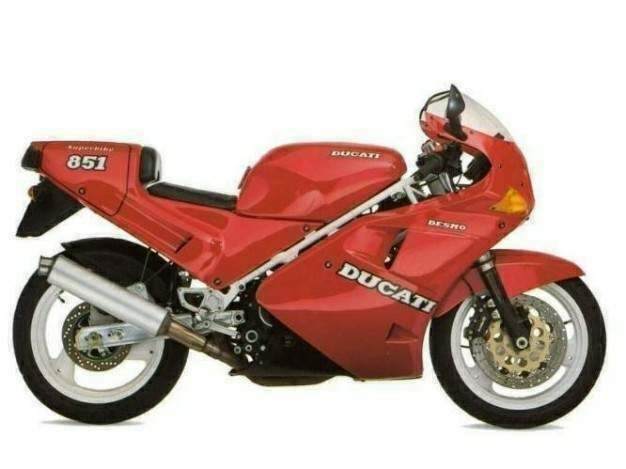
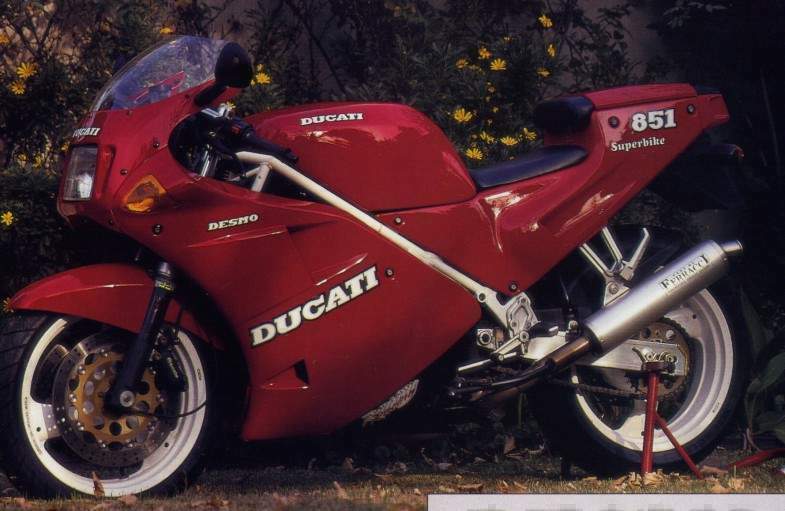
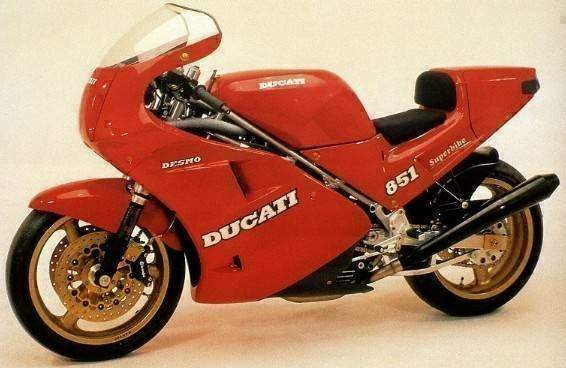
Ducati 851SP
Something weird seems to happen to motorcycle journalists when they test Ducatis they try and become writers. Instead of self-fornicating about 'rear-wheel steering', 'squaring-off turns or braking 'deep' into corners they waste their time trying to convey the EVOcativeness of the Ducati name, explaining the animateness of its hand-built construction or worse, attempting to phoneticise the rasping off-beat of the V-twin exhaust. The good news is that they can only perform this sycophancy once; the bad news is that with the advent of the 888 they'll probably try and combine both styles of literary onanism. The reason for this is simply because the big twin can no longer be considered a cute if largely anachronistic slice of industrial architecture. Rather, Massimo Bordi's latest incarnation of the classic Bologna prescription proves there is plenty of life yet in the most traditional of motorcycle engine configurations and demonstrates beyond all reasonable doubt that the weight-saving advantages inherent in a twin, can more than compensate for the marginal power advantages of a multi. I have to admit that even in the heady days of my youth, I was never a dEVOtee either of twins generally or Ducatis in particular and in common with the current 20-23 year old hardcore biking generation (gotta have something in common with 20-23 year olds) I've always considered Ducati a quaint if rather uninspiring irrelevance. I even managed to dismiss or more accurately, ignore their current domination of World Superbike racing on the grounds that perhaps the formula wasn't really pukka or serious enough, because quite honestly if you haven't ridden either an 888 or one of the race-kitted 851 s, it's difficult to imagine that a twin could ever be competitive with a Jap four.
Well, it's time to eat humble pie, hats or any other item of self-deprecating cuisine because the Ducati can be ridden on the road harder and faster than almost any other motorcycle I can think of and its handling abilities are the least of its virtues. On the track too, it's not the 888's agility per se that's humiliating the opposition, rather it's the devastating torque out of corners and the yards it puts on the multis before they can achieve similar velocity. The Ducati is fast; not fast by European, twin-cylinder, or any other equally idiosyncratic standards; it's fast by any bloody body's standards; incredibly fast, staggeringly fast, outrageously fast. Fast to the point where even road-testers and EXUP owners have to back off the throttle. Fast to the point where the Japanese are now lobbying for a capacity bee they're fed up to the back-teeth of staring up Roche's rectum. How ran this be? I know all you cynical adolescents are pondering. How ran a twin with nothing more innovative than 4-valves per cylinder and a bolt-on injection kit be laying waste to prior Oriental omnipotence? Perhaps only Mr Bordi knows; certainly I was just as disbelieving of his claims of 85bhp at the back wheel for the first 851 back in 1987 and I proved to be looking up my own bottom then too. Well first you gotta understand that the 888 is not the888 anyway, which is
why it's only got 851 still writ large on all the fibre. The 888 might be 888,
but it's not die888 which is reserved exclusively for the hand-assembled,
blue-printed, race-shop prepared Lucchi replicas. The road-going 888 is in fact
the SP2 which, of course. version of the larger engine, so that whilst it does
indeed enjoy the extra capacity, it only has Ducati's important changes have oeen installed to gain the extra I5bhp (at the gearbox) that the 888 boasts over the 1990851 and the most obvious of these is of course the simple 37mm scrape job. But that ain't all; the SP incorporates the longer duration cams of the race-bikes plus larger valves, oil-cooler and an unproved collector box (not to mention the very 'free-flowing' exhaust). The radical, but significant changes which bequeathe the SP a claimed I 15 brake and provide it with an urge which is truly irresistable. If you've been brought up on an exclusive diet of Jap bikes you can barely begin to conceive of what 'true' torque is; it's not the frantic, panic-stricken suddeness of a multi-valve four at six grand, rather it's the un rest rai nab I e, overwhelming and overpowering tide of influence right through the rev-range that simply cannot be resisted. You feel safe and secure in its strength; priviliged and superior in its 'correctness'. This is quite simply how all road motorcycles should develop power and it is equally difficult to conceive just how quick these bikes are out of the turns unless you've ridden one or, of course, watched them disappear up the track in front of you. An open, dry, multi-plate clutch is not an ideal accessory for ten-yard
sprints but with I OSkph on tap before you have to change into second, 0-60
times are quite incredible. The sound of a spin-dryer full of cutlery is
slightly unnerving if you ever do find neutral, but in over lOOOkms I found only
the green light (twice) and the appropriate space in the gearbox once (and that
was only when I got shunted from the rear on Bologna's South circular and my toe
stabbed the fever as I exited over the screen). Try and pop a wheel ie (as of
course, you are obliged to in every Italian High St) and the sound of a
spin-dryer full of cutlery changes subtely to a spin-drying full of cutlery
having been sbmmed into r Power is not so pronounced at 6,500 as it is on the Cagiva Elephant version
of the DFI engine, but it's still about the most exciting phase. At 10.500 the
inherent desmodronic valve limrters cut in and the motor cuts out
(sometimes).-.and after first the ratios become a lot closer, possibly too dose
for a road bike between second and third, which, in turn, is the most
interesting cog in the gearbox at the appropriate six and a half grand. Don't
ask me what actual speeds in gears are. because the pull of the mill, is so
acute, that through the acceler Whichever one of us was support-trucking in our demolition-derby Fiat Tipo he could hear the 888 accelerating away for over two miles—this is one hell of a loud motorcycle. With the 888 within a 50ft proximity, you could not hear the car engine at all or the stereo or anything else for that matter. ami no matter how accustomed we should have become to it. the 888 still provided more shocks than a John Carpenter movie each time it went past. If your idea of fun is splitting a street in two with the sound of your depature, then this is definitely your cycle, though how popuar this 'safety feature' proves in anally-retentive old Blighty remains to be seen. The difference is, of course, that unlike the average unsilenced Jap four, the 888 does not promise that it cannot deliver. Traditional in so many respects, it is untraditional in the way it can be ridden; you don't need to be a purist nan to make it handle because that wild, snarling beast of a motorcycle that the Ducati is in traffic, becomes an utterly mild, cooperative, subordiate pooch on the open road. Do it wrong, and the 888*11 do it right; it is so light on the move that you can enter a corner at any point, on any line, after course and still get round it Virgo Intacto. The 888 exhibits none of the chronic over-steer that plagued the early 851s with their sixteen inch front wheels. Fact is those early bikes were about as far away from the legend of Ducati handling as 3-seriesBMWs are from their self-proclaimed reputation for reliability.
In fact chassis-wise, not much has changed either from those early bikes that'd stop you dead in your tracks. The awful front wheel went in 1989 and the Öhlins 'Upside-Downers' that replaced the original bog Teles have been superceeded yet again by a set of cunningly similar items which, it is claimed were designed by Ducati but which are actually moulded in the and of the Rising Yen. Oddly enough, these are not the awesomely uncompromising items that you might fear, but are actually about as pliant as the standard EXUP front-end and, along with the standard Ohl ins rear, complete the transformation of Italian suspension theory which previously held there was so such thing as too hard a suspension setting. The rear Öhlins unit.now as much a part of Ducati as the engine itself, joins the only part of the superstructure made from box-section, though a further development this year on the 888 is the addition of the rear sub-frame in alloy. But the rest, the simple tubed space-frame, weighing nothing and going nowhere, is all that we've come to love. This particular prescription translates as agility more than anything else; the ability to turn quickly, to rethink without complaint. With a wheelbase of only 1430mm and 69 degrees of head you'd be disappointed if it couldn't turn on its own ass but you don't pay for it in terms of stability. The huge 180 rear rim gives you more girth than you could use and with the super-sticky Michel in radials (the best road tyres I have used, ever) it's almost impossible to kick die back end out. Nor does the front wash-away which makes it the best steering Ducati I have been aboard; light, neutral, deadly. About the onfy aspect of the bike's chassis that I was disappointed with was the brakes; it wouldn't hold a candle to an EXUP going into a turn, but then I suppose it doesn't have to because it would torch it through the turn and on the gas out of it. I am told the 851 generally is a great bike to sell on a test ride. It
doesn't matter what people ride to a Ducati dealership, they can't fail to be i Source Bike 1990
|
|
|
Any corrections or more information on these motorcycles will be kindly appreciated. |