|
|
|
|
Classic Bikes
Custom Bikes
Individual
Racing Bikes AJP
AJS
Aprilia
Ariel
Avinton / Wakan
Bajaj
Benelli
Beta
Bimota
BMW
Brough Superior
BRP Cam-Am
BSA
Buell / EBR
Bullit
Bultaco
Cagiva
Campagna
CCM
CF Moto
Combat Motors
Derbi
Deus
Ducati
Excelsior
Fantic
GASGAS
Ghezzi Brian
Gilera
GIMA
Harley Davidson
Hero
Highland
Honda
Horex
Husaberg
Husqvarna
Hyosung
Indian
Jawa
Kawasaki
KTM
KYMCO
Laverda
Lazareth
Magni
Maico
Mash
Matchless
Mondial
Moto Guzzi
Moto Morini
MV Agusta
MZ / MuZ
NCR
Norton
NSU
Paton
Peugeot
Piaggio
Revival Cycles
Roland Sands
Royal Enfield
Sachs
Sherco
Sunbeam
Suzuki
SWM
SYM
Triumph
TVS
Ural
Velocette
Vespa
Victory
Vincent
VOR
Voxan
Vyrus
Walt Siegl
Walz
Wrenchmonkees
Wunderlich
XTR / Radical
Yamaha
Zero
Video
Technical
Manufacturer List Contact
|
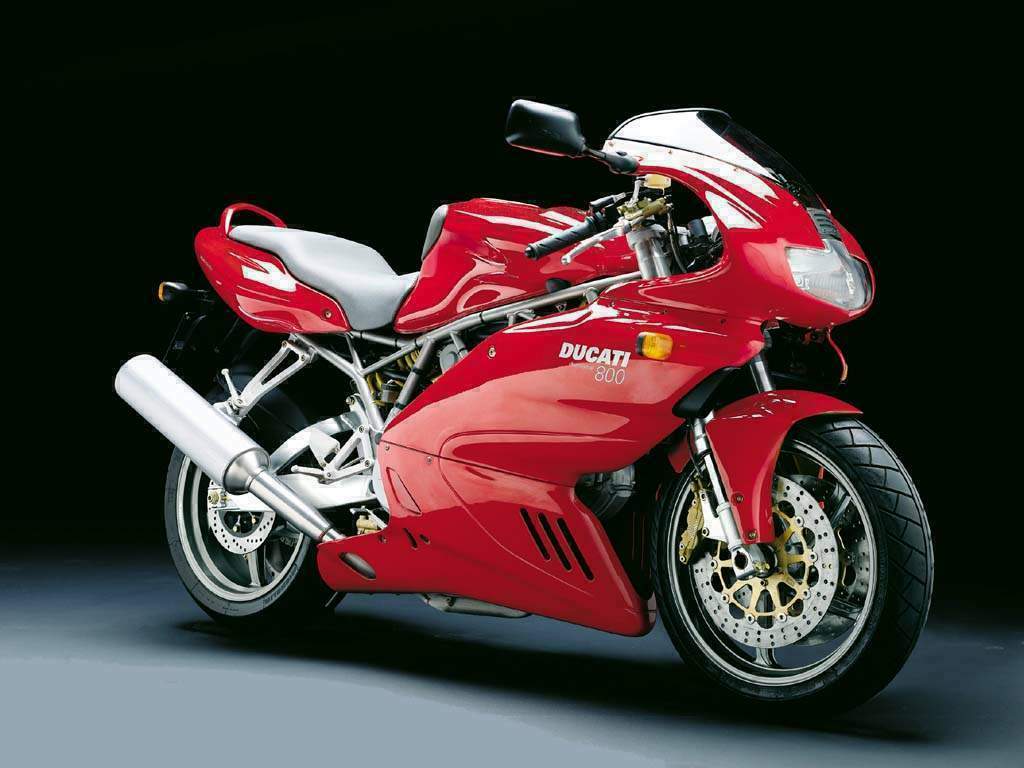
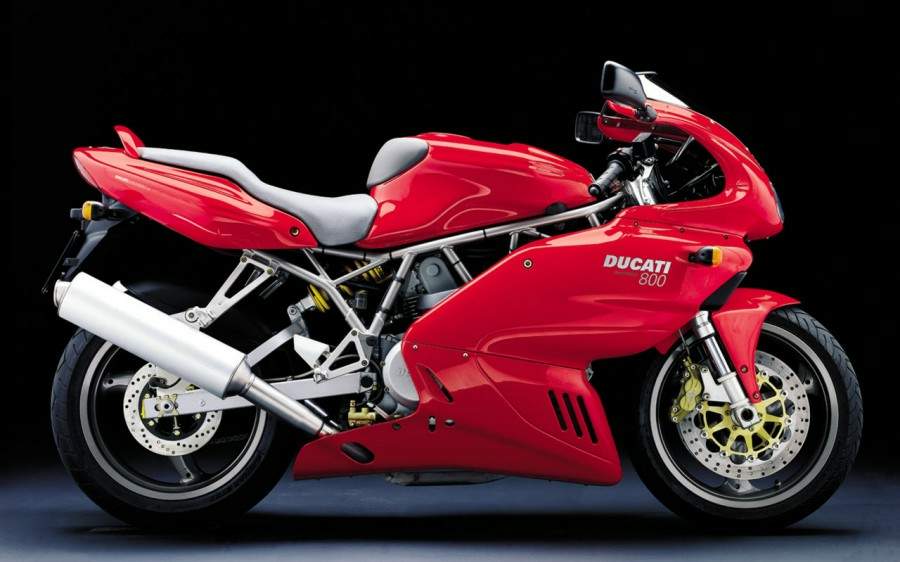
Ducati 800SS
Take a good A or B road and a relatively low powered but good handling motorcycle for today's standards, and you can have some fun. Do the same thing on a Ducati and it will be a great experience. The new fuel-injected Desmo L-Twin engine, and the new six-speed gearbox fitted to the latest Supersport 800 seem to make a huge difference when it comes to riding on ordinary roads. The bike is sharp, it feels planted to the ground and almost nothing will deviate this bike from getting round any corner you care to throw at it. The two-valve per cylinder engine fitted to the 800 has reasonable bottom and mid-range performance (74.5 HP @ 8250 rpm) but it does suffer a lack of a top end urge. Shifting at anything over 8,000rpm is almost wasting your time as you are well out of the torque curve by then (70 Nm - 7,1 Kgm @ 6250 rpm) so short shifting is the way to make good progress with this bike. If you are a power fiend then this bike will not suit you in the slightest, any reasonable Japanese 4cyl sportsbike of 600cc or above would comprehensively blow its doors off when acceleration enters the equation. But it must be said that on a tight set of twisting roads the bottom end of the Ducati will allow you to stay with most bikes. In this situation less experienced riders may well be better on the 800 than they would on something like a Japanese 600. The Ducati would probably also improve the skills of many riders, as to get the best out of it you have to ride well and concentrate on being smooth and flowing rather than the more frantic riding style that the small Japanese fours lean towards. The engine does make good bottom end power but the vibes that shudder through the bike when trying to use the bottom end pretty much render it as a pointless exercise. When trying to pull from 2,500 or 3,000rpm there's a lot of vibration going through, some people refer to this as character.... The 800ss is available in half fairing or full fairing versions which are otherwise technically identical. The full fairing model accentuates the aggressive lines of the Supersport while the half fairing exposes the rather impressive Desmodue L-Twin engine. Like the latest 1000, it features an aluminium swingarm and a new advanced alloy clutch basket and discs, which is a great improvement over the previous models. Front forks are Marzocchi 43 mm upside-down units and the fully adjustable Boge shock, delivers fairly precise and stable handling on most rides. The signature Trellis frame chassis is very taut and reasonably hard sprung, with most road irregularities making themselves felt, sometimes a little too harshly. On smoother roads the stiff suspension is a big plus but when any bumps enter the equation a rider will feel every one of them. A lot of weight is placed on the wrists and hands and this discomfort is compounded by the hard suspension. Pillion accommodation is typical for a sportsbike, which is of course uncomfortable but no worse than most other sportsbikes. It seems a lot of thought has been put into the design of the seat, which is well padded and excellently shaped, but the harsh ride makes it work hard. With some suspension work adjusting pre-load and rebound we did manage to make it a lot better so it became a far more enjoyable ride on ordinary roads. It was a lot more comfortable to sit on for a long time but the wrists still took the brunt of the weight over time. We had the opportunity to take the 800 up to Cadwell Park as a second bike on a track day, needless to say it was indeed put through its paces and we actually had quite a good time with it giving some other larger bikes a real run for their money.
Braking is good but requires a little more effort through the lever than most Japanese set-ups. This is not always a trait of the Brembo braking systems, they work well, it's just that a harder squeeze is needed to pull the bike up quick on this particular model. When taking this into account the brakes work very well indeed with plenty of power and good feedback. The dash layout seems, and is, somewhat old fashioned by today's standards but apart from a bit of shaking about under vibration it wasn't a problem. You only get a tripmeter, speedo, tacho, temp gauge. Warning lights for neutral, oil, side stand, high beam, indicator and fuel. The quality of all the new Ducati's is generally excellent nowadays, gone are those 'I can't take it out in the rain' moments as I can honestly say that the Ducati's red bodywork has to have the best paint finish seen on any motorcycle. I had luggage strapped to the Ducati for a few trips and I noticed that even after a long time on there, and removal, the full surface lustre survived which is quite amazing. Many any other bikes paint finishes would have either rubbed through or at least have completely lost all their shine, but the Ducati was unmarked. Yes, the Ducati will stay looking good for many years and should give good service. The Ducati 800 Supersport is a bike for people who just don't want, or think they need a lot of power. Maybe it's a good choice for someone just stepping up to the big-bore class and at a reasonably competitive price, but most of all it's a bike that will improve your riding skills. As I said before you need to be smooth and precise with this bike, for this it will reward you immensely. Play with the suspension to soften it up a bit and it all becomes clear as to just what this bike can do. Suddenly it is transformed on minor roads and this bumps and ridges are nearly meaningless, just wear some wrist supports and you will be fine! The 800 is a bike that will cost you a bit more in servicing than it's Japanese counterparts, but It has the street cred, the name and the looks. It's a sportsbike where keeping your licence does not have to be a constant battle. Source Road test by Adrian Percival
|
|
|
Any corrections or more information on these motorcycles will be kindly appreciated. |