|
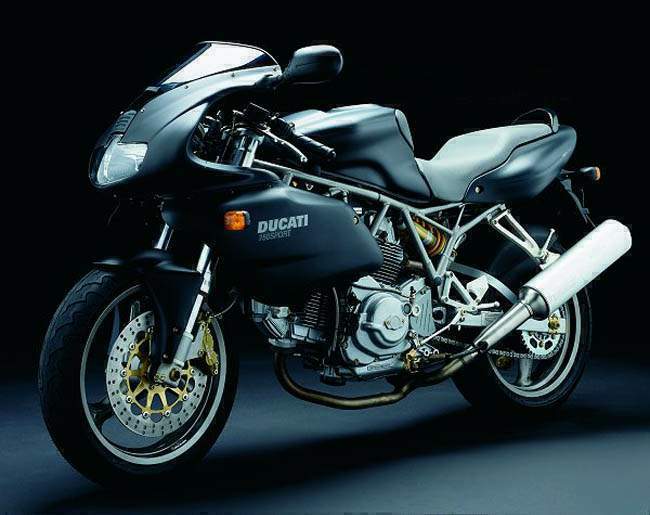
Ducati 750 Sport ie

|
Make Model |
Ducati 750 Sport ie |
|
Year |
2001 |
|
Engine |
Air cooled, four
stroke, 90°“L” twin cylinder, SOHC desmodromic 2 valve per cylinder, |
|
Capacity |
748 |
|
Bore x Stroke |
88 x 61.5 mm |
|
Compression Ratio |
9.0:1 |
|
Induction |
|
|
Ignition /
Starting |
- / electric |
|
Max Power |
47 KW 64 CV @ 8250 rpm |
|
Max Torque |
6.1 Kg-m @ 6000 rpm |
|
Transmission /
Drive |
5 Speed / cahin |
|
Front Suspension |
43mm Forcella forks, 120mm wheel travel |
|
Rear Suspension |
Cantilever with monoshock SACHS. 136mm wheel
travel |
|
Front Brakes |
Single 320mm disc 4 piston caliper |
|
Rear Brakes |
Single 245mm disc 2 piston caliper |
|
Front Tyre |
120/70 ZR17 |
|
Rear Tyre |
160/60 ZR17 |
|
Seat Height |
815 mm |
|
Dry-Weight / |
181 kg |
|
Fuel Capacity |
16 Litres |
|
Reviews |
Motocorse |
Heritage dates back to
1972 at the first Imola 200 mile race and the triumph of the Ducati 750s of
Smart and Spaggiari. This victory inspired the creation
of 750 SS, which was first launched in 1973. SS have
been among the Company’s most popular and best selling for over 2 decades.
Exemplifies the Ducati spirit and its legendary roots in contemporary
motorcycling and during this time the SS family has undergone a series of
design and technical updates while retaining its essential characteristics.
The new Ducati SS bikes aim to reassert their pure sports commitment
but remain easy and enjoyable, unbeatable on mixed terrain, accessible, and
unique in their combination of traditional motorcycling qualities.
SuperSport segment maintains the heritage of Ducati and is aimed at
riders that prefer improved handling and smooth power delivery to maximum
HP. Characterized by lightweight, superior handling, and
tight cornering ability, easy to tame by someone getting on a sports-bike
for the first time.
Updates for 2001:
-
New model worldwide
-
Smaller, lighter, sealed-for-life battery
-
Half fairing only
-
Gray seat & tank protector
-
Lateral tank protector removed
-
Single front brake disc
-
43mm non adjustable Marzocchi forks
-
Steel clip-ons
-
Intergrated reservoir brake & clutch master cylinders
-
Fairing with out air intakes
Review
The Ducati 750 Sport is the marque's foray into the entry-level sportsbike sector. Mark Fattore delivers the
verdict
If there's one sure way of opening up new markets for a good or service it's via
brand extension - at an introductory price you just can't dismiss out of hand.
And that's exactly what the boffins at Ducati are on about with the release of
the matt black-only 750 Sport, the marque's half-faired sportsbike - and down-spec'd
version of the popular 750SS. A Mac Oz of the motorcycle world if you like.
But don't think the Sport - which was unveiled at the Munich Show last September
- is a marketing test case, as Ducati has already hit the high mark with the 600
Dark, a cheaper variant to the established M600 Monster. If you're on a roll,
keep all guns blazing...
WHEN THE GOING GETS TOUGH
I'll have to admit from the outset that the Sport just gets over the line in my
books - that's not a rejection of what Ducati is trying to achieve with it's
$11,995, no-frills price tag, but rather a critique of the issues at hand. And
the issues include a front brake which easily throws in the towel when the going
gets tough; and a five-speed gearbox which is not all that well mated to the
air-cooled, two-valve engine.
The 748cc fuel-injected, metallic silver powerplant pumps out a claimed 64ps at
8250rpm and torque of 6.1kg-m at 6000rpm. Those figures alone are not serious
warning bells, but when the wide-ratio gearbox (the 750SS has a six-speed
gearbox) is brought into the equation, it really does upset the balance.
The missing ratio is very obvious around town, with the gap between second and
third gear quite wide. That means you are constantly shuffling between the two
gears - second is a touch too low and third too high. No problem with commuting
in second with the Sport hustling along at 5500rpm, but in third you're always
on the verge of catching a bad dose of transmission snatch, which starts to
become an issue at around 3800rpm and below.
A rethink of the ratios is required, and maybe adding a tooth or two to the rear
sprocket to lower the final gearing.
Despite the below-par ratios (the gearbox itself is quite slick), the Sport's
90-degree V-twin engine does an admirable job of building revs. The power
delivery on the 183kg machine is quite linear all the way through to the 9000rpm
rev-limiter, although you'll be wasting your time by progressing that far - its
most productive work is well and truly over. All the while, it emits a decent
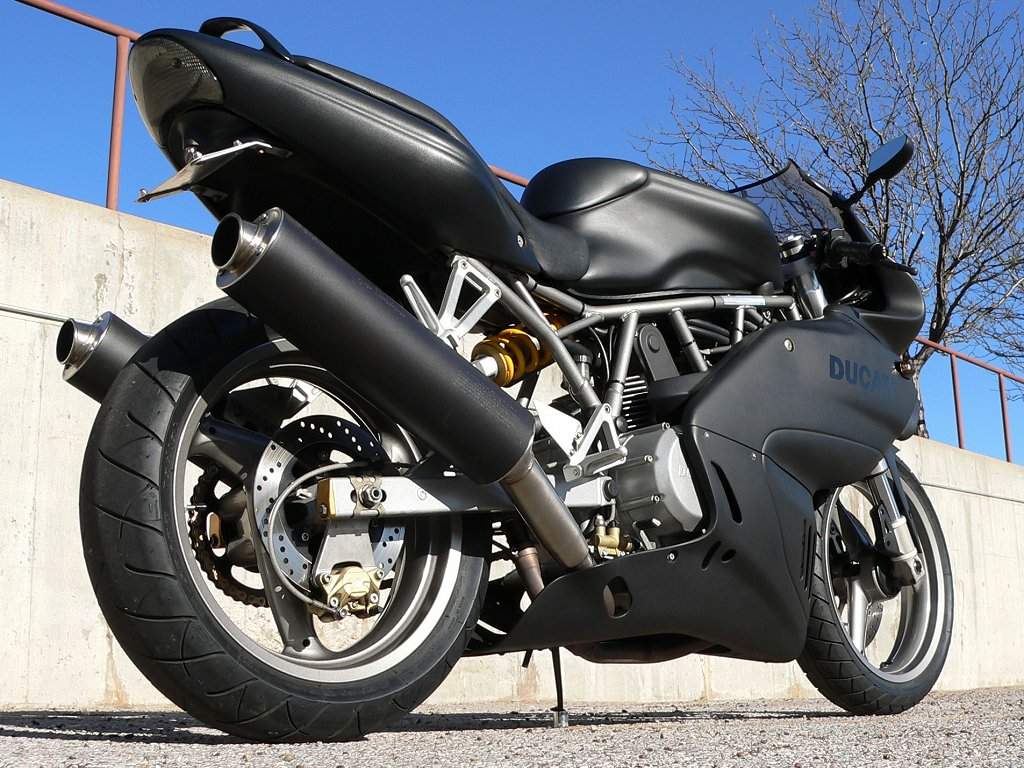
rumble from the two-into-two exhaust.
The Sport hums along at 4000rpm in top gear at 100kmh - if you followed that
sort of behaviour for any length of time, fuel consumption would easily top the
20km/lt mark, which would see a servo stop around everyone 300km or so. The
Sport has a 16lt tank.
IMMEDIATE RECOVERY
As for the earlier assessment on the Sport's brakes, the 'throw in the towel'
critique was particularly felt during a commute to work one morning when I was
diverted from my usual route because of an accident. After filing through the
middle of traffic on a trailing brake for only a few minutes, there was
immediate brake fade from the single disc setup, which frankly was a bit
unnerving considering its hitherto tame use.
I suppose the oppressive 40-degree conditions Melbourne has been experiencing
didn't help the cause either. However, lay idle for a few moments and there's
immediate recovery. But why not just double up on front discs to remove this
fade factor altogether.
The rear also lacks feel and bite. Just to complicate matters, the rear brake
lever is mounted way too low, which means that you have to make a conscious
effort to pivot your foot to apply pressure on the lever.
The Sport is fitted with a Brembo twin-piston caliper at the pointy end, married
to a 320mm floating disc. On the rear it's more of the same, only there's a
245mm disc on duty.
While the braking is definitely not the Sport's calling card, it really is still
a nice sportsbike to punt around - even considering some of the hardware at its
disposal. For example, there's no adjustment available on the upside-down 43mm
forks, leaving a lot of the front-end burden on the OEM Bridgestone Battlax BT57
hoop.
However, the standard settings are good and there's ample feedback from the
front - although the wrists bear a lot of the weight burden in achieving this.
Actually, there's quite a long reach to the bars on the 750 Sport, which means
you adopt quite an aggressive riding position.
The rear suspension is a cantilever link-less design, with a Sachs shock
absorber. Unlike the front-end, the rear is fully adjustable for preload,
rebound and compression. The response from this end of town is also acceptable,
although some consistent, hard riding soon tested the damping capabilities. I'm
not a big fan of the 'budget' Sachs shock, with Aprilia's first-model RSV1000
also suffering fade from its Sachs unit (it was up-spec'd for the next model
RSV).
A 160-section Battlax radial tyre is also standard fare on the back, different
to the European models which are Dunlop-shod.
ACTIVE INTEREST
Irrespective of the quality of the running gear, anecdotal evidence suggests the
black matt Sport is a visual winner - and I would have to agree. You know you're
on a winner when the IT guru from upstairs takes an active interest in the
machine's welfare, even to the point of being taken aback when you tell them
it's only Ducati's entry-level sportsbike. "But it looks so fast..."
There are two versions of the 750 Sport: the half-faired and full-faired,
although only the former is available in Australia. Personally, I'm a supporter
of the half-faired, as I believe it's in keeping with the bike's more relaxed
ethos.
Pillions are well accommodated on the Sport, with a rear grab rail and well
located pegs. As for the sidestand, it's quite flimsy, which makes it difficult
to park the thing on less than ideal terra firma.
The second shipment of 750 Sports has just arrived in Australia, still at the
same $11,995 price. As first base in the Ducati sportsbike tree, the Sport is
great value for money and a hoot to punt around, but whether that's enough to
make it a sales success is another thing - even for a rider looking to make
their first foray into the knee down market....Mark Fattore.
Source
Bikepoint
|