|
|
|
|
Classic Bikes
Custom Bikes
Individual
Racing Bikes AJP
AJS
Aprilia
Ariel
Avinton / Wakan
Bajaj
Benelli
Beta
Bimota
BMW
Brough Superior
BRP Cam-Am
BSA
Buell / EBR
Bullit
Bultaco
Cagiva
Campagna
CCM
CF Moto
Combat Motors
Derbi
Deus
Ducati
Excelsior
Fantic
GASGAS
Ghezzi Brian
Gilera
GIMA
Harley Davidson
Hero
Highland
Honda
Horex
Husaberg
Husqvarna
Hyosung
Indian
Jawa
Kawasaki
KTM
KYMCO
Laverda
Lazareth
Magni
Maico
Mash
Matchless
Mondial
Moto Guzzi
Moto Morini
MV Agusta
MZ / MuZ
NCR
Norton
NSU
Paton
Peugeot
Piaggio
Revival Cycles
Roland Sands
Royal Enfield
Sachs
Sherco
Sunbeam
Suzuki
SWM
SYM
Triumph
TVS
Ural
Velocette
Vespa
Victory
Vincent
VOR
Voxan
Vyrus
Walt Siegl
Walz
Wrenchmonkees
Wunderlich
XTR / Radical
Yamaha
Zero
Video
Technical
Manufacturer List Contact
|
Ducati 750 Sport
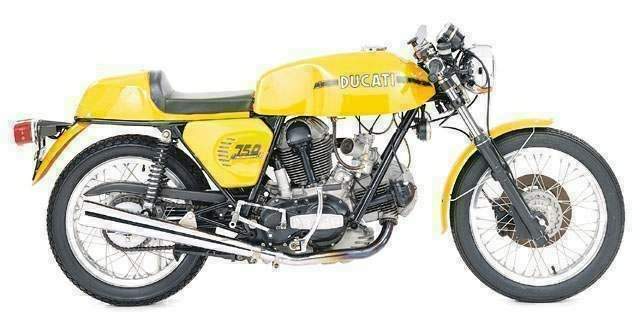
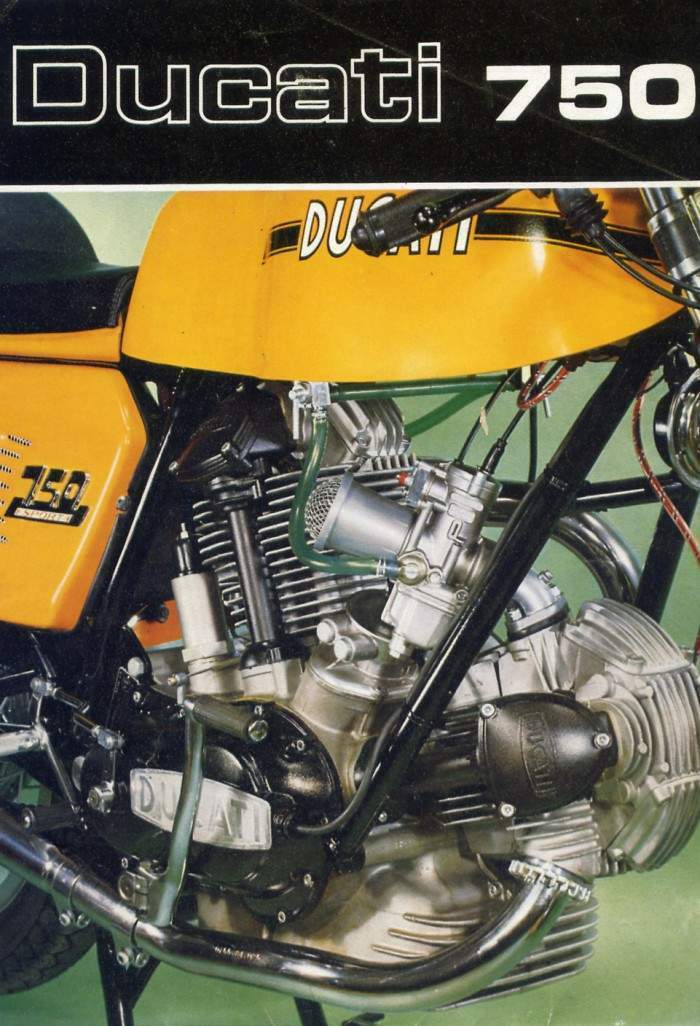
Without the traffic it would be a brilliant biking route. The road snakes and dips through the countryside, a narrow two-lane ribbon whose many bends offer a challenging variety of angles, cambers, and speeds. It's Ducati Country, to quote the famous advertising phrase except that today there are far too many trucks, each one droning slowly along at the head of a long line of cars. But it's still a great ride on the 750 Sport, which dispatches the traffic almost as though it wasn't there. Every time I catch up to a line of vehicles, the slim Ducati zips past, barely needing to use the opposite side of the road as it picks them off one by one. The bike's stability is impressive, its instant reaction to an occasional touch of brake reassuring, and its effortless acceleration hugely satisfying. The 750 Sport's pace and efficiency on that busy road came as some surprise, because early Ducati V-twins are normally revered more for their speed through fast curves than their ability to cut through traffic. Although this Sport's handling didn't disappoint, it was the motor's flexibility that made even more of a lasting impression. This bike's V-twin engine is not a desmo, either. Back in 1973, Ducati had yet to introduce desmodromic valve gear for roadsters. But the Sport, whose single overhead cams operate valves closed by conventional coil springs, is an important model in Ducati history. Lean, aggressive, and functional, the 750 was the Bologna factory's first true sporting V-twin. Essentially the 750 Sport was a racier version of the 750GT, Ducati's first big V-twin, which had been introduced two years earlier by the firm then best known for elegant singles. Engineer Fabio Taglioni's design established the 90-degree air-cooled layout, with dimensions of 80 x 74.4 mm giving a capacity of 748cc. The GT's peak output of 50 hp was raised to 56 hp at 8200 rpm for the Sport, by a higher 9:1 compression ratio, plus larger 32 mm Dell'Orto carburetors that were filterless apart from wire mesh over the end of each bellmouth. The Sport's basic chassis components were also shared with the GT, including the steel frame that was a larger version of the trellis designed for Ducati's 500cc V-twin racers by British specialist Colin Seeley. Marzocchi supplied leading-axle forks and rear shocks; braking was handled by a single 280 mm (11 in) front disc, with a single-leading-shoe drum at the rear. Where the Sport chassis differed was in its clip-on .handlebars, rear-set footpegs and singly seat, plus a half-fairing in some markets. The Sport's other most obvious difference was its yellow tank and side panels, in contrast to the restrained red and black of the GT. This bike just looks right, its bold paintwork complementing the heavily finned motor and slender Conti pipes. There's no starter motor, no indicators, no excess weight. That's great once you're moving, although the high-compression motor needs a hefty kick before it will roar into life. The bars are low and well forward, but the footpegs are not radically rear-set, giving a rather hunched riding position that leaves knees and elbows in close proximity. The clutch is light; first gear goes in with a gentle, right-footed nudge on the one-up, four-down gearbox. And then the Sport is accelerating away, its midrange torque and light weight doing much to compensate for the lack of outright horsepower. My first impression of the engine was of how tractable and eager it was. Throttle response was excellent at virtually any speed, a crack of the right wrist prompting the Dell'Ortos' accelerator pumps to deliver a dollop of straight juice that sent the Ducati barreling forward. The gears snicked in easily, and the 750's flexibility meant that on a fairly fast road there was rarely any need to come down more than one ratio for all but the tightest of bends. Some vibration came drumming through the bars and seat from about 70 mph (113 km/h), giving a reminder that the sparsely padded Sport was too single-minded to be comfortable on long runs. Even so, the 750 cruised with a fairly unstressed and long-legged feel. Revved harder, it would produce useful power to the 8000 rpm red zone, with a top speed of about 125 mph (200 km/h) - good enough to show a clean pair of Contis to most bike in 1973. That was especially true when a few bends were added, for i1 was then that the Ducati's lightness and chassis quality showed their worth. Aided by braided hose, this bike's cast-iron single di: and Lockheed caliper hauled the Sport up efficiently—hard enou that I didn't feel the need for the second disc that was originally optional extra. And although the Marzocchis at either end didn't provide mu comfort, the suspension and frame coped well with hard corneri With the V-twin's lengthy 1500 mm (59 in) wheelbase and a 19-inch front wheel, the Sport was never going to be particularly agile but it could be made to change direction precisely and even quickly, a firm nudge on the narroVv clip-ons. i bumpy roads, the Sport bounced around a bit as the stiff rrudely damped units failed to react fast enough. But this ; Dunlop TT100s gave plenty of grip, Ground Clearance was rous, and it was easy to imagine how a hard-charging Ducati' could have embarrassed riders of more powerful bikes, espite this and the publicity boost from Paul Smart's famous in the Imola 200 race in April 1972, the expensive and impractical Sport was not a huge success for Ducati. Production halted at the end of 1974, after a few specification changes, including new forks and switchgear. A year later the Sport was softened with a dual seat and pillion footrests in a belated attempted to attract a wider audience. Partly because of its comparative rarity, the 750 Sport is now a /desirable model—and why not, indeed? With its classical lines, geous sound, exhilarating performance, and purposeful charac-the aptly named Sport was the model that heralded a string of V-twins from Ducati. Source Superbike of the seventies
|
|
|
Any corrections or more information on these motorcycles will be kindly appreciated. |