|
|
|
|
Classic Bikes
Custom Bikes
Individual
Racing Bikes AJP
AJS
Aprilia
Ariel
Avinton / Wakan
Bajaj
Benelli
Beta
Bimota
BMW
Brough Superior
BRP Cam-Am
BSA
Buell / EBR
Bultaco
Cagiva
Campagna
CCM
CF Moto
Combat Motors
Derbi
Deus
Ducati
Excelsior
GASGAS
Ghezzi Brian
Gilera
GIMA
Harley Davidson
Hero
Highland
Honda
Horex
Husaberg
Husqvarna
Hyosung
Indian
Jawa
Kawasaki
KTM
KYMCO
Laverda
Lazareth
Magni
Maico
Mash
Matchless
Mondial
Moto Guzzi
Moto Morini
MV Agusta
MZ / MuZ
NCR
Norton
NSU
Paton
Peugeot
Piaggio
Revival Cycles
Roland Sands
Royal Enfield
Sachs
Sherco
Sunbeam
Suzuki
SWM
SYM
Triumph
TVS
Ural
Velocette
Vespa
Victory
Vincent
VOR
Voxan
Vyrus
Walt Siegl
Walz
Wrenchmonkees
Wunderlich
XTR / Radical
Yamaha
Zero
Video
Technical
Complete Manufacturer List
|
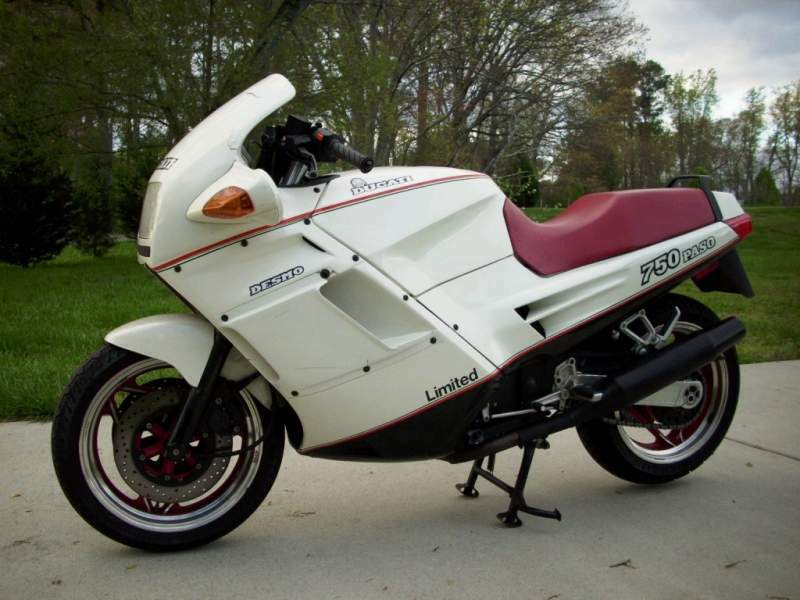
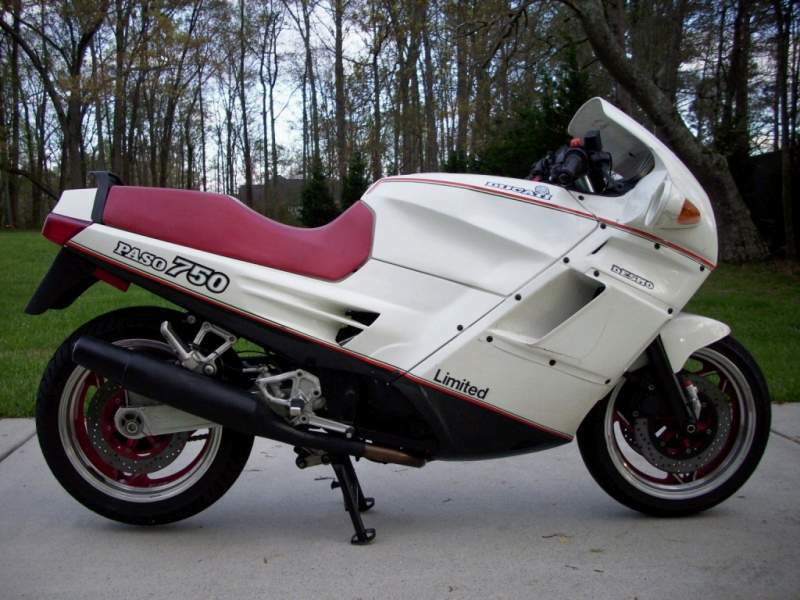
Ducati 750 Paso Limited
The Ducati 90-degree V-twin we've come to know and love and have watched win Daytona has a new twist; it's called a Weber. But if you remember the October test report on the prototype Paso, you know there was more than red paint to attract us. After all, Honda Rebels come in red but don't affect us the same way. Would the production Paso retain the streetabil-ity of the prototype? With bursting lungs we climbed aboard the Paso that Cagiva North America delivered to our office on a brilliant winter afternoon. The Paso comes in black or red; guess which color we requested. The full bodywork gives the impression of a carved piece of wood or bubble of blown glass with its smooth, compact shape. The bike appears low and squat, and that feeling stays with you when you're planted in the long, red saddle. The reach to the buffed aluminum handlebars isn't the long stretch to the Ducati F-1's low clip-ons, and combined with the rearward but civilly low foot-pegs, the riding position is unquestionably comfortable, a la RG500 Gamma. The wind flowing over the solid fiberglass windscreen area helps prop the rider in position and hits him high on the chest. The production version has a slightly more curved screen area that tallies even more style points than the prototype. We say "windscreen area" because it is solid painted fiberglass, a direct extension of the bodywork, not a transparent plastic windshield. Missing from the prototype, but necessary in the modern world, were mirrors and turn signals. Where do you graft signals and mirrors on bodywork this exquisite? Ducati cut the problem in half by making the front signals and mirrors one and the same. The turn signal/mirror pods snap onto the lower section of the fairing uppers, much like on the BMW K100RS. This places the mirrors quite low, even lower than the handlebars, and adjusting to the new mirror position takes a few blocks. In the four-inch, round mirrors the rider sees a little bit of his leg, and beyond that, the road and any cars on it in surprising clarity. Our testers noted that to use the low mirrors, the rider had to take his eyes off the road for a little longer than was comfortable, and direct rearward viewing necessitated a slight change of rider position. The Ducati stylists and test riders each achieved victory; the mirrors fit the Paso perfectly and work better than mirrors on several current Japanese sport bikes, notably the FZ600 and Ninja series. The rear turn signals will be revised to American specifications on the Pasos delivered to dealers because they are now too close together to suit our Department of Transportation. Look for the flush-mounted rear shiners to be replaced by uglier, but legal, stalk signals. The details of the Paso add a great deal to the whole package. For instance, the switches are the best yet on an Italian bike. The turn signal is push-to-cancel, something Kawasaki can't seem to provide on its sport bikes, and the lights, starter and on/off switch are functionally straightforward. Our early production model was rushed to the U.S. with the European high-beam flasher switch still in place; later models will have the same excellent switch gear, minus the passing switch. While the initial impression of the Paso is awe-inspiring, a pretty face won't sustain a motorcycle. What exactly is behind the Paso's pretty face, and does it sustain this motorcycle? Close inspection of both the details and the main components gives us the answer: functionally as well as aesthetically, the Paso can look any sport bike in the headlight without flinching. For a first-year bike, the Paso has amazingly few rough edges. The Ducati 90-degree V-twin we've come to know and love and have watched win Daytona has a new twist, and it's called a Weber. The twin Dell'Or-tos are gone, the rear cylinder head has been spun around 180 degrees and a dual-throat Weber carburetor plonked down in the V. Gone with the Dell'Ortos is the stiff throttle pull no rider will miss, and other than a slight lean stumble just off idle, the carburetion is glitchless and our forearms are now crampless—a wonderful trade. Another Weber benefit is its simple and infinite adjustability; Weber hasn't remained in the carb business for decades because of dumb luck.
The frame engulfs the engine. From the steering stem, a cradle of two rectangular steel frame tubes drops down and under the engine, meeting with a second set of rails that span the gap from the steering stem to the swingarm axle in the straightest path possible. Both these rectangular sections brace the bottom of the steering stem and a third member extends from the top of the steering stem to halfway down the top frame rail. For the seat and tail-section support, smaller rectangular steel frame members are welded on the main unit, forming triangles from the main frame to the rear of the bike. None of this is particularly lightweight or cutting-edge technology, but the welds are neat, the frame rigid and successful. A frame is successful if it doesn't flex under hard sport riding. The Paso frame doesn't flex detectably. We spent a lot of time making sure. Welded to the frame are all manner of brackets. Brackets to hold the coils, the electric fuel pump and the small sub-frame reaching ahead of the steering stem that supports the wide headlight and gauges. Under the prototype's bodywork, the brackets, fittings and hoses looked rough, a few didn't work well and a few were missing. All that has been corrected on the production version, and the details have been developed to improve the Paso's underbody function and looks. The dual oil coolers now slide into the fairing lowers on beds of dense foam rather than rely on the rubber straps of the prototype; details such as the oil hoses and thermostat wiring on the right cooler have been updated. The word details keeps appearing in this test. From the quality of the bar switches to the finish of the welds and tabs, the Paso sets new detailing standards for Ducati. The Cagiva buyout of Ducati has brought updated quality standards. This motorcycle was almost titled the Cagiva Paso until Cagiva's president, Gianfranco Castiglioni, had a change of heart and decided to use the Ducati name. If you've been noticing Cagiva's products over the past two years, you know the company is serious about making motorcycles that compete head on with current (read Japanese) bikes. The Paso is one more big step in that direction. A few items on the Paso need a little work, however. The bright red seat on our bike matches the Paso's paint well but doesn't fit flush with the tailpiece there's a half-inch gap when the seat is locked in place. In direct sunlight a few of the dash lights are unreadable, such as the turn-signal indicator. At night the red dash lighting makes it difficult to read the clock and gauges, which have red numbers and lines. We had to trace down a faulty electrical connection in the fairing that was causing the lights to flicker on and off. We'd also like a grab rail on the left side under the passenger seat so we can more easily hoist the Paso on its centerstand. A matching rail on the right would provide a bungee-cord fastening point. The seat-bar-peg combination, which staffers rated between comfortable and terrific, is complemented by the well-thought-out suspension. Each end has approximately five and a half inches of wheel travel, and the suspension units are top-rate and highly adjustable. In back, an Öhlins shock rides in Cagiva's Soft-Damp forged alloy progressive linkage. With adjustable spring preload, rebound damping and compression damping, we could dial in any ride characteristics we wanted. From the company that brought us the buckboard ride of the F-1 comes one of the smoothest-riding sport bikes we've tried. Apparently, the Cagiva-Ducati engineers discovered what the Suzuki GSXR designers know about sport-bike suspensions. The lighter preload settings gave away a little Ground Clearance, but after we made some adjustments under the left side cover to firm the ride, the ground-clearance problems vanished. Two alien bolts hold the side cover, and the alien wrench is under the seat in the tool kit. As the inscription on the fork proudly announces, it's Marzocchi's best, the M1R. And again, there are plenty of adjustments. The right leg handles the rebound-damping chore with an external adjuster knob we mistook for anti-dive when we first spotted it. Compression damping is the left leg's responsibility, and if the rider wants it changed, he must change the fork oil—but only in one leg. Air valves hide under rubber spin-off caps at the top of each leg. The M1R complements the rear Öhlins wonderfully. Both systems keep the tires firmly from highway expansion joints to braking ripples on a racetrack, and their progressive action allowed our testers to run comfortably compliant settings, but the Paso never felt undersuspended. The Paso isn't a snap-steerer like the FZ600 or the Bimota DB1. At 57.2 from axle to axle, the Paso is medium long, and although 25 degrees of rake and 4.13 inches of trail seem like quick numbers, the longish wheelbase that comes with Ducati's engine layout keeps the steering in the human realm. The 492-pound wet weight, with the 5.9-gallon gas tank full, must also be plugged into the equation. Frankly, we expected the bike to weigh in at around 450 pounds. The minuscule DB1 is three inches shorter and weighs 85 pounds less than the Paso, but no testers complained that the Ducati felt heavy. Regardless of the weight, the Paso responds sharply and crisply to steering inputs but not with the alacrity of the above-mentioned bikes. The wide, squat 16-inch Pirelli MP7-S radial tires have a big effect on the Paso's steering. Initial turning takes a relatively light push or pull on the handlebars, but as the tires roll up on the wide, flat outer contact patches, they begin to resist the turning force. More counter-steering force must be applied to continue to lean the Paso the extra few degrees onto the cornering patches of the Pirellis. Looking at the frayed tires after the test rides, you realize this characteristic didn't bother any of our testers. It just takes a little adjustment in steering pressure at the handlebar. The flip side to the wide Pirellis' handling traits is their wide contact patch and impressive traction under braking and cornering loads. These suckers stick. Our corner entrances and exits were full brakes to full throttle because the radials refused to slide or misbehave in any way. They are quite soft, however, so plan on replacing them fairly frequently; that's the price of premium rubber. As we noted in the initial test of the prototype Paso, the wide 130/60 front radial wants to stand the bike up if the front brake is applied while leaned over. The monstrous 160/60 rear radial adds to this tendency. More common than braking in a corner is running into the corner with the front brake on. The wide tires force the rider to increase his pressure at the bar to initiate the turn with the brakes on. This tendency isn't as pronounced on the Paso as on the db1. The Bimota has much stiffer suspension, which makes the frame react more quickly to any braking force. Again, our testers noted this tendency but, to a man, feel it can be easily adjusted to. Nothing about the engine's performance takes acclimation. The power is as seamless as the paint on the fairing and potent enough to whip the Paso through the quarter-mile in 12.89 seconds at 103.3 mph, corrected for altitude and weather. In our 50-mph roll-on the Ducati reached 74.9 mph after 200 yards, compared to 72.8 for the F-1 and 79.1 for the strong Alazzurra 650. The Paso version of the familiar des-mo utilizes a larger oil pump to keep the slippery stuff pumping through the two fairing-mounted coolers, and the right clutch cover hides a hydraulically operated dry clutch that hasn't given us a peep of trouble. The air-cooled twin, in either production or prototype form, never hinted at overheating even in stop-and-go traffic on hot days running on regular unleaded fuel. Ducati claims 52 foot-pounds of torque at 7000 rpm, with a maximum claimed output of 75 horsepower at the 9000-rpm redline. Our testers found no point in habitually spinning the desmo to redline because the midrange power is so usably abundant and the power levels off above 7500 anyway. The throttle takes a full half twist until the Weber is WFO, and the last few sixteenths of an inch of throttle make a big difference. At full throttle the sound reaches its zenith, the slight intake honk meshing with the dual mufflers' shout. We can thank the full bodywork for the Paso's exhaust music because the engine's noise is effectively muted, allowing the exhaust to flow more freely, or loudly, and still sneak under the U.S. standard. It's interesting that we can thank the red full-wrap plastic and fiberglass body for more than simply putting our hearts on overrun. The body gives the Ducati desmodromic V-twin a second lease on life; the front half of the huge fuel tank masks the Weber's airbox and the bodywork saves us, the consumers, money on the Paso's retail price. An encompassing body allows the engineers to skip the expensive and time-consuming job of finishing the engine case bolts, routing the hoses out of sight or hiding items such as the coils, fuel pump or turn-signal flasher. All these necessary items can be bolted on where they fit, then covered with ABS and fiberglass—clean, neat and intelligent. We hoped the full-coverage body would help keep the price under $6000, but the price is set at $6377. That's high for a 750, but we're betting Cagiva will sell every Paso imported. It shouldn't be hard—just 700 units are slated for the U.S. market in '87. Source Motorcyclist 1986
|
|
|
Any corrections or more information on these motorcycles will be kindly appreciated. |