
|
|
|
|
Classic Bikes
Custom Bikes
Individual
Racing Bikes AJP
AJS
Aprilia
Ariel
Avinton / Wakan
Bajaj
Benelli
Beta
Bimota
BMW
Brough Superior
BRP Cam-Am
BSA
Buell / EBR
Bultaco
Cagiva
Campagna
CCM
CF Moto
Combat Motors
Derbi
Deus
Ducati
Excelsior
GASGAS
Ghezzi Brian
Gilera
GIMA
Harley Davidson
Hero
Highland
Honda
Horex
Husaberg
Husqvarna
Hyosung
Indian
Jawa
Kawasaki
KTM
KYMCO
Laverda
Lazareth
Magni
Maico
Mash
Matchless
Mondial
Moto Guzzi
Moto Morini
MV Agusta
MZ / MuZ
NCR
Norton
NSU
Paton
Peugeot
Piaggio
Revival Cycles
Roland Sands
Royal Enfield
Sachs
Sherco
Sunbeam
Suzuki
SWM
SYM
Triumph
TVS
Ural
Velocette
Vespa
Victory
Vincent
VOR
Voxan
Vyrus
Walt Siegl
Walz
Wrenchmonkees
Wunderlich
XTR / Radical
Yamaha
Zero
Video
Technical
Complete Manufacturer List
|
Ducati 750GT Prototype
|
|
Make Model |
Ducati 750GT Prototype |
|
Year |
1970 |
|
Engine |
Four stroke, 90°“L”twin cylinder, SOHC, 2 valves per cylinder, bevel gear driven |
|
Capacity |
748 cc / 45.6 cu-in |
| Bore x Stroke | 80 x 74.4 mm |
| Compression Ratio | 8.5:1 |
|
Induction |
2 x 30mm Amal R 930/76 |
| Cooling System | Air cooled |
|
Spark Plugs |
Marelli CW 260T, Lodge 3HN |
|
Ignition |
Points and coil |
| Battery | Yuasa 12N-12A-4A-12V |
| Starting | Kick |
|
Max Power |
41.9 kW / 57 hp @ 7700 rpm |
|
Clutch |
Wet, multiplate |
|
Transmission |
5 Speed |
| Primary Drive Ratio | 2.448:1 (29/71) |
| Gear Ratios | 1st 2.237 / 2nd 1.562 / 3rd 1.203 / 4th 1.000 / 5th 0.887:1 |
| Final Drive Ratio | 2.250:1 (16/36) |
| Final Drive | Chain |
|
Front Suspension |
38 mm Marzocchi fork |
|
Rear Suspension |
Dual shocks, Marzocchi 305 mm, 3-way adjustable |
|
Front Brakes |
Single 280mm disc |
|
Rear Brakes |
200 mm Drum |
|
Front Tyre |
3.25-19 |
|
Rear Tyre |
3.50-18 |
| Dimensions |
Length 2250 mm / 88.6 in Width 710 mm / 28.0 in Height 1070 mm / 42.1 in |
| Wheelbase | 1530 mm / 60.2 in |
| Seat Height | 780 mm / 30.7 in |
|
Dry Weight |
185 kg / 408 lbs |
|
Fuel Capacity |
17 Litres / 4.5 US gal |
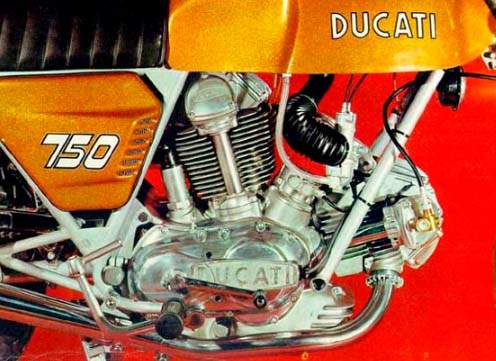
While origins are often cloaked in mystery, the
precise EVOlution of the Ducati 750 GT is still discernible. The bevel-gear twin
cylinders with a 90° V configuration, long known as an “L-twin” configuration,
have a precise date of birth: March 20, 1970. British historian Ian Faloon
relates that Fabio Taglioni drew the first sketch of what is perhaps his most
famous and best loved engine, which over the years was to acquire the
affectionate name of “pompone” (“big pump”), on the last day of winter 1970.
It was not long before the prototype was on the bench. It was a twin cylinder
(really, a motorcycle engine’s ideal structure) arranged longitudinally and in a
90° V configuration. As far as balance went, this was also the best choice.
Taglioni’s method was direct, logical, and practical. He envisioned the bike as
an essential sports machine. The distribution used the same single overhead
camshaft driven by bevel-gear as the single-cylinders, while the capacity of 750
cc was obtained with a bore and stroke of 76 x 75 mm. The prototype was built
rapidly. The result: a very personal sort of motorbike in which the engine
played the central role, even stylistically.
The final bike was very similar to the prototype. The GT 750 appeared in June
1971. Its frame was more proportionate than that of the prototype, while the
carburetors were 30 mm Amal Concentrics. It was also fitted with a front
Lockheed disk brake. Its very name, Gran Turismo, immediately revealed that it
was no sports bike, but the potential of this twin was immediately apparent to
its enthusiasts.

|
Any corrections or more information on these motorcycles will be kindly appreciated. |

