|
|
|
|
Classic Bikes
Custom Bikes
Individual
Racing Bikes AJP
AJS
Aprilia
Ariel
Avinton / Wakan
Bajaj
Benelli
Beta
Bimota
BMW
Brough Superior
BRP Cam-Am
BSA
Buell / EBR
Bullit
Bultaco
Cagiva
Campagna
CCM
CF Moto
Combat Motors
Derbi
Deus
Ducati
Excelsior
Fantic
GASGAS
Ghezzi Brian
Gilera
GIMA
Harley Davidson
Hero
Highland
Honda
Horex
Husaberg
Husqvarna
Hyosung
Indian
Jawa
Kawasaki
KTM
KYMCO
Laverda
Lazareth
Magni
Maico
Mash
Matchless
Mondial
Moto Guzzi
Moto Morini
MV Agusta
MZ / MuZ
NCR
Norton
NSU
Paton
Peugeot
Piaggio
Revival Cycles
Roland Sands
Royal Enfield
Sachs
Sherco
Sunbeam
Suzuki
SWM
SYM
Triumph
TVS
Ural
Velocette
Vespa
Victory
Vincent
VOR
Voxan
Vyrus
Walt Siegl
Walz
Wrenchmonkees
Wunderlich
XTR / Radical
Yamaha
Zero
Video
Technical
Manufacturer List Contact
|
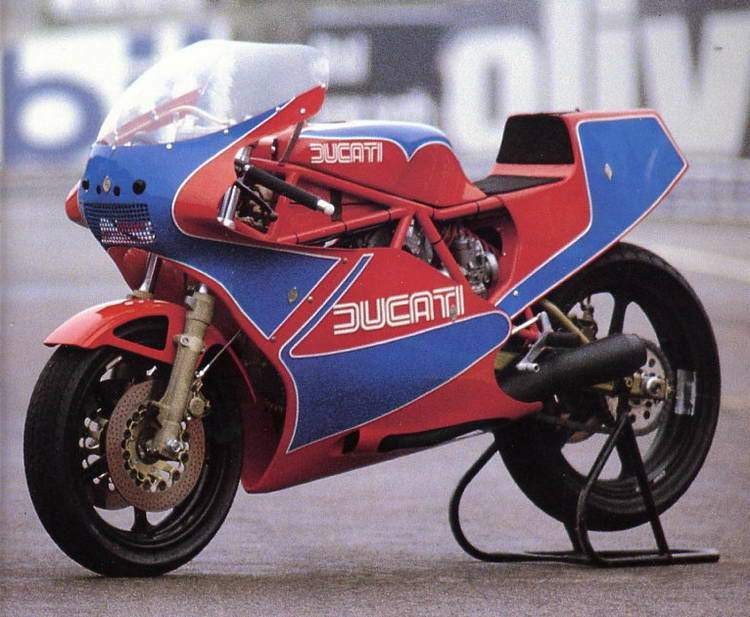
Ducati 750 TT1
The so called 'TT Formula' race series had been devised by the A-CU to keep the
Isle of Man TT in the forefront of international racing after its loss of World
Championship status in 1977. There were three classes: TT F1, TT F2, and TT F3,
all for production-based machinery. From the IoM TT being the series' only
event, the championship progressed until by 1990 it was run over five rounds,
though by this time the F2 and F3 categories had been dropped. Ducati was quick
to see the series' potential as a showcase for its products, with British rider
Tony Rutter winning the F2 class four years on the trot (1981-1984) for the
Italian manufacturer. Ducati being Ducati, there was, of course, a limited-edition customer version of Rutter's World Championship-winning machinery: the TT2, which arrived in 1981 featuring a Verlicchi frame with cantilever rear suspension and magnesium Marzocchi forks, while the Fabio Taglioni-designed Pantah-based 597cc engine was delivered in race tune, producing 76bhp initially. The factory then offered a 750cc conversion kit for customers wishing to contest the F1 class, which was followed by a short run of TT1 machines with the 750cc engine, closely based on the bikes Rutter was campaigning in the World Championship. Relatively few changes were made to the larger model, the most obvious being a wider cantilever to accommodate a larger-section rear tyre, and an outboard countershaft sprocket, adopted for the same reason. Only a few TT1s were built, but Ducati capitalised on its racing successes by introducing a road version: the 750 F1, which was produced during 1985 and 1986. The TT2 and later TT1. These spectacular machines were similar to Tony Rutter's four-time World TT2 Championship-winning TT2 racers. Modeled closely after the factory TT2, the production version also featured a 597cc engine using special two-ring Borgo pistons (weighing only 408 grams). Valve sizes were 41mm and 35mm, and racing camshafts provided 11mm of intake valve lift and 10.5mm of exhaust valve lift. The crankshaft and con-rods were highly polished, with a new steel clutch and straight-cut primary gears. The clutch was a cable-operated wet type similar to the street bike. All TT2s were fitted with an oil cooler—the 1982 version had a cylinder head bypass, while the 1983 TT2 received a full-flow cooling system with stainless-steel lines. 1983 TT2s also had a steering damper. All TT2s came with an electric start. Ignition was the usual Bosch BTZ, with the battery situated in the tailpiece.
The compact Verlicchi frame with cantilever rear suspension was shared with the factory bikes, as was the racing Marzocchi fork with magnesium fork legs and adjustable rebound damping. The Marzocchi rear shock had a remote reservoir and adjustment for both compression and rebound damping. Wheels were magnesium Campagnolo, 2.15 x 18-inch and 2.50 x 18- inch in 1982, with a wider 3.50 x 16-inch front and 3.50 x 18-inch rear for 1983. Brakes were 05 Brembo Gold Series with fully floating disc rotors. For 1984, a factory 750 kit was available to transform the TT2 into a 750 before a limited run of TT1 replicas was constructed. These were basically the earlier TT2 fitted with a 748cc engine. The Valve sizes were identical. These catalog racers were heavily based on the Tony Rutter 1984 TT1. The Verlicchi frame was the same except for a wider aluminum cantilever swingarm to accommodate the wider wheels. The Marzocchi fork and Brembo brakes were shared with the TT2, but an outboard countershaft sprocket allowed for the larger-section 18-inch rear tire, with an endurance-style quick-change assembly. This allowed the disc and caliper to stay in the swingarm as the wheel and sprocket were removed. The front wheel was still a 16-inch. While largely unappreciated, except by the cognoscenti, the diminutive TT2 and TT1 were among the finest of all catalog Ducatis. In many ways they epitomized Taglioni's philosophy of maximum performance through light weight and simplicity. There was nothing superfluous on the TT, with function determining the form of every component. Source Ducati author Ian Falloon
|
|
|
Any corrections or more information on these motorcycles will be kindly appreciated. |