|
|
|
|
Classic Bikes
Custom Bikes
Individual
Racing Bikes AJP
AJS
Aprilia
Ariel
Avinton / Wakan
Bajaj
Benelli
Beta
Bimota
BMW
Brough Superior
BRP Cam-Am
BSA
Buell / EBR
Bultaco
Cagiva
Campagna
CCM
CF Moto
Combat Motors
Derbi
Deus
Ducati
Excelsior
GASGAS
Ghezzi Brian
Gilera
GIMA
Harley Davidson
Hero
Highland
Honda
Horex
Husaberg
Husqvarna
Hyosung
Indian
Jawa
Kawasaki
KTM
KYMCO
Laverda
Lazareth
Magni
Maico
Mash
Matchless
Mondial
Moto Guzzi
Moto Morini
MV Agusta
MZ / MuZ
NCR
Norton
NSU
Paton
Peugeot
Piaggio
Revival Cycles
Roland Sands
Royal Enfield
Sachs
Sherco
Sunbeam
Suzuki
SWM
SYM
Triumph
TVS
Ural
Velocette
Vespa
Victory
Vincent
VOR
Voxan
Vyrus
Walt Siegl
Walz
Wrenchmonkees
Wunderlich
XTR / Radical
Yamaha
Zero
Video
Technical
Complete Manufacturer List
|
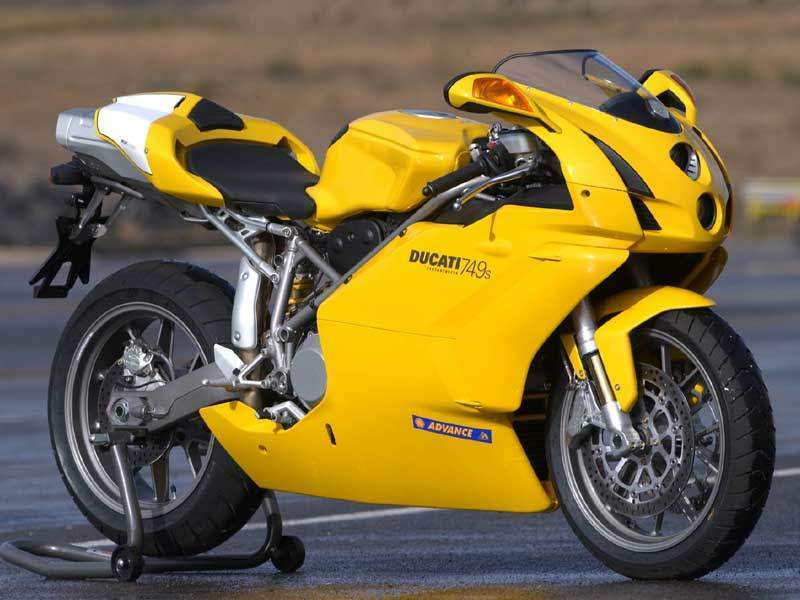
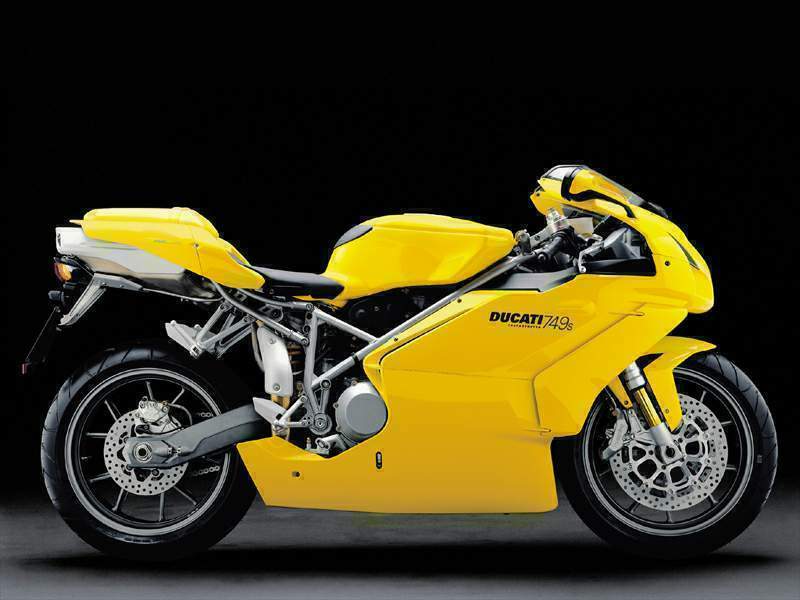
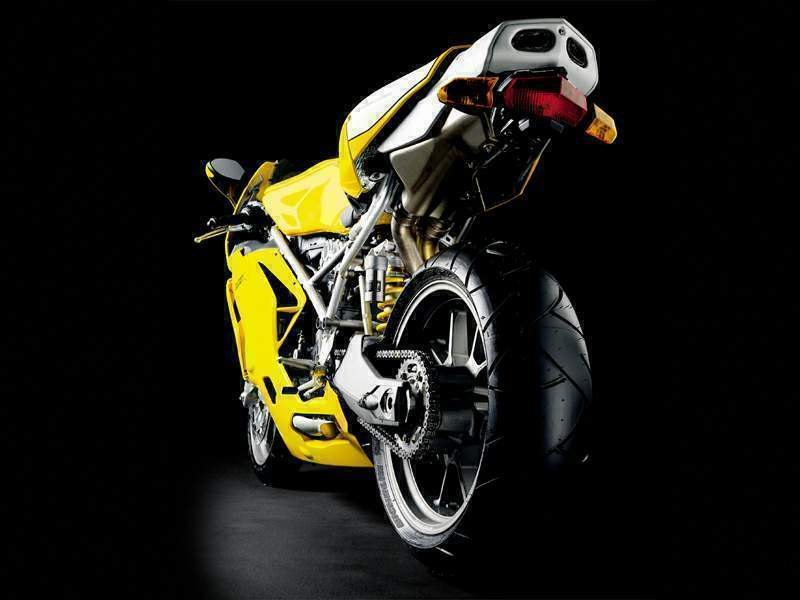
Ducati 749S
The 749S Testastretta is the highest performance middleweight Superbike Ducati has ever built by 2003, establishing a new approach and vision of the interaction between man, machine and the elements. The 749S has a 748 cc Testastretta engine that supplies 116 hp at 10,500 rpm and 8.4 kgm at 8500 rpm, allowing for maximum performance without compromising reliability. By applying the knowledge gained on the racetrack, Ducati engineers have created our highest performance middleweight Superbike ever, with fully adjustable suspension, box-section aluminum alloy swingarm, and steering damper. The 749 is as at home on the road as it is on the track and is designed to offer an exciting, safe ride whatever the road conditions. A sleek riding position blends man and machine perfectly.
At 108 hp, the Testastretta provides lightning acceleration out of corners and incredibly smooth power delivery without putting stress on the chassis set-up. Excellent torque (8.2 kgm at 8500 rpm), even at very low rpms, guarantees superb performance while making the motorcycle easy to handle in heavy traffic. High engine revs are allowed by a special valve retainer collet system used to secure the steel intake and exhuast valves. The system is also used on the R versions as well as the World Superbike and MotoGP race engines. The L-twin Testastretta engines are very compact, making the finished motorcycles incredibly narrow and agile, much like their racing cousins. They also offer excellent torque and remarkably vigorous power delivery compared to four cylinder engines. Ducati Superbikes have incredible acceleration and provide outstanding riding thrills. The suspension is fully adjustable at both ends and features a TiN-treated upside down Showa fork at the front and a Showa rear shock. Thanks to a wide steering angle (28.5°), the steering damper, adjustable headstock rake (from 23.5° to 24.5°) and foot rests that can be set at any of 5 different positions, the Ducati 749s can be adapted to suit individual riding styles. In addition, on the single-seat version, the seat-tank assembly is adjustable longitudinally by 20 mm, thus giving the rider the opportunity to personalise his or her riding position on the bike for track use.
Review Ducati has certainly come a long way in recent years. American investors moved in and restructured the way the company does things. As a result the Bologna factory is certainly producing much higher quality products than we have seen before. Recently I have enjoyed good stints aboard the new 1000SS and also the new Multistrada, but my most recent Ducati sojourn was onboard the new 749S. This is a more focussed sports machine than those aforementioned models but at the same time it also possesses a civility that Ducati’s earlier top line sportsbikes certainly never offered. Of course the trademark bangs and rattles that are synonymous with Ducati emanate from the engine room and dry clutch area but as soon as you sling a leg over the latest machines you immediately appreciate the vastly improved ergonomics. In fact these latest Ducatis even allow the rider to tailor the riding position to their individual preference with the pegs offering different mounting positions while the seat can be slid fore or aft through a range of 20mm. I never felt the need to adjust a thing, even after a 600km day in the saddle.
Speaking of saddles, the seat on the 749 is fantastic. It has the perfect balance of firmness and cushioning that manufacturers so rarely get just right. There is still some weight on the wrists and hands of course, but it is very manageable and certainly nothing I would gripe about. Cruising at a fair clip the only minor annoyance I found was a slight tingle through the pegs. Selecting a different gear to lower or raise the revs seemed to make it go away. Gearing is something I would experiment with if I was to have a lot more time with this bike. I would add a few teeth to the rear sprocket and possibly even drop a tooth on the front to liven things up a bit more on the road. I think Ducati may have over-geared the bike to pass the drive-by noise regulations required for road registration in Australia. The engines appetite for revs means it is most happy with more than 5,000rpm on the tacho, just as the cams really start to reach into their sweet spot. That is not to say there is nothing below this mark as that is certainly not the case. The 749 pulls reasonably well with only 3,000rpm on the tacho and the remarkably fine Marelli fuel injection system that is now synonymous with Ducati ensures that there is no complaints from the engine when lugging around on city streets. Ducati twins are now smoother and more refined in the lower parts of the rev range than any similar capacity Japanese twins. Up top the power does tail off a little but I am sure a set of pipes and appropriate fuelling adjustments would certainly extend the top end. If I was to take this step though I would certainly ensure I found an excellent tuning centre I could trust to get the injection tuned to suit the pipes. As standard the fuelling is just about perfect and if I was not confident of finding a tuner to replicate that finesse with aftermarket pipes fitted then I would leave well enough alone. As with most sporting twins, fuel range is not a Ducati strong point. If out for a strop in the country you will have to fuel often as the low fuel warning light starts to glow on the comprehensive instrumentation panel in as little as 150km. This light signals that there is only 3 Litres remaining in the incredibly skinny 15 litre tank.
The front stoppers are sourced from Brembo and offer excellent stopping
power along with good feel at the lever. During my experience with the
bike the rear brake proved virtually useless. As with most high revving twins things are prone to vibrate loose and I discovered the left clip-on bar had slipped down the fork stanchion when I couldn’t complete a left hand turn due to the bar hitting the fairing! Just remember to keep a check on all the bolts during the running in period and everything should be fine. Overall I was certainly impressed with the 749S. In fact I could imagine myself living with one and thoroughly enjoying it, and that is certainly something I would never have said about its predecessor. Yes, it is that much better. Source MCNews.com
|
|
|
Any corrections or more information on these motorcycles will be kindly appreciated. |