|
|

|
|
|
|
Classic Bikes
Custom Bikes
Individual
Racing Bikes AJP
AJS
Aprilia
Ariel
Avinton / Wakan
Bajaj
Benelli
Beta
Bimota
BMW
Brough Superior
BRP Cam-Am
BSA
Buell / EBR
Bultaco
Cagiva
Campagna
CCM
CF Moto
Combat Motors
Derbi
Deus
Ducati
Excelsior
GASGAS
Ghezzi Brian
Gilera
GIMA
Harley Davidson
Hero
Highland
Honda
Horex
Husaberg
Husqvarna
Hyosung
Indian
Jawa
Kawasaki
KTM
KYMCO
Laverda
Lazareth
Magni
Maico
Mash
Matchless
Mondial
Moto Guzzi
Moto Morini
MV Agusta
MZ / MuZ
NCR
Norton
NSU
Paton
Peugeot
Piaggio
Revival Cycles
Roland Sands
Royal Enfield
Sachs
Sherco
Sunbeam
Suzuki
SWM
SYM
Triumph
TVS
Ural
Velocette
Vespa
Victory
Vincent
VOR
Voxan
Vyrus
Walt Siegl
Walz
Wrenchmonkees
Wunderlich
XTR / Radical
Yamaha
Zero
Video
Technical
Complete Manufacturer List
|
Ducati 748SP
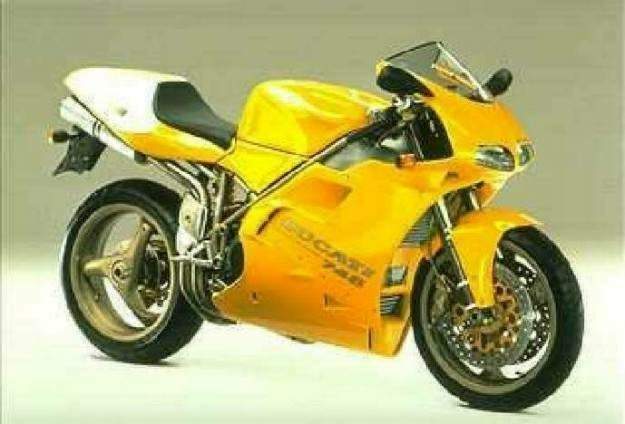
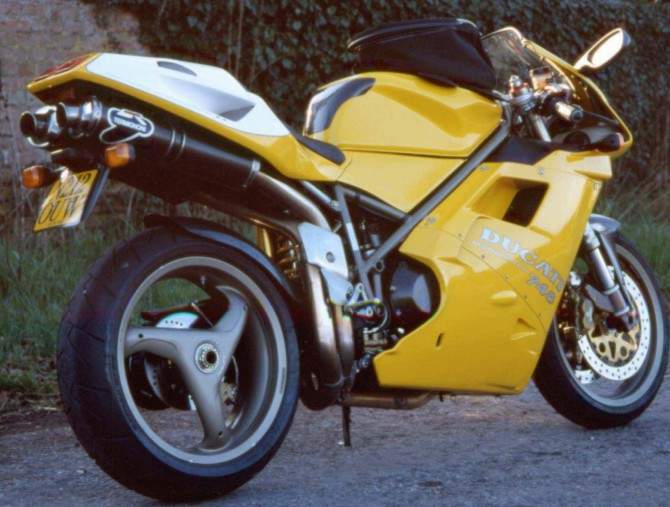
Few bikes have assaulted the rider's senses quite like Ducati's 748SP. The Italian V-twin's bright yellow bodywork caught the eye; its booming exhaust note battered the ears; its fierce combination of acceleration, braking power and cornering ability took the breath away. A day at speed on the SP left reflexes sharpened, riding skills honed and body pummelled. Relaxing, the 748SP wasn't. Exciting it certainly was.
Building a smaller version of the previous year's 916 flagship was a logical move for Ducati in 1995. The race-ready 748SP, which was launched along with a cheaper, dual-seat 748 Biposto model, was designed to compete against the Japanese fours in the increasingly important 600 Supersport class.
The new 748cc capacity came from a reduction in the 916's bore and stroke, while the bottom-end contained a lightened flywheel and close-ratio gearbox. With a revised Weber-Marelli injection system and a pair of carbon-fibre Termignoni cans, the 748SP produced a maximum of lOObhp at ll,000rpm, 9bhp less than the standard 916.
Both 748 models shared their basic chassis layout with the 916, including an identical blend of tubular steel frame and single-sided aluminium swingarm. Both used 43mm Showa upside-down forks, but the upmarket SP wore a rear shock from Öhlins rather than Showa. There was a change in braking, too, where the SP's Brembo discs were made from cast iron rather than steel. The racy 748SP was uncomfortable and demanding in town, and low-rev response was poor, but on the open road it came thrillingly to life. Provided its rider kept the revs above 7000rpm, the Ducati was addictively fast. At I0,000rpm, where the 916 would have been getting distinctly breathless, the 748 was still roaring towards the 11,000rpm redline through its sweet-shifting six-speed gearbox, heading for a top speed of 150mph (241km/h).
Concentration required The 748's peakier nature made it more demanding than the 916 to ride. Approaching a slight bend with a gentle dab of brakes, the 748 needed a down-change where the bigger bike would have stormed forward again without. That was sometimes frustrating, but the greater effort and concentration required to get the best out of the 748SP often made for even more enjoyment, especially on a twisty road.
That was also partly due to the brilliance of its chassis. Suspension at both ends was firm, which made for a harsh ride on a bumpy road, but on smoother surfaces the Ducati was superb. Its steering was not outstandingly quick but stability in mid-corner was sublime, and the Öhlins shock supplied an awe-inspiring level of feedback and control. Braking power from the big iron Brembos was excellent, too.
The fast, loud, demanding 748SP was certainly not a bike for every rider or every trip, but on the right day and the right road there was arguably not another machine that was faster or more fun. Ducati's new star became a hit in Supersport racing, too, where the V-twin successfully challenged the Japanese fours to bring the Italian firm a string of world titles.
Review Several hours after handing back the keys of the 748SP to its owner, the adrenaline has not yet subsided. My head aches from too much sun and the day-long roar from wind and high-level carbon-fiber cans. When I shut my eyes, I have visions of one particular decreasing-radius, downhill lefthander that took even the SP close to its limit of adhesion. I've barely stopped twitching at the thought of unmarked police cars and blue flashing lights. Few bikes on the road assault the rider's senses like the Ducati 748SP. Its brilliant yellow bodywork jabs you in the eye, its booming exhaust note batters your ears, its stunning combination of acceleration, braking and cornering abilities takes your breath away. A day at speed on the SP leaves your reflexes sharpened, your nerves jangled, your body pummeled. Relaxing the 748SP isn't. Exciting it certainly is. Going in, I pretty much figured the new 748SP—which isn't yet available in the U.S.—was nothing more than a smaller-engined version of Ducati's mighty 916. But after riding it, I quickly learned there was far more to the story. Naturally, the smaller bike is second best in some areas, particularly midrange acceleration, but it has distinct advantages of its own. Building a smaller version of the 916 flagship was a logical move for Ducati, who already had both 750 and 600cc versions of the air/oil-cooled 900SS. That's particularly true because, unlike the less-expensive, twin-seat 748 Biposto, the race-ready 748SP was also designed to compete against the Honda and Kawasaki fours in the increasingly important 600 Supersport class. (It has already shown much promise, with wins in Italy and three top-six places at the opening European championship round at Germany's ultra-fast Hockenheim.) The new capacity comes from a reduction in both bore and stroke to 88x61.5mm (same as the 750ss), while the engine's bottom-end contains a lightened flywheel and a gearbox whose top four ratios are closer together. The We-ber/Marelli fuel-injection system retains the standard single-injector-per-cylinder setup (like the standard 916), but the chip is reprogrammed, and this bike has a pair of carbon-fiber Termignoni canisters poking from beneath its tailpiece. Peak power is a claimed 100 horsepower, produced at about 11,000 rpm. That's nine horses down on the 916 Biposto, but 20 horsepower up on the 900SS. Both 748 models share a basic chassis layout with the 916, including an identical blend of traditional steel frame and single-sided alloy swingarm. The multi-adjustable 43mm Showa inverted fork is the same, and the SP sports an Ohlins unit just like the 1 995 U.S.-spec 916. There's a change in braking, though: The SP's fully floating 320mm Brembo discs are made from cast iron rather than steel, and the four-piston calipers are plumbed with braided hose.
Pity the poor stylist who eventually must improve upon the shape of Massimo Tamburini's masterpiece. Ducati has wisely left well enough alone with the 748, whose bodywork differs only in color from the 916's. Having greeted the downsized Desmo with less enthusiasm than I normally find for a hot new Ducati, I'll admit to being won over virtually at first sight. In sunlight, the yellow is just gorgeous and gives the new bike an exclusivity that the all-conquering 916 relinquished months ago. When you climb aboard and drink in the details, everything else is every bit as good. The Ducati feels low and narrow, and, if anything, seems to weigh even less than its 440 pounds. Your eyes meet the broad triple clamp, the transverse-mounted steering damper, the speedometer and matching tachometer, the low screen. You hit the button and the SP comes instantly to life with an exhaust roar that makes you wonder how Ducati ever got this bike homologated. (Answer: They didn't. The carbon canisters are in addition to the standard mufflers, and come in a box marked "for track use only.") My first impressions after picking up the 748 in town were of a riding position that felt typically racy and uncomfortable at slow speed; of the light, easy operation of clutch and throttle; and of the Ducati's surprisingly docile behavior at low revs. The 748 is certainly no city bike, but it pulled from below three grand even in top gear, felt slightly smoother and more manageable than the 916, and was generally less trouble than I'd expected. And as soon as the SP hit the open road, it came thrillingly to life. With the throttle wound open and my left foot working hard to keep the tacho needle above 7000 rpm, the Ducati was seriously fast. At ten grand, where the 916 would have been finished, the 748 was still motoring toward its 11,000-rpm red-line, its engine's power pulses hardening to a drumming noise that all but drowned even the snarling exhaust note. Ducati estimates the top speed at around 155 mph, and the SP will probably have a slight edge on the CBR600F3 and ZX-6R in a straight-line shootout. Of course, there was nowhere near as much of the delicious midrange torque that helps make the 916 so enjoyable and easy to ride fast. Below 6500 rpm, the SP pulled cleanly but gently, building the revs slowly before it suddenly took off— not unlike the 600cc fours against which it was built to compete. That made the 748 more demanding to ride, requiring plenty of input from the pilot. Approaching a slight bend with a gentle dab of brakes, the 748 needed a downshift where the bigger bike would have stormed forward again without. From slow speed there was still enough midrange grunt to lift the front wheel with a first-gear flick of the wrist, but riding fast on the 748 was certainly harder than on the bigger bike. On a busy main road, for example, overtaking a line of cars required frequent stirring of the gear lever, rather than a lazy roll-on of the throttle. On the other hand, the greater effort and concentration required to get the best out of the 748SP made for even more fun on a winding road, where the Ducati rewarded slick shifting and aggressive cornering with a very rapid rate of progress. That, of course, was partly due to the chassis, which was every bit as taut, well-controlled and generally ace as the 916's—and a little more so besides. Suspension at both ends was decidedly firm, which made for a harsh ride over big bumps, but on smoother surfaces the Ducati was superb. The unchanged front end required a fair nudge on the bars to flick the bike into a sharp bend, but once there it felt utterly planted and totally under control. At the rear, the SP's Ohlins shock was just brilliant, supplying infinite feedback about exactly what the fat, 180/55-section rear Pirelli Dragon—considerably wider than the 600cc fours' rubber, and superbly grippy—was doing. Braking power from the big iron Brem-bos was excellent, too, with heaps of controllable power and none of the sponginess that 916 anchors have been prone to. (The SP also gains span-adjustable hand levers for both brake and clutch.) Like the racebike that it almost is, the 748SP responded near perfectly to every rider command, whether I was howling the front tire into a tight bend, carving through an empty roundabout, or simply burying my head behind the screen for a brief and nerve-wracking flat-out blast on the over-policed highway. Throughout the test, the SP didn't put a wheel out of place, though this bike, like many others, has already suffered problems with its regulator/rectifier unit. That fragility apart, the Ducati is well-built and superbly designed. Costing only slightly less than the 916 Biposto in Europe, it's also undoubtedly expensive; not to mention uncompromising, uncomfortable and demanding. But I simply can't think of another bike that would have been more fun—especially on a long, hot summer day, with miles to cover and no particular place to go. There are also very few that would have been faster—and then not by very much. All of which goes to show, if anyone was in any doubt, that motorcycles can't be judged on paper—particularly dyno sheets—alone. Immediately after riding the SP, I was sure that it had ousted last year's 916 from atop my personal list of all-time great roadsters. The 748 is newer, rarer, yellower, better braked, more trick—so who cares about the loss of a bit of straight-line speed? Now that I've calmed down a little I'm not so sure. But the fact that the SP is up there challenging for top spot is an indication of just how fabulous a bike it is. HQ Source MOTORCYCLIST 1995
|
|
|
Any corrections or more information on these motorcycles will be kindly appreciated. |