
|
|
|
|
Classic Bikes
Custom Bikes
Individual
Racing Bikes AJP
AJS
Aprilia
Ariel
Avinton / Wakan
Bajaj
Benelli
Beta
Bimota
BMW
Brough Superior
BRP Cam-Am
BSA
Buell / EBR
Bullit
Bultaco
Cagiva
Campagna
CCM
CF Moto
Combat Motors
Derbi
Deus
Ducati
Excelsior
Fantic
GASGAS
Ghezzi Brian
Gilera
GIMA
Harley Davidson
Hero
Highland
Honda
Horex
Husaberg
Husqvarna
Hyosung
Indian
Jawa
Kawasaki
KTM
KYMCO
Laverda
Lazareth
Magni
Maico
Mash
Matchless
Mondial
Moto Guzzi
Moto Morini
MV Agusta
MZ / MuZ
NCR
Norton
NSU
Paton
Peugeot
Piaggio
Revival Cycles
Roland Sands
Royal Enfield
Sachs
Sherco
Sunbeam
Suzuki
SWM
SYM
Triumph
TVS
Ural
Velocette
Vespa
Victory
Vincent
VOR
Voxan
Vyrus
Walt Siegl
Walz
Wrenchmonkees
Wunderlich
XTR / Radical
Yamaha
Zero
Video
Technical
Manufacturer List Contact
|
Ducati 748R
|
|
Make Model |
Ducati 748R |
|
Year |
2002 |
|
Engine |
Four stroke, 90°“L”twin cylinder, DOHC, desmodromic 4 valves per cylinder, belt driven |
|
Capacity |
748 cc / 45.6 cu in |
| Bore x Stroke | 88 x 61.5 mm |
| Cooling System | Liquid cooled |
| Compression Ratio | 11.6:1 |
| Lubrication | Wet sump |
| Engine Oil | Semi-Synthetic, 10W/40 |
| Oil Capacity | 3.5 L / 3.7 US qt / 3.1 Imp qt |
|
Induction |
Weber I.A.W. CPU 1.6M |
| Spark Plug | Champion RA59 |
|
Ignition |
Electronic |
| Battery | 12V 16Ah |
| Starting | Electric |
|
Max Power |
77 kW / 105 hp @ 1100 rpm |
|
Max Torque |
75 Nm / 7.65 kg-m /55.3 ft-lb @ 8700 rpm |
| Clutch | Dry, multi-plate, hydraulic control |
|
Transmission |
6 Speed |
| Primary Drive Ratio | 2:1 (31/62) |
| Gear Ratios | 1st 2.466 / 2nd 1.765 / 3rd 1.400 / 4th 1.182 / 5th 1.043 / 6th 0.958:1 |
| Final Drive Ratio | 2.64:1 (14/37) |
| Final Drive | Chain, 520 VL4 - 5/8" x 1/4" |
| Frame | Trestle type constructed of "ALS 450" steel alloy |
|
Front Suspension |
Inverted type, 43 mm diameter stanchions, Öhlins, fully adjustable, TiN coated |
| Front Wheel Travel | 127 mm / 5.0 in |
|
Rear Suspension |
Progressive linkage with adjustable monoshock, Öhlins |
| Rear Wheel Travel | 130 mm / 5.1 in |
|
Front Brakes |
2 x 320mm Discs, 4 piston calipers, Brembo |
|
Rear Brakes |
Single 220 mm disc, 1 piston caliper, Brembo |
|
Front Tyre |
120/60 ZR17 |
|
Rear Tyre |
180/55 ZR17 |
| Rake | 24.5° |
| Dimensions |
Length: 2050 mm / 80.7 in Width: 685 mm / 27.0 in Height: 1090 mm / 42.9 in |
| Wheelbase | 1410 mm / 55.5 in |
| Seat Height | 790 mm / 31.1 in |
| Ground Clearance | 150 mm / 5.9 in. |
| Handlebar Height | 850 mm / 33.5 in. |
|
Dry Weight |
198 kg / 436 lbs |
|
Fuel Capacity |
17 Litres / 4.5 US gal / 3.7 Imp gal |
|
Consumption Average |
5.8 L/100 km / 17.3 km/l / 40.7 US mpg / 48.9 Imp mpg |
|
Braking 60 km/h - 0 |
13.3 m / 43.6 ft |
|
Braking 100 km/h - 0 |
37.7 m / 123.7 ft |
|
Standing ¼ Mile |
11.2 sec / 204 km/h / 127 mph |
|
Top Speed |
250 km/h / 155 mph |
By 2000, the 748 range was due for an overhaul, and Ducati took the decision to expand the range at the entry level. Consequently, three 748s were launched in late 1999. The base 748E was a budget, entry-level model, with cheaper chassis components and the same engine as used in the previous 748 Biposto. The middle bike of the range was the 748S, which used the older engine design but had uprated wheels and suspension.
But the star of the 2000 748 lineup was undoubtedly the 748R. This racer-for-the-road incorporated a number of changes to improve the 748's chances in World Supersport racing. A new frame, borrowed from the 996 WSB machine, allowed the use of a new, larger airbox. This in turn allowed an all-new fuel-injection setup, with Formula One-style 'shower' fuel injectors mounted deep inside the airbox, pointing straight into the massive 54mm (2.1in) throttle bodies.
Together with higher lift cams and large valves, these changes transformed the performance of the 748 engine, boosting power to 79kW (106bhp). and giving increased potential for power increases on racing machines.
The chassis was also radically overhauled. New, lightweight Marchesini wheels reduced unsprung weight and increased style. Fully adjustable Showa suspension front and rear is highly specified, with a gold-coloured titanium-nitride coating on the fork stanchions to reduce stiction and improve performance.
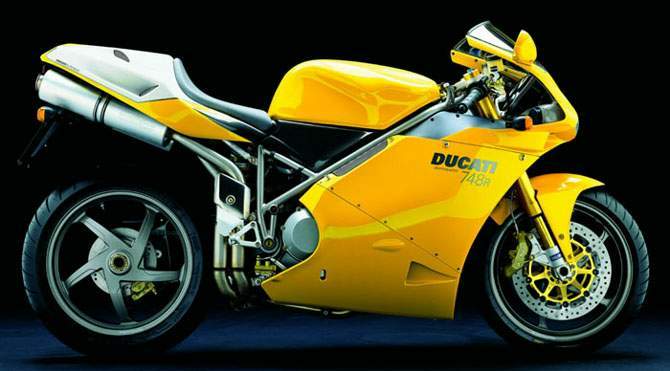
For 2001, the 748R received a further update. The Showa suspension was replaced with race-spec Öhlins forks and rear shock, and a lighter frame was fitted.
Detail engine refinements improved drive and reliability and a carbon-fibre airbox added extra stiffness to the lightweight frame.
The 748R riding experience is sublime. Best kept for track riding, the feedback and response from the chassis, together with the strong engine, makes riding the 748R one of the purest sportsbike experiences available.
I guess the first question you ask yourself is, why would anyone consider spending around $25k on a twin-cylinder 750 that only goes as fast as a good 600 and costs more than most one litre bikes? Well, if I have to explain it to you, then you most likely would not understand anyway.
There is no doubt that Ducati's 748R is both special and exclusive. Its specifications and price see to that. The reason the bike exists at all is simply so that the factory could meet the 1000 units required to be produced to be eligible to compete in the World Supersport Championship.
Similar requirements gave an earlier generation the classic 750SS, so already this bike is starting to look like a collector's piece.
What else makes this bike so special? Well, it's only got a single seat so immediately forget about impressing the other half, it runs the latest Swedish-made Öhlins suspension front and rear, it features top-spec Brembo brakes and comes with engine mods that liberate an extra nine horsepower over that of the standard 748.
Add some detail work and your favourite set of tyres and you can go racing. As a road bike, the R's racetrack focus detracts from the experience. For a start, the fuel injection mapping is not perfect at low engine speeds or at fixed throttle openings that are the norm on the street, the dry clutch squawks and grabs and is generally inconsistent in operation (at least it was on our test bike) and the top-line front Brembos needed to be treated with respect owing to their tremendous initial bite, while the rear was weak and wooden.
The riding position is aggressive and typically uncomfortable, and the race-spec suspension has limited travel. On the other hand, the travel it does have provides a superb combination of suppleness and control. And the gearbox is a gem.
I guess all of us have fantasised about having a race bike on the street, but it's not that easy or wonderful. At least the R is a Supersport replica, not a Superbike replica.
Given its mission statement, the 748R, while compromised for street use, is right at home on track days. A great combination of sorted steering geometry and suspension, powerful and responsive engine, with almost as much power the first 916, light weight and with that wonderfully slim, almost petite profile that makes the bike feel smaller than it really is.
That ropey fuel injection mapping, the uncomfortable riding position and touchy front brakes now make sense as you start to explore the outer limitsThe word 'thouroughbred' springs to mind. Razor sharp steering balanced with high-speed stability, fade-free brakes, instant throttle response and a sweet-shifting gearbox erase those street-based criticisms.
Even that wooden rear brake makes sense when you really start to lean on the front lever going into a tight corner, and the slipper clutch helps reduce the likelihood of rear wheel lock-up during rapid downshifting.
Okay, the 748R is not as user-friendly on the street as it could be, but excels on the track.
It's expensive, it has 'collectable' written all over it, and what price street cred and race class?
As a street scoot, a regular 748 or 996 is better value, but for a Sunday fang or a track day bike, you can't do much better.
Review
Ducati's 748R is marketed as the road-going version of its World Supersport contender, and just looking at it, you can only agree. Single-seat, Ohlins suspension front and back, hard-nosed riding position, it all points to one thing
This bike was designed from the word go to win Ducati its first World Supersport Championship, spurred on by the previously unofficial World Series achieving championship status for 1999.
Ducati had already won the Supersport World Series in 1997 with Paolo Casoli aboard a 748SP, and intended to do it again in 2000, this time with Casoli aboard the RS version of the 748, especially built for the mission (refer to the panel story on page 30 to see how close Ducati got).
The upside of this single-minded determination to win is that to qualify for championship contention, a minimum of 1000 homologation units must be made.
So Ducati developed the 748RS racebike first, and then worried about building the road-going homologation bike, essentially a more user-friendly version of the full-house model. Enter the 748R.
Rain on
The specification list reads like a who's who of performance parts manufacturers
which, when combined with the R's minute dimensions and subsequent light weight,
add up to a true performance bike for the road - even if 748cc is traditionally
deemed small for a V-twin. It's difficult to convey just how small this bike is
unless you've seen it and sat on it. It's tiny!
And it definitely felt that way when I climbed aboard for a day ride along the Great Ocean Road. Having recently done a similar trip on the somewhat larger Luxo-tourers (see Barge Wars page 44), I was pretty keen to cover the same roads on the 996R's little sibling. But little did I know that the sun I started out with was to be replaced with torrential rain by midday. And I mean torrential. Typical!
Also immediately apparent once astride is the somewhat aggressive seating position. The single seat unit actually points you downhill, helping to put your weight over the front Marchesini, also affording an excellent view of the machine's individual production number stamped on the adjustable triple clamp.
The traditional needle and clock instruments, with anything but traditional green characters, are easy to read, however the tacho curiously lacks a red-line. No matter, the power tails off above 11,000 rpm, just before the rev-limiter, so no need to rev any higher than that.
Race-spec
On the road, the upside-down Ohlins forks feel somewhat firm, as to be expected.
The faster I went though, the better the front worked, due to the increased
loads better suiting the forks design. The same applied to the rear 'piggy-back'
Ohlins monoshock.
With both ends fully adjustable, the firm ride could be modified to some degree, though if you were expecting a plush, marshmallow ride, you are probably part of the wrong customer demographic.
The race-spec front brakes, comprising Brembo four-piston calipers squeezing 320mm semi-floating rotors via braided lines, were more than up to the task. Applying that adjustable front lever hard in a straight line resulted in enough stopping power to render the rear Brembo set-up superfluous. After all, what's the point of applying the rear brake if the back end is in the air.
The feel through the lever allowed me to brake confidently on suspect surfaces, also a function of the Pirelli Dragon Corsa front tyre, a quality I really appreciated when a storm turned the road I was travelling on into something resembling a muddy lake.
Also assisting in this unbridled confidence was the nature of the 748R's engine. Lacking the lumpy, pulsing low-down delivery characteristics of the larger V-twins, the 'little' 748R tractered confidently through the conditions.
The Marelli EFI also had a lot to do with this, allowing for the precise throttle control required in these sort of conditions. There was very little of the on/off/on throttle hesitation common to other fuel injection systems.
This also shone through before the big wet set in, giving me the option of either sticking to one gear and lazily rolling through, or playing boy racer and tapping away on the sweet-shifting gear lever with the tacho needle hovering near the limiter.
Letting the revs get too low, however, will see the engine misbehave a little. Remember though, this bike is racer first, road-bike second.
It isn't a major problem though, as the bike revs out so cleanly through the mid-range and beyond, that it's a pleasure to ride it this way. Any vibes are quite low-key - it really is a great road engine.
Initiation
But as I mentioned earlier, this bike is meant for the racetrack, and what a way
to sample Phillip Island for my first time ever.
And what a bike to learn the track on. Any mistakes with line choice, brakes or throttle were easily absorbed by the bike, as its limits were well beyond mine.
Honda Corner was interesting as it requires braking from fifth gear speed to first gear, and showed up a number of the bikes attributes. I just couldn't seem to brake late enough. Before I knew it I was down to below the speed necessary, and in fact had to release the brakes altogether a couple of times just to get to the turn-in point.
Despite braking later and later, the front Pirelli wasn't protesting too much, the bike was dead in line, and downshifts didn't create any compression lock-ups. The bike was mocking me.
Once at the turn-in point, only small inputs were required to lay the bike over, where upon both wheels would track exactly where I wanted. Even with the adjustable triple-clamps in the 'standard' position (24.5 degrees), the steering was fast, but not at the expense of stability.
The small non-adjustable steering dampener may have had something to do with that, though I suspect it was more the sweet set-up of the chassis.
The track is where the firm settings at both ends came into their own. Dive under heavy braking was well controlled, and the 748R felt balanced through all corners, fast or slow.
To tell the truth, I hardly noticed the suspension action at all, a sign there was nothing untoward going on.
Response from the engine was instantaneous, which combined with the rear Dragon Corsa to give me the confidence to drive hard out of every corner, before shifting up through that sweet action box.
Boggy
beginnings
Which brings me to the one thing this bike makes hard for the rider, race
starts. The dry clutch made it difficult to get off the line cleanly, either
hoisting the front wheel or bogging down. In the bike's defence, I only had
three or four goes at it for fear of damaging the clutch, and I am sure practice
will get it better.
Truthfully, it was very difficult to fault the 748R in terms of performance or finish. Small touches such as the quick-release fairing fasteners and hydraulically operated clutch just served to highlight Ducati's attention to detail.
And it's not as though the company has rested on its laurels with the 2001 748R. A lighter flywheel and crank, lighter pistons, revised gear selector drum and the same Ohlins forks as found on the 996R now grace the '01 748R. The frame too is similar to the 996R-s, although lighter in construction.
Just like the exotic $50,000 996R, the 748R is as close to a racebike for the street as you can currently buy. It's $6000 more expensive than the standard 748, but you get a lot more than just the additional claimed nine horsepower.
In retrospect, the storm I suffered on the Great Ocean Road was a blessing in disguise, showing another side to a bike that has a well-deserved reputation as an out-and-out sportsbike. It's a side that I was happy to see when piloting the $24,995 748R contender through atrocious, twisty roads, and proof to me that it's worth every cent.
Source Bikepoint
|
Any corrections or more information on these motorcycles will be kindly appreciated. |

